Magnesium
What is Magnesium?
ď‚— 2nd most abundant intracellular cation in
the body.
ď‚— Supplementing a normal intake increases
urinary excretion, and serum magnesium
level remains normal.
ď‚— Low dietary intake of magnesium reduced
urinary excretion, same as in nursing
women.
Function:
ď‚— Stabilize the structure of ATP-dependent
enzyme reactions.
ď‚— Cofactor for more than 300 enzymes
involved in the metabolism of food
components and the synthesis of many
metabolic products.
ď‚— DNA and protein synthesis
ď‚— Important in the formation of cAMP
ď‚— Plays a role in neuromuscular
transmission and activity.
ď‚— Acts as physiologic calcium-channel
blocker and is called “nature’s blocker”
ď‚— Parathyroid hormone synthesis.
ď‚— Bone Health
ď‚— Carbohydrate Metabolism
ď‚— Blood Pressure Regulation
Total Body Content:
ď‚— 2000 mEq or 24 grams.
Distribution:
ď‚— 67% in bone
ď‚— 31% intracellularly
ď‚— 1% extracellularly
In which,
ď‚— 25-30% is protein bound
ď‚— 10-15% complexed
ď‚— 50-60% ionized
Regulation and Excretion:
ď‚— Regulated by the Kidneys.
ď‚— Absorbed by the proximal convulated
tubules and thick ascending limb of Loop
of Henle.
Normal Serum
Concentration:
1.5 – 2.0 mEq/L
1.8 – 3.0 mg/dl
0.8 – 1.2 mmol/L
ď‚—40 mEq/L (ICF)
RDA:
ď‚—300 -350 mg; or
ď‚—15 mmol
Food Sources:
ď‚—Seeds
ď‚—Nuts
ď‚—Legumes
ď‚—Wheat grains
ď‚—Dark green vegetables
ď‚—Cashews
ď‚—Chili
ď‚—Halibut
ď‚—Swiss chard
ď‚—Tofu
ď‚—Banana
ď‚—Avocado
ď‚—Dark chocolate
Relation to other
Electrolytes:
ď‚—Directly proportional to: K, Ca,
Phosphorus
ď‚—Inversely proportional to: Na, Cl
HYPOMAGNESEMIA
Alterations:
Definition:
ď‚—A plasma magnesium level less
than 1.5 mEq/L or 1.8 mg/dl.
Cause of Disorder:
ď‚— Chronic alcoholism
ď‚— Hyperparathyroidism
ď‚— Hyperaldosteronism
ď‚— Diuretic phase of renal failure
ď‚— Malabsorptive disorders
ď‚— Diabetic ketoacidosis
ď‚— Refeeding after starvation
ď‚— Parenteral nutrition
ď‚— Chronic laxative use
ď‚— Diarrhea
ď‚— Heart failure
Clinical Manefestations:
ď‚— Seizures
 Trosseau’s & Chvostek’s sign, tremors,
tetany
ď‚— Anorexia
ď‚— Rapid HR, increased BP, inverted T-
waves,
ď‚— Vomiting
ď‚— Emotional liability, insomnia
ď‚— Deep tendon increased,
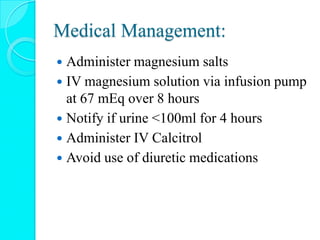
Medical Management:
ď‚— Administer magnesium salts
ď‚— IV magnesium solution via infusion pump
at 67 mEq over 8 hours
ď‚— Notify if urine <100ml for 4 hours
ď‚— Administer IV Calcitrol
ď‚— Avoid use of diuretic medications
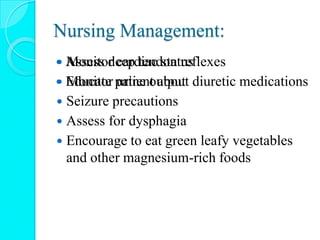
Nursing Management:
ď‚— Monitor cardiac status
ď‚— Monitor urine output
ď‚— Seizure precautions
ď‚— Assess for dysphagia
ď‚— Encourage to eat green leafy vegetables
and other magnesium-rich foods
ď‚— Assess deep tendon reflexes
ď‚— Educate patient about diuretic medications
HYPERMAGNESEMIA
Alterations:
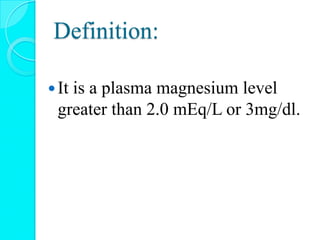
Definition:
ď‚—It is a plasma magnesium level
greater than 2.0 mEq/L or 3mg/dl.
Cause of Disorder:
ď‚— Oliguric phase of Renal Failure
ď‚— Excessive use of antacids
ď‚— Hyperalimentation (TPN)
ď‚— Patient who has untreated diabetic
ketoacidosis
ď‚— Excessive magnesium administered to
treat HTN in pregnancy
ď‚— Excessive use of laxatives (Milk of
Magnesia)
ď‚— Opioid and Anticholinergic medications
ď‚— Intestinal hypomotility
Clinical Manifestations:
ď‚— Reflexes decreased, muscle weakness,
paralysis
ď‚— ECG changes, tachycardia to bradycardia,
hypotension, prolonged PR interval and
QRS, cardiac arrest
ď‚— Nausea & vomiting, flushing,
ď‚— Lethargy, drowsiness, coma
ď‚— Depressed respiration
Medical Management:
ď‚— Avoid administration of Magnesium.
ď‚— Saline infusions with a loop diuretic
increases renal elimination
ď‚— Ventilatory support
ď‚— Calcium Gluconate
ď‚— Renal examinations
ď‚— Hemodialysis
Nursing Management:
ď‚— Monitor VS, respiratory function, ECG
recordings, I&O, LOC, deep tendon
reflexes
ď‚— Teach clients to avoid constant use of
laxatives and antacids
ď‚— Encourage eating foods containing fiber
and drinking adequate fluids to promote
fecal elimination.
ď‚— Do not administer medications with
magnesium with renal failure

Magnesium

  • 1.
  • 2.
    What is Magnesium? ď‚—2nd most abundant intracellular cation in the body. ď‚— Supplementing a normal intake increases urinary excretion, and serum magnesium level remains normal. ď‚— Low dietary intake of magnesium reduced urinary excretion, same as in nursing women.
  • 3.
    Function:  Stabilize thestructure of ATP-dependent enzyme reactions.  Cofactor for more than 300 enzymes involved in the metabolism of food components and the synthesis of many metabolic products.  DNA and protein synthesis  Important in the formation of cAMP  Plays a role in neuromuscular transmission and activity.  Acts as physiologic calcium-channel blocker and is called “nature’s blocker”  Parathyroid hormone synthesis.  Bone Health  Carbohydrate Metabolism  Blood Pressure Regulation
  • 4.
    Total Body Content: ď‚—2000 mEq or 24 grams.
  • 5.
    Distribution: ď‚— 67% inbone ď‚— 31% intracellularly ď‚— 1% extracellularly In which, ď‚— 25-30% is protein bound ď‚— 10-15% complexed ď‚— 50-60% ionized
  • 6.
    Regulation and Excretion: ď‚—Regulated by the Kidneys. ď‚— Absorbed by the proximal convulated tubules and thick ascending limb of Loop of Henle.
  • 7.
    Normal Serum Concentration: 1.5 –2.0 mEq/L 1.8 – 3.0 mg/dl 0.8 – 1.2 mmol/L 40 mEq/L (ICF)
  • 8.
    RDA: ď‚—300 -350 mg;or ď‚—15 mmol
  • 9.
    Food Sources: ď‚—Seeds ď‚—Nuts ď‚—Legumes ď‚—Wheat grains ď‚—Darkgreen vegetables ď‚—Cashews ď‚—Chili ď‚—Halibut ď‚—Swiss chard ď‚—Tofu ď‚—Banana ď‚—Avocado ď‚—Dark chocolate
  • 10.
    Relation to other Electrolytes: ď‚—Directlyproportional to: K, Ca, Phosphorus ď‚—Inversely proportional to: Na, Cl
  • 11.
  • 12.
    Definition: ď‚—A plasma magnesiumlevel less than 1.5 mEq/L or 1.8 mg/dl.
  • 13.
    Cause of Disorder: ď‚—Chronic alcoholism ď‚— Hyperparathyroidism ď‚— Hyperaldosteronism ď‚— Diuretic phase of renal failure ď‚— Malabsorptive disorders ď‚— Diabetic ketoacidosis ď‚— Refeeding after starvation ď‚— Parenteral nutrition ď‚— Chronic laxative use ď‚— Diarrhea ď‚— Heart failure
  • 14.
    Clinical Manefestations:  Seizures Trosseau’s & Chvostek’s sign, tremors, tetany  Anorexia  Rapid HR, increased BP, inverted T- waves,  Vomiting  Emotional liability, insomnia  Deep tendon increased,
  • 15.
    Medical Management: ď‚— Administermagnesium salts ď‚— IV magnesium solution via infusion pump at 67 mEq over 8 hours ď‚— Notify if urine <100ml for 4 hours ď‚— Administer IV Calcitrol ď‚— Avoid use of diuretic medications
  • 16.
    Nursing Management: ď‚— Monitorcardiac status ď‚— Monitor urine output ď‚— Seizure precautions ď‚— Assess for dysphagia ď‚— Encourage to eat green leafy vegetables and other magnesium-rich foods ď‚— Assess deep tendon reflexes ď‚— Educate patient about diuretic medications
  • 17.
  • 18.
    Definition: ď‚—It is aplasma magnesium level greater than 2.0 mEq/L or 3mg/dl.
  • 19.
    Cause of Disorder: ď‚—Oliguric phase of Renal Failure ď‚— Excessive use of antacids ď‚— Hyperalimentation (TPN) ď‚— Patient who has untreated diabetic ketoacidosis ď‚— Excessive magnesium administered to treat HTN in pregnancy ď‚— Excessive use of laxatives (Milk of Magnesia) ď‚— Opioid and Anticholinergic medications ď‚— Intestinal hypomotility
  • 20.
    Clinical Manifestations: ď‚— Reflexesdecreased, muscle weakness, paralysis ď‚— ECG changes, tachycardia to bradycardia, hypotension, prolonged PR interval and QRS, cardiac arrest ď‚— Nausea & vomiting, flushing, ď‚— Lethargy, drowsiness, coma ď‚— Depressed respiration
  • 21.
    Medical Management: ď‚— Avoidadministration of Magnesium. ď‚— Saline infusions with a loop diuretic increases renal elimination ď‚— Ventilatory support ď‚— Calcium Gluconate ď‚— Renal examinations ď‚— Hemodialysis
  • 22.
    Nursing Management: ď‚— MonitorVS, respiratory function, ECG recordings, I&O, LOC, deep tendon reflexes ď‚— Teach clients to avoid constant use of laxatives and antacids ď‚— Encourage eating foods containing fiber and drinking adequate fluids to promote fecal elimination. ď‚— Do not administer medications with magnesium with renal failure