Role of MAGIC population in
Vegetable improvement
Presented by:
Anusha K.R
L-2021-H-88-D
However, the identification of QTLs remains a challenge for plant breeders
Identification of QTLs that
contribute to improving yield
and quality traits
Key factor in promoting
a new Green Revolution.
Marker-assisted selection
(MAS)
Introgression breeding
Pyramiding of QTLs
Improved
cultivars
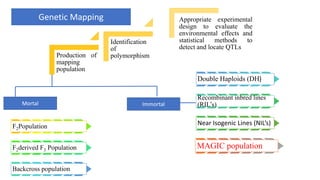
Production of
mapping
population
Identification
of
polymorphism
Appropriate experimental
design to evaluate the
environmental effects and
statistical methods to
detect and locate QTLs
Genetic Mapping
Mortal Immortal
Double Haploids (DH)
Recombinant inbred lines
(RIL’s)
Near Isogenic Lines (NIL’s)
F2Population
F2derived F3 Population
Backcross population
MAGIC population
Limitations of Biparental populations
• Shortage of diversity
• Limited opportunities for genetic recombination events
• Only two alleles are analyzed, with a maximum resolution of 10–30
cM
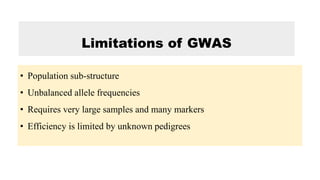
• Population sub-structure
• Unbalanced allele frequencies
• Requires very large samples and many markers
• Efficiency is limited by unknown pedigrees
Limitations of GWAS
M •Multi-parent
A •Advanced
G •Generation
I •Inter
C •Crosses
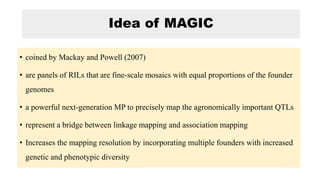
Idea of MAGIC
• coined by Mackay and Powell (2007)
• are panels of RILs that are fine-scale mosaics with equal proportions of the founder
genomes
• a powerful next-generation MP to precisely map the agronomically important QTLs
• represent a bridge between linkage mapping and association mapping
• Increases the mapping resolution by incorporating multiple founders with increased
genetic and phenotypic diversity
(Stadlmeier et al 2018)
MAGIC Development Strategies
• Founder Selection
• Population Size
• Cross-Designs
• Analysis Software for QTL Mapping
Founder Selection
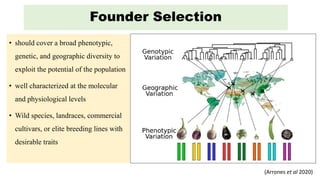
• should cover a broad phenotypic,
genetic, and geographic diversity to
exploit the potential of the population
• well characterized at the molecular
and physiological levels
• Wild species, landraces, commercial
cultivars, or elite breeding lines with
desirable traits
(Arrones et al 2020)
Population Size
• Large population sizes are essential in each generation
• MP of at least 100-250 individuals is required for coarse QTL mapping
• As the population size increases, the power and resolution of QTL mapping also increases
• could be affected by the plants with poor development, fruit setting, or by the appearance of
parthenocarpic fruits
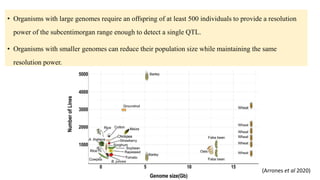
• Organisms with large genomes require an offspring of at least 500 individuals to provide a resolution
power of the subcentimorgan range enough to detect a single QTL.
• Organisms with smaller genomes can reduce their population size while maintaining the same
resolution power.
(Arrones et al 2020)
Cross-Designs
• MAGIC populations can be developed by different breeding designs that give rise to
different population structures.
• Basically, the two main approaches to develop MAGIC populations are the following :
1. The Funnel Approach
2. The Diallel Approach
The Funnel Approach
• The development of MAGIC population starts with a funnel
breeding scheme.
• Several generations of inter-crossing among a number (n) of elite
parental lines to obtain n/2 F1 hybrids
• Subsequently intercrossed in a set mating design to combine the
genomes of all founders in the progeny lines.
(Scott et al 2020)
The Diallel Approach
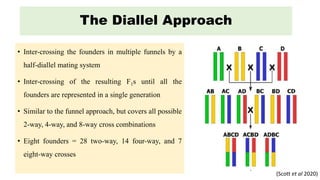
• Inter-crossing the founders in multiple funnels by a
half-diallel mating system
• Inter-crossing of the resulting F1s until all the
founders are represented in a single generation
• Similar to the funnel approach, but covers all possible
2-way, 4-way, and 8-way cross combinations
• Eight founders = 28 two-way, 14 four-way, and 7
eight-way crosses
(Scott et al 2020)
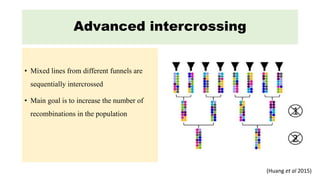
Advanced intercrossing
• Mixed lines from different funnels are
sequentially intercrossed
• Main goal is to increase the number of
recombinations in the population
(Huang et al 2015)
Inbreeding
• progressed to create homozygous
individuals
• RILs in plants can be created via SSD or
DH production
• DH production is faster but, the multiple
generations of selfing will introduce
additional recombination
(Huang et al 2015)
Analysis Software for QTL Mapping
• R/mpMap
• R package for 4-way and 8-way MAGIC populations
• Developed for analyzing MP designs with greater flexibility in pedigree definition and
• Accommodate linear mixed models to simultaneously assess genetic and environmental
variation
Advantages
MAGIC population - primarily used for
two purposes:
Permanent immortal MP for precise
QTL location
Development of new elite material to be
directly released as pre-breeding
material
QTL detection
Large number of accumulated recombinant events achieved
over multiple rounds of inter-crossing and selfing
Improves QTL mapping accuracy
Greater resolution
Increases the
number of
QTLs that
segregate in
the cross
Higher
genetic and
phenotypic
diversity
within a
single MP
Combination
of multiple
founders
Promote
novel
rearrangement
of alleles
Immortal RILs that constitute
the final MAGIC population
Exploited in breeding programs for the
development of improved lines and hybrids
Analyzed across a wide range of
environments to increase the
understanding of G×E interaction and
phenotypic plasticity
• More investment in time
• Greater efforts to be developed due to their complex crossing scheme
• Requires a larger population size compared to a bi-parent population.
• Logistically challenging and labor-intensive.
• Many molecular markers are required
• When wild species are in the panel of founder parents, genetic incompatibility may appear.
Limitations
Comparison of advantages and limitations of
biparental, association and MAGIC MPs
Characteristic Population Type
Bi-Parental Association MAGIC
Investment in time to be established - + - -
Required population size + - -
Genetic and phenotypic diversity - + + +
Suitability for coarse mapping + - +
Suitability for fine mapping - + +
QTL resolution - + + +
Required marker density + - -
Recombination rate - + +
Low population sub-structure + - +
Low LD + - +
(Arrones et al 2020)
+ Advantages ; - Limitations
Species Founders Details Genotype data References
Tomato
(Solanum lycopersicum)
8 4 S. lycopersicum and 4 S.
lycopersicum var.
cerasiforme diverse lines,
crossed in 1 funnel, 397
RILs
4 million SNPs from
WGS of founders
(6.7–16.6x);1536
KASP SNPs
genotyped in 397
RILs
(Causse et al 2013,
Pascual et al 2015)
8 4 cherry and 4 large-fruited
tomato accessions crossed
in 1 funnel, 124 RILs
7400 SNP markers
and a total of 25
QTLs were mapped
(Burgos et al 2021)
Brinjal
(Solanum melongena)
8 7 S. melongena and 1 S.
incanum
7724 SNP markers
genotyped in 420
RILs
(Mangino et al 2022)
Common bean
(Phaseolus vulgaris L)
8 8 Mesoamerican breeding
lines
20,615 polymorphic
markers in 996 RILs
(Diaz et al 2020)
Cowpea
(Vigna unguiculata)
8 1 US cultivar and 7
cultivars from sub-Saharan
Africa chosen for
agronomic traits, crossed in
6 funnels, 305 RILs
32130 genotyping
array SNPs in 305
RILs
(Huynh et al. 2018)
MAGIC population studies in Vegetables
Case studies
• Material used: seven cultivated eggplants, i.e., MM1597 (A), DH ECAVI (B), AN-S-26 (D), H15 (E), A0416
(F), IVIA- 371 (G) and ASI-S-1 (H), and the S. incanum accession MM577- Funnel breeding scheme
• Genotyping : eggplant 5k probes SPET platform and
• Phenotyping: anthocyanin presence in vegetative plant tissues (PA) and fruit epidermis (FA) and
Pigmentation Under the Calyx(PUC)
Genome-wide founder haplotype blocks assignment
across the entire S3MEGGIC population
• PA - revealed two major peaks on chromosome 9 and 10 with seven significant SNPs
• FA - 11 SNPs above the Bonferroni threshold were plotted on three major peaks located on
chromosomes 1, 9, and 10
• Pigmentation Under the Calyx- 7 main peaks on chromosomes 1 , 3 and 10 with 23 SNPs above the
Bonferroni threshold.
• BLAST analysis of the SMEL_001 onto the tomato genome indicated that this gene corresponded to the
orthologue SlANT1-like with 70.99% identity.
• The eggplant SMEL_010 corresponded to the tomato orthologue SlAN2-like with a 73.73% identity,
which is the best candidate gene for the anthocyanin fruit biosynthesis in tomato.
• A single duplication event and a translocation of a fragment of at least 357 kb from chromosome 10 to 1
occurred during eggplant evolution
Tomato-eggplant microsynteny representation of a tomato region from
chromosome 10 (Solyc10), eggplant region of chromosome 10 (SMEL_010),
where candidate genes for anthocyanins synthesis are located.
Results
o The 7,724 filtered high-confidence single-nucleotide polymorphisms (SNPs) confirmed
• low residual heterozygosity (6.87%) and
• a lack of genetic structure in the S3MEGGIC population
o Duplication of an ancestral gene with a translocation from chromosome 10 to chromosome 1 was
compared with the tomato genome.
• A candidate gene, related to light-dependent anthocyanin biosynthesis in fruits, was detected at the
beginning of chromosome10
• Aim: To develop a common bean MAGIC to identify genomic regions associated with yield,
micromineral accumulation, and physiological traits under drought conditions.
• Material used: inter-crossing of eight Mesoamerican elite breeding lines
• Genetic mapping was carried out with two methods, using association mapping with GWAS,
and linkage mapping with haplotype-based interval screening
Assessment of population structure for 629 MAGIC lines and
8 founders using GBS data
Distribution of the founder’s haplotypes in the MAGIC population
Results
• Founder haplotypes in the population were identified using GBS. No major population structure
was observed.
• Thirteen high confidence QTL were identified using both methods and several QTL hotspots were
found controlling multiple traits.
• Major QTL hotspot located on chromosome Pv01 for phenology traits and yield was identified.
• Major QTL for seed Fe content was contributed by MIB778, the founder line with highest
micromineral accumulation.
Conclusion
• MAGIC populations represent powerful tools for the detection of QTLs present in the set of
parents, with considerable advantages over bi-parental and germplasm sets.
• Recombinant elite lines can be directly selected by breeders for being introduced in breeding
programs.
• Increases the precision of QTL mapping.
• MAGIC populations will play an important role in addressing the formidable challenges faced by
breeders in a scenario of climate change by significantly contributing to the development of new
generations of resilient, highly productive, and resource-efficient cultivars.
Thank you
Acknowledgment
Dr. Mamta Pathak Dr. Hira Singh Dr. S.K.Jindal

MAGIC population in Vegetables

  • 1.
    Role of MAGICpopulation in Vegetable improvement Presented by: Anusha K.R L-2021-H-88-D
  • 2.
    However, the identificationof QTLs remains a challenge for plant breeders Identification of QTLs that contribute to improving yield and quality traits Key factor in promoting a new Green Revolution. Marker-assisted selection (MAS) Introgression breeding Pyramiding of QTLs Improved cultivars
  • 3.
    Production of mapping population Identification of polymorphism Appropriate experimental designto evaluate the environmental effects and statistical methods to detect and locate QTLs Genetic Mapping Mortal Immortal Double Haploids (DH) Recombinant inbred lines (RIL’s) Near Isogenic Lines (NIL’s) F2Population F2derived F3 Population Backcross population MAGIC population
  • 4.
    Limitations of Biparentalpopulations • Shortage of diversity • Limited opportunities for genetic recombination events • Only two alleles are analyzed, with a maximum resolution of 10–30 cM
  • 5.
    • Population sub-structure •Unbalanced allele frequencies • Requires very large samples and many markers • Efficiency is limited by unknown pedigrees Limitations of GWAS
  • 6.
    M •Multi-parent A •Advanced G•Generation I •Inter C •Crosses
  • 7.
    Idea of MAGIC •coined by Mackay and Powell (2007) • are panels of RILs that are fine-scale mosaics with equal proportions of the founder genomes • a powerful next-generation MP to precisely map the agronomically important QTLs • represent a bridge between linkage mapping and association mapping • Increases the mapping resolution by incorporating multiple founders with increased genetic and phenotypic diversity
  • 8.
  • 9.
    MAGIC Development Strategies •Founder Selection • Population Size • Cross-Designs • Analysis Software for QTL Mapping
  • 10.
    Founder Selection • shouldcover a broad phenotypic, genetic, and geographic diversity to exploit the potential of the population • well characterized at the molecular and physiological levels • Wild species, landraces, commercial cultivars, or elite breeding lines with desirable traits (Arrones et al 2020)
  • 11.
    Population Size • Largepopulation sizes are essential in each generation • MP of at least 100-250 individuals is required for coarse QTL mapping • As the population size increases, the power and resolution of QTL mapping also increases • could be affected by the plants with poor development, fruit setting, or by the appearance of parthenocarpic fruits
  • 12.
    • Organisms withlarge genomes require an offspring of at least 500 individuals to provide a resolution power of the subcentimorgan range enough to detect a single QTL. • Organisms with smaller genomes can reduce their population size while maintaining the same resolution power. (Arrones et al 2020)
  • 13.
    Cross-Designs • MAGIC populationscan be developed by different breeding designs that give rise to different population structures. • Basically, the two main approaches to develop MAGIC populations are the following : 1. The Funnel Approach 2. The Diallel Approach
  • 14.
    The Funnel Approach •The development of MAGIC population starts with a funnel breeding scheme. • Several generations of inter-crossing among a number (n) of elite parental lines to obtain n/2 F1 hybrids • Subsequently intercrossed in a set mating design to combine the genomes of all founders in the progeny lines. (Scott et al 2020)
  • 15.
    The Diallel Approach •Inter-crossing the founders in multiple funnels by a half-diallel mating system • Inter-crossing of the resulting F1s until all the founders are represented in a single generation • Similar to the funnel approach, but covers all possible 2-way, 4-way, and 8-way cross combinations • Eight founders = 28 two-way, 14 four-way, and 7 eight-way crosses (Scott et al 2020)
  • 16.
    Advanced intercrossing • Mixedlines from different funnels are sequentially intercrossed • Main goal is to increase the number of recombinations in the population (Huang et al 2015)
  • 17.
    Inbreeding • progressed tocreate homozygous individuals • RILs in plants can be created via SSD or DH production • DH production is faster but, the multiple generations of selfing will introduce additional recombination (Huang et al 2015)
  • 18.
    Analysis Software forQTL Mapping • R/mpMap • R package for 4-way and 8-way MAGIC populations • Developed for analyzing MP designs with greater flexibility in pedigree definition and • Accommodate linear mixed models to simultaneously assess genetic and environmental variation
  • 19.
  • 20.
    MAGIC population -primarily used for two purposes: Permanent immortal MP for precise QTL location Development of new elite material to be directly released as pre-breeding material
  • 21.
    QTL detection Large numberof accumulated recombinant events achieved over multiple rounds of inter-crossing and selfing Improves QTL mapping accuracy Greater resolution Increases the number of QTLs that segregate in the cross Higher genetic and phenotypic diversity within a single MP Combination of multiple founders Promote novel rearrangement of alleles
  • 22.
    Immortal RILs thatconstitute the final MAGIC population Exploited in breeding programs for the development of improved lines and hybrids Analyzed across a wide range of environments to increase the understanding of G×E interaction and phenotypic plasticity
  • 23.
    • More investmentin time • Greater efforts to be developed due to their complex crossing scheme • Requires a larger population size compared to a bi-parent population. • Logistically challenging and labor-intensive. • Many molecular markers are required • When wild species are in the panel of founder parents, genetic incompatibility may appear. Limitations
  • 24.
    Comparison of advantagesand limitations of biparental, association and MAGIC MPs Characteristic Population Type Bi-Parental Association MAGIC Investment in time to be established - + - - Required population size + - - Genetic and phenotypic diversity - + + + Suitability for coarse mapping + - + Suitability for fine mapping - + + QTL resolution - + + + Required marker density + - - Recombination rate - + + Low population sub-structure + - + Low LD + - + (Arrones et al 2020) + Advantages ; - Limitations
  • 25.
    Species Founders DetailsGenotype data References Tomato (Solanum lycopersicum) 8 4 S. lycopersicum and 4 S. lycopersicum var. cerasiforme diverse lines, crossed in 1 funnel, 397 RILs 4 million SNPs from WGS of founders (6.7–16.6x);1536 KASP SNPs genotyped in 397 RILs (Causse et al 2013, Pascual et al 2015) 8 4 cherry and 4 large-fruited tomato accessions crossed in 1 funnel, 124 RILs 7400 SNP markers and a total of 25 QTLs were mapped (Burgos et al 2021) Brinjal (Solanum melongena) 8 7 S. melongena and 1 S. incanum 7724 SNP markers genotyped in 420 RILs (Mangino et al 2022) Common bean (Phaseolus vulgaris L) 8 8 Mesoamerican breeding lines 20,615 polymorphic markers in 996 RILs (Diaz et al 2020) Cowpea (Vigna unguiculata) 8 1 US cultivar and 7 cultivars from sub-Saharan Africa chosen for agronomic traits, crossed in 6 funnels, 305 RILs 32130 genotyping array SNPs in 305 RILs (Huynh et al. 2018) MAGIC population studies in Vegetables
  • 26.
  • 27.
    • Material used:seven cultivated eggplants, i.e., MM1597 (A), DH ECAVI (B), AN-S-26 (D), H15 (E), A0416 (F), IVIA- 371 (G) and ASI-S-1 (H), and the S. incanum accession MM577- Funnel breeding scheme • Genotyping : eggplant 5k probes SPET platform and • Phenotyping: anthocyanin presence in vegetative plant tissues (PA) and fruit epidermis (FA) and Pigmentation Under the Calyx(PUC)
  • 28.
    Genome-wide founder haplotypeblocks assignment across the entire S3MEGGIC population
  • 29.
    • PA -revealed two major peaks on chromosome 9 and 10 with seven significant SNPs • FA - 11 SNPs above the Bonferroni threshold were plotted on three major peaks located on chromosomes 1, 9, and 10 • Pigmentation Under the Calyx- 7 main peaks on chromosomes 1 , 3 and 10 with 23 SNPs above the Bonferroni threshold.
  • 30.
    • BLAST analysisof the SMEL_001 onto the tomato genome indicated that this gene corresponded to the orthologue SlANT1-like with 70.99% identity. • The eggplant SMEL_010 corresponded to the tomato orthologue SlAN2-like with a 73.73% identity, which is the best candidate gene for the anthocyanin fruit biosynthesis in tomato. • A single duplication event and a translocation of a fragment of at least 357 kb from chromosome 10 to 1 occurred during eggplant evolution Tomato-eggplant microsynteny representation of a tomato region from chromosome 10 (Solyc10), eggplant region of chromosome 10 (SMEL_010), where candidate genes for anthocyanins synthesis are located.
  • 31.
    Results o The 7,724filtered high-confidence single-nucleotide polymorphisms (SNPs) confirmed • low residual heterozygosity (6.87%) and • a lack of genetic structure in the S3MEGGIC population o Duplication of an ancestral gene with a translocation from chromosome 10 to chromosome 1 was compared with the tomato genome. • A candidate gene, related to light-dependent anthocyanin biosynthesis in fruits, was detected at the beginning of chromosome10
  • 32.
    • Aim: Todevelop a common bean MAGIC to identify genomic regions associated with yield, micromineral accumulation, and physiological traits under drought conditions. • Material used: inter-crossing of eight Mesoamerican elite breeding lines • Genetic mapping was carried out with two methods, using association mapping with GWAS, and linkage mapping with haplotype-based interval screening
  • 33.
    Assessment of populationstructure for 629 MAGIC lines and 8 founders using GBS data
  • 34.
    Distribution of thefounder’s haplotypes in the MAGIC population
  • 37.
    Results • Founder haplotypesin the population were identified using GBS. No major population structure was observed. • Thirteen high confidence QTL were identified using both methods and several QTL hotspots were found controlling multiple traits. • Major QTL hotspot located on chromosome Pv01 for phenology traits and yield was identified. • Major QTL for seed Fe content was contributed by MIB778, the founder line with highest micromineral accumulation.
  • 38.
    Conclusion • MAGIC populationsrepresent powerful tools for the detection of QTLs present in the set of parents, with considerable advantages over bi-parental and germplasm sets. • Recombinant elite lines can be directly selected by breeders for being introduced in breeding programs. • Increases the precision of QTL mapping. • MAGIC populations will play an important role in addressing the formidable challenges faced by breeders in a scenario of climate change by significantly contributing to the development of new generations of resilient, highly productive, and resource-efficient cultivars.
  • 39.
    Thank you Acknowledgment Dr. MamtaPathak Dr. Hira Singh Dr. S.K.Jindal

Editor's Notes

  • #5 due to the narrow genetic base that is limited to both parents especially in F2, BC1, and DH populations, limits the resolution for QTL detection as just a single opportunity of recombination has been possible during F1 meiosis.
  • #6 Genome-wide association studies (GWAS) have become one of the main genomic tools to dissect QTLs. (which can lead to inaccurate results),
  • #7 The weaknesses of existing designs have led to a new type of complex experimental design intermediate to biparental and association mapping designs in terms of diversity, and resolution.
  • #11 One of the most important decisions to take prior to the development of MAGIC populations is the selection of founders that are going to give rise to the final population. The selection of wild relatives to broaden genetic diversity could lead to incompatibilities, linkage drag due to a lack of recombination in some regions of the genome, and the selection of certain phenotypic traits like a lack of seed dormancy or early flowering time. In these cases, the number of offspring families may suffer a reduction that could endanger the development of the MAGIC population . Currently available MAGIC populations have generally been obtained using only intraspecific diversity, as in most cases their founders are landraces, improved and adapted breeding lines, or commercial cultivars.
  • #12 The largest losses of families take place in the early generations as selection for appropriate development, high fertility, and seed production takes place.
  • #13 An optimum population strongly depends on the genome size.
  • #15 The funnel is created by Which are
  • #16 Followed by In the case of
  • #18 Individuals resulting from the AI stage are
  • #19 The construction of genetic maps for marker-trait association analyses in MAGIC populations is challenging due to their complex cross-design.
  • #23 Phenotypic plasticity can be defined as 'the ability of individual genotypes to produce different phenotypes when exposed to different environmental conditions
  • #24 Involvement of multiple founders makes the process
  • #28 Single Primer Enrichment Technology (SPET) -  relying on the sequencing of a region flanking a primer. Its reliance on single primers, rather than on primer pairs, greatly simplifies panel design, and allows higher levels of multiplexing than PCR-based genotyping
  • #29 Two of the founder genomes (A0416 and IVIA-371) had a high representation in the genome of the S3 individuals (32.6% and 23.6%, respectively), while two others (AN-S-26 and H15) had a small representation (0.3% in both cases). The wild founder, S. incanum, had an average haplotype representation of 5.8%.
  • #31 Microsynteny can be defined as a fine-scale syntenic (genes that lie on same chromosome)  linkage with no or very few genes interposed between the two syntenic loci Basic Local Alignment Search Tool -  to generate alignments between a nucleotide or protein sequence, Orthologues ('ortho' meaning 'exact') are genes that are derived by speciation, whereas paralogues ('para' meaning 'beside' or 'next to') are genes that evolved through duplication.
  • #32  Paralouge- A pair of genes that derives from the same ancestral gene and now reside at different locations within the same genome.
  • #34 All MAGIC and founder lines are evenly separated from the center of the tree (Fig. 3a), except for MIB778 which showed a longer matching distance. There are no defined clusters that separate lines in the tree, indicating no significant population structure within the MAGIC population 2. principal components show a uniform dispersal of the genotypes, with MIB778 drawing more distant from the other founders
  • #35 the reduced complexity level of population structure and an even representation of parental haplotypes in the MAGIC lines
  • #36 In total, 17 QTL for 7 traits were identified with significant peaks in the GWAS analysis.