Money: Meaning – Types - Functions of Money - Banking: Meaning – Types -
Functions of Commercial Banks - Functions of Central Bank
Meaning & Definition of Money
Meaning:
Anything which is commonly accepted as a medium of exchange is called
money. Example : a rupee in India is money, as it is a commonly accepted
medium of exchange here. Likewise , a dollar in USA is money , as it is a
commonly accepted medium of exchange there.
Definition:
According to Walker “ Money is What Money Does”.
D.H. Robertson defines money as “ anything which is widely accepted in
payment for goods, or in discharge of other kinds of business obligations.
Seligman defines money as “ one thing that possesses general acceptability.
G.D.H. Cole, “ the essence of money is that it can be passed from hand to
hand in one act of circulation after another”.
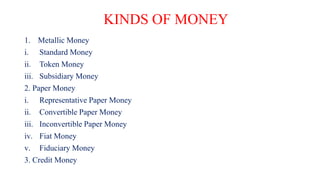
KINDS OF MONEY
1. Metallic Money
i. Standard Money
ii. Token Money
iii. Subsidiary Money
2. Paper Money
i. Representative Paper Money
ii. Convertible Paper Money
iii. Inconvertible Paper Money
iv. Fiat Money
v. Fiduciary Money
3. Credit Money
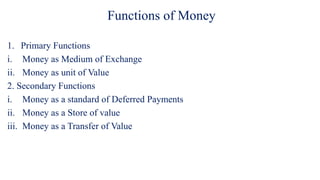
Functions of Money
1. Primary Functions
i. Money as Medium of Exchange
ii. Money as unit of Value
2. Secondary Functions
i. Money as a standard of Deferred Payments
ii. Money as a Store of value
iii. Money as a Transfer of Value
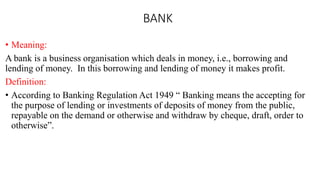
BANK
• Meaning:
A bank is a business organisation which deals in money, i.e., borrowing and
lending of money. In this borrowing and lending of money it makes profit.
Definition:
• According to Banking Regulation Act 1949 “ Banking means the accepting for
the purpose of lending or investments of deposits of money from the public,
repayable on the demand or otherwise and withdraw by cheque, draft, order to
otherwise”.
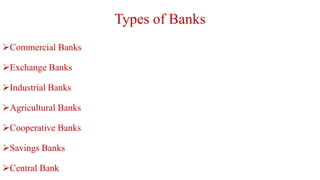
Types of Banks
Commercial Banks
Exchange Banks
Industrial Banks
Agricultural Banks
Cooperative Banks
Savings Banks
Central Bank
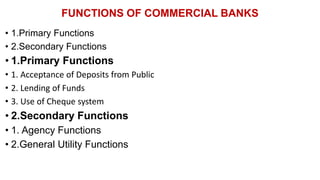
FUNCTIONS OF COMMERCIAL BANKS
• 1.Primary Functions
• 2.Secondary Functions
• 1.Primary Functions
• 1. Acceptance of Deposits from Public
• 2. Lending of Funds
• 3. Use of Cheque system
• 2.Secondary Functions
• 1. Agency Functions
• 2.General Utility Functions
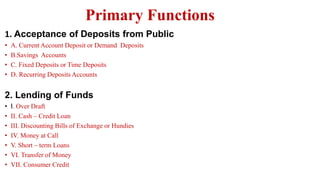
Primary Functions
1. Acceptance of Deposits from Public
• A. Current Account Deposit or Demand Deposits
• B.Savings Accounts
• C. Fixed Deposits or Time Deposits
• D. Recurring Deposits Accounts
2. Lending of Funds
• I. Over Draft
• II. Cash – Credit Loan
• III. Discounting Bills of Exchange or Hundies
• IV. Money at Call
• V. Short – term Loans
• VI. Transfer of Money
• VII. Consumer Credit
• 3. Use of Cheque System
• I. Bearer Cheque
• II. The Crossed Cheque
• Secondary Functions
• A. Agency Functions
• 1. Collection of Payment of various items
• 2.Purchase and sale of securities
• 3.Income Tax consultant
• 4. Payment of Premia
• 5. Transfer of funds
• General Utility Service
• 1. Locker Facilities
• 2. Traveller Cheque and Letter of Credit
• 3. Business information and Statistics
• 4. Purchase and sale of Foreign Exchange
Central Bank or Reserve Bank of India
• Introduction
• The Central Bank is a Apex institution
• The Central Bank also known as the Reserve Bank of India
• The RBI set up in 1935 and nationalised in 1949.
• The Central Bank run for promote financial and economic stability.
• The RBI run for welfare of the country not for profit making banks like
ordinary banking.
DEFINITION
• According to Dr. Naseem A. Azad the Central bank is the bank which
control the whole economy of the nation and has a monopoly of note
issue and rate over all the banks of country.
Functions of Central Bank
• 1. It act as a note issuing Agency
• 2. It act as the banker to state
• 3.It acts as the Banker’s bank
i) Custodian of Cash Reserves of Commercial
Banks
• ii)Lender of the Last Resort
• iii) Clearing Agent
• 4.In controls Credit
• 5.It Manages Exchange Rate
• 6. Promote Economic Development
THANK YOU

General Economics

  • 1.
    Money: Meaning –Types - Functions of Money - Banking: Meaning – Types - Functions of Commercial Banks - Functions of Central Bank
  • 3.
    Meaning & Definitionof Money Meaning: Anything which is commonly accepted as a medium of exchange is called money. Example : a rupee in India is money, as it is a commonly accepted medium of exchange here. Likewise , a dollar in USA is money , as it is a commonly accepted medium of exchange there. Definition: According to Walker “ Money is What Money Does”. D.H. Robertson defines money as “ anything which is widely accepted in payment for goods, or in discharge of other kinds of business obligations. Seligman defines money as “ one thing that possesses general acceptability. G.D.H. Cole, “ the essence of money is that it can be passed from hand to hand in one act of circulation after another”.
  • 4.
    KINDS OF MONEY 1.Metallic Money i. Standard Money ii. Token Money iii. Subsidiary Money 2. Paper Money i. Representative Paper Money ii. Convertible Paper Money iii. Inconvertible Paper Money iv. Fiat Money v. Fiduciary Money 3. Credit Money
  • 6.
    Functions of Money 1.Primary Functions i. Money as Medium of Exchange ii. Money as unit of Value 2. Secondary Functions i. Money as a standard of Deferred Payments ii. Money as a Store of value iii. Money as a Transfer of Value
  • 7.
    BANK • Meaning: A bankis a business organisation which deals in money, i.e., borrowing and lending of money. In this borrowing and lending of money it makes profit. Definition: • According to Banking Regulation Act 1949 “ Banking means the accepting for the purpose of lending or investments of deposits of money from the public, repayable on the demand or otherwise and withdraw by cheque, draft, order to otherwise”.
  • 8.
    Types of Banks CommercialBanks Exchange Banks Industrial Banks Agricultural Banks Cooperative Banks Savings Banks Central Bank
  • 9.
    FUNCTIONS OF COMMERCIALBANKS • 1.Primary Functions • 2.Secondary Functions • 1.Primary Functions • 1. Acceptance of Deposits from Public • 2. Lending of Funds • 3. Use of Cheque system • 2.Secondary Functions • 1. Agency Functions • 2.General Utility Functions
  • 10.
    Primary Functions 1. Acceptanceof Deposits from Public • A. Current Account Deposit or Demand Deposits • B.Savings Accounts • C. Fixed Deposits or Time Deposits • D. Recurring Deposits Accounts 2. Lending of Funds • I. Over Draft • II. Cash – Credit Loan • III. Discounting Bills of Exchange or Hundies • IV. Money at Call • V. Short – term Loans • VI. Transfer of Money • VII. Consumer Credit
  • 11.
    • 3. Useof Cheque System • I. Bearer Cheque • II. The Crossed Cheque • Secondary Functions • A. Agency Functions • 1. Collection of Payment of various items • 2.Purchase and sale of securities • 3.Income Tax consultant • 4. Payment of Premia • 5. Transfer of funds
  • 12.
    • General UtilityService • 1. Locker Facilities • 2. Traveller Cheque and Letter of Credit • 3. Business information and Statistics • 4. Purchase and sale of Foreign Exchange
  • 13.
    Central Bank orReserve Bank of India • Introduction • The Central Bank is a Apex institution • The Central Bank also known as the Reserve Bank of India • The RBI set up in 1935 and nationalised in 1949. • The Central Bank run for promote financial and economic stability. • The RBI run for welfare of the country not for profit making banks like ordinary banking.
  • 14.
    DEFINITION • According toDr. Naseem A. Azad the Central bank is the bank which control the whole economy of the nation and has a monopoly of note issue and rate over all the banks of country.
  • 15.
    Functions of CentralBank • 1. It act as a note issuing Agency • 2. It act as the banker to state • 3.It acts as the Banker’s bank i) Custodian of Cash Reserves of Commercial Banks • ii)Lender of the Last Resort • iii) Clearing Agent • 4.In controls Credit • 5.It Manages Exchange Rate • 6. Promote Economic Development
  • 16.