Team 5
INVESTMENT FUNCTION:DETERMINANTS AND ROLE
OF INTEREST RATE IN INVESTMENT DECISIONS
Presentatiom Topic
2.
1. OVERVIEW OF
INVESTMENTFUNCTION
Presenter Name: MD JAHANGIR
Student ID : 24134142
Department of Management
Course Title : Macroeconomics
Date : 27th November 2025
3.
The Investment Functionexplains how the level of
investment in an economy is determined by
different factors—mainly the interest rate,
expected profit, income level, technology, and
government policies. It helps economists
understand how much firms are willing to invest
under different economic conditions.
OVERVIEW OF INVESTMENT FUNCTION
4.
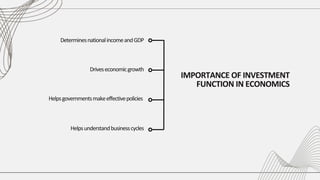
IMPORTANCE OF INVESTMENT
FUNCTIONIN ECONOMICS
DeterminesnationalincomeandGDP
Driveseconomicgrowth
Helpsgovernmentsmakeeffectivepolicies
Helpsunderstandbusinesscycles
5.
2. OBJECTIVES OF
STUDYINGINVESTMENT
FUNCTION
Presenter Name: Asma Akter
Student ID : 24134139
Department of Management
Course Title : Macroeconomics
Date : 27th November 2025
6.
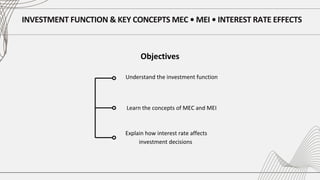
INVESTMENT FUNCTION &KEY CONCEPTS MEC • MEI • INTEREST RATE EFFECTS
Objectives
Understand the investment function
Learn the concepts of MEC and MEI
Explain how interest rate affects
investment decisions
7.
Investment Function MEC(Marginal Efficiency
of Capital)
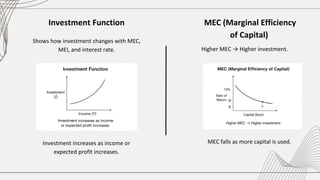
Shows how investment changes with MEC,
MEI, and interest rate.
Investment increases as income or
expected profit increases.
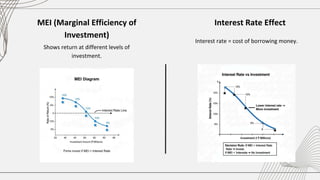
Higher MEC → Higher investment.
MEC falls as more capital is used.
8.
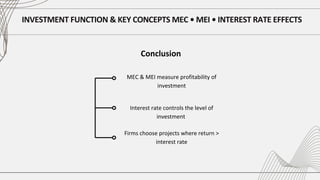
MEI (Marginal Efficiencyof
Investment)
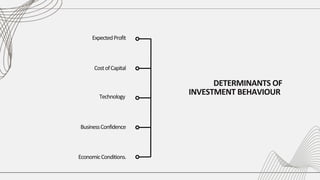
Interest Rate Effect
Shows return at different levels of
investment.
Interest rate = cost of borrowing money.
9.
INVESTMENT FUNCTION &KEY CONCEPTS MEC • MEI • INTEREST RATE EFFECTS
Conclusion
MEC & MEI measure profitability of
investment
Interest rate controls the level of
investment
Firms choose projects where return >
interest rate
10.
3. DETERMINANTS OF
INVESTMENTBEHAVIOUR
Presenter Name: Md.Ratul Hasan
Student ID :24134146
Department of Management
Course Title : Macroeconomics
Date : 27th November 2025
4. METHODOLOGY FOR
ANALYZINGINVESTMENT
Presenter Name: Bhumika Banik
Student ID :24134141
Department of Management
Course Title : Macroeconomics
Date : 27th November 2025
13.
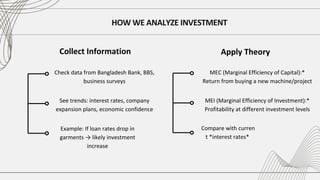
HOW WE ANALYZEINVESTMENT
Collect Information
Check data from Bangladesh Bank, BBS,
business surveys
See trends: interest rates, company
expansion plans, economic confidence
Example: If loan rates drop in
garments → likely investment
increase
Apply Theory
MEC (Marginal Efficiency of Capital):*
Return from buying a new machine/project
MEI (Marginal Efficiency of Investment):*
Profitability at different investment levels
Compare with curren
t *interest rates*
14.
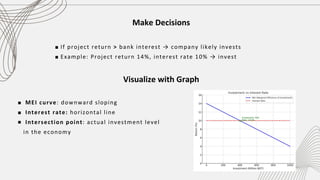
Make Decisions
If projectreturn > bank interest → company likely invests
Example: Project return 14%, interest rate 10% → invest
Visualize with Graph
MEI curve: downward sloping
Interest rate: horizontal line
Intersection point: actual investment level
in the economy
15.
5. MARGINAL EFFICIENCY
OFCAPITAL (MEC)
Presenter Name: Mainul Hasan Sagor
Student ID :24134144
Department of Management
Course Title : Macroeconomics
Date : 27th November 2025
16.
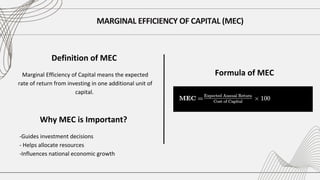
MARGINAL EFFICIENCY OFCAPITAL (MEC)
Marginal Efficiency of Capital means the expected
rate of return from investing in one additional unit of
capital.
Definition of MEC
Formula of MEC
Why MEC is Important?
-Guides investment decisions
- Helps allocate resources
-Influences national economic growth
17.
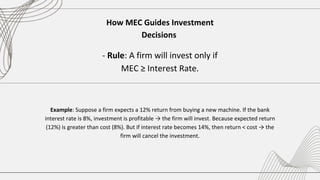
- Rule: Afirm will invest only if
MEC ≥ Interest Rate.
How MEC Guides Investment
Decisions
Example: Suppose a firm expects a 12% return from buying a new machine. If the bank
interest rate is 8%, investment is profitable → the firm will invest. Because expected return
(12%) is greater than cost (8%). But if interest rate becomes 14%, then return < cost → the
firm will cancel the investment.
18.
6. MARGINAL EFFICIENCY
OFINVESTMENT (MEI)
Presenter Name: FAHMIDA MOZUMDER
Student ID :23134133
Department of Management
Course Title : Macroeconomics
Date : 27th November 2025
19.
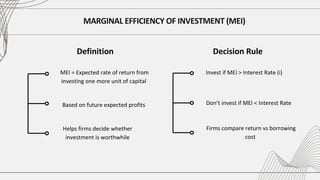
MARGINAL EFFICIENCY OFINVESTMENT (MEI)
Definition
MEI = Expected rate of return from
investing one more unit of capital
Based on future expected profits
Helps firms decide whether
investment is worthwhile
Decision Rule
Invest if MEI > Interest Rate (i)
Don’t invest if MEI < Interest Rate
Firms compare return vs borrowing
cost
20.
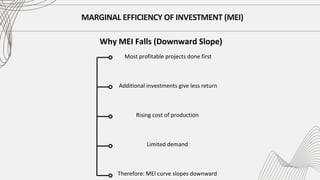
MARGINAL EFFICIENCY OFINVESTMENT (MEI)
Why MEI Falls (Downward Slope)
Most profitable projects done first
Additional investments give less return
Rising cost of production
Limited demand
Therefore: MEI curve slopes downward
21.
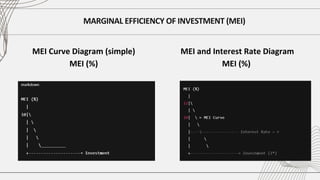
MARGINAL EFFICIENCY OFINVESTMENT (MEI)
MEI Curve Diagram (simple)
MEI (%)
MEI and Interest Rate Diagram
MEI (%)
22.
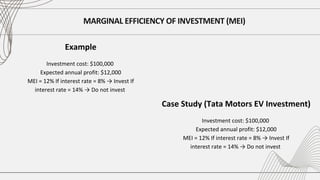
MARGINAL EFFICIENCY OFINVESTMENT (MEI)
Example
Investment cost: $100,000
Expected annual profit: $12,000
MEI = 12% If interest rate = 8% → Invest If
interest rate = 14% → Do not invest
Case Study (Tata Motors EV Investment)
Investment cost: $100,000
Expected annual profit: $12,000
MEI = 12% If interest rate = 8% → Invest If
interest rate = 14% → Do not invest
23.
MARGINAL EFFICIENCY OFINVESTMENT (MEI)
Factors Affecting MEI
Business expectations
Technological progress
Taxes
Economic & political stability
Changes in interest rate
24.
7. ROLE OFINTEREST
RATE IN INVESTMENT
DECISIONS
Presenter Name: Anu shree podder
Student ID 24134138
Department of Management
Course Title : Macroeconomics
Date : 27th November 2025
25.
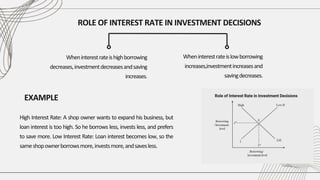
ROLE OF INTERESTRATE IN INVESTMENT DECISIONS
Wheninterestrateishighborrowing
decreases,investmentdecreasesandsaving
increases.
Wheninterestrateislowborrowing
increases,investmentincreasesand
savingdecreases.
EXAMPLE
High Interest Rate: A shop owner wants to expand his business, but
loan interest is too high. So he borrows less, invests less, and prefers
to save more. Low Interest Rate: Loan interest becomes low, so the
sameshopownerborrowsmore,investsmore,andsavesless.
26.
8. ANALYSIS OF
INVESTMENTFUNCTION
IN REAL-WORLD
CONTEXT
Presenter Name: Anita Khatun
Student ID : 24134143
Department of Management
Course Title : Macroeconomics
Date : 27th November 2025
9. FINDINGS ON
INVESTMENTBEHAVIOUR
Presenter Name: Raisul Islam Rahat
Student ID :24134145
Department of Management
Course Title : Macroeconomics
Date : 27th November 2025