About this Course / Program
FUN
Motivation R
E
S
E
A
R
C
H
Strong Community Engagement
Agenda
•Intro to Machine Learning
•Types of Machine Learning System
•Supervised Machine Learning
•Regression
•Hands-On
What is Machine Learning ?
First Questions first
What is Machine Learning ?
Machine learning is a specific field of AI where a system learns to find
patterns in examples in order to make predictions.
It can be understood as Computers learning how to do a task without
'being explicitly programmed' to do so.
What is Machine Learning ?
Machine Learning Algorithms are those that can tell you something
interesting about the data (patterns !), without you having to write any
custom code specific to the problem.
Instead of writing code explicitly, we feed data to these ML algorithms and
they build their own logic based on the data and its patterns.
What is Machine Learning ?
Hence, ML is the “Art of Seeking Information and Meaning from Data”
What is Machine Learning ?
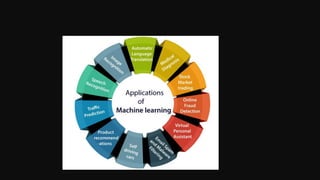
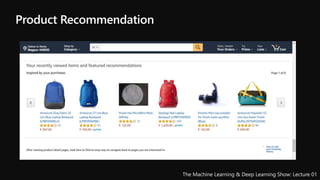
What are your favorite application
of Machine Learning?
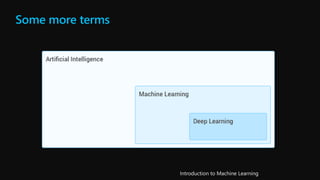
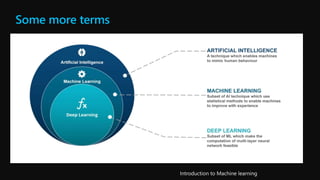
Some more terms
Some more terms
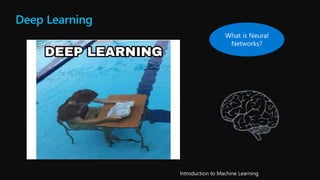
Deep Learning
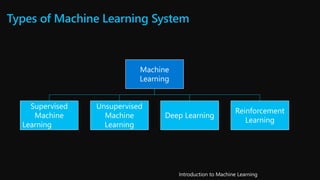
Types of Machine Learning System
Machine
Learning
Supervised
Machine
Learning
Unsupervised
Machine
Learning
Deep Learning
Reinforcement
Learning
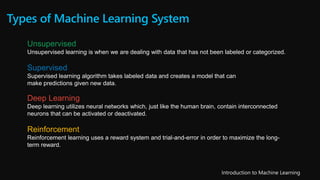
Types of Machine Learning System
Unsupervised
Unsupervised learning is when we are dealing with data that has not been labeled or categorized.
Supervised
Supervised learning algorithm takes labeled data and creates a model that can
make predictions given new data.
Deep Learning
Deep learning utilizes neural networks which, just like the human brain, contain interconnected
neurons that can be activated or deactivated.
Reinforcement
Reinforcement learning uses a reward system and trial-and-error in order to maximize the long-
term reward.
Types of Machine Learning System
[NOC]
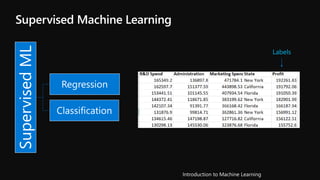
SupervisedML
Regression
Classification
Labels
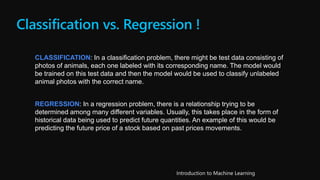
Classification vs. Regression !
CLASSIFICATION: In a classification problem, there might be test data consisting of
photos of animals, each one labeled with its corresponding name. The model would
be trained on this test data and then the model would be used to classify unlabeled
animal photos with the correct name.
REGRESSION: In a regression problem, there is a relationship trying to be
determined among many different variables. Usually, this takes place in the form of
historical data being used to predict future quantities. An example of this would be
predicting the future price of a stock based on past prices movements.
What are Features ?
Features are the variables which distinguish one example from another. They tell
the machine learning model what parts of the data to look for patterns for
achieving the goal.
Lots of data is crucial to a machine learning system but it needs to be helpful
and relevant data. Though you never know until you experiment to see what
variables truly make an impact.
An Example
Consider the problem, "Predicting the Price of a House"
What features should we use ?
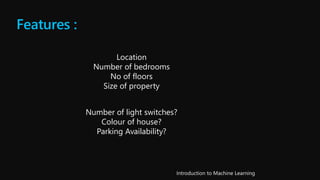
Features :
Location
Number of bedrooms
No of floors
Size of property
Number of light switches?
Colour of house?
Parking Availability?
Weights & Bias:
Weights and biases (commonly referred to as w and b or Ѳ {theta} notation) are
the learnable parameters of a machine learning model.
Weights control the signal (or the strength of the connection) between two
neurons. In other words, a weight decides how much influence the input will
have on the output.
Biases, which are constant, are an additional input into the next layer that will
always have the value of 1.
Regression
(by fitting a curve / an equation to observed data).
For example, a modeler might want to relate the weights of individuals
to their heights using a linear regression model.
Regression
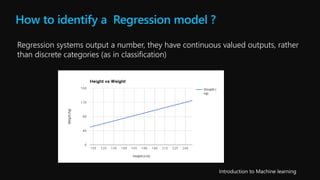
How to identify a Regression model ?
Ready to dive deeper?
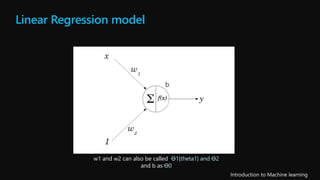
Linear Regression model
w1 and w2 can also be called Ѳ1{theta1} and Ѳ2
and b as Ѳ0
b
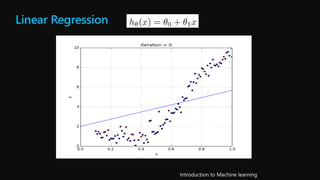
Linear Regression
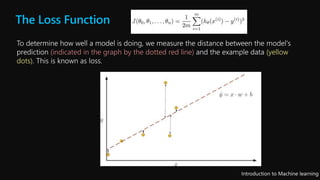
The Loss Function
(indicated in the graph by the dotted red line) (yellow
dots)
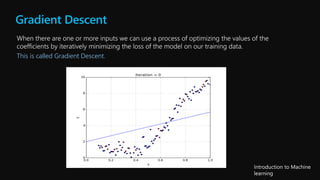
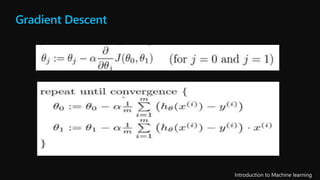
Gradient Descent
Gradient Descent
This is called Gradient Descent.
Gradient Descent
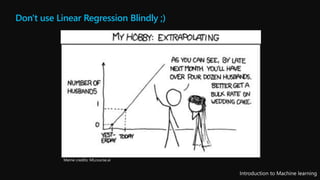
Don't use Linear Regression Blindly ;)
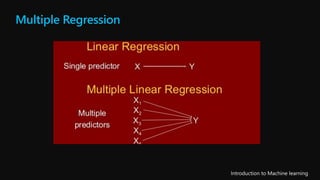
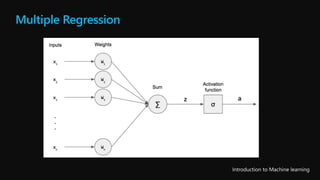
Multiple Regression
Multiple Regression
So that was Regression !!
Python??
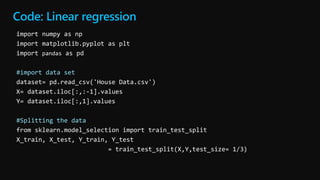
Code: Linear regression
#import data set
#Splitting the data
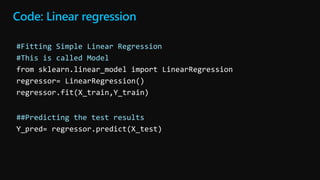
Code: Linear regression
#Fitting Simple Linear Regression
#This is called Model
##Predicting the test results
Code: Linear regression
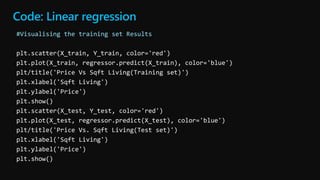
#Visualising the training set Results
Code: Linear regression
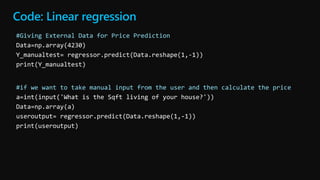
#Giving External Data for Price Prediction
#if we want to take manual input from the user and then calculate the price
MachineLlearning introduction

MachineLlearning introduction

  • 2.
    About this Course/ Program FUN Motivation R E S E A R C H Strong Community Engagement
  • 3.
    Agenda •Intro to MachineLearning •Types of Machine Learning System •Supervised Machine Learning •Regression •Hands-On
  • 4.
    What is MachineLearning ? First Questions first
  • 5.
    What is MachineLearning ?
  • 6.
    What is MachineLearning ? Machine learning is a specific field of AI where a system learns to find patterns in examples in order to make predictions. It can be understood as Computers learning how to do a task without 'being explicitly programmed' to do so.
  • 7.
    What is MachineLearning ? Machine Learning Algorithms are those that can tell you something interesting about the data (patterns !), without you having to write any custom code specific to the problem. Instead of writing code explicitly, we feed data to these ML algorithms and they build their own logic based on the data and its patterns.
  • 8.
    What is MachineLearning ? Hence, ML is the “Art of Seeking Information and Meaning from Data”
  • 9.
    What is MachineLearning ?
  • 14.
    What are yourfavorite application of Machine Learning?
  • 15.
  • 16.
  • 17.
  • 18.
    Types of MachineLearning System Machine Learning Supervised Machine Learning Unsupervised Machine Learning Deep Learning Reinforcement Learning
  • 19.
    Types of MachineLearning System Unsupervised Unsupervised learning is when we are dealing with data that has not been labeled or categorized. Supervised Supervised learning algorithm takes labeled data and creates a model that can make predictions given new data. Deep Learning Deep learning utilizes neural networks which, just like the human brain, contain interconnected neurons that can be activated or deactivated. Reinforcement Reinforcement learning uses a reward system and trial-and-error in order to maximize the long- term reward.
  • 20.
    Types of MachineLearning System [NOC]
  • 21.
  • 22.
    Classification vs. Regression! CLASSIFICATION: In a classification problem, there might be test data consisting of photos of animals, each one labeled with its corresponding name. The model would be trained on this test data and then the model would be used to classify unlabeled animal photos with the correct name. REGRESSION: In a regression problem, there is a relationship trying to be determined among many different variables. Usually, this takes place in the form of historical data being used to predict future quantities. An example of this would be predicting the future price of a stock based on past prices movements.
  • 23.
    What are Features? Features are the variables which distinguish one example from another. They tell the machine learning model what parts of the data to look for patterns for achieving the goal. Lots of data is crucial to a machine learning system but it needs to be helpful and relevant data. Though you never know until you experiment to see what variables truly make an impact.
  • 24.
    An Example Consider theproblem, "Predicting the Price of a House" What features should we use ?
  • 25.
    Features : Location Number ofbedrooms No of floors Size of property Number of light switches? Colour of house? Parking Availability?
  • 26.
    Weights & Bias: Weightsand biases (commonly referred to as w and b or Ѳ {theta} notation) are the learnable parameters of a machine learning model. Weights control the signal (or the strength of the connection) between two neurons. In other words, a weight decides how much influence the input will have on the output. Biases, which are constant, are an additional input into the next layer that will always have the value of 1.
  • 27.
    Regression (by fitting acurve / an equation to observed data). For example, a modeler might want to relate the weights of individuals to their heights using a linear regression model.
  • 28.
  • 29.
    How to identifya Regression model ?
  • 30.
  • 31.
  • 32.
    Linear Regression model w1and w2 can also be called Ѳ1{theta1} and Ѳ2 and b as Ѳ0 b
  • 33.
  • 34.
    The Loss Function (indicatedin the graph by the dotted red line) (yellow dots)
  • 35.
  • 36.
    Gradient Descent This iscalled Gradient Descent.
  • 37.
  • 38.
    Don't use LinearRegression Blindly ;)
  • 39.
  • 40.
  • 41.
    So that wasRegression !!
  • 42.
  • 43.
    Code: Linear regression #importdata set #Splitting the data
  • 44.
    Code: Linear regression #FittingSimple Linear Regression #This is called Model ##Predicting the test results
  • 45.
    Code: Linear regression #Visualisingthe training set Results
  • 46.
    Code: Linear regression #GivingExternal Data for Price Prediction #if we want to take manual input from the user and then calculate the price