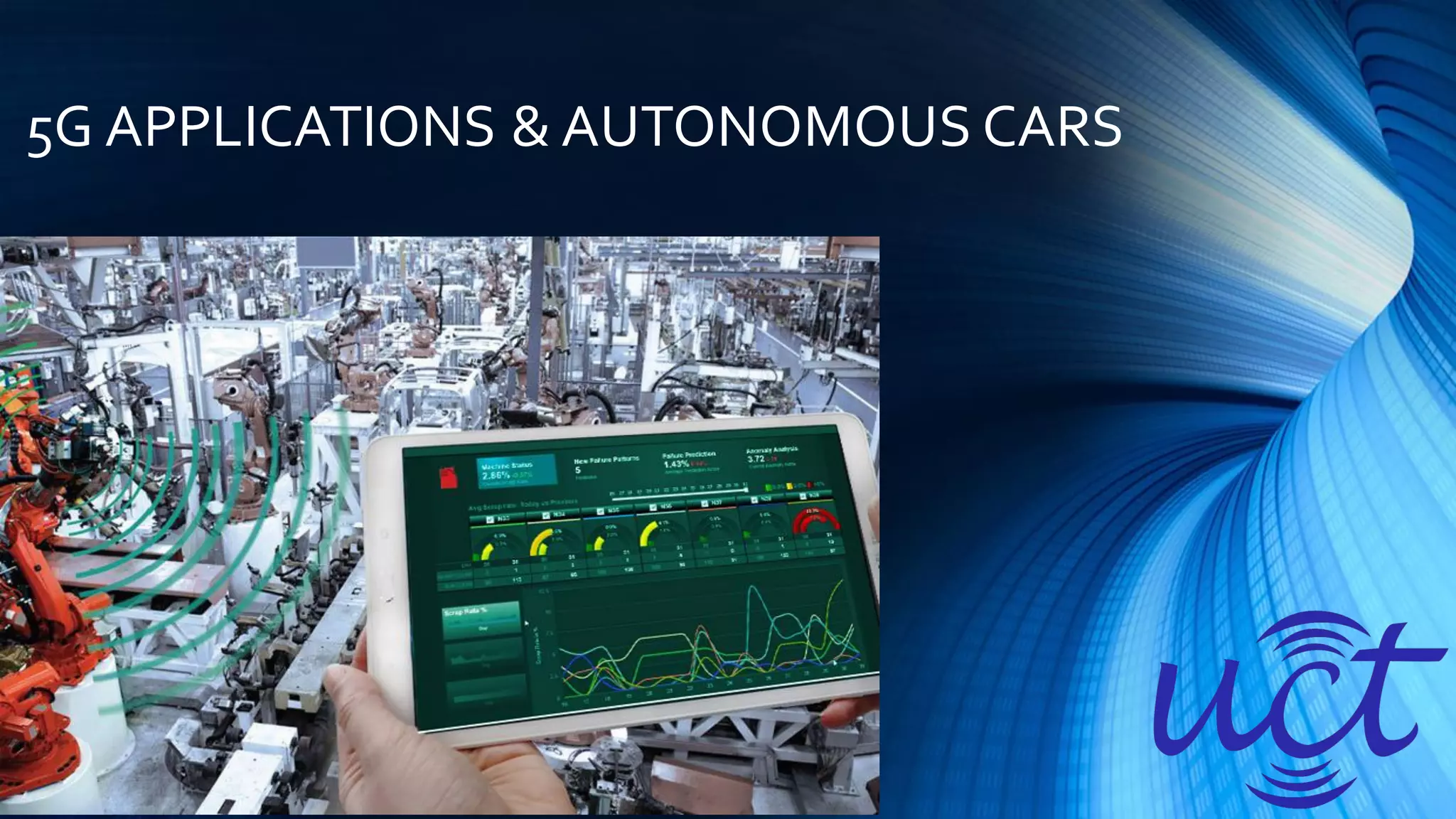






5G APPLICATIONS & AUTONOMOUS CARS
About Myself
• IIT KanpurAlumnus
• 19+ year Industry experience
• Presently working as Director at UniConvergeTechnologies Pvt. Ltd.
(UCT)
• Chief Mentor ofThe IoT Academy “Skill development andTrainings”
• Worked with many MNCs
• Ericsson AB, Sweden (for 7 years)
• STMicroelectronics Pvt. Ltd, Noida
• UbiNetics India Pvt Ltd, Bangalore
• SASKENCommunicationTech., Bangalore
What to discuss today?
• Evolution from 1G to 5G
• Driving/Motivational factors
• Key concepts of 5G
• 5GApplications
• 5GArchitecture
• Present status of 5G worldwide and in India
• Conclusion
• Q&A
3
Evolution from 1G to 5G
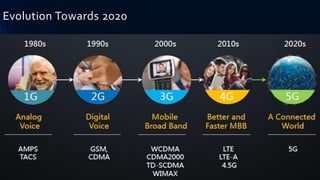
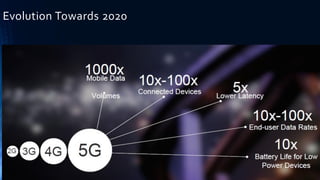
Evolution Towards 2020
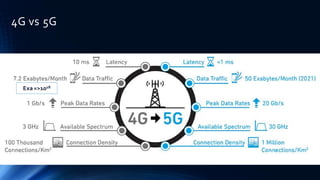
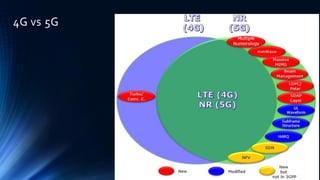
4G vs 5G
Exa =>1018
4G vs 5G
Driving/ Motivational factors
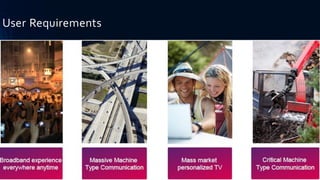
User Requirements
The Economic and Political needs for 5G
• OECD (Committee on Digital Economic Policy) has stated clear
objectives for 5G:
• IncreasingGDP
• Creating employment
• Digitizing the economy
• EuropeanCommission (Digital Single Market) also sets clear
objectives for 5G:
• Digital Transformation of Industry
• Maximising economic growth
• Note:These aims will only be achievable if 5G is designed
such that it meets the requirements of all industry sectors
The Technical Needs for 5G
• Existing 3GPP technologies are capable of meeting todays
needs, but:
• First LTE networks were deployed 8 years ago
• Data consumption continues to grow as consumers make more use
of mobile broadband services
• The “Internet ofThings” will result in billions of connected devices
• New (and unforeseen) users of 3GPP technologies continue to
emerge (e.g., public safety and automotive)
• There is a constant demand to improve spectrum and energy
efficiency and to leverage the benefits of modern research
• It takes several years to design and build a next generation
system (and even longer to obtain spectrum)
Key takeaways
There are economic, political and
technicalneeds for 5G
Existing technologiesare capable of
satisfying today’srequirementsbut
not those of tomorrow
It takes a long time to design and
builda next generationsystem
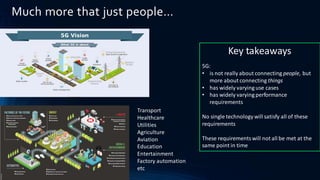
Much more that just people…
Transport
Healthcare
Utilities
Agriculture
Aviation
Education
Entertainment
Factory automation
etc
Key takeaways
5G:
• is not really about connecting people, but
more about connecting things
• has widely varying use cases
• has widely varying performance
requirements
No single technology will satisfy all of these
requirements
These requirementswill not all be met at the
same point in time
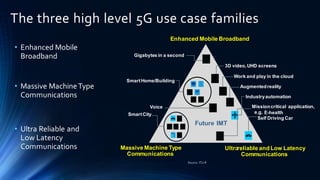
The three high level 5G use case families
• Enhanced Mobile
Broadband
• Massive MachineType
Communications
• Ultra Reliable and
Low Latency
Communications
Source: ITU-R
Enhanced Mobile Broadband
Massive Machine Type
Communications
Ultra-reliable and Low Latency
Communications
3D video,UHD screens
SmartCity
Industryautomation
Gigabytes in a second
Self Driving Car
Augmentedreality
SmartHome/Building
Work and play in the cloud
Voice Missioncritical application,
e.g. E-health
Future IMT
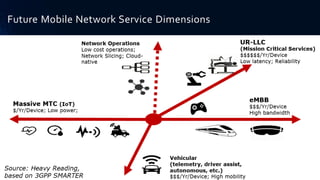
Future Mobile Network Service Dimensions
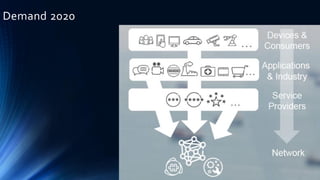
Demand 2020
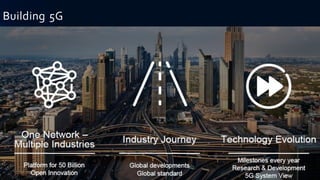
Building 5G
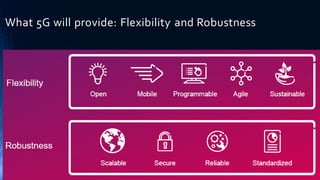
What 5G will provide: Flexibility and Robustness
Flexibility and Robustness
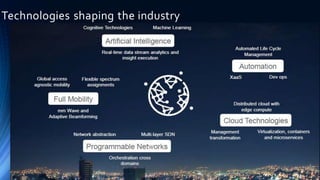
Technologies shaping the industry
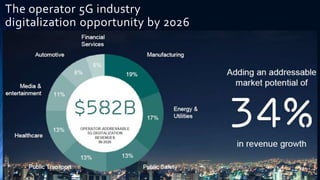
The operator 5G industry
digitalization opportunity by 2026
The operator 5G industry
digitalization opportunity by 2026
Performance Requirements
To meet these requirements, 3GPP will specify:
• a new radio interface (NR)
• an evolved LTE radio interface
• a new core network (NextGen)
• An evolved LTE core network (EPC)
Use Case order of priority:
First: Enhanced Mobile Broadband and some Ultra Reliable/Low Latency
functionality
Later: Massive Machine Type communicationsand more comprehensive Ultra
Reliable/Low Latency functionality
5G Architecture
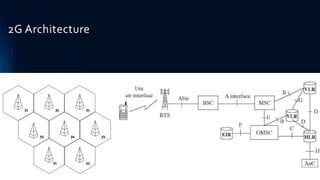
2G Architecture
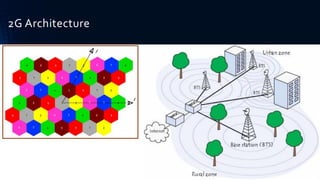
2G Architecture
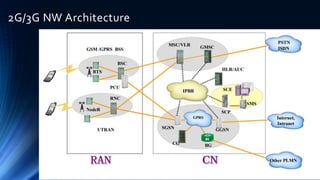
2G/3G NW Architecture
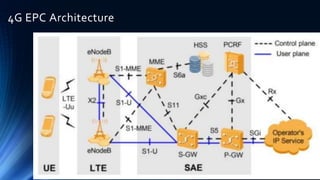
4G EPC Architecture
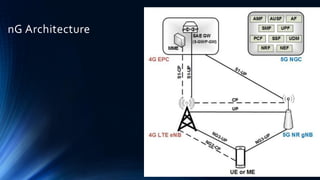
nG Architecture
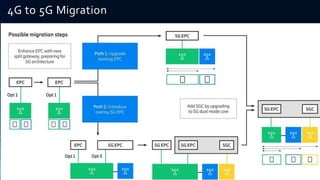
4G to 5G Migration
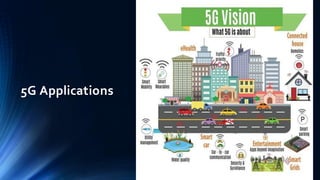
5G Applications
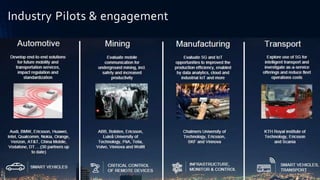
Industry Pilots & engagement
The operator 5G industry
digitalization opportunity by 2026
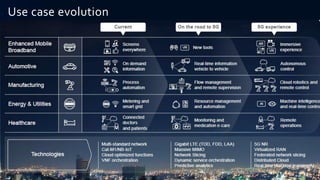
Use case evolution
The operator 5G industry
digitalization opportunity by 2026
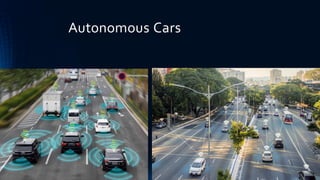
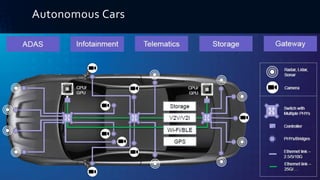
Autonomous Cars
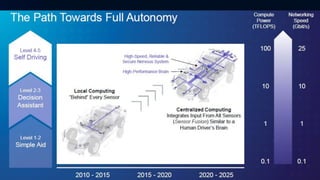
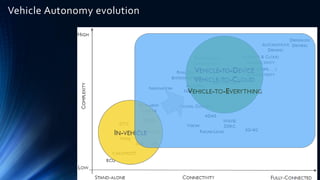
Vehicle Autonomy evolution
Autonomous Cars
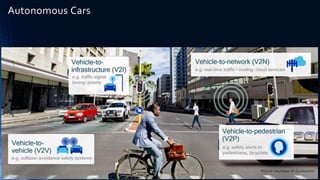
Autonomous Cars
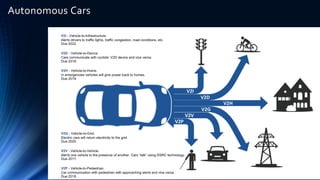
Autonomous Cars
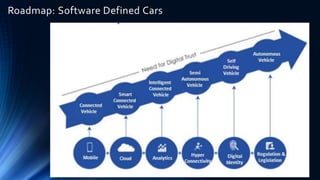
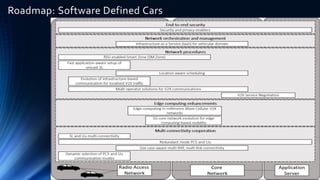
Roadmap: Software Defined Cars
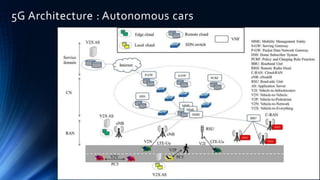
5G Architecture : Autonomous cars
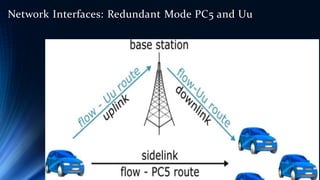
Network Interfaces: Redundant Mode PC5 and Uu
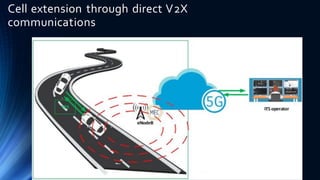
Cell extension through direct V2X
communications
5G Key Concepts
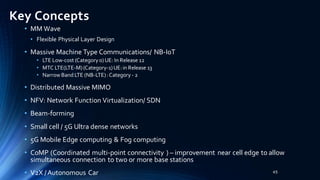
Key Concepts
• MM Wave
• Flexible Physical Layer Design
• Massive Machine Type Communications/ NB-IoT
• LTE Low-cost (Category 0)UE: In Release 12
• MTC LTE(LTE-M)(Category-1)UE:in Release 13
• Narrow Band LTE (NB-LTE):Category - 2
• Distributed Massive MIMO
• NFV: Network Function Virtualization/ SDN
• Beam-forming
• Small cell / 5G Ultra dense networks
• 5G Mobile Edge computing & Fog computing
• CoMP (Coordinated multi-point connectivity ) – improvement near cell edge to allow
simultaneous connection to two or more base stations
• V2X /Autonomous Car 45
5G Deployment
When will 5G be ready?
• 2020 is the headline date for 5G
• This date has been chosen more for political rather than technical reasons
• It is also happens to coincide with the Olympic Games in Japan,July 2020
• However, there is a push to bring the date forward because of:
• MobileOperator rush “to be the first”
• Winter OlympicGamesheldin Korea, February 2018 showcased5G
• RugbyWorldCup to be held in Japan, September 2019
• 5G OpenTrial Specification Alliance formed by SKTelecom, KT, NTT DoCoMo and
Verizon:
• To speed up deployment&To meet the early deployment objective
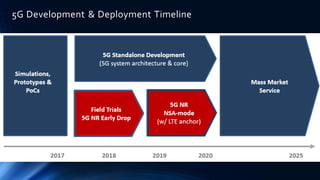
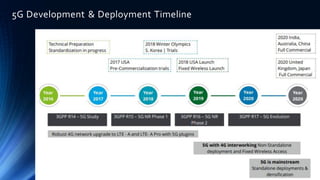
5G Development & Deployment Timeline
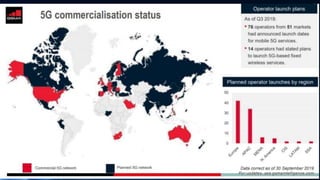
Present status of 5G worldwide and in India
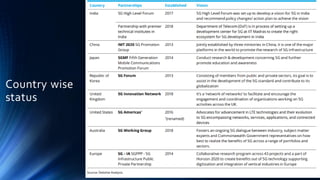
Country wise
status
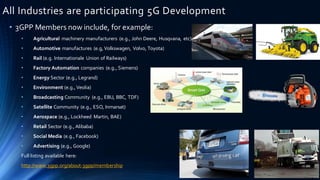
All Industries are participating 5G Development
• 3GPP Members now include, for example:
• Agricultural machinery manufacturers (e.g., John Deere, Husqvana, etc)
• Automotive manufactures (e.g, Volkswagen, Volvo, Toyota)
• Rail (e.g. Internationale Union of Railways)
• Factory Automation companies (e.g., Siemens)
• Energy Sector (e.g., Legrand)
• Environment (e.g., Veolia)
• Broadcasting Community (e.g., EBU, BBC, TDF)
• Satellite Community (e.g., ESO, Inmarsat)
• Aerospace (e.g., Lockheed Martin, BAE)
• Retail Sector (e.g., Alibaba)
• Social Media (e.g., Facebook)
• Advertising (e.g., Google)
Full listing available here:
http://www.3gpp.org/about-3gpp/membership
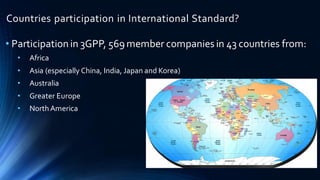
Countries participation in International Standard?
• Participationin 3GPP, 569member companies in 43 countries from:
• Africa
• Asia (especially China, India, Japan and Korea)
• Australia
• Greater Europe
• North America
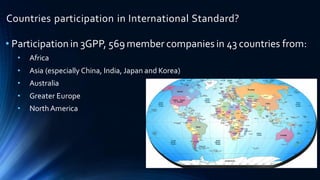
Countries participation in International Standard?
• Participationin 3GPP, 569 member companies in 43 countries from:
• Africa
• Asia (especially China, India, Japan and Korea)
• Australia
• Greater Europe
• North America
Barriers to success - Conclusion
• For 5G to be successful,the telco industry must engage with other industry sectors
such as transport, healthcare, mining and exploration, utilities, agriculture, aviation
(drones), entertainment, factory automation, etc.
• We cannot expect them to come to us, we must be prepared to go to them and to meet
them on level terms
• Various political,strategicand tacticalchallengesthat can hold backdeploymentof 5G
networks.
• Spectrum issuesWe have seen above how the use of higherfrequenciesis a major part of 5G
development. However, those frequencies – as with allradio spectrum – constitute a valuable
resource over which differentcompetinginterests have a claim.The wireless telecomsservices
communityneeds to make a compellingcasefor accessto those frequenciesinthe face of
competitionfrom existingusers.
• BusinessCase: Defining5G is a particularlydifficultchallengeasit is not yet clear whether an air-
interface-based,technologydefinitionora service-orienteddefinitionmakesmost sense
• Within each Government, 5G must be coordinated across all ministries (e.g., transport,
health, industry etc) and not justwithin a communications or ICT ministry
• Optical Fiber backhaul
• Small cell deployment challenges
UCT 4G-5G Setup
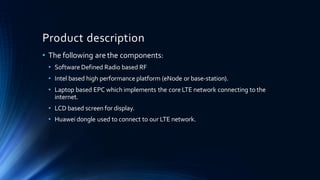
Product description
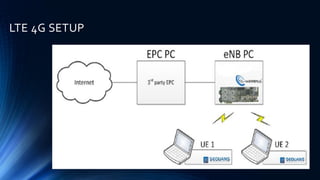
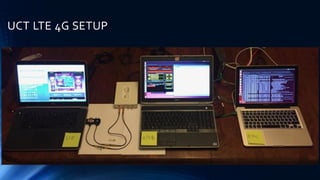
• The following are the components:
• Software Defined Radio based RF
• Intel based high performance platform (eNode or base-station).
• Laptop based EPC which implements the core LTE network connecting to the
internet.
• LCD based screen for display.
• Huawei dongle used to connect to our LTE network.
LTE 4G SETUP
UCT LTE 4G SETUP
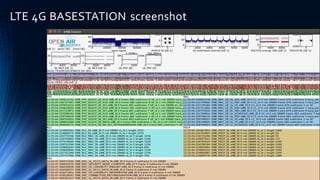
LTE 4G BASESTATION screenshot
THANKS
UniConverge Technologies Pvt. Ltd.
(www.uniconvergetech.in)
&
The IoT Academy
(www.theiotacademy.co)
C56/11, Sector-62, Noida

Uct 5G Autonomous Cars

  • 1.
    5G APPLICATIONS &AUTONOMOUS CARS
  • 2.
    About Myself • IITKanpurAlumnus • 19+ year Industry experience • Presently working as Director at UniConvergeTechnologies Pvt. Ltd. (UCT) • Chief Mentor ofThe IoT Academy “Skill development andTrainings” • Worked with many MNCs • Ericsson AB, Sweden (for 7 years) • STMicroelectronics Pvt. Ltd, Noida • UbiNetics India Pvt Ltd, Bangalore • SASKENCommunicationTech., Bangalore
  • 3.
    What to discusstoday? • Evolution from 1G to 5G • Driving/Motivational factors • Key concepts of 5G • 5GApplications • 5GArchitecture • Present status of 5G worldwide and in India • Conclusion • Q&A 3
  • 4.
  • 5.
  • 6.
  • 7.
  • 8.
  • 9.
  • 10.
  • 11.
    The Economic andPolitical needs for 5G • OECD (Committee on Digital Economic Policy) has stated clear objectives for 5G: • IncreasingGDP • Creating employment • Digitizing the economy • EuropeanCommission (Digital Single Market) also sets clear objectives for 5G: • Digital Transformation of Industry • Maximising economic growth • Note:These aims will only be achievable if 5G is designed such that it meets the requirements of all industry sectors
  • 12.
    The Technical Needsfor 5G • Existing 3GPP technologies are capable of meeting todays needs, but: • First LTE networks were deployed 8 years ago • Data consumption continues to grow as consumers make more use of mobile broadband services • The “Internet ofThings” will result in billions of connected devices • New (and unforeseen) users of 3GPP technologies continue to emerge (e.g., public safety and automotive) • There is a constant demand to improve spectrum and energy efficiency and to leverage the benefits of modern research • It takes several years to design and build a next generation system (and even longer to obtain spectrum) Key takeaways There are economic, political and technicalneeds for 5G Existing technologiesare capable of satisfying today’srequirementsbut not those of tomorrow It takes a long time to design and builda next generationsystem
  • 13.
    Much more thatjust people… Transport Healthcare Utilities Agriculture Aviation Education Entertainment Factory automation etc Key takeaways 5G: • is not really about connecting people, but more about connecting things • has widely varying use cases • has widely varying performance requirements No single technology will satisfy all of these requirements These requirementswill not all be met at the same point in time
  • 14.
    The three highlevel 5G use case families • Enhanced Mobile Broadband • Massive MachineType Communications • Ultra Reliable and Low Latency Communications Source: ITU-R Enhanced Mobile Broadband Massive Machine Type Communications Ultra-reliable and Low Latency Communications 3D video,UHD screens SmartCity Industryautomation Gigabytes in a second Self Driving Car Augmentedreality SmartHome/Building Work and play in the cloud Voice Missioncritical application, e.g. E-health Future IMT
  • 15.
    Future Mobile NetworkService Dimensions
  • 16.
  • 17.
  • 18.
    What 5G willprovide: Flexibility and Robustness
  • 19.
  • 20.
  • 21.
    The operator 5Gindustry digitalization opportunity by 2026 The operator 5G industry digitalization opportunity by 2026
  • 22.
    Performance Requirements To meetthese requirements, 3GPP will specify: • a new radio interface (NR) • an evolved LTE radio interface • a new core network (NextGen) • An evolved LTE core network (EPC) Use Case order of priority: First: Enhanced Mobile Broadband and some Ultra Reliable/Low Latency functionality Later: Massive Machine Type communicationsand more comprehensive Ultra Reliable/Low Latency functionality
  • 23.
  • 24.
  • 25.
  • 26.
  • 27.
  • 28.
  • 29.
    4G to 5GMigration
  • 30.
  • 31.
    Industry Pilots &engagement The operator 5G industry digitalization opportunity by 2026
  • 32.
    Use case evolution Theoperator 5G industry digitalization opportunity by 2026
  • 33.
  • 35.
  • 36.
  • 37.
  • 38.
  • 39.
  • 40.
  • 41.
    5G Architecture :Autonomous cars
  • 42.
  • 43.
    Cell extension throughdirect V2X communications
  • 44.
  • 45.
    Key Concepts • MMWave • Flexible Physical Layer Design • Massive Machine Type Communications/ NB-IoT • LTE Low-cost (Category 0)UE: In Release 12 • MTC LTE(LTE-M)(Category-1)UE:in Release 13 • Narrow Band LTE (NB-LTE):Category - 2 • Distributed Massive MIMO • NFV: Network Function Virtualization/ SDN • Beam-forming • Small cell / 5G Ultra dense networks • 5G Mobile Edge computing & Fog computing • CoMP (Coordinated multi-point connectivity ) – improvement near cell edge to allow simultaneous connection to two or more base stations • V2X /Autonomous Car 45
  • 46.
  • 47.
    When will 5Gbe ready? • 2020 is the headline date for 5G • This date has been chosen more for political rather than technical reasons • It is also happens to coincide with the Olympic Games in Japan,July 2020 • However, there is a push to bring the date forward because of: • MobileOperator rush “to be the first” • Winter OlympicGamesheldin Korea, February 2018 showcased5G • RugbyWorldCup to be held in Japan, September 2019 • 5G OpenTrial Specification Alliance formed by SKTelecom, KT, NTT DoCoMo and Verizon: • To speed up deployment&To meet the early deployment objective
  • 48.
    5G Development &Deployment Timeline
  • 49.
    5G Development &Deployment Timeline
  • 50.
    Present status of5G worldwide and in India
  • 51.
  • 52.
    All Industries areparticipating 5G Development • 3GPP Members now include, for example: • Agricultural machinery manufacturers (e.g., John Deere, Husqvana, etc) • Automotive manufactures (e.g, Volkswagen, Volvo, Toyota) • Rail (e.g. Internationale Union of Railways) • Factory Automation companies (e.g., Siemens) • Energy Sector (e.g., Legrand) • Environment (e.g., Veolia) • Broadcasting Community (e.g., EBU, BBC, TDF) • Satellite Community (e.g., ESO, Inmarsat) • Aerospace (e.g., Lockheed Martin, BAE) • Retail Sector (e.g., Alibaba) • Social Media (e.g., Facebook) • Advertising (e.g., Google) Full listing available here: http://www.3gpp.org/about-3gpp/membership
  • 53.
    Countries participation inInternational Standard? • Participationin 3GPP, 569member companies in 43 countries from: • Africa • Asia (especially China, India, Japan and Korea) • Australia • Greater Europe • North America
  • 54.
    Countries participation inInternational Standard? • Participationin 3GPP, 569 member companies in 43 countries from: • Africa • Asia (especially China, India, Japan and Korea) • Australia • Greater Europe • North America
  • 56.
    Barriers to success- Conclusion • For 5G to be successful,the telco industry must engage with other industry sectors such as transport, healthcare, mining and exploration, utilities, agriculture, aviation (drones), entertainment, factory automation, etc. • We cannot expect them to come to us, we must be prepared to go to them and to meet them on level terms • Various political,strategicand tacticalchallengesthat can hold backdeploymentof 5G networks. • Spectrum issuesWe have seen above how the use of higherfrequenciesis a major part of 5G development. However, those frequencies – as with allradio spectrum – constitute a valuable resource over which differentcompetinginterests have a claim.The wireless telecomsservices communityneeds to make a compellingcasefor accessto those frequenciesinthe face of competitionfrom existingusers. • BusinessCase: Defining5G is a particularlydifficultchallengeasit is not yet clear whether an air- interface-based,technologydefinitionora service-orienteddefinitionmakesmost sense • Within each Government, 5G must be coordinated across all ministries (e.g., transport, health, industry etc) and not justwithin a communications or ICT ministry • Optical Fiber backhaul • Small cell deployment challenges
  • 57.
  • 58.
    Product description • Thefollowing are the components: • Software Defined Radio based RF • Intel based high performance platform (eNode or base-station). • Laptop based EPC which implements the core LTE network connecting to the internet. • LCD based screen for display. • Huawei dongle used to connect to our LTE network.
  • 59.
  • 60.
  • 61.
  • 62.
    THANKS UniConverge Technologies Pvt.Ltd. (www.uniconvergetech.in) & The IoT Academy (www.theiotacademy.co) C56/11, Sector-62, Noida