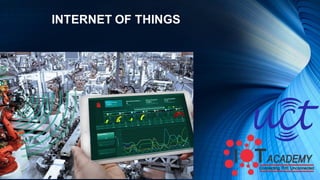












INTERNET OF THINGS
Agenda
•Introduction of IoT
•IoT Architecture
•IoT Applications
•IoT DeploymentChallenges
•Careers and Needed skills
•HowUCT is using IoT in it’s Products
•Q&A
2
Introduction to IoT
3
4
IoT is not a technology
it’s a complex ecosystem
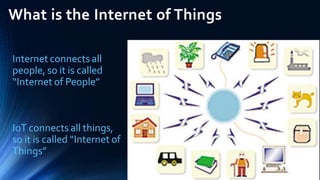
What is the Internet of Things
Internet connects all
people, so it is called
“Internet of People”
IoT connects all things,
so it is called “Internet of
Things”
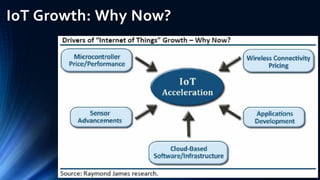
IoT Growth: Why Now?
Goal of IoT
• The IoT allows objects to be sensed or controlled remotely
across existing network infrastructure.
• Creating opportunities for direct integration of the physical
world into computer-based systems.
• Improve efficiency,accuracy and economicbenefit in
addition to reduced human intervention.
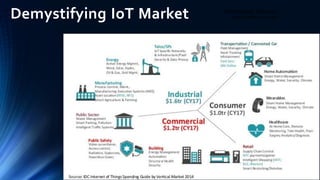
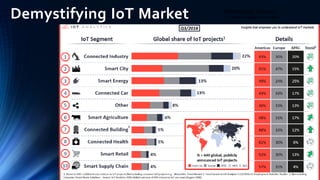
Demystifying IoT Market Information Security
Office of Budget and Finance
Demystifying IoT Market Information Security
Office of Budget and Finance
IoT Architecture
10
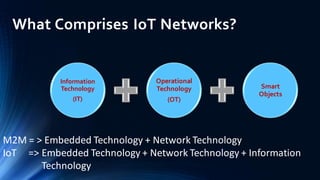
What Comprises IoT Networks?
Information
Technology
(IT)
Operational
Technology
(OT)
Smart
Objects
M2M = > Embedded Technology + Network Technology
IoT => Embedded Technology + Network Technology + Information
Technology
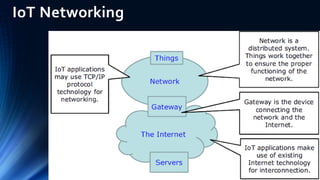
IoT Networking
12
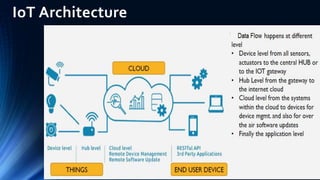
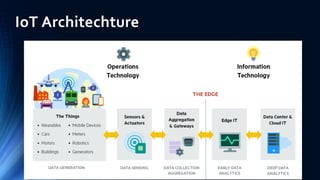
IoT Architecture
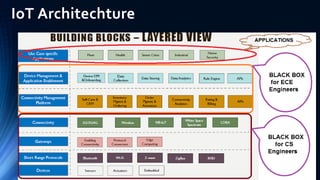
IoT Architechture
IoT Architechture
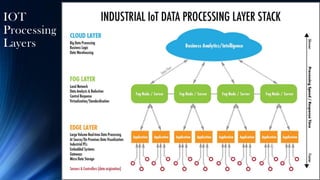
IOT
Processing
Layers
Education – Partnership – Solutions
Information Security
Office of Budget and Finance
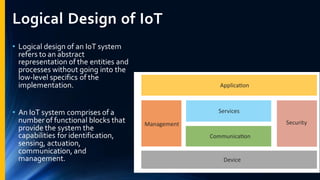
Logical Design of IoT
• Logical design of an IoT system
refers to an abstract
representation of the entities and
processes without going into the
low-level specifics of the
implementation.
• An IoT system comprises of a
number of functional blocks that
provide the system the
capabilities for identification,
sensing, actuation,
communication, and
management.
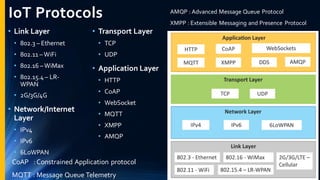
IoT Protocols
• Link Layer
• 802.3 – Ethernet
• 802.11 –WiFi
• 802.16 –WiMax
• 802.15.4 – LR-
WPAN
• 2G/3G/4G
• Network/Internet
Layer
• IPv4
• IPv6
• 6LoWPAN
• Transport Layer
• TCP
• UDP
• Application Layer
• HTTP
• CoAP
• WebSocket
• MQTT
• XMPP
• AMQP
CoAP : Constrained Application protocol
MQTT : Message Queue Telemetry
AMQP : Advanced Message Queue Protocol
XMPP : Extensible Messaging and Presence Protocol
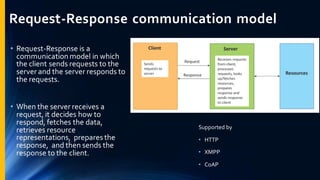
Request-Response communication model
• Request-Response is a
communication model in which
the client sends requests to the
server and the server responds to
the requests.
• When the server receives a
request, it decides how to
respond, fetches the data,
retrieves resource
representations, prepares the
response, and then sends the
response to the client.
Supported by
• HTTP
• XMPP
• CoAP
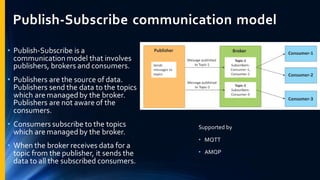
Publish-Subscribe communication model
• Publish-Subscribe is a
communication model that involves
publishers, brokers and consumers.
• Publishers are the source of data.
Publishers send the data to the topics
which are managed by the broker.
Publishers are not aware of the
consumers.
• Consumers subscribe to the topics
which are managed by the broker.
• When the broker receives data for a
topic from the publisher, it sends the
data to all the subscribed consumers.
Supported by
• MQTT
• AMQP
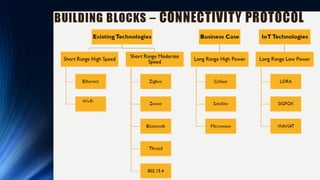
IoT Connectivity
21
22
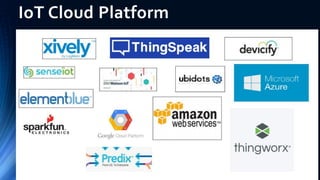
IoT Cloud Platform
23
IoT Cloud Platform
24
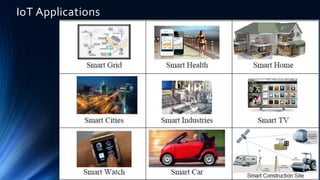
IoT Applications
25
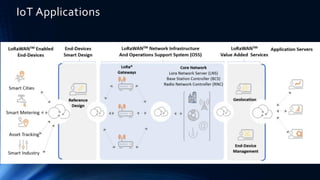
IoT Applications
IoT Applications
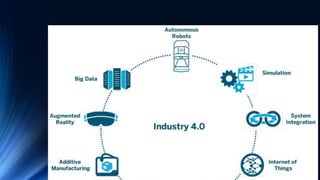
IoT and Manufacturing Processes
IoT will generate 4 primary forms of value in terms of
manufacturing processes:
• Supply Chain Management;
• Operating Efficiency;
• Predictive Maintenance;
• Inventory Optimization.
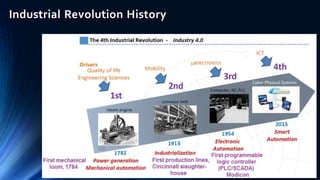
Industrial Revolution
29
Industrial Revolution History
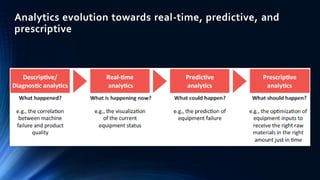
Analytics evolution towards real-time, predictive, and
prescriptive
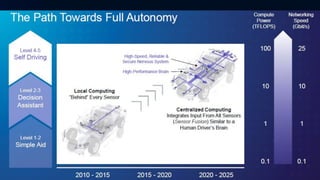
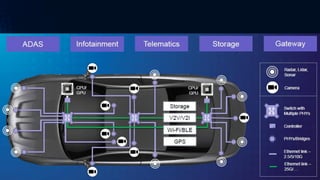
Autonomous Cars
33
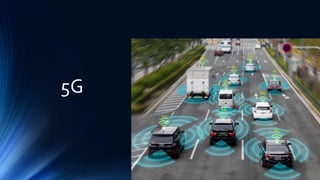
5G
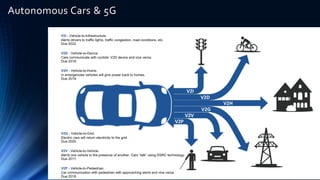
Autonomous Cars & 5G
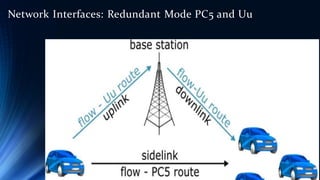
Network Interfaces: Redundant Mode PC5 and Uu
IoT Deployment Challenges
• Global cooperation
• Proprietary and incompatible protocols
• Lack ofAPIs
• Example:Common external power supply
• Technological challenges
• Power usage
• Scalability
• Security
• Latency
• Communication mechanisms
Challenges
• IoT suffers from “Chicken-and-Egg” Challenges e.g.,The success of many
IoT apps depends on the success of complementary technologies/systems
(e.g., energy/transit).
• Interoperability and Standards-Setting Issues e.g. Governments have an
important coordinating role to play in developing large-scale deployments
of sensor networks and smart infrastructure that spans multiple
jurisdictions.
• Ensuring adequate radio spectrum and coherent regulatory approach.
IoT Data- Challenges
• Multi-modal and heterogeneous
• Noisy and incomplete
• Time and location dependent
• Dynamic and varies in quality
• Crowed sourced data can be unreliable
• Requires (near-) real-time analysis
• Privacy and security are important issues
• Data can be biased- we need to know our data!
41
• Are they important?
• What is the risk?
• What are the challenges?
• Device level
• Network level
• System level
• User level
• Solutions?
Security & Privacy
42
Careers and Needed skills
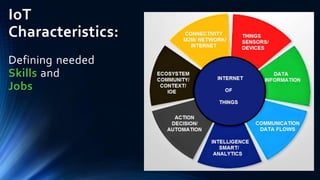
IoT
Characteristics:
Defining needed
Skills and
Jobs
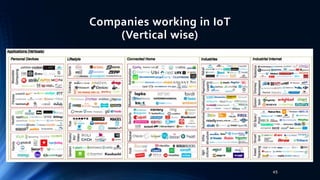
Companies working in IoT
(Vertical wise)
45
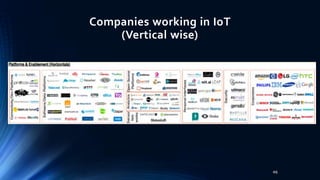
Companies working in IoT
(Vertical wise)
46
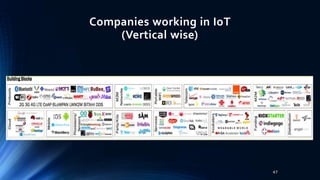
Companies working in IoT
(Vertical wise)
47
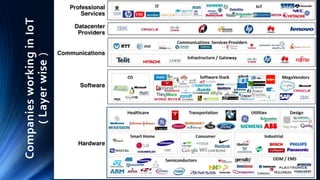
48
CompaniesworkinginIoT
(Layerwise)
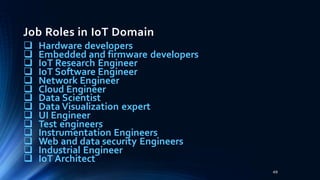
Job Roles in IoT Domain
49
 Hardware developers
 Embedded and firmware developers
 IoT Research Engineer
 IoT Software Engineer
 Network Engineer
 Cloud Engineer
 Data Scientist
 Data Visualization expert
 UI Engineer
 Test engineers
 Instrumentation Engineers
 Web and data security Engineers
 Industrial Engineer
 IoT Architect
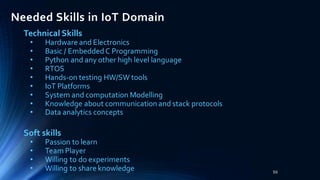
Needed Skills in IoT Domain
50
Technical Skills
• Hardware and Electronics
• Basic / Embedded C Programming
• Python and any other high level language
• RTOS
• Hands-on testing HW/SW tools
• IoT Platforms
• System and computation Modelling
• Knowledge about communication and stack protocols
• Data analytics concepts
Soft skills
• Passion to learn
• Team Player
• Willing to do experiments
• Willing to share knowledge
How UCT is using IoT in it’s Products
52
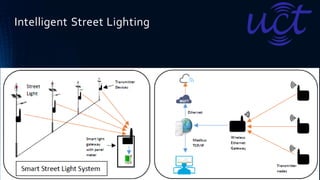
Intelligent Street Lighting
53
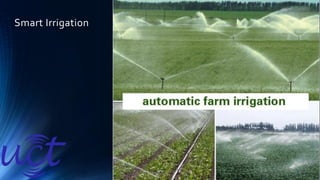
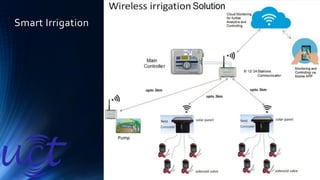
Smart Irrigation
54
Smart Irrigation
55
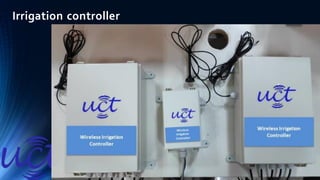
Irrigation controller
56
Irrigation controller
57
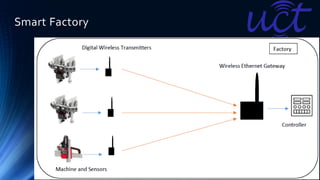
Smart Factory
58
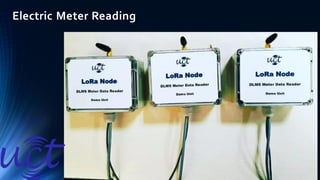
Electric Meter Reading
59
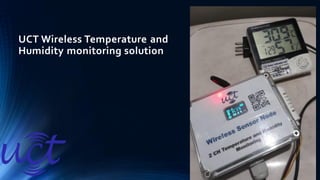
UCT Wireless Temperature and
Humidity monitoring solution
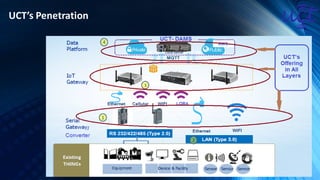
UCT’s Penetration
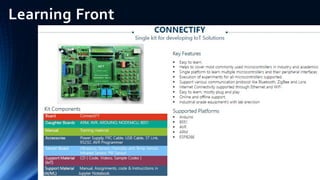
Learning Front
Learning Front
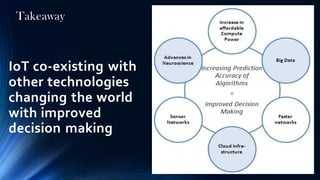
IoT co-existing with
other technologies
changing the world
with improved
decision making
63
Takeaway
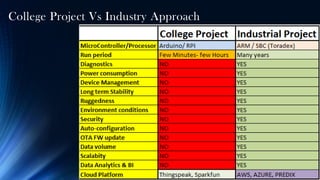
College Project Vs Industry Approach
Takeaway
• If misunderstood and misconfigured, IoT poses risk to our data, privacy,
and safety
• If understood and secured, IoT will enhance communications, lifestyle, and
delivery of services
• Look out the challenges in the job market and be better prepared for
upcoming opportunities
THANKS
UniConverge Technologies Pvt. Ltd.
(www.uniconvergetech.in)
&
The IoT Academy
(www.theiotacademy.co)
C56/11, Sector-62, Noida

IoT Introduction Architecture and Applications

  • 1.
  • 2.
    Agenda •Introduction of IoT •IoTArchitecture •IoT Applications •IoT DeploymentChallenges •Careers and Needed skills •HowUCT is using IoT in it’s Products •Q&A 2
  • 3.
  • 4.
    4 IoT is nota technology it’s a complex ecosystem
  • 5.
    What is theInternet of Things Internet connects all people, so it is called “Internet of People” IoT connects all things, so it is called “Internet of Things”
  • 6.
  • 7.
    Goal of IoT •The IoT allows objects to be sensed or controlled remotely across existing network infrastructure. • Creating opportunities for direct integration of the physical world into computer-based systems. • Improve efficiency,accuracy and economicbenefit in addition to reduced human intervention.
  • 8.
    Demystifying IoT MarketInformation Security Office of Budget and Finance
  • 9.
    Demystifying IoT MarketInformation Security Office of Budget and Finance
  • 10.
  • 11.
    What Comprises IoTNetworks? Information Technology (IT) Operational Technology (OT) Smart Objects M2M = > Embedded Technology + Network Technology IoT => Embedded Technology + Network Technology + Information Technology
  • 12.
  • 13.
  • 14.
  • 15.
  • 16.
    IOT Processing Layers Education – Partnership– Solutions Information Security Office of Budget and Finance
  • 17.
    Logical Design ofIoT • Logical design of an IoT system refers to an abstract representation of the entities and processes without going into the low-level specifics of the implementation. • An IoT system comprises of a number of functional blocks that provide the system the capabilities for identification, sensing, actuation, communication, and management.
  • 18.
    IoT Protocols • LinkLayer • 802.3 – Ethernet • 802.11 –WiFi • 802.16 –WiMax • 802.15.4 – LR- WPAN • 2G/3G/4G • Network/Internet Layer • IPv4 • IPv6 • 6LoWPAN • Transport Layer • TCP • UDP • Application Layer • HTTP • CoAP • WebSocket • MQTT • XMPP • AMQP CoAP : Constrained Application protocol MQTT : Message Queue Telemetry AMQP : Advanced Message Queue Protocol XMPP : Extensible Messaging and Presence Protocol
  • 19.
    Request-Response communication model •Request-Response is a communication model in which the client sends requests to the server and the server responds to the requests. • When the server receives a request, it decides how to respond, fetches the data, retrieves resource representations, prepares the response, and then sends the response to the client. Supported by • HTTP • XMPP • CoAP
  • 20.
    Publish-Subscribe communication model •Publish-Subscribe is a communication model that involves publishers, brokers and consumers. • Publishers are the source of data. Publishers send the data to the topics which are managed by the broker. Publishers are not aware of the consumers. • Consumers subscribe to the topics which are managed by the broker. • When the broker receives data for a topic from the publisher, it sends the data to all the subscribed consumers. Supported by • MQTT • AMQP
  • 21.
  • 22.
  • 23.
  • 24.
  • 25.
  • 26.
  • 27.
  • 28.
    IoT and ManufacturingProcesses IoT will generate 4 primary forms of value in terms of manufacturing processes: • Supply Chain Management; • Operating Efficiency; • Predictive Maintenance; • Inventory Optimization.
  • 29.
  • 30.
  • 31.
    Analytics evolution towardsreal-time, predictive, and prescriptive
  • 33.
  • 36.
  • 37.
  • 38.
  • 39.
    IoT Deployment Challenges •Global cooperation • Proprietary and incompatible protocols • Lack ofAPIs • Example:Common external power supply • Technological challenges • Power usage • Scalability • Security • Latency • Communication mechanisms
  • 40.
    Challenges • IoT suffersfrom “Chicken-and-Egg” Challenges e.g.,The success of many IoT apps depends on the success of complementary technologies/systems (e.g., energy/transit). • Interoperability and Standards-Setting Issues e.g. Governments have an important coordinating role to play in developing large-scale deployments of sensor networks and smart infrastructure that spans multiple jurisdictions. • Ensuring adequate radio spectrum and coherent regulatory approach.
  • 41.
    IoT Data- Challenges •Multi-modal and heterogeneous • Noisy and incomplete • Time and location dependent • Dynamic and varies in quality • Crowed sourced data can be unreliable • Requires (near-) real-time analysis • Privacy and security are important issues • Data can be biased- we need to know our data! 41
  • 42.
    • Are theyimportant? • What is the risk? • What are the challenges? • Device level • Network level • System level • User level • Solutions? Security & Privacy 42
  • 43.
  • 44.
  • 45.
    Companies working inIoT (Vertical wise) 45
  • 46.
    Companies working inIoT (Vertical wise) 46
  • 47.
    Companies working inIoT (Vertical wise) 47
  • 48.
  • 49.
    Job Roles inIoT Domain 49  Hardware developers  Embedded and firmware developers  IoT Research Engineer  IoT Software Engineer  Network Engineer  Cloud Engineer  Data Scientist  Data Visualization expert  UI Engineer  Test engineers  Instrumentation Engineers  Web and data security Engineers  Industrial Engineer  IoT Architect
  • 50.
    Needed Skills inIoT Domain 50 Technical Skills • Hardware and Electronics • Basic / Embedded C Programming • Python and any other high level language • RTOS • Hands-on testing HW/SW tools • IoT Platforms • System and computation Modelling • Knowledge about communication and stack protocols • Data analytics concepts Soft skills • Passion to learn • Team Player • Willing to do experiments • Willing to share knowledge
  • 51.
    How UCT isusing IoT in it’s Products
  • 52.
  • 53.
  • 54.
  • 55.
  • 56.
  • 57.
  • 58.
  • 59.
    59 UCT Wireless Temperatureand Humidity monitoring solution
  • 60.
  • 61.
  • 62.
  • 63.
    IoT co-existing with othertechnologies changing the world with improved decision making 63 Takeaway
  • 64.
    College Project VsIndustry Approach
  • 65.
    Takeaway • If misunderstoodand misconfigured, IoT poses risk to our data, privacy, and safety • If understood and secured, IoT will enhance communications, lifestyle, and delivery of services • Look out the challenges in the job market and be better prepared for upcoming opportunities
  • 66.
    THANKS UniConverge Technologies Pvt.Ltd. (www.uniconvergetech.in) & The IoT Academy (www.theiotacademy.co) C56/11, Sector-62, Noida