MACHINE VISION SYSTEM
S.VEDANARAYANA
16751A0328
MECHANICAL
MACHINE VISION
 Machine vision system may be defined as a means of electro-
optically simulating the image recognition capability of the
human eye/brain system.
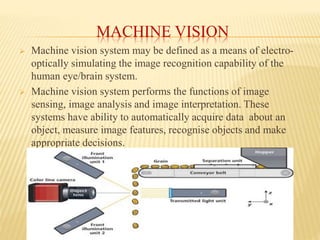
 Machine vision system performs the functions of image
sensing, image analysis and image interpretation. These
systems have ability to automatically acquire data about an
object, measure image features, recognise objects and make
appropriate decisions.
PRINCIPLE OF WORKING
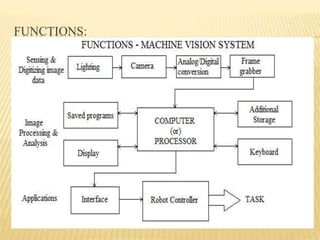
 A camera takes a picture of the object to be tested in the
presence of lens with suitable intensity of light source
and sends it to a computer for image processing.
 The computer will define and analyse the characteristics
of the image.
 After analysing the computer system will communicate
with rejection unit if any defects in the part, or else if it
is defect free it will send to the next station for
processing.
STEPS INVOLVED IN MACHINE VISION
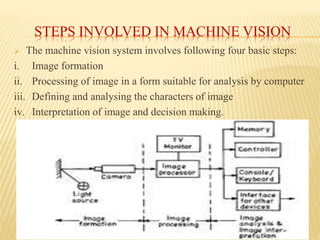
 The machine vision system involves following four basic steps:
i. Image formation
ii. Processing of image in a form suitable for analysis by computer
iii. Defining and analysing the characters of image
iv. Interpretation of image and decision making.
Image Formation:
 For formation of image suitable light source is required. Polarised
or Ultraviolet light is used to reduce glare or increase contrast.
 Light source is placed currently since it influences the contrast of
the image.
 Back lighting is suited when a simple image is required to obtain
maximum image contrast.
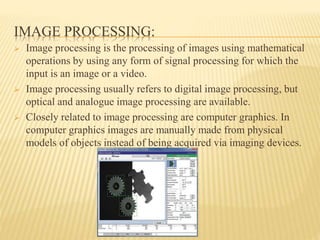
IMAGE PROCESSING:
 Image processing is the processing of images using mathematical
operations by using any form of signal processing for which the
input is an image or a video.
 Image processing usually refers to digital image processing, but
optical and analogue image processing are available.
 Closely related to image processing are computer graphics. In
computer graphics images are manually made from physical
models of objects instead of being acquired via imaging devices.
FUNCTIONS:
FIELDS OF MACHINE VISION SYSTEMS:
 The machine vision could be used for:
 Inspection: The ability of automated vision system to recognise
well defined patterns and determine if these patterns match those
stored in the system makes machine ideal for inspection of raw
materials, parts, assemblies etc.
 Part Identification: Machine vision system due to their ability of
part recognition provide positive identification of an object for
decision making purposes.
 Guidance and Control: Machine vision system are being used to
provide sensory feedback for real time guidance and control
applications, ranging from visual serving of industrial robots and
assembly operations.
APPLICATIONS:
 Quality Assurance: Metrology, Flaw deflection.
 Defect Detection: Foreign particles, contamination.
 Test & Calibration: Sensor calibration.
 Counting: Counting bottles or cans in a conveyer.
 Safety: Detect obstacles and alarm or stop.
 Gauging/ Metrology: Not Contact measurement.
 Robotic/Machine Guideline: Recognise, Locate, Guide.
 Machine Monitoring: Operation monitoring.
THANK YOU

Machine Vision System

  • 1.
  • 2.
    MACHINE VISION  Machinevision system may be defined as a means of electro- optically simulating the image recognition capability of the human eye/brain system.  Machine vision system performs the functions of image sensing, image analysis and image interpretation. These systems have ability to automatically acquire data about an object, measure image features, recognise objects and make appropriate decisions.
  • 3.
    PRINCIPLE OF WORKING A camera takes a picture of the object to be tested in the presence of lens with suitable intensity of light source and sends it to a computer for image processing.  The computer will define and analyse the characteristics of the image.  After analysing the computer system will communicate with rejection unit if any defects in the part, or else if it is defect free it will send to the next station for processing.
  • 4.
    STEPS INVOLVED INMACHINE VISION  The machine vision system involves following four basic steps: i. Image formation ii. Processing of image in a form suitable for analysis by computer iii. Defining and analysing the characters of image iv. Interpretation of image and decision making.
  • 5.
    Image Formation:  Forformation of image suitable light source is required. Polarised or Ultraviolet light is used to reduce glare or increase contrast.  Light source is placed currently since it influences the contrast of the image.  Back lighting is suited when a simple image is required to obtain maximum image contrast.
  • 6.
    IMAGE PROCESSING:  Imageprocessing is the processing of images using mathematical operations by using any form of signal processing for which the input is an image or a video.  Image processing usually refers to digital image processing, but optical and analogue image processing are available.  Closely related to image processing are computer graphics. In computer graphics images are manually made from physical models of objects instead of being acquired via imaging devices.
  • 7.
  • 8.
    FIELDS OF MACHINEVISION SYSTEMS:  The machine vision could be used for:  Inspection: The ability of automated vision system to recognise well defined patterns and determine if these patterns match those stored in the system makes machine ideal for inspection of raw materials, parts, assemblies etc.  Part Identification: Machine vision system due to their ability of part recognition provide positive identification of an object for decision making purposes.  Guidance and Control: Machine vision system are being used to provide sensory feedback for real time guidance and control applications, ranging from visual serving of industrial robots and assembly operations.
  • 9.
    APPLICATIONS:  Quality Assurance:Metrology, Flaw deflection.  Defect Detection: Foreign particles, contamination.  Test & Calibration: Sensor calibration.  Counting: Counting bottles or cans in a conveyer.  Safety: Detect obstacles and alarm or stop.  Gauging/ Metrology: Not Contact measurement.  Robotic/Machine Guideline: Recognise, Locate, Guide.  Machine Monitoring: Operation monitoring.
  • 10.