Sridhar Ratakonda
Founder, PredixDATA, LLC
http://www.predixdata.com
Machine learning /
Algorithms
&
Business use cases
What is Statistical learning?
Let’s say you want to associate sales based on advertising channel.
Input variables “Xn” => “TV budget”, “Radio budget”, “newspaper budget”
Output variable “Y” => Sales
Y = f(X) + ͼ
Statistical learning refers to set of ways for estimating “f”
Estimate of “f” / Prediction
In many situations, a set of inputs X are readily
available, but the output Y cannot be easily obtained.
we can predict Y using Yˆ = ˆf(X),
fˆ = estimate for f
Yˆ = resulting prediction for Y
Ex: Predicting sales based on advertisement spend
Estimate of “f” / Inference 1 of 2
In some cases we want to understand how Y changes as
a function of X1,...,Xp.
• Which predictors are associated with the response?
• What is the relationship between the response and
each predictor?
• Can the relationship between Y and each predictor
be adequately summarized using a linear equation
Estimating “f”
Broadly speaking two methods are applied:
• Parametric
• Non-Parametric
Parametric models 1 of 2
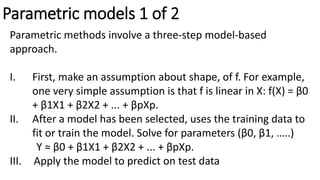
Parametric methods involve a three-step model-based
approach.
I. First, make an assumption about shape, of f. For example,
one very simple assumption is that f is linear in X: f(X) = β0
+ β1X1 + β2X2 + ... + βpXp.
II. After a model has been selected, uses the training data to
fit or train the model. Solve for parameters (β0, β1, …..)
Y ≈ β0 + β1X1 + β2X2 + ... + βpXp.
III. Apply the model to predict on test data
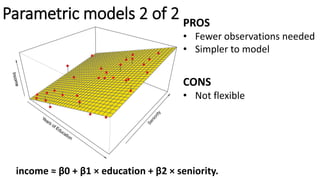
Parametric models 2 of 2 PROS
• Fewer observations needed
• Simpler to model
CONS
• Not flexible
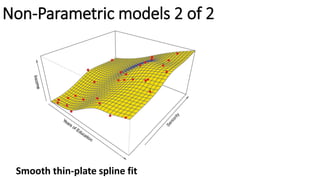
income ≈ β0 + β1 × education + β2 × seniority.
Non-Parametric models 1 of 2
 Non-parametric methods do not make explicit assumptions about
the functional form of f
 Instead they seek an estimate of f that gets as close to the data
points as possible
 Accurately fits known data (train data)
 Optimized to fit existing data
 High variability for true data
Non-Parametric models 2 of 2
Smooth thin-plate spline fit
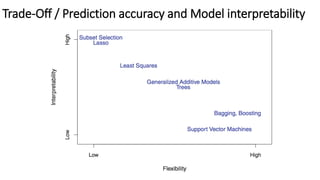
Trade-Off / Prediction accuracy and Model interpretability
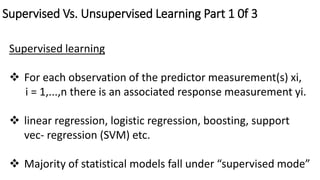
Supervised Vs. Unsupervised Learning Part 1 0f 3
Supervised learning
 For each observation of the predictor measurement(s) xi,
i = 1,...,n there is an associated response measurement yi.
 linear regression, logistic regression, boosting, support
vec- regression (SVM) etc.
 Majority of statistical models fall under “supervised mode”
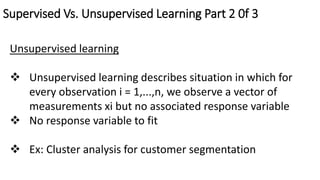
Supervised Vs. Unsupervised Learning Part 2 0f 3
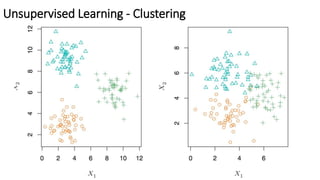
Unsupervised learning
 Unsupervised learning describes situation in which for
every observation i = 1,...,n, we observe a vector of
measurements xi but no associated response variable
 No response variable to fit
 Ex: Cluster analysis for customer segmentation
Unsupervised Learning - Clustering
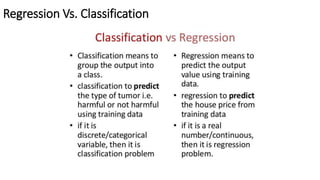
Regression Vs. Classification
Classification model use cases
 Spam Filter
 Google news classification
 Cancel cell classification (Benign, Malignant)
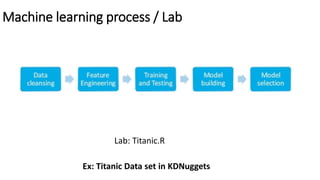
Machine learning process / Lab
Ex: Titanic Data set in KDNuggets
Lab: Titanic.R
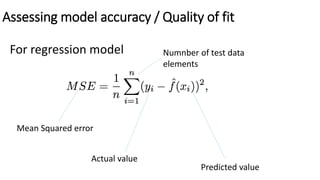
Assessing model accuracy / Quality of fit
For regression model Numnber of test data
elements
Mean Squared error
Actual value
Predicted value
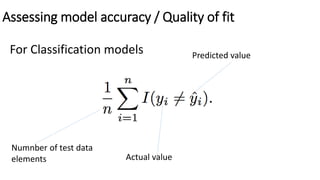
Assessing model accuracy / Quality of fit
For Classification models Predicted value
Actual value
Numnber of test data
elements
Top Machine learning algorithms and business
use cases
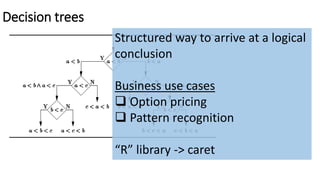
Decision trees
Structured way to arrive at a logical
conclusion
Business use cases
 Option pricing
 Pattern recognition
“R” library -> caret
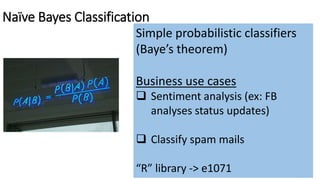
Naïve Bayes Classification
Simple probabilistic classifiers
(Baye’s theorem)
Business use cases
 Sentiment analysis (ex: FB
analyses status updates)
 Classify spam mails
“R” library -> e1071
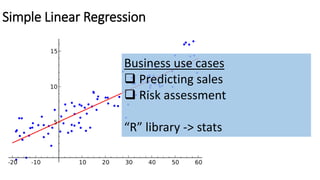
Simple Linear Regression
Business use cases
 Predicting sales
 Risk assessment
“R” library -> stats
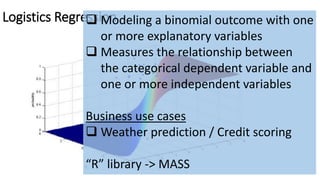
Logistics Regression Modeling a binomial outcome with one
or more explanatory variables
 Measures the relationship between
the categorical dependent variable and
one or more independent variables
Business use cases
 Weather prediction / Credit scoring
“R” library -> MASS
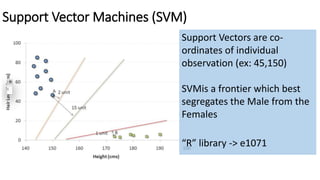
Support Vector Machines (SVM)
Support Vectors are co-
ordinates of individual
observation (ex: 45,150)
SVMis a frontier which best
segregates the Male from the
Females
“R” library -> e1071
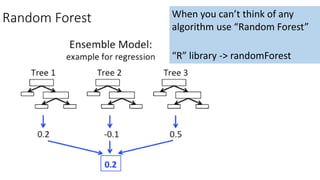
Random Forest When you can’t think of any
algorithm use “Random Forest”
“R” library -> randomForest
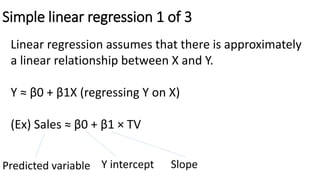
Simple linear regression 1 of 3
Linear regression assumes that there is approximately
a linear relationship between X and Y.
Y ≈ β0 + β1X (regressing Y on X)
(Ex) Sales ≈ β0 + β1 × TV
Predicted variable SlopeY intercept
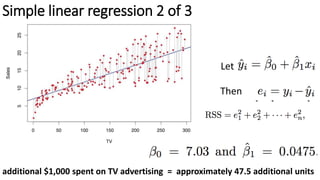
Simple linear regression 2 of 3
Let
Then
additional $1,000 spent on TV advertising = approximately 47.5 additional units
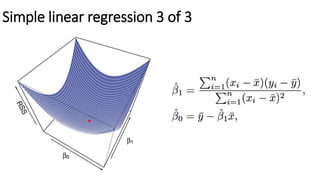
Simple linear regression 3 of 3
Accuracy of estimates (standard error) 1 of 2
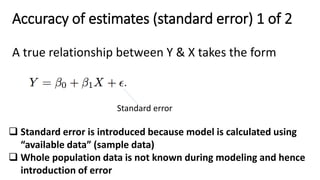
A true relationship between Y & X takes the form
Standard error
 Standard error is introduced because model is calculated using
“available data” (sample data)
 Whole population data is not known during modeling and hence
introduction of error
Accuracy of estimates (standard error) 2 of 2
Standard errors can be used to compute confidence intervals
For linear regression, the 95 % confidence interval for β1, β0
approximately takes the form:
In the case of the advertising data, the 95 % confidence interval for
β0 is [6.130, 7.935] and the 95 % confidence interval for β1 is
[0.042, 0.053].
Interpreting standard error in regression
LAB Advertising (Summary output)
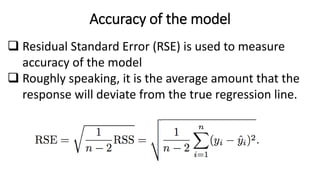
Accuracy of the model
 Residual Standard Error (RSE) is used to measure
accuracy of the model
 Roughly speaking, it is the average amount that the
response will deviate from the true regression line.
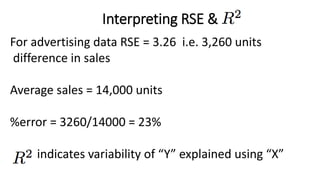
Interpreting RSE &
For advertising data RSE = 3.26 i.e. 3,260 units
difference in sales
Average sales = 14,000 units
%error = 3260/14000 = 23%
indicates variability of “Y” explained using “X”
ABOUT ME
25 years in Technology Industry
LinkedIn Profile:
https://www.linkedin.com/in/ratakondas/
Experience working for multiple early stage
startups and leading global teams
Current
Principal Founder – PredixDATA
(a analytics/bigdata service company)
Board of managers – Syntilla (stealth startup)

Machine learning algorithms and business use cases

  • 1.
    Sridhar Ratakonda Founder, PredixDATA,LLC http://www.predixdata.com Machine learning / Algorithms & Business use cases
  • 2.
    What is Statisticallearning? Let’s say you want to associate sales based on advertising channel. Input variables “Xn” => “TV budget”, “Radio budget”, “newspaper budget” Output variable “Y” => Sales Y = f(X) + ͼ Statistical learning refers to set of ways for estimating “f”
  • 3.
    Estimate of “f”/ Prediction In many situations, a set of inputs X are readily available, but the output Y cannot be easily obtained. we can predict Y using Yˆ = ˆf(X), fˆ = estimate for f Yˆ = resulting prediction for Y Ex: Predicting sales based on advertisement spend
  • 4.
    Estimate of “f”/ Inference 1 of 2 In some cases we want to understand how Y changes as a function of X1,...,Xp. • Which predictors are associated with the response? • What is the relationship between the response and each predictor? • Can the relationship between Y and each predictor be adequately summarized using a linear equation
  • 5.
    Estimating “f” Broadly speakingtwo methods are applied: • Parametric • Non-Parametric
  • 6.
    Parametric models 1of 2 Parametric methods involve a three-step model-based approach. I. First, make an assumption about shape, of f. For example, one very simple assumption is that f is linear in X: f(X) = β0 + β1X1 + β2X2 + ... + βpXp. II. After a model has been selected, uses the training data to fit or train the model. Solve for parameters (β0, β1, …..) Y ≈ β0 + β1X1 + β2X2 + ... + βpXp. III. Apply the model to predict on test data
  • 7.
    Parametric models 2of 2 PROS • Fewer observations needed • Simpler to model CONS • Not flexible income ≈ β0 + β1 × education + β2 × seniority.
  • 8.
    Non-Parametric models 1of 2  Non-parametric methods do not make explicit assumptions about the functional form of f  Instead they seek an estimate of f that gets as close to the data points as possible  Accurately fits known data (train data)  Optimized to fit existing data  High variability for true data
  • 9.
    Non-Parametric models 2of 2 Smooth thin-plate spline fit
  • 10.
    Trade-Off / Predictionaccuracy and Model interpretability
  • 11.
    Supervised Vs. UnsupervisedLearning Part 1 0f 3 Supervised learning  For each observation of the predictor measurement(s) xi, i = 1,...,n there is an associated response measurement yi.  linear regression, logistic regression, boosting, support vec- regression (SVM) etc.  Majority of statistical models fall under “supervised mode”
  • 12.
    Supervised Vs. UnsupervisedLearning Part 2 0f 3 Unsupervised learning  Unsupervised learning describes situation in which for every observation i = 1,...,n, we observe a vector of measurements xi but no associated response variable  No response variable to fit  Ex: Cluster analysis for customer segmentation
  • 13.
  • 14.
  • 15.
    Classification model usecases  Spam Filter  Google news classification  Cancel cell classification (Benign, Malignant)
  • 16.
    Machine learning process/ Lab Ex: Titanic Data set in KDNuggets Lab: Titanic.R
  • 17.
    Assessing model accuracy/ Quality of fit For regression model Numnber of test data elements Mean Squared error Actual value Predicted value
  • 18.
    Assessing model accuracy/ Quality of fit For Classification models Predicted value Actual value Numnber of test data elements
  • 19.
    Top Machine learningalgorithms and business use cases
  • 20.
    Decision trees Structured wayto arrive at a logical conclusion Business use cases  Option pricing  Pattern recognition “R” library -> caret
  • 21.
    Naïve Bayes Classification Simpleprobabilistic classifiers (Baye’s theorem) Business use cases  Sentiment analysis (ex: FB analyses status updates)  Classify spam mails “R” library -> e1071
  • 22.
    Simple Linear Regression Businessuse cases  Predicting sales  Risk assessment “R” library -> stats
  • 23.
    Logistics Regression Modelinga binomial outcome with one or more explanatory variables  Measures the relationship between the categorical dependent variable and one or more independent variables Business use cases  Weather prediction / Credit scoring “R” library -> MASS
  • 24.
    Support Vector Machines(SVM) Support Vectors are co- ordinates of individual observation (ex: 45,150) SVMis a frontier which best segregates the Male from the Females “R” library -> e1071
  • 25.
    Random Forest Whenyou can’t think of any algorithm use “Random Forest” “R” library -> randomForest
  • 26.
    Simple linear regression1 of 3 Linear regression assumes that there is approximately a linear relationship between X and Y. Y ≈ β0 + β1X (regressing Y on X) (Ex) Sales ≈ β0 + β1 × TV Predicted variable SlopeY intercept
  • 27.
    Simple linear regression2 of 3 Let Then additional $1,000 spent on TV advertising = approximately 47.5 additional units
  • 28.
  • 29.
    Accuracy of estimates(standard error) 1 of 2 A true relationship between Y & X takes the form Standard error  Standard error is introduced because model is calculated using “available data” (sample data)  Whole population data is not known during modeling and hence introduction of error
  • 30.
    Accuracy of estimates(standard error) 2 of 2 Standard errors can be used to compute confidence intervals For linear regression, the 95 % confidence interval for β1, β0 approximately takes the form: In the case of the advertising data, the 95 % confidence interval for β0 is [6.130, 7.935] and the 95 % confidence interval for β1 is [0.042, 0.053].
  • 31.
    Interpreting standard errorin regression LAB Advertising (Summary output)
  • 32.
    Accuracy of themodel  Residual Standard Error (RSE) is used to measure accuracy of the model  Roughly speaking, it is the average amount that the response will deviate from the true regression line.
  • 33.
    Interpreting RSE & Foradvertising data RSE = 3.26 i.e. 3,260 units difference in sales Average sales = 14,000 units %error = 3260/14000 = 23% indicates variability of “Y” explained using “X”
  • 34.
    ABOUT ME 25 yearsin Technology Industry LinkedIn Profile: https://www.linkedin.com/in/ratakondas/ Experience working for multiple early stage startups and leading global teams Current Principal Founder – PredixDATA (a analytics/bigdata service company) Board of managers – Syntilla (stealth startup)

Editor's Notes

  • #15 Ex; Logistics regression SVM Naïve Bayes Classifier
  • #16 Ex; Logistics regression SVM Naïve Bayes Classifier
  • #21 Mainly classification but regression possible (regression trees)
  • #24 Classification problem
  • #25 Regression & class