Supervised Learning
and k Nearest
Neighbors
Business Intelligence for Managers
Supervised learning
and classification
 Given: dataset of instances with
known categories
 Goal: using the “knowledge” in the
dataset, classify a given instance
 predict the category of the given
instance that is rationally consistent
with the dataset
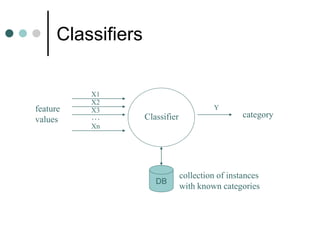
Classifiers
Classifier
…
feature
values
category
X1
X2
X3
Xn
Y
DB
collection of instances
with known categories
Algorithms
 K Nearest Neighbors (kNN)
 Naïve-Bayes
 Decision trees
 Many others (support vector
machines, neural networks, genetic
algorithms, etc)
K - Nearest Neighbors
 For a given instance T, get the top k
dataset instances that are “nearest” to
T
 Select a reasonable distance measure
 Inspect the category of these k
instances, choose the category C that
represent the most instances
 Conclude that T belongs to category C
Example 1
 Determining decision on scholarship
application based on the following features:
 Household income (annual income in
millions of pesos)
 Number of siblings in family
 High school grade (on a QPI scale of 1.0 –
4.0)
 Intuition (reflected on data set): award
scholarships to high-performers and to
those with financial need
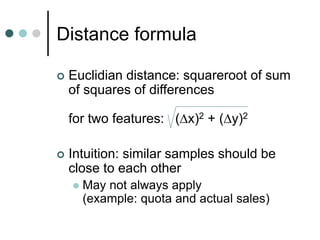
Distance formula
 Euclidian distance: squareroot of sum
of squares of differences
for two features: (x)2 + (y)2
 Intuition: similar samples should be
close to each other
 May not always apply
(example: quota and actual sales)
Incomparable ranges
 The Euclidian distance formula has
the implicit assumption that the
different dimensions are comparable
 Features that span wider ranges
affect the distance value more than
features with limited ranges
Example revisited
 Suppose household income was
instead indicated in thousands of
pesos per month and that grades are
given on a 70-100 scale
 Note different results produced by
kNN algorithm on the same dataset
Non-numeric data
 Feature values are not always
numbers
 Example
 Boolean values: Yes or no, presence
or absence of an attribute
 Categories: Colors, educational
attainment, gender
 How do these values factor into the
computation of distance?
Dealing with non-numeric
data
 Boolean values => convert to 0 or 1
 Applies to yes-no/presence-absence
attributes
 Non-binary characterizations
 Use natural progression when applicable;
e.g., educational attainment: GS, HS,
College, MS, PHD => 1,2,3,4,5
 Assign arbitrary numbers but be careful
about distances; e.g., color: red, yellow, blue
=> 1,2,3
 How about unavailable data?
(0 value not always the answer)
Preprocessing your dataset
 Dataset may need to be preprocessed
to ensure more reliable data mining
results
 Conversion of non-numeric data to
numeric data
 Calibration of numeric data to reduce
effects of disparate ranges
 Particularly when using the Euclidean
distance metric
k-NN variations
 Value of k
 Larger k increases confidence in prediction
 Note that if k is too large, decision may be
skewed
 Weighted evaluation of nearest neighbors
 Plain majority may unfairly skew decision
 Revise algorithm so that closer neighbors
have greater “vote weight”
 Other distance measures
Other distance measures
 City-block distance (Manhattan dist)
 Add absolute value of differences
 Cosine similarity
 Measure angle formed by the two samples
(with the origin)
 Jaccard distance
 Determine percentage of exact matches
between the samples (not including
unavailable data)
 Others
k-NN Time Complexity
 Suppose there are m instances and n
features in the dataset
 Nearest neighbor algorithm requires
computing m distances
 Each distance computation involves
scanning through each feature value
 Running time complexity is
proportional to m X n

K nearest neighbors s machine learning method

  • 1.
    Supervised Learning and kNearest Neighbors Business Intelligence for Managers
  • 2.
    Supervised learning and classification Given: dataset of instances with known categories  Goal: using the “knowledge” in the dataset, classify a given instance  predict the category of the given instance that is rationally consistent with the dataset
  • 3.
  • 4.
    Algorithms  K NearestNeighbors (kNN)  Naïve-Bayes  Decision trees  Many others (support vector machines, neural networks, genetic algorithms, etc)
  • 5.
    K - NearestNeighbors  For a given instance T, get the top k dataset instances that are “nearest” to T  Select a reasonable distance measure  Inspect the category of these k instances, choose the category C that represent the most instances  Conclude that T belongs to category C
  • 6.
    Example 1  Determiningdecision on scholarship application based on the following features:  Household income (annual income in millions of pesos)  Number of siblings in family  High school grade (on a QPI scale of 1.0 – 4.0)  Intuition (reflected on data set): award scholarships to high-performers and to those with financial need
  • 7.
    Distance formula  Euclidiandistance: squareroot of sum of squares of differences for two features: (x)2 + (y)2  Intuition: similar samples should be close to each other  May not always apply (example: quota and actual sales)
  • 8.
    Incomparable ranges  TheEuclidian distance formula has the implicit assumption that the different dimensions are comparable  Features that span wider ranges affect the distance value more than features with limited ranges
  • 9.
    Example revisited  Supposehousehold income was instead indicated in thousands of pesos per month and that grades are given on a 70-100 scale  Note different results produced by kNN algorithm on the same dataset
  • 10.
    Non-numeric data  Featurevalues are not always numbers  Example  Boolean values: Yes or no, presence or absence of an attribute  Categories: Colors, educational attainment, gender  How do these values factor into the computation of distance?
  • 11.
    Dealing with non-numeric data Boolean values => convert to 0 or 1  Applies to yes-no/presence-absence attributes  Non-binary characterizations  Use natural progression when applicable; e.g., educational attainment: GS, HS, College, MS, PHD => 1,2,3,4,5  Assign arbitrary numbers but be careful about distances; e.g., color: red, yellow, blue => 1,2,3  How about unavailable data? (0 value not always the answer)
  • 12.
    Preprocessing your dataset Dataset may need to be preprocessed to ensure more reliable data mining results  Conversion of non-numeric data to numeric data  Calibration of numeric data to reduce effects of disparate ranges  Particularly when using the Euclidean distance metric
  • 13.
    k-NN variations  Valueof k  Larger k increases confidence in prediction  Note that if k is too large, decision may be skewed  Weighted evaluation of nearest neighbors  Plain majority may unfairly skew decision  Revise algorithm so that closer neighbors have greater “vote weight”  Other distance measures
  • 14.
    Other distance measures City-block distance (Manhattan dist)  Add absolute value of differences  Cosine similarity  Measure angle formed by the two samples (with the origin)  Jaccard distance  Determine percentage of exact matches between the samples (not including unavailable data)  Others
  • 15.
    k-NN Time Complexity Suppose there are m instances and n features in the dataset  Nearest neighbor algorithm requires computing m distances  Each distance computation involves scanning through each feature value  Running time complexity is proportional to m X n