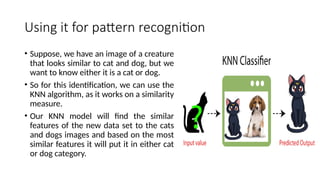
The k-nearest neighbor (k-NN) algorithm is a simple, non-parametric supervised learning technique used for classification and density estimation based on the similarity between data points. It is a lazy learner that does not learn from the training data until classification begins, and its performance depends significantly on the choice of k, the distance metric, and a balanced training set. The document also discusses applications in image recognition and the importance of distance measurement, highlighting the need for standardization of predictors and cross-validation to determine the most effective parameters.











![Example 1:
• We can now use the training set to
classify an unknown case (Age=48 and
Loan=$142,000) using Euclidean
distance.
• If K=1 then the nearest neighbor is the
last case in the training set with
Default=Y.
• D = Sqrt[(48-33)^2 + (142000-
150000)^2] = 8000.01 >> Default=Y
• With K=3, there are two “Default=Y”
and one “Default=N” out of three
closest neighbors. The prediction for
the unknown case is again Default=Y.](https://image.slidesharecdn.com/w5classification-241217074634-f62e152f/85/W5_CLASSIFICATION-pptxW5_CLASSIFICATION-pptx-27-320.jpg)


