Download as PDF, PPTX
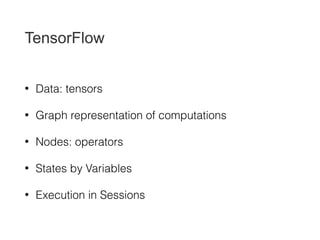
![TensorFlow
Advanced features
• Construction phase
• Execution phase
import tensorflow as tf
# Create a Constant op that produces a 1x2 matrix. The op is
# added as a node to the default graph.
#
# The value returned by the constructor represents the output
# of the Constant op.
matrix1 = tf.constant([[3., 3.]])
# Create another Constant that produces a 2x1 matrix.
matrix2 = tf.constant([[2.],[2.]])
with tf.Session() as sess:
result = sess.run([product])
print(result)](https://image.slidesharecdn.com/20160304-ntnu-dldive-200214172444/85/Dive-into-Deep-Learning-7-320.jpg)
![TensorFlow
Advanced features
• Working with Variables
# Create two variables.
weights = tf.Variable(tf.random_normal([784, 200], stddev=0.35),
name="weights")
biases = tf.Variable(tf.zeros([200]), name="biases")
...
# Add an op to initialize the variables.
init_op = tf.initialize_all_variables()
# Later, when launching the model
with tf.Session() as sess:
# Run the init operation.
sess.run(init_op)
...
# Use the model
...](https://image.slidesharecdn.com/20160304-ntnu-dldive-200214172444/85/Dive-into-Deep-Learning-8-320.jpg)
![TensorFlow
Advanced features
• Graph Visualization
• Using GPUs
• Sharing variables
https://www.tensorflow.org/
with tf.Session() as sess:
with tf.device("/gpu:1"):
matrix1 = tf.constant([[3., 3.]])
matrix2 = tf.constant([[2.],[2.]])](https://image.slidesharecdn.com/20160304-ntnu-dldive-200214172444/85/Dive-into-Deep-Learning-9-320.jpg)

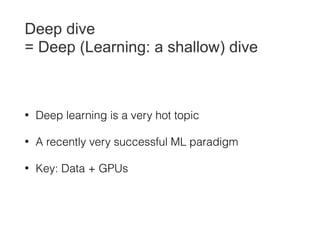
The document discusses deep learning as a significant machine learning paradigm that leverages data and GPUs. It highlights TensorFlow's framework, including its graph representation of computations and advanced features like variable management and GPU usage. Code examples demonstrate how to create and manipulate constants and variables within TensorFlow sessions.


