A Semantic Search Approach
to Task-Completion Engines
Darío Garigliotti

TN910 - Innovation and project awareness

UiS - February 27, 2018
Background: Semantics
- An entity is an individual or thing, uniquely identified

Henrik Ibsen, Stavanger, UEFA Champions League
- We describe entity properties using triples 

- Attributes: (Henrik Ibsen, birthdate, 20 March 1828)
- Types: (Henrik Ibsen, is a, writer)
- Relations: (Henrik Ibsen, work, A Doll’s House)
- A knowledge base (KB) is a set of triples. 

- For us, semantics == structured knowledge
2
Semantic Search
- "With great power comes

great responsibility"

- More users, greater expectations:
understanding the search query

- Search engines are becoming answer engines

- Multiple techniques for query semantics

- I am focusing on the next evolution stage:
task completion
3
Objective
- My research goal is to understand:

- which challenges in semantic search are promissory
for supporting task-completion engines,
- which methods prove effective to model those
challenges,
- and how to integrate them into task-based search.
4
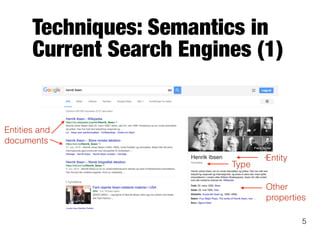
Techniques: Semantics in
Current Search Engines (1)
Type
Other
properties
Entities and
documents
Entity
5
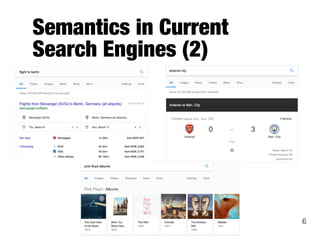
Semantics in Current
Search Engines (2)
6
Status
- I'm in my third year of studies in Computer
Science

- I have made contributions in these challenges:

- utilizing entity type information for entity retrieval
- understanding entity-oriented search intents
- generating query suggestions to support task-based
search
7
Stakeholders and Societal
Factors
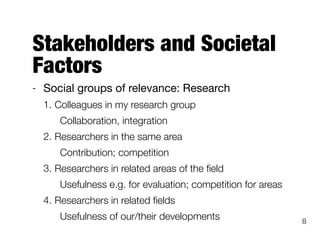
- Social groups of relevance: Research

1. Colleagues in my research group
Collaboration, integration
2. Researchers in the same area
Contribution; competition
3. Researchers in related areas of the field
Usefulness e.g. for evaluation; competition for areas
4. Researchers in related fields
Usefulness of our/their developments 8
Stakeholders and Societal
Factors
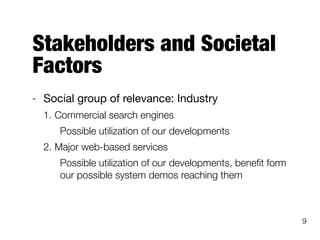
- Social group of relevance: Industry

1. Commercial search engines
Possible utilization of our developments
2. Major web-based services
Possible utilization of our developments, benefit form
our possible system demos reaching them
9
Stakeholders and Societal
Factors
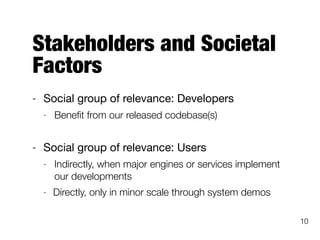
- Social group of relevance: Developers

- Benefit from our released codebase(s)
- Social group of relevance: Users

- Indirectly, when major engines or services implement
our developments
- Directly, only in minor scale through system demos
10
Stakeholders and Societal
Factors
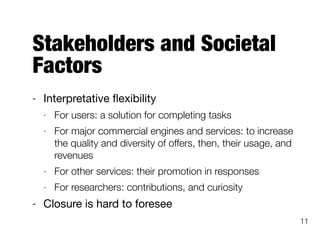
- Interpretative flexibility

- For users: a solution for completing tasks
- For major commercial engines and services: to increase
the quality and diversity of offers, then, their usage, and
revenues
- For other services: their promotion in responses
- For researchers: contributions, and curiosity
- Closure is hard to foresee
11
Challenges in RRI
- Scalability

- Whether our models and results are indeed extensible
as working solutions on larger, real data
- Data Privacy

- Anonymization of datasets (collected by us or
provided by previous work)
- Development of tasks and evaluation methodologies
oriented to protect privacy
12
RRI Measures
- RRI goals

- "respond to needs and ambitions of society, reflects
its values, be responsible..."
- "societal actors work together during the whole
research process..."
- privacy, security among the values by which to
evaluate research outcomes and options
13
RRI Measures
- EPSRC AREA framework

- Reflect:
‣ the closer to a practical implementation of a working
solution, the larger the reflections should be on
motivations and implications: dilemmas, social
transformations
‣ permanent reflection on assumptions, questions,
areas of ignorance
14

A Semantic Search Approach to Task-Completion Engines

  • 1.
    A Semantic SearchApproach to Task-Completion Engines Darío Garigliotti TN910 - Innovation and project awareness UiS - February 27, 2018
  • 2.
    Background: Semantics - Anentity is an individual or thing, uniquely identified Henrik Ibsen, Stavanger, UEFA Champions League - We describe entity properties using triples - Attributes: (Henrik Ibsen, birthdate, 20 March 1828) - Types: (Henrik Ibsen, is a, writer) - Relations: (Henrik Ibsen, work, A Doll’s House) - A knowledge base (KB) is a set of triples. - For us, semantics == structured knowledge 2
  • 3.
    Semantic Search - "Withgreat power comes great responsibility" - More users, greater expectations: understanding the search query - Search engines are becoming answer engines - Multiple techniques for query semantics - I am focusing on the next evolution stage: task completion 3
  • 4.
    Objective - My researchgoal is to understand: - which challenges in semantic search are promissory for supporting task-completion engines, - which methods prove effective to model those challenges, - and how to integrate them into task-based search. 4
  • 5.
    Techniques: Semantics in CurrentSearch Engines (1) Type Other properties Entities and documents Entity 5
  • 6.
  • 7.
    Status - I'm inmy third year of studies in Computer Science - I have made contributions in these challenges: - utilizing entity type information for entity retrieval - understanding entity-oriented search intents - generating query suggestions to support task-based search 7
  • 8.
    Stakeholders and Societal Factors -Social groups of relevance: Research 1. Colleagues in my research group Collaboration, integration 2. Researchers in the same area Contribution; competition 3. Researchers in related areas of the field Usefulness e.g. for evaluation; competition for areas 4. Researchers in related fields Usefulness of our/their developments 8
  • 9.
    Stakeholders and Societal Factors -Social group of relevance: Industry 1. Commercial search engines Possible utilization of our developments 2. Major web-based services Possible utilization of our developments, benefit form our possible system demos reaching them 9
  • 10.
    Stakeholders and Societal Factors -Social group of relevance: Developers - Benefit from our released codebase(s) - Social group of relevance: Users - Indirectly, when major engines or services implement our developments - Directly, only in minor scale through system demos 10
  • 11.
    Stakeholders and Societal Factors -Interpretative flexibility - For users: a solution for completing tasks - For major commercial engines and services: to increase the quality and diversity of offers, then, their usage, and revenues - For other services: their promotion in responses - For researchers: contributions, and curiosity - Closure is hard to foresee 11
  • 12.
    Challenges in RRI -Scalability - Whether our models and results are indeed extensible as working solutions on larger, real data - Data Privacy - Anonymization of datasets (collected by us or provided by previous work) - Development of tasks and evaluation methodologies oriented to protect privacy 12
  • 13.
    RRI Measures - RRIgoals - "respond to needs and ambitions of society, reflects its values, be responsible..." - "societal actors work together during the whole research process..." - privacy, security among the values by which to evaluate research outcomes and options 13
  • 14.
    RRI Measures - EPSRCAREA framework - Reflect: ‣ the closer to a practical implementation of a working solution, the larger the reflections should be on motivations and implications: dilemmas, social transformations ‣ permanent reflection on assumptions, questions, areas of ignorance 14