Lecture 3: Transport and Reliability
Overview 
 End-to-end model 
 User datagram protocol (UDP) 
 Packet checksums 
 Reliability: sliding window 
 TCP connection setup 
 TCP windows, retransmissions, and 
acknowledgments
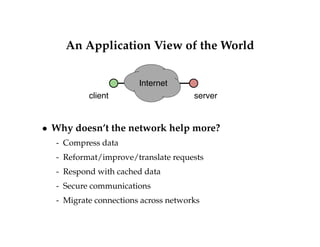
An Application View of theWorld 
Internet 
client server 
 Why doesn’t the network help more? 
- Compress data 
- Reformat/improve/translate requests 
- Respond with cached data 
- Secure communications 
- Migrate connections across networks
End-to-End Model 
The function in question can completely and correctly 
be implemented only with the knowledge and help of 
the application standing at the end points of the 
communication system. Therefore, providing that 
questioned function as a feature of the communication 
system itself is not possible. (Sometimes an incomplete 
version of the function provided by the communication 
system may be useful as a performance enhancement.) 
We call this line of reasoning. . . “the end-to-end 
argument.” 
– Saltzer, Reed, and Clark, 1984
Strong End-to-End 
The network’s job is to transmit datagrams as 
efficiently and flexibly as possible. Everything 
else should be done at the fringes. . . 
– [RFC 1958] 
 Why?
Example: File Transfer 
 What can go wrong? 
- File might not arrive at receiver 
- File could be corrupted in transit 
 How can we be sure a file arrives successfully? 
- Send acknowledgment to ensure file arrived at destination 
- Use checksum to ensure data has not been corrupted 
 Why do something in the middle? 
- Network often drops packets because of congestion, 
sometimes corrupts packets because of transmission errors 
- Cheaper to resend one packet than whole file 
- . . . or to re-send over one link than through whole network
Link-by-link reliability 
 Link-by-link reliability is not sufficient 
- MIT network did link-by-link ack and checksum 
- Thought transmission was most likely source or errors 
- But problem arose from bad RAM in router 
- Ended up corrupting a lot of MULTICS source code 
 Principle applies even above the network layer 
- E.g., Google learned disk error-correction insufficient. . . 
GFS keeps its own application-layer checkums
End-to-end  net neutrality 
 “Dumb” network clearly beneficial. . . 
- But what if ISPs want to do complex things? 
 Require ISPs to treat everyone’s traffic equally? 
 Pro: prevent extortion from last-mile duopoly 
- Create a hugely profitable business (next Google)? 
- Seeing $$$s, ISPs could charge you to reach their customers 
 Con: reduces ISP flexibility to cope with change 
- E.g., new applications that clog the network 
 Current FCC strongly in favor of Net neutrality
FCC net neutrality history 
 2002: Classifies cable modems as information services 
- Much less regulated than telephone or TV 
 2005: FCC issues Internet Policy Statement: 
- Users should be able to 1) access any lawful content, 2) run any 
applications, 3) use any devices, and 4) enjoy competition 
between network, application, and content providers. 
 2007: Comcast forges RSTs to BitTorrent 
 2008: FCC finds Comcast in violation of policy 
 2009: FCC proposes 2 more network guidelines 
- ISPs should 5) treat content/applications/services in 
nondiscriminatory manner, and 6) provide transparency 
 2010: Court finds FCC lacks authority to regulate ISPs
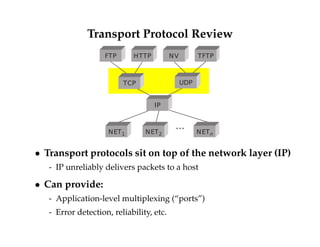
Transport Protocol Review 
HTTP NV TFTP 
… 
FTP 
TCP UDP 
IP 
NET1 NET2 NETn 
 Transport protocols sit on top of the network layer (IP) 
- IP unreliably delivers packets to a host 
 Can provide: 
- Application-level multiplexing (“ports”) 
- Error detection, reliability, etc.
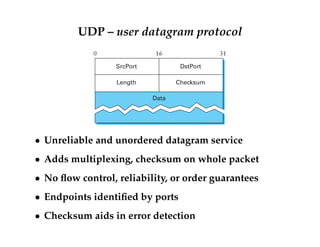
UDP – user datagram protocol 
0 16 31 
SrcPort DstPort 
Length Checksum 
Data 
 Unreliable and unordered datagram service 
 Adds multiplexing, checksum on whole packet 
 No flow control, reliability, or order guarantees 
 Endpoints identified by ports 
 Checksum aids in error detection
Error detection 
 Transmission errors definitely happen 
- Cosmic rays, radio interference, etc. 
- If error probability is 230, that’s 1 error per 128 MB! 
 Some link-layer protocols provide error detection 
- But UDP/IP must work over many link layers 
- Not all links on a path may have error detection 
- Moreover, recall end-to-end argument! 
Need end-to-end check 
 UDP detects errors with a checksum 
- Compute small checksum value, like a hash of the packet 
- If packet corrupted in transit, checksum likely to be wrong 
- Similar checksum on IP header, but doesn’t cover payload
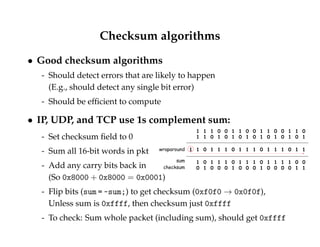
Checksum algorithms 
 Good checksum algorithms 
- Should detect errors that are likely to happen 
(E.g., should detect any single bit error) 
- Should be efficient to compute 
 IP, UDP, and TCP use 1s complement sum: 
- Set checksum field to 0 
- Sum all 16-bit words in pkt 
- Add any carry bits back in 
(So 0x8000 + 0x8000 = 0x0001) 
- Flip bits (sum = ~sum;) to get checksum (0xf0f0 ! 0x0f0f), 
Unless sum is 0xffff, then checksum just 0xffff 
- To check: Sum whole packet (including sum), should get 0xffff
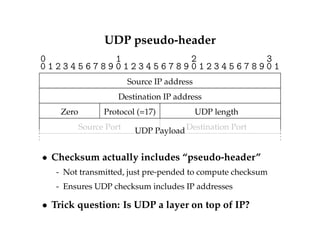
UDP pseudo-header 
0 1 2 3 
0 1 2 3 4 5 6 7 8 9 0 1 2 3 4 5 6 7 8 9 0 1 2 3 4 5 6 7 8 9 0 1 
Source IP address 
Destination IP address 
Zero Protocol (=17) UDP length 
Source Port Destination Port 
UDP Payload 
 Checksum actually includes “pseudo-header” 
- Not transmitted, just pre-pended to compute checksum 
- Ensures UDP checksum includes IP addresses 
 Trick question: Is UDP a layer on top of IP?
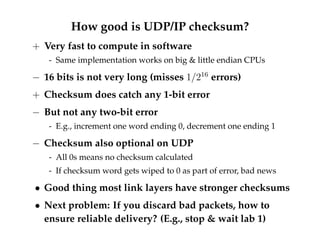
How good is UDP/IP checksum? 
+ Very fast to compute in software 
- Same implementation works on big  little endian CPUs 
 16 bits is not very long (misses 1=216 errors) 
+ Checksum does catch any 1-bit error 
 But not any two-bit error 
- E.g., increment one word ending 0, decrement one ending 1 
 Checksum also optional on UDP 
- All 0s means no checksum calculated 
- If checksum word gets wiped to 0 as part of error, bad news 
 Good thing most link layers have stronger checksums 
 Next problem: If you discard bad packets, how to 
ensure reliable delivery? (E.g., stop  wait lab 1)
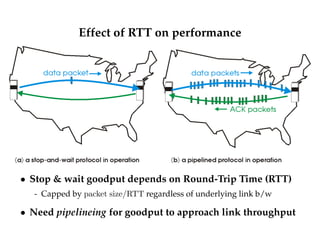
Effect of RTT on performance 
 Stop  wait goodput depends on Round-Trip Time (RTT) 
- Capped by packet size=RTT regardless of underlying link b/w 
 Need pipelineing for goodput to approach link throughput
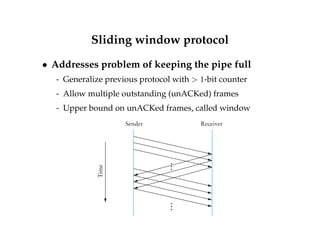
Sliding window protocol 
 Addresses problem of keeping the pipe full 
- Generalize previous protocol with  1-bit counter 
- Allow multiple outstanding (unACKed) frames 
- Upper bound on unACKed frames, called window 
Sender Receiver 
Time 
… …
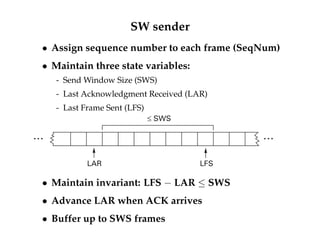
SW sender 
 Assign sequence number to each frame (SeqNum) 
 Maintain three state variables: 
- SendWindow Size (SWS) 
- Last Acknowledgment Received (LAR) 
- Last Frame Sent (LFS) 
£ SWS 
… … 
LAR LFS 
 Maintain invariant: LFS  LAR  SWS 
 Advance LAR when ACK arrives 
 Buffer up to SWS frames
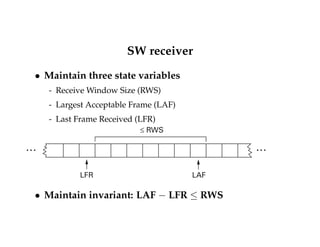
SW receiver 
 Maintain three state variables 
- Receive Window Size (RWS) 
- Largest Acceptable Frame (LAF) 
- Last Frame Received (LFR) 
£ RWS 
… … 
LFR LAF 
 Maintain invariant: LAF  LFR  RWS
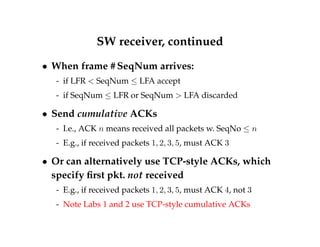
SW receiver, continued 
 When frame #SeqNum arrives: 
- if LFR  SeqNum  LFA accept 
- if SeqNum  LFR or SeqNum  LFA discarded 
 Send cumulative ACKs 
- I.e., ACK n means received all packets w. SeqNo  n 
- E.g., if received packets 1; 2; 3; 5, must ACK 3 
 Or can alternatively use TCP-style ACKs, which 
specify first pkt. not received 
- E.g., if received packets 1; 2; 3; 5, must ACK 4, not 3 
- Note Labs 1 and 2 use TCP-style cumulative ACKs
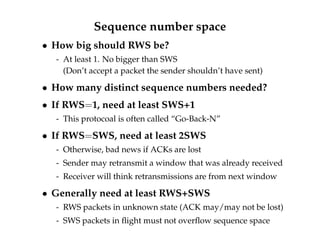
Sequence number space 
 How big should RWS be? 
- At least 1. No bigger than SWS 
(Don’t accept a packet the sender shouldn’t have sent) 
 How many distinct sequence numbers needed? 
 If RWS=1, need at least SWS+1 
- This protocoal is often called “Go-Back-N” 
 If RWS=SWS, need at least 2SWS 
- Otherwise, bad news if ACKs are lost 
- Sender may retransmit a window that was already received 
- Receiver will think retransmissions are from next window 
 Generally need at least RWS+SWS 
- RWS packets in unknown state (ACK may/may not be lost) 
- SWS packets in flight must not overflow sequence space
High-level view of TCP 
Application process 
Write 
bytes 
TCP 
Send buffer 
Segment Segment Segment 
Transmit segments 
Application process 
Read 
bytes 
TCP 
Receive buffer 
… 
… 
… 
 Full duplex, connection-oriented byte stream 
 Flow control 
- If one end stops reading, writes at other eventually block/fail 
 Congestion control 
- Keeps sender from overrunning network [more in lecture 5]
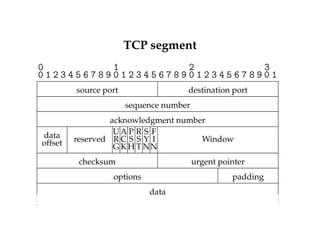
TCP segment 
0 1 2 3 
0 1 2 3 4 5 6 7 8 9 0 1 2 3 4 5 6 7 8 9 0 1 2 3 4 5 6 7 8 9 0 1 
source port destination port 
sequence number 
acknowledgment number 
data offset 
reserved 
Window 
UR 
data 
G 
A P R S F 
CK 
SH 
ST 
YN 
IN 
checksum urgent pointer 
options padding
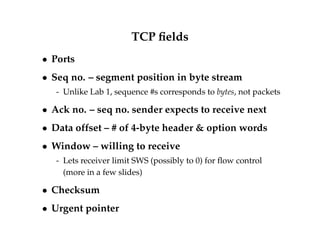
TCP fields 
 Ports 
 Seq no. – segment position in byte stream 
- Unlike Lab 1, sequence #s corresponds to bytes, not packets 
 Ack no. – seq no. sender expects to receive next 
 Data offset – # of 4-byte header  option words 
 Window – willing to receive 
- Lets receiver limit SWS (possibly to 0) for flow control 
(more in a few slides) 
 Checksum 
 Urgent pointer
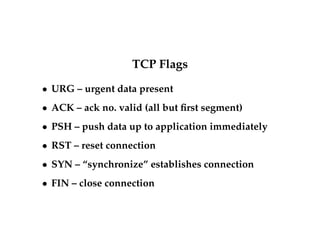
TCP Flags 
 URG – urgent data present 
 ACK – ack no. valid (all but first segment) 
 PSH – push data up to application immediately 
 RST – reset connection 
 SYN – “synchronize” establishes connection 
 FIN – close connection
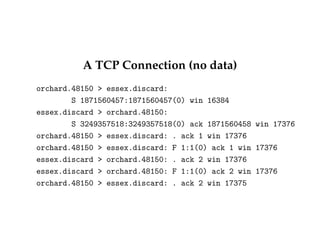
A TCP Connection (no data) 
orchard.48150  essex.discard: 
S 1871560457:1871560457(0) win 16384 
essex.discard  orchard.48150: 
S 3249357518:3249357518(0) ack 1871560458 win 17376 
orchard.48150  essex.discard: . ack 1 win 17376 
orchard.48150  essex.discard: F 1:1(0) ack 1 win 17376 
essex.discard  orchard.48150: . ack 2 win 17376 
essex.discard  orchard.48150: F 1:1(0) ack 2 win 17376 
orchard.48150  essex.discard: . ack 2 win 17375
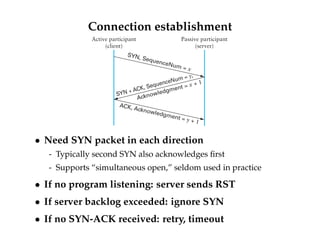
Connection establishment 
Active participant 
(client) 
Passive participant 
(server) 
SYN, SequenceNum = x 
SYN + ACK, SequenceNum = y, 
ACK, Acknowledgment = y + 1 
Acknowledgment = x + 1 
 Need SYN packet in each direction 
- Typically second SYN also acknowledges first 
- Supports “simultaneous open,” seldom used in practice 
 If no program listening: server sends RST 
 If server backlog exceeded: ignore SYN 
 If no SYN-ACK received: retry, timeout
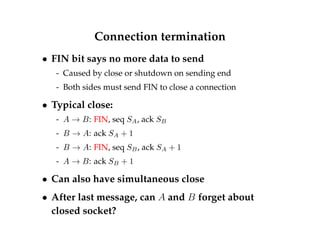
Connection termination 
 FIN bit says no more data to send 
- Caused by close or shutdown on sending end 
- Both sides must send FIN to close a connection 
 Typical close: 
- A ! B: FIN, seq SA, ack SB 
- B ! A: ack SA + 1 
- B ! A: FIN, seq SB, ack SA + 1 
- A ! B: ack SB + 1 
 Can also have simultaneous close 
 After last message, can A and B forget about 
closed socket?
2-minute stretch
TIME WAIT 
 Problems with closed socket 
- What if final ack is lost in the network? 
- What if the same port pair is immediately reused for a new 
connection? (Old packets might still be floating around.) 
 Solution: “active” closer goes into TIME WAIT 
- Active close is sending FIN before receiving one 
- After receiving ACK and FIN, keep socket around for 2MSL 
(twice the “maximum segment lifetime”) 
 Can pose problems with servers 
- OS has too many sockets in TIME WAIT, slows things down 
Hack: Can send RST and delete socket, set SO LINGER 
socket option to time 0 (useful for benchmark programs) 
- OS won’t let you re-start server because port still in use 
SO REUSEADDR option lets you re-bind used port number
State summary [RFC 793] 
CLOSED 
LISTEN 
Active open/SYN 
SYN_RCVD SYN_SENT 
ESTABLISHED 
CLOSE_WAIT 
Close/FIN 
CLOSING LAST_ACK 
TIME_WAIT 
FIN_WAIT_1 
FIN_WAIT_2 
Passive open Close 
Send/SYN 
SYN/SYN + ACK 
SYN + ACK/ACK 
SYN/SYN + ACK 
ACK 
Close/FIN 
Close/FIN FIN/ACK 
FIN/ACK 
ACK + FIN/ACK 
Timeout after two 
segment lifetimes 
FIN/ACK 
ACK 
ACK 
ACK 
Close 
CLOSED
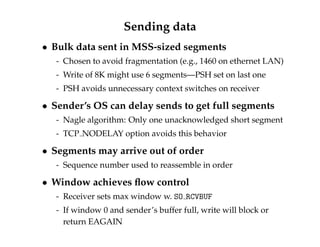
Sending data 
 Bulk data sent in MSS-sized segments 
- Chosen to avoid fragmentation (e.g., 1460 on ethernet LAN) 
- Write of 8K might use 6 segments—PSH set on last one 
- PSH avoids unnecessary context switches on receiver 
 Sender’s OS can delay sends to get full segments 
- Nagle algorithm: Only one unacknowledged short segment 
- TCP NODELAY option avoids this behavior 
 Segments may arrive out of order 
- Sequence number used to reassemble in order 
 Window achieves flow control 
- Receiver sets max window w. SO RCVBUF 
- If window 0 and sender’s buffer full, write will block or 
return EAGAIN
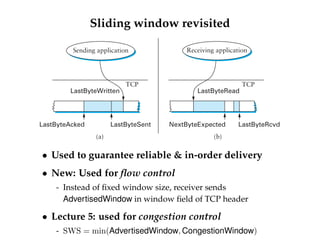
Sliding window revisited 
Sending application 
LastByteWritten 
TCP 
LastByteAcked LastByteSent 
Receiving application 
LastByteRead 
TCP 
NextByteExpected LastByteRcvd 
(a) (b) 
 Used to guarantee reliable  in-order delivery 
 New: Used for flow control 
- Instead of fixed window size, receiver sends 
AdvertisedWindow in window field of TCP header 
 Lecture 5: used for congestion control 
- SWS = min(AdvertisedWindow; CongestionWindow)
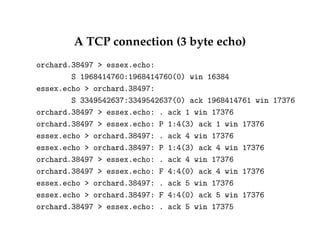
A TCP connection (3 byte echo) 
orchard.38497  essex.echo: 
S 1968414760:1968414760(0) win 16384 
essex.echo  orchard.38497: 
S 3349542637:3349542637(0) ack 1968414761 win 17376 
orchard.38497  essex.echo: . ack 1 win 17376 
orchard.38497  essex.echo: P 1:4(3) ack 1 win 17376 
essex.echo  orchard.38497: . ack 4 win 17376 
essex.echo  orchard.38497: P 1:4(3) ack 4 win 17376 
orchard.38497  essex.echo: . ack 4 win 17376 
orchard.38497  essex.echo: F 4:4(0) ack 4 win 17376 
essex.echo  orchard.38497: . ack 5 win 17376 
essex.echo  orchard.38497: F 4:4(0) ack 5 win 17376 
orchard.38497  essex.echo: . ack 5 win 17375
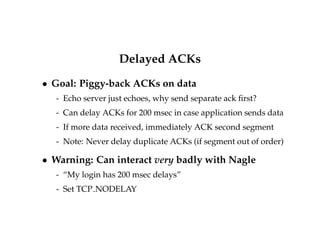
Delayed ACKs 
 Goal: Piggy-back ACKs on data 
- Echo server just echoes, why send separate ack first? 
- Can delay ACKs for 200 msec in case application sends data 
- If more data received, immediately ACK second segment 
- Note: Never delay duplicate ACKs (if segment out of order) 
 Warning: Can interact very badly with Nagle 
- “My login has 200 msec delays” 
- Set TCP NODELAY
Retransmission 
 TCP dynamically estimates round trip time 
 If segment goes unacknowledged, must retransmit 
 Use exponential backoff (in case loss from 
congestion) 
 After 10 minutes, give up and reset connection 
 Problem: Don’t necessarily want to halt everything 
for one lost packet 
- Lecture 5 will explain fast retransmit optimization
Other details 
 Persist timer 
- Sender can block because of 0-sized receive window 
- Receiver may open window, but ACK message lost 
- Sender keeps probing (sending one byte beyond window) 
 Keep-alives [RFC 1122] 
- Detect dead connection even when no data to send 
- E.g., remote login server, and client rebooted 
- Solution: Send “illegal” segments with no data and already 
acknowledged sequence number (SND.NXT-1) 
- Or can include one byte of garbage data 
- Remote side will RST (if rebooted), or timeout (if crashed)
Summary 
 User datagram protocol (UDP) 
 Packet checksums 
 Reliability: sliding window 
 TCP connection setup 
 TCP sliding windows, retransmissions, and 
acknowledgments 
 Using windows for flow control

Computer network (11)

  • 1.
    Lecture 3: Transportand Reliability
  • 2.
    Overview End-to-endmodel User datagram protocol (UDP) Packet checksums Reliability: sliding window TCP connection setup TCP windows, retransmissions, and acknowledgments
  • 3.
    An Application Viewof theWorld Internet client server Why doesn’t the network help more? - Compress data - Reformat/improve/translate requests - Respond with cached data - Secure communications - Migrate connections across networks
  • 4.
    End-to-End Model Thefunction in question can completely and correctly be implemented only with the knowledge and help of the application standing at the end points of the communication system. Therefore, providing that questioned function as a feature of the communication system itself is not possible. (Sometimes an incomplete version of the function provided by the communication system may be useful as a performance enhancement.) We call this line of reasoning. . . “the end-to-end argument.” – Saltzer, Reed, and Clark, 1984
  • 5.
    Strong End-to-End Thenetwork’s job is to transmit datagrams as efficiently and flexibly as possible. Everything else should be done at the fringes. . . – [RFC 1958] Why?
  • 6.
    Example: File Transfer What can go wrong? - File might not arrive at receiver - File could be corrupted in transit How can we be sure a file arrives successfully? - Send acknowledgment to ensure file arrived at destination - Use checksum to ensure data has not been corrupted Why do something in the middle? - Network often drops packets because of congestion, sometimes corrupts packets because of transmission errors - Cheaper to resend one packet than whole file - . . . or to re-send over one link than through whole network
  • 7.
    Link-by-link reliability Link-by-link reliability is not sufficient - MIT network did link-by-link ack and checksum - Thought transmission was most likely source or errors - But problem arose from bad RAM in router - Ended up corrupting a lot of MULTICS source code Principle applies even above the network layer - E.g., Google learned disk error-correction insufficient. . . GFS keeps its own application-layer checkums
  • 8.
    End-to-end netneutrality “Dumb” network clearly beneficial. . . - But what if ISPs want to do complex things? Require ISPs to treat everyone’s traffic equally? Pro: prevent extortion from last-mile duopoly - Create a hugely profitable business (next Google)? - Seeing $$$s, ISPs could charge you to reach their customers Con: reduces ISP flexibility to cope with change - E.g., new applications that clog the network Current FCC strongly in favor of Net neutrality
  • 9.
    FCC net neutralityhistory 2002: Classifies cable modems as information services - Much less regulated than telephone or TV 2005: FCC issues Internet Policy Statement: - Users should be able to 1) access any lawful content, 2) run any applications, 3) use any devices, and 4) enjoy competition between network, application, and content providers. 2007: Comcast forges RSTs to BitTorrent 2008: FCC finds Comcast in violation of policy 2009: FCC proposes 2 more network guidelines - ISPs should 5) treat content/applications/services in nondiscriminatory manner, and 6) provide transparency 2010: Court finds FCC lacks authority to regulate ISPs
  • 10.
    Transport Protocol Review HTTP NV TFTP … FTP TCP UDP IP NET1 NET2 NETn Transport protocols sit on top of the network layer (IP) - IP unreliably delivers packets to a host Can provide: - Application-level multiplexing (“ports”) - Error detection, reliability, etc.
  • 11.
    UDP – userdatagram protocol 0 16 31 SrcPort DstPort Length Checksum Data Unreliable and unordered datagram service Adds multiplexing, checksum on whole packet No flow control, reliability, or order guarantees Endpoints identified by ports Checksum aids in error detection
  • 12.
    Error detection Transmission errors definitely happen - Cosmic rays, radio interference, etc. - If error probability is 230, that’s 1 error per 128 MB! Some link-layer protocols provide error detection - But UDP/IP must work over many link layers - Not all links on a path may have error detection - Moreover, recall end-to-end argument! Need end-to-end check UDP detects errors with a checksum - Compute small checksum value, like a hash of the packet - If packet corrupted in transit, checksum likely to be wrong - Similar checksum on IP header, but doesn’t cover payload
  • 13.
    Checksum algorithms Good checksum algorithms - Should detect errors that are likely to happen (E.g., should detect any single bit error) - Should be efficient to compute IP, UDP, and TCP use 1s complement sum: - Set checksum field to 0 - Sum all 16-bit words in pkt - Add any carry bits back in (So 0x8000 + 0x8000 = 0x0001) - Flip bits (sum = ~sum;) to get checksum (0xf0f0 ! 0x0f0f), Unless sum is 0xffff, then checksum just 0xffff - To check: Sum whole packet (including sum), should get 0xffff
  • 14.
    UDP pseudo-header 01 2 3 0 1 2 3 4 5 6 7 8 9 0 1 2 3 4 5 6 7 8 9 0 1 2 3 4 5 6 7 8 9 0 1 Source IP address Destination IP address Zero Protocol (=17) UDP length Source Port Destination Port UDP Payload Checksum actually includes “pseudo-header” - Not transmitted, just pre-pended to compute checksum - Ensures UDP checksum includes IP addresses Trick question: Is UDP a layer on top of IP?
  • 15.
    How good isUDP/IP checksum? + Very fast to compute in software - Same implementation works on big little endian CPUs 16 bits is not very long (misses 1=216 errors) + Checksum does catch any 1-bit error But not any two-bit error - E.g., increment one word ending 0, decrement one ending 1 Checksum also optional on UDP - All 0s means no checksum calculated - If checksum word gets wiped to 0 as part of error, bad news Good thing most link layers have stronger checksums Next problem: If you discard bad packets, how to ensure reliable delivery? (E.g., stop wait lab 1)
  • 16.
    Effect of RTTon performance Stop wait goodput depends on Round-Trip Time (RTT) - Capped by packet size=RTT regardless of underlying link b/w Need pipelineing for goodput to approach link throughput
  • 17.
    Sliding window protocol Addresses problem of keeping the pipe full - Generalize previous protocol with 1-bit counter - Allow multiple outstanding (unACKed) frames - Upper bound on unACKed frames, called window Sender Receiver Time … …
  • 18.
    SW sender Assign sequence number to each frame (SeqNum) Maintain three state variables: - SendWindow Size (SWS) - Last Acknowledgment Received (LAR) - Last Frame Sent (LFS) £ SWS … … LAR LFS Maintain invariant: LFS LAR SWS Advance LAR when ACK arrives Buffer up to SWS frames
  • 19.
    SW receiver Maintain three state variables - Receive Window Size (RWS) - Largest Acceptable Frame (LAF) - Last Frame Received (LFR) £ RWS … … LFR LAF Maintain invariant: LAF LFR RWS
  • 20.
    SW receiver, continued When frame #SeqNum arrives: - if LFR SeqNum LFA accept - if SeqNum LFR or SeqNum LFA discarded Send cumulative ACKs - I.e., ACK n means received all packets w. SeqNo n - E.g., if received packets 1; 2; 3; 5, must ACK 3 Or can alternatively use TCP-style ACKs, which specify first pkt. not received - E.g., if received packets 1; 2; 3; 5, must ACK 4, not 3 - Note Labs 1 and 2 use TCP-style cumulative ACKs
  • 21.
    Sequence number space How big should RWS be? - At least 1. No bigger than SWS (Don’t accept a packet the sender shouldn’t have sent) How many distinct sequence numbers needed? If RWS=1, need at least SWS+1 - This protocoal is often called “Go-Back-N” If RWS=SWS, need at least 2SWS - Otherwise, bad news if ACKs are lost - Sender may retransmit a window that was already received - Receiver will think retransmissions are from next window Generally need at least RWS+SWS - RWS packets in unknown state (ACK may/may not be lost) - SWS packets in flight must not overflow sequence space
  • 22.
    High-level view ofTCP Application process Write bytes TCP Send buffer Segment Segment Segment Transmit segments Application process Read bytes TCP Receive buffer … … … Full duplex, connection-oriented byte stream Flow control - If one end stops reading, writes at other eventually block/fail Congestion control - Keeps sender from overrunning network [more in lecture 5]
  • 23.
    TCP segment 01 2 3 0 1 2 3 4 5 6 7 8 9 0 1 2 3 4 5 6 7 8 9 0 1 2 3 4 5 6 7 8 9 0 1 source port destination port sequence number acknowledgment number data offset reserved Window UR data G A P R S F CK SH ST YN IN checksum urgent pointer options padding
  • 24.
    TCP fields Ports Seq no. – segment position in byte stream - Unlike Lab 1, sequence #s corresponds to bytes, not packets Ack no. – seq no. sender expects to receive next Data offset – # of 4-byte header option words Window – willing to receive - Lets receiver limit SWS (possibly to 0) for flow control (more in a few slides) Checksum Urgent pointer
  • 25.
    TCP Flags URG – urgent data present ACK – ack no. valid (all but first segment) PSH – push data up to application immediately RST – reset connection SYN – “synchronize” establishes connection FIN – close connection
  • 26.
    A TCP Connection(no data) orchard.48150 essex.discard: S 1871560457:1871560457(0) win 16384 essex.discard orchard.48150: S 3249357518:3249357518(0) ack 1871560458 win 17376 orchard.48150 essex.discard: . ack 1 win 17376 orchard.48150 essex.discard: F 1:1(0) ack 1 win 17376 essex.discard orchard.48150: . ack 2 win 17376 essex.discard orchard.48150: F 1:1(0) ack 2 win 17376 orchard.48150 essex.discard: . ack 2 win 17375
  • 27.
    Connection establishment Activeparticipant (client) Passive participant (server) SYN, SequenceNum = x SYN + ACK, SequenceNum = y, ACK, Acknowledgment = y + 1 Acknowledgment = x + 1 Need SYN packet in each direction - Typically second SYN also acknowledges first - Supports “simultaneous open,” seldom used in practice If no program listening: server sends RST If server backlog exceeded: ignore SYN If no SYN-ACK received: retry, timeout
  • 28.
    Connection termination FIN bit says no more data to send - Caused by close or shutdown on sending end - Both sides must send FIN to close a connection Typical close: - A ! B: FIN, seq SA, ack SB - B ! A: ack SA + 1 - B ! A: FIN, seq SB, ack SA + 1 - A ! B: ack SB + 1 Can also have simultaneous close After last message, can A and B forget about closed socket?
  • 29.
  • 30.
    TIME WAIT Problems with closed socket - What if final ack is lost in the network? - What if the same port pair is immediately reused for a new connection? (Old packets might still be floating around.) Solution: “active” closer goes into TIME WAIT - Active close is sending FIN before receiving one - After receiving ACK and FIN, keep socket around for 2MSL (twice the “maximum segment lifetime”) Can pose problems with servers - OS has too many sockets in TIME WAIT, slows things down Hack: Can send RST and delete socket, set SO LINGER socket option to time 0 (useful for benchmark programs) - OS won’t let you re-start server because port still in use SO REUSEADDR option lets you re-bind used port number
  • 31.
    State summary [RFC793] CLOSED LISTEN Active open/SYN SYN_RCVD SYN_SENT ESTABLISHED CLOSE_WAIT Close/FIN CLOSING LAST_ACK TIME_WAIT FIN_WAIT_1 FIN_WAIT_2 Passive open Close Send/SYN SYN/SYN + ACK SYN + ACK/ACK SYN/SYN + ACK ACK Close/FIN Close/FIN FIN/ACK FIN/ACK ACK + FIN/ACK Timeout after two segment lifetimes FIN/ACK ACK ACK ACK Close CLOSED
  • 32.
    Sending data Bulk data sent in MSS-sized segments - Chosen to avoid fragmentation (e.g., 1460 on ethernet LAN) - Write of 8K might use 6 segments—PSH set on last one - PSH avoids unnecessary context switches on receiver Sender’s OS can delay sends to get full segments - Nagle algorithm: Only one unacknowledged short segment - TCP NODELAY option avoids this behavior Segments may arrive out of order - Sequence number used to reassemble in order Window achieves flow control - Receiver sets max window w. SO RCVBUF - If window 0 and sender’s buffer full, write will block or return EAGAIN
  • 33.
    Sliding window revisited Sending application LastByteWritten TCP LastByteAcked LastByteSent Receiving application LastByteRead TCP NextByteExpected LastByteRcvd (a) (b) Used to guarantee reliable in-order delivery New: Used for flow control - Instead of fixed window size, receiver sends AdvertisedWindow in window field of TCP header Lecture 5: used for congestion control - SWS = min(AdvertisedWindow; CongestionWindow)
  • 34.
    A TCP connection(3 byte echo) orchard.38497 essex.echo: S 1968414760:1968414760(0) win 16384 essex.echo orchard.38497: S 3349542637:3349542637(0) ack 1968414761 win 17376 orchard.38497 essex.echo: . ack 1 win 17376 orchard.38497 essex.echo: P 1:4(3) ack 1 win 17376 essex.echo orchard.38497: . ack 4 win 17376 essex.echo orchard.38497: P 1:4(3) ack 4 win 17376 orchard.38497 essex.echo: . ack 4 win 17376 orchard.38497 essex.echo: F 4:4(0) ack 4 win 17376 essex.echo orchard.38497: . ack 5 win 17376 essex.echo orchard.38497: F 4:4(0) ack 5 win 17376 orchard.38497 essex.echo: . ack 5 win 17375
  • 35.
    Delayed ACKs Goal: Piggy-back ACKs on data - Echo server just echoes, why send separate ack first? - Can delay ACKs for 200 msec in case application sends data - If more data received, immediately ACK second segment - Note: Never delay duplicate ACKs (if segment out of order) Warning: Can interact very badly with Nagle - “My login has 200 msec delays” - Set TCP NODELAY
  • 36.
    Retransmission TCPdynamically estimates round trip time If segment goes unacknowledged, must retransmit Use exponential backoff (in case loss from congestion) After 10 minutes, give up and reset connection Problem: Don’t necessarily want to halt everything for one lost packet - Lecture 5 will explain fast retransmit optimization
  • 37.
    Other details Persist timer - Sender can block because of 0-sized receive window - Receiver may open window, but ACK message lost - Sender keeps probing (sending one byte beyond window) Keep-alives [RFC 1122] - Detect dead connection even when no data to send - E.g., remote login server, and client rebooted - Solution: Send “illegal” segments with no data and already acknowledged sequence number (SND.NXT-1) - Or can include one byte of garbage data - Remote side will RST (if rebooted), or timeout (if crashed)
  • 38.
    Summary Userdatagram protocol (UDP) Packet checksums Reliability: sliding window TCP connection setup TCP sliding windows, retransmissions, and acknowledgments Using windows for flow control