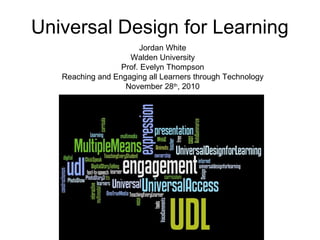
Universal Design for Learning
Jordan White
Walden University
Prof. Evelyn Thompson
Reaching and Engaging all Learners through Technology
November 28th
, 2010
What is UDL?
• Universal Design for Learning is an
approach with its roots in architecture that
helps create a curriculum in which
everyone can succeed.
• Just as building are to be used and
accessed by the maximum number of
people, UDL is trying to allow for the
maximum amount of learners.
http://www.cast.org/research/udl/index.html
Inspirations for UDL
Language selection
Braille for the
seeing impaired
Audio jacks for the hearing
impaired
This ATM is
outfitted with
many design
features so the
most amount of
people can use it
effectively.
Presentation
Expression Engagement
3 Principles of UDL3 Principles of UDL
Presentation
• The presentation portion of UDL is how
students receive the lesson or information.
Students can
read the
information
individually.
Students can explore
websites in order to
familiarize themselves. Lecture or presentation
modes with an
instructor and pictures.
A film or movie could be used
to present information to
students.
Expression
• This principle offers students many output
modes to display the knowledge gained.
Podcasting offers
an outlet for
learners to
describe their
learning.
Students can create
a website to show
and exhibit their
knowledge.
Collaborative
learning can be
shown with the
implementation of
a wiki.
Engagement
• Students are engaged and engrossed by
the material and lesson to motivate each
student to do their best to learn.
Technology and UDL
• Technology facilitates UDL because it
offers so many avenues for students to
absorb and display their knowledge.
• For example, students can express their
knowledge in many different ways using
technology.
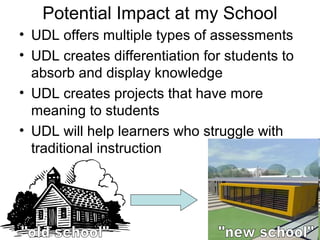
Potential Impact at my School
• UDL offers multiple types of assessments
• UDL creates differentiation for students to
absorb and display knowledge
• UDL creates projects that have more
meaning to students
• UDL will help learners who struggle with
traditional instruction
Brain Research and UDL
• The brain has three distinct sets of
networks that must work in conjunction in
order for learning to take place.
Recognition Strategic
Affective
Recognition
• This network of
the brain is
responsible for
identifying and
recalling
images or
information.
(Rose, D., & Meyer, A., 2002)
Taken from CAST website
Strategic
• This network of
the brain is
specific to
carrying out the
process that is
related to the
learning.
(Rose, D., & Meyer, A., 2002)
Taken from CAST website
Affective
• This network
of the brain is
responsible
for
sequencing
material.
(Rose, D., & Meyer, A., 2002)
Taken from CAST website
How does UDL support Cultural
Diversity?
• UDL will allow students of all learning and
expression types to be reached
educationally.
• More students will be able to succeed at a
higher level and have a more profound
impact.
CAST Tools
• UDL Lesson Builder
• Teaching Every Student
How can my school use it?
• My school can adopt this model to easily
assist more students with learning that is
more fun and relevant to each student.
Resources
Center for Applied Special Technology
(CAST), (2010) Universal Design for
Learning.
Rose, D., & Meyer, A. (2002). Teaching
Every Student in the Digital Age: Universal
Design for Learning.

App4 whitej

  • 1.
    Universal Design forLearning Jordan White Walden University Prof. Evelyn Thompson Reaching and Engaging all Learners through Technology November 28th , 2010
  • 2.
    What is UDL? •Universal Design for Learning is an approach with its roots in architecture that helps create a curriculum in which everyone can succeed. • Just as building are to be used and accessed by the maximum number of people, UDL is trying to allow for the maximum amount of learners. http://www.cast.org/research/udl/index.html
  • 3.
    Inspirations for UDL Languageselection Braille for the seeing impaired Audio jacks for the hearing impaired This ATM is outfitted with many design features so the most amount of people can use it effectively.
  • 4.
  • 5.
    Presentation • The presentationportion of UDL is how students receive the lesson or information. Students can read the information individually. Students can explore websites in order to familiarize themselves. Lecture or presentation modes with an instructor and pictures. A film or movie could be used to present information to students.
  • 6.
    Expression • This principleoffers students many output modes to display the knowledge gained. Podcasting offers an outlet for learners to describe their learning. Students can create a website to show and exhibit their knowledge. Collaborative learning can be shown with the implementation of a wiki.
  • 7.
    Engagement • Students areengaged and engrossed by the material and lesson to motivate each student to do their best to learn.
  • 8.
    Technology and UDL •Technology facilitates UDL because it offers so many avenues for students to absorb and display their knowledge. • For example, students can express their knowledge in many different ways using technology.
  • 9.
    Potential Impact atmy School • UDL offers multiple types of assessments • UDL creates differentiation for students to absorb and display knowledge • UDL creates projects that have more meaning to students • UDL will help learners who struggle with traditional instruction
  • 10.
    Brain Research andUDL • The brain has three distinct sets of networks that must work in conjunction in order for learning to take place. Recognition Strategic Affective
  • 11.
    Recognition • This networkof the brain is responsible for identifying and recalling images or information. (Rose, D., & Meyer, A., 2002) Taken from CAST website
  • 12.
    Strategic • This networkof the brain is specific to carrying out the process that is related to the learning. (Rose, D., & Meyer, A., 2002) Taken from CAST website
  • 13.
    Affective • This network ofthe brain is responsible for sequencing material. (Rose, D., & Meyer, A., 2002) Taken from CAST website
  • 14.
    How does UDLsupport Cultural Diversity? • UDL will allow students of all learning and expression types to be reached educationally. • More students will be able to succeed at a higher level and have a more profound impact.
  • 15.
    CAST Tools • UDLLesson Builder • Teaching Every Student
  • 16.
    How can myschool use it? • My school can adopt this model to easily assist more students with learning that is more fun and relevant to each student.
  • 17.
    Resources Center for AppliedSpecial Technology (CAST), (2010) Universal Design for Learning. Rose, D., & Meyer, A. (2002). Teaching Every Student in the Digital Age: Universal Design for Learning.