






Analytical Method for
Asphalt Concrete Mix
Design
Presented by
PENKI RAMU
14011D2211
Analytical Method for Asphalt Concrete Mix Design by PENKI RAMU is licensed under a Creative Commons
Attribution 4.0 International License.
CONTENTS
• Introduction
• Literature Review
• Methodology Adopted
• Results
• Conclusion
• References
Introduction
• 3000 metric ton/ day as a by-product
• This leads to serious environmental pollution.
• Porosity and Permeability of the top soil reduced.
• Ground water level has gone down to deeper
levels.
• The fine dust reduces the fertility of the soil by
increasing its alkalinity.
• Contamination of ground water, drainage problem.
Introduction
• The mix design involves three important steps
– selection of aggregates
– aggregates gradation
– proportion of aggregates.
• Selection of aggregates:
• qualities of a bituminous paving mixture are dependent
• C.A-Stability(interlocking & frictional resistance of adjacent particles)
• fines or sand- stability failure function in filling the voids
between C.A.
• Mineral filler is largely visualized as a void filling agent.
Introduction
• Aggregates gradation:
– density and stability depends upon Aggregates gradation.
– best gradation is one that produces maximum density.
– Particle arrangement where smaller particles are packed
between larger particles
– Thus reducing the void space between particles.
– This creates more particle-to-particle contact so, increase
stability and reduce water interaction.
– Minimum amount of void space is necessary to:
– provide adequate volume for the binder to occupy
– Provide resistance to frost action for base &sub base
Introduction
• Aggregate Blending:
– Trial and Error: Vary the proportion of
materials until the required aggregate gradation
is achieved.
– Graphical Methods: Triangular chart method
and Roch's method.
• The former is used when only three materials
are to be mixed.
Introduction
• Analytical Method: System of equations are
developed based on the gradation of each
aggregates, required gradation, and solved by
numerical methods.
– With the advent of computer, this method is
becoming popular and is discussed below.
– The resulting solution gives the proportion of
each type of material required for the given
aggregate gradation.
Introduction
• Analytical Method by SOLVER
– the solver can handle problems that involve
many variable cells and can help to find
combinations of variables that maximize or
minimize a target cell.
– İt also specifies one or more constraints-
conditions that must be met for the solution to
be valid
OBJECTIVES
• Utilisation of ‘Granite Powder’ as filler in mix design.
• To Develop a mathematical model for Aggregate Blending
• To Develop a Mathematical model for Aggregate
gradation area estimation.
• Marshall Stability parameters evaluated.
• Evaluation of the filler type on the mastics rheological
properties, before and after ageing.
• As the estimation measure of the change in the
rheological properties caused by the ageing process.
LITERATRURE REVIEW
• Marek Iwanski,Grzegorz Mazurek(2013)
• SMA mixture contained 6.2% of 60/70 bitumen
and 4% SBS polymer.
• Hydrated lime was dosed into SMA mixture to
replace 30% filler mass.
• Bitumen samples were obtained from SMA
wearing course layer at the site of the rut and out
of rut.
• On the basis of rheological properties the
recovered bitumen with hydrated lime had a
positive effect on reducing aging process.
LITERATRURE REVIEW
• Ismat M. Easa Hassan (1987)
• Simpson one-third formula used for unequal intervals.
• A composite generalized Simpson formula for calculating
the area given any even number of intervals is then
presented.
• An extended formula is developed for cases in which the
number of intervals is odd.
• In this paper evaluated irregular boundary area
computation by Simpsons 3/8 rule.
• The trapezoidal rule and Sampson’s rule are the most
common methods for computation of the area of
irregular boundary.
LITERATRURE REVIEW
Priyansh Singh and Gurpreet Singh Walia(2014)
• The aggregate blending can be performed through
trial and errors to more complex computation
techniques.
• In the present scenario every contractor is interested
in the cost effective aggregate blend. The old methods
are acceptable for rough use or to provide initial
solution.
• But in order to obtain a cost effective blend with
satisfactory specification requirement one needs to
accommodate more sizes of aggregates.
• These many constraint cannot be optimized with
traditional method. Hence the more accurate and
capable tools which can resolve these problems are
reviewed in this paper.
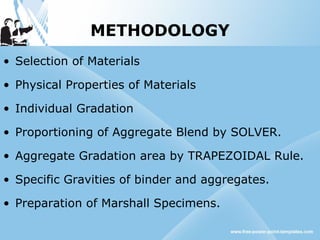
METHODOLOGY
• Selection of Materials
• Physical Properties of Materials
• Individual Gradation
• Proportioning of Aggregate Blend by SOLVER.
• Aggregate Gradation area by TRAPEZOIDAL Rule.
• Specific Gravities of binder and aggregates.
• Preparation of Marshall Specimens.
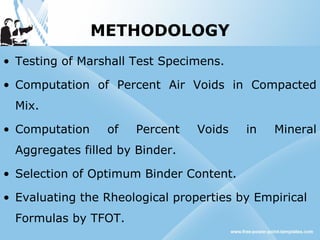
METHODOLOGY
• Testing of Marshall Test Specimens.
• Computation of Percent Air Voids in Compacted
Mix.
• Computation of Percent Voids in Mineral
Aggregates filled by Binder.
• Selection of Optimum Binder Content.
• Evaluating the Rheological properties by Empirical
Formulas by TFOT.
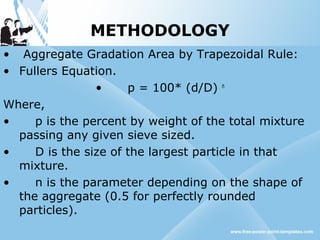
METHODOLOGY
• Aggregate Gradation Area by Trapezoidal Rule:
• Fullers Equation.
• p = 100* (d/D) n
Where,
• p is the percent by weight of the total mixture
passing any given sieve sized.
• D is the size of the largest particle in that
mixture.
• n is the parameter depending on the shape of
the aggregate (0.5 for perfectly rounded
particles).
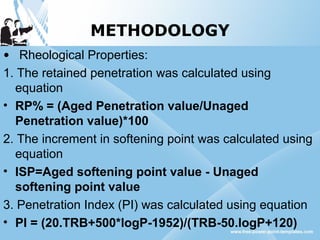
METHODOLOGY
• Rheological Properties:
1. The retained penetration was calculated using
equation
• RP% = (Aged Penetration value/Unaged
Penetration value)*100
2. The increment in softening point was calculated using
equation
• ISP=Aged softening point value - Unaged
softening point value
3. Penetration Index (PI) was calculated using equation
• PI = (20.TRB+500*logP-1952)/(TRB-50.logP+120)
RESULTS
1. Proportion of Aggregates by Excel Solver
• X1=0.125178
• X2=0.223287
• X3=0.19685
• X4=0.434381
• X5=0.020305
RESULTS
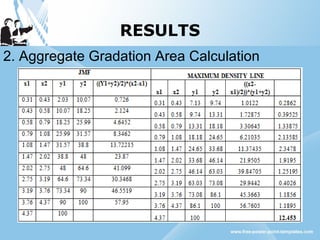
2. Aggregate Gradation Area Calculation
RESULTS
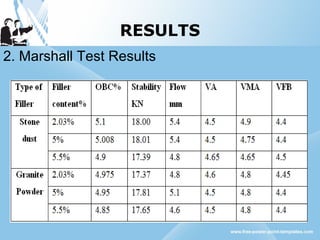
2. Marshall Test Results
RESULTS
3. The retained penetration was calculated using
equation
– RP% For GP = (62/65)*100
= 95.38
– RP% For Stone Dust = (63/65)*100
= 96.92
4. The increment in softening point
– ISP for GP = 57.5-48.1
= 9.4
– ISP for Stone Dust = 57-48.1
= 8.9
RESULTS
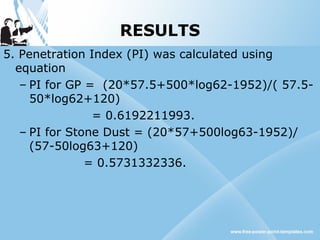
5. Penetration Index (PI) was calculated using
equation
– PI for GP = (20*57.5+500*log62-1952)/( 57.5-
50*log62+120)
= 0.6192211993.
– PI for Stone Dust = (20*57+500log63-1952)/
(57-50log63+120)
= 0.5731332336.
CONCLUSIONS
• Reducing Environment Pollution
– land pollution
– water logging problems
– fertility power
– ground water contamination
• Excel Solver (Linear Optimization) can be applied
in the field
– to quickly and accurately assess the proper aggregate
proportioning.
CONCLUSIONS
• The area between the maximum density line and job mix
formula curve by using Trapezoidal Rule.
– which area is more that area is having more air voids at
different binder contents.
– By using the model a lot of time is saved as it indicates the
occurrence of air voids based upon the area obtained.
CONCLUSIONS
• The addition of granite dust to asphalt concrete can
produce properties comparable to the conventional
asphalt concrete mixes with stone dust as filler.
• These fillers can be used up to 8 % in asphalt
concrete mixes.
• But it is suggested to use them in the range of 2 to
5.5 % initially to observe their performance in
field.
CONCLUSIONS
• The addition of the Granite Powder to the binder
– decrease the penetration value
– increase the softening point
– increase the Penetration Index.
• The PI value of the bitumen increases as more
Granite Powder is added to the bitumen.
– increased in stiffness (hardness)
– improve the temperature Susceptability
CONCLUSIONS
• Based on PI value,
– higher PI are more resistant to
•low temperature cracking
•permanent deformation (cracking).
• The Granite Powder has influenced on the aging
process of the bitumen samples.
•ensured a greater rut resistance
•resistance to climatic factors.
DISCUSSIONS
• A widely used equation to describe a maximum density
gradation was developed by Fuller and Thompson in 1907.
• Dense or Well Graded:
• Refers to a gradation that is near the FHWA’s 0.45 power curve
for maximum density.
• The most common HMA and PCC mix designs in the U.S. tend
to use dense graded aggregate. Typical gradations are near the
0.45 power curve but not right on it.
• Generally, a true maximum density gradation (exactly on the
0.45 power curve) would result in unacceptably low VMA.
REFERENCES
1. Saad Issa Sarsam(2015): Modeling Asphalt
Concrete Mix Design Using Least Square
Optimization
2. Priyansh Singh and Gurpreet Singh Walia(2014).:
Review of Optimization Methods for Aggregate
Blending.
3. Khaled A. Kandil and Al-Sayed A. Al-Sobky(2013):
Aggregate Blending Model for Hot-Mix Asphalt
Using Linear Optimization
4. Tumu Swapna(2013): Modelling of Bituminous
mixes, JNTU Hyderabad.
5. Y. Cengiz Toklu(2005): Aggregate Blending Using
Genetic Algorithms
REFERENCES
6.Ismat M.EI Hassan(1987).: Irregular area
computation
7. Said M. Easa and Emre K.can(1985).:
Optimization model for aggregate blending
8.Ahmed, F.A(1983).: Area computation using sailent
boundary points
9.Mario T. Tabucanon, Pakorn Adulbhan and Stephen
S. Y. Chen(1979): A probabilistic programming
model for blending aggregates.
10.Tom V. Mathew and K V Krishna Rao: Dry mix
design NPTEL- IIT Bombay.
11.B. Pollington: Using Excel to solve linear
REFERENCES
13.https://www.quora.com/What is the easiest way to
calculate the area under the curve integral of a graph in
excel/ Kamran Hyder.
14. Dipu Sutradhar*, Mintu Miah, Golam Jilany
Chowdhury, Mohd. Abdus Sobhan(2015): Effect of
Using Waste Material as Filler in Bituminous Mix Design.
15. Olugbenga A. Ehinola, Olugbenga A. Falode and G.
Jonathan(2012): Softening point and Penetration Index
of bitumen from parts of South western Nigeria.
16. Hanaa Mohammed Mahan(2013): Influence of Mineral
Filler- Asphalt Ratio on Asphalt Mixture Performance.
REFERENCES
17.Ravindra Tomar, R K Jain And M K Kostha (2013):EFFECT OF
FILLERS ON BITUMINOUS PAVING MIXES.
18. IRC:111-2009 specifications for dense graded mixes.
19.Afifa Rahman, Syed Ashik Ali*, Sajal Kumar Adhikary and Quazi
Sazzad Hossain (2009): effect of fillers on bituminous paving mixes:
an experimental study.
20.Wojciech GRABOWSKI*, Jarosław WILANOWICZ, Mieczysław
SŁOWIK, Tomasz SOBÓL(2007): Research Into The Influence Of
Short-term Ageing On The Change In The Rheological Properties Of
Mastics Containing Fillers Of Different Origin.
21. Prabir Kumar Das (2014): Ageing of Asphalt Mixtures: Micro-scale
and mixture morphology investigation-Doctoral Thesis.
22. HP Bitumen Hand Book
REFERENCES
23. Prajapati Harshad C, Dr. P. J. Gundaliya(2014): Review on Effect of
Aging on Paving Grade Bitumen using Different Filler Material.
24. Rajan Choudhary , Satish Chandra : GRANITE AND MARBLE
DUSTS AS FILLER IN ASPHALT CONCRETE.
25. Debashish Kar, Mahabir Panda and Jyoti Prakash Giri (2014):
INFLUENCE OF FLY-ASH AS A FILLER IN BITUMINOUS
MIXES.
26. MORT&H 5th
Edition (2013).
27. Marek Iwanski,Grzegorz Mazurek(2013): Hydrated lime as the Anti
Aging Bitumen Agent.
28.Aging of Bitumen by Nazma Presentation.
Thank You

Analytical Method for Asphalt Concrete Mix Design

  • 1.
    Analytical Method for AsphaltConcrete Mix Design Presented by PENKI RAMU 14011D2211 Analytical Method for Asphalt Concrete Mix Design by PENKI RAMU is licensed under a Creative Commons Attribution 4.0 International License.
  • 2.
    CONTENTS • Introduction • LiteratureReview • Methodology Adopted • Results • Conclusion • References
  • 3.
    Introduction • 3000 metricton/ day as a by-product • This leads to serious environmental pollution. • Porosity and Permeability of the top soil reduced. • Ground water level has gone down to deeper levels. • The fine dust reduces the fertility of the soil by increasing its alkalinity. • Contamination of ground water, drainage problem.
  • 4.
    Introduction • The mixdesign involves three important steps – selection of aggregates – aggregates gradation – proportion of aggregates. • Selection of aggregates: • qualities of a bituminous paving mixture are dependent • C.A-Stability(interlocking & frictional resistance of adjacent particles) • fines or sand- stability failure function in filling the voids between C.A. • Mineral filler is largely visualized as a void filling agent.
  • 5.
    Introduction • Aggregates gradation: –density and stability depends upon Aggregates gradation. – best gradation is one that produces maximum density. – Particle arrangement where smaller particles are packed between larger particles – Thus reducing the void space between particles. – This creates more particle-to-particle contact so, increase stability and reduce water interaction. – Minimum amount of void space is necessary to: – provide adequate volume for the binder to occupy – Provide resistance to frost action for base &sub base
  • 6.
    Introduction • Aggregate Blending: –Trial and Error: Vary the proportion of materials until the required aggregate gradation is achieved. – Graphical Methods: Triangular chart method and Roch's method. • The former is used when only three materials are to be mixed.
  • 7.
    Introduction • Analytical Method:System of equations are developed based on the gradation of each aggregates, required gradation, and solved by numerical methods. – With the advent of computer, this method is becoming popular and is discussed below. – The resulting solution gives the proportion of each type of material required for the given aggregate gradation.
  • 8.
    Introduction • Analytical Methodby SOLVER – the solver can handle problems that involve many variable cells and can help to find combinations of variables that maximize or minimize a target cell. – İt also specifies one or more constraints- conditions that must be met for the solution to be valid
  • 9.
    OBJECTIVES • Utilisation of‘Granite Powder’ as filler in mix design. • To Develop a mathematical model for Aggregate Blending • To Develop a Mathematical model for Aggregate gradation area estimation. • Marshall Stability parameters evaluated. • Evaluation of the filler type on the mastics rheological properties, before and after ageing. • As the estimation measure of the change in the rheological properties caused by the ageing process.
  • 10.
    LITERATRURE REVIEW • MarekIwanski,Grzegorz Mazurek(2013) • SMA mixture contained 6.2% of 60/70 bitumen and 4% SBS polymer. • Hydrated lime was dosed into SMA mixture to replace 30% filler mass. • Bitumen samples were obtained from SMA wearing course layer at the site of the rut and out of rut. • On the basis of rheological properties the recovered bitumen with hydrated lime had a positive effect on reducing aging process.
  • 11.
    LITERATRURE REVIEW • IsmatM. Easa Hassan (1987) • Simpson one-third formula used for unequal intervals. • A composite generalized Simpson formula for calculating the area given any even number of intervals is then presented. • An extended formula is developed for cases in which the number of intervals is odd. • In this paper evaluated irregular boundary area computation by Simpsons 3/8 rule. • The trapezoidal rule and Sampson’s rule are the most common methods for computation of the area of irregular boundary.
  • 12.
    LITERATRURE REVIEW Priyansh Singhand Gurpreet Singh Walia(2014) • The aggregate blending can be performed through trial and errors to more complex computation techniques. • In the present scenario every contractor is interested in the cost effective aggregate blend. The old methods are acceptable for rough use or to provide initial solution. • But in order to obtain a cost effective blend with satisfactory specification requirement one needs to accommodate more sizes of aggregates. • These many constraint cannot be optimized with traditional method. Hence the more accurate and capable tools which can resolve these problems are reviewed in this paper.
  • 13.
    METHODOLOGY • Selection ofMaterials • Physical Properties of Materials • Individual Gradation • Proportioning of Aggregate Blend by SOLVER. • Aggregate Gradation area by TRAPEZOIDAL Rule. • Specific Gravities of binder and aggregates. • Preparation of Marshall Specimens.
  • 14.
    METHODOLOGY • Testing ofMarshall Test Specimens. • Computation of Percent Air Voids in Compacted Mix. • Computation of Percent Voids in Mineral Aggregates filled by Binder. • Selection of Optimum Binder Content. • Evaluating the Rheological properties by Empirical Formulas by TFOT.
  • 15.
    METHODOLOGY • Aggregate GradationArea by Trapezoidal Rule: • Fullers Equation. • p = 100* (d/D) n Where, • p is the percent by weight of the total mixture passing any given sieve sized. • D is the size of the largest particle in that mixture. • n is the parameter depending on the shape of the aggregate (0.5 for perfectly rounded particles).
  • 16.
    METHODOLOGY • Rheological Properties: 1.The retained penetration was calculated using equation • RP% = (Aged Penetration value/Unaged Penetration value)*100 2. The increment in softening point was calculated using equation • ISP=Aged softening point value - Unaged softening point value 3. Penetration Index (PI) was calculated using equation • PI = (20.TRB+500*logP-1952)/(TRB-50.logP+120)
  • 17.
    RESULTS 1. Proportion ofAggregates by Excel Solver • X1=0.125178 • X2=0.223287 • X3=0.19685 • X4=0.434381 • X5=0.020305
  • 18.
  • 19.
  • 20.
    RESULTS 3. The retainedpenetration was calculated using equation – RP% For GP = (62/65)*100 = 95.38 – RP% For Stone Dust = (63/65)*100 = 96.92 4. The increment in softening point – ISP for GP = 57.5-48.1 = 9.4 – ISP for Stone Dust = 57-48.1 = 8.9
  • 21.
    RESULTS 5. Penetration Index(PI) was calculated using equation – PI for GP = (20*57.5+500*log62-1952)/( 57.5- 50*log62+120) = 0.6192211993. – PI for Stone Dust = (20*57+500log63-1952)/ (57-50log63+120) = 0.5731332336.
  • 22.
    CONCLUSIONS • Reducing EnvironmentPollution – land pollution – water logging problems – fertility power – ground water contamination • Excel Solver (Linear Optimization) can be applied in the field – to quickly and accurately assess the proper aggregate proportioning.
  • 23.
    CONCLUSIONS • The areabetween the maximum density line and job mix formula curve by using Trapezoidal Rule. – which area is more that area is having more air voids at different binder contents. – By using the model a lot of time is saved as it indicates the occurrence of air voids based upon the area obtained.
  • 24.
    CONCLUSIONS • The additionof granite dust to asphalt concrete can produce properties comparable to the conventional asphalt concrete mixes with stone dust as filler. • These fillers can be used up to 8 % in asphalt concrete mixes. • But it is suggested to use them in the range of 2 to 5.5 % initially to observe their performance in field.
  • 25.
    CONCLUSIONS • The additionof the Granite Powder to the binder – decrease the penetration value – increase the softening point – increase the Penetration Index. • The PI value of the bitumen increases as more Granite Powder is added to the bitumen. – increased in stiffness (hardness) – improve the temperature Susceptability
  • 26.
    CONCLUSIONS • Based onPI value, – higher PI are more resistant to •low temperature cracking •permanent deformation (cracking). • The Granite Powder has influenced on the aging process of the bitumen samples. •ensured a greater rut resistance •resistance to climatic factors.
  • 27.
    DISCUSSIONS • A widelyused equation to describe a maximum density gradation was developed by Fuller and Thompson in 1907. • Dense or Well Graded: • Refers to a gradation that is near the FHWA’s 0.45 power curve for maximum density. • The most common HMA and PCC mix designs in the U.S. tend to use dense graded aggregate. Typical gradations are near the 0.45 power curve but not right on it. • Generally, a true maximum density gradation (exactly on the 0.45 power curve) would result in unacceptably low VMA.
  • 28.
    REFERENCES 1. Saad IssaSarsam(2015): Modeling Asphalt Concrete Mix Design Using Least Square Optimization 2. Priyansh Singh and Gurpreet Singh Walia(2014).: Review of Optimization Methods for Aggregate Blending. 3. Khaled A. Kandil and Al-Sayed A. Al-Sobky(2013): Aggregate Blending Model for Hot-Mix Asphalt Using Linear Optimization 4. Tumu Swapna(2013): Modelling of Bituminous mixes, JNTU Hyderabad. 5. Y. Cengiz Toklu(2005): Aggregate Blending Using Genetic Algorithms
  • 29.
    REFERENCES 6.Ismat M.EI Hassan(1987).:Irregular area computation 7. Said M. Easa and Emre K.can(1985).: Optimization model for aggregate blending 8.Ahmed, F.A(1983).: Area computation using sailent boundary points 9.Mario T. Tabucanon, Pakorn Adulbhan and Stephen S. Y. Chen(1979): A probabilistic programming model for blending aggregates. 10.Tom V. Mathew and K V Krishna Rao: Dry mix design NPTEL- IIT Bombay. 11.B. Pollington: Using Excel to solve linear
  • 30.
    REFERENCES 13.https://www.quora.com/What is theeasiest way to calculate the area under the curve integral of a graph in excel/ Kamran Hyder. 14. Dipu Sutradhar*, Mintu Miah, Golam Jilany Chowdhury, Mohd. Abdus Sobhan(2015): Effect of Using Waste Material as Filler in Bituminous Mix Design. 15. Olugbenga A. Ehinola, Olugbenga A. Falode and G. Jonathan(2012): Softening point and Penetration Index of bitumen from parts of South western Nigeria. 16. Hanaa Mohammed Mahan(2013): Influence of Mineral Filler- Asphalt Ratio on Asphalt Mixture Performance.
  • 31.
    REFERENCES 17.Ravindra Tomar, RK Jain And M K Kostha (2013):EFFECT OF FILLERS ON BITUMINOUS PAVING MIXES. 18. IRC:111-2009 specifications for dense graded mixes. 19.Afifa Rahman, Syed Ashik Ali*, Sajal Kumar Adhikary and Quazi Sazzad Hossain (2009): effect of fillers on bituminous paving mixes: an experimental study. 20.Wojciech GRABOWSKI*, Jarosław WILANOWICZ, Mieczysław SŁOWIK, Tomasz SOBÓL(2007): Research Into The Influence Of Short-term Ageing On The Change In The Rheological Properties Of Mastics Containing Fillers Of Different Origin. 21. Prabir Kumar Das (2014): Ageing of Asphalt Mixtures: Micro-scale and mixture morphology investigation-Doctoral Thesis. 22. HP Bitumen Hand Book
  • 32.
    REFERENCES 23. Prajapati HarshadC, Dr. P. J. Gundaliya(2014): Review on Effect of Aging on Paving Grade Bitumen using Different Filler Material. 24. Rajan Choudhary , Satish Chandra : GRANITE AND MARBLE DUSTS AS FILLER IN ASPHALT CONCRETE. 25. Debashish Kar, Mahabir Panda and Jyoti Prakash Giri (2014): INFLUENCE OF FLY-ASH AS A FILLER IN BITUMINOUS MIXES. 26. MORT&H 5th Edition (2013). 27. Marek Iwanski,Grzegorz Mazurek(2013): Hydrated lime as the Anti Aging Bitumen Agent. 28.Aging of Bitumen by Nazma Presentation.
  • 33.