LZW COMPRESSION
Presented By:
Rabia Nazir
12-Mtech-2015
DEPARTMENT OF COMPUTER SCIENCE & IT
CONTENTS
 Introduction
 Implementation of lzw compression
 Improving lzw compression
 Advantages
 Limitations
 Applications
 Implementation in matlab
 References
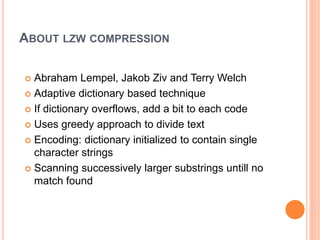
ABOUT LZW COMPRESSION
 Abraham Lempel, Jakob Ziv and Terry Welch
 Adaptive dictionary based technique
 If dictionary overflows, add a bit to each code
 Uses greedy approach to divide text
 Encoding: dictionary initialized to contain single
character strings
 Scanning successively larger substrings untill no
match found
AMERICAN JOURNAL OF ENGINEERING RESEARCH
LZW DATA COMPRESSION [1]
DECODING
ADVANTAGES
 Most popular Lossless compression
 Reduces file size containing repetitive data
 No need to pass string table to decompression
 Table can be recreated
 Fast and simple
INTERNATIONAL JOURNAL OF INFORMATION SCIENCES AND TECHNIQUES
DESIGN AND IMPLEMENTATION OF LZW IMAGE
COMPRESSION[2]
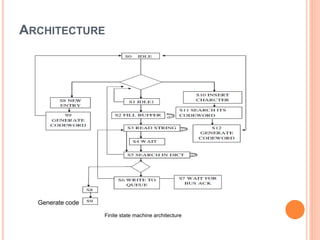
o Evaluated by finite state machine in VHDL
o Dictionary based on content access memory
o Each character replaced by less number of bits
than its ASCII value
 Simulations by Xilinix ISE simulator synthesises
HDL
 Reduction of storage by 60.25% & increased
compression rate by 30.3%
ARCHITECTURE
Finite state machine architecture
Generate code
LIMITATIONS OF LZW COMPRESSION
 Suitable for repetitive data only
 Type of image & number of colors must be
considered
 Can’t be used in images with shadows or gradient
EUROPEAN JOURNAL OF SCIENTIFIC RESEARCH
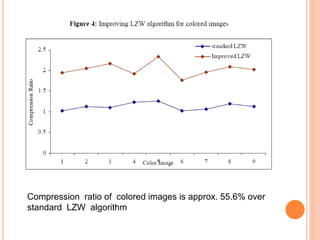
IMPROVING LZW IMAGE COMPRESSION [3]
o Focuses on LZW, Adaptive Huffman Coding and Bit Plane
Slicing
o Adaptive Huffman builds frequency table according to data
statistics
o Bit plane slicing highlights contribution of each bit in
appearance of image
o Slice gray scale images into 8 binary images using bit plane
slicing
o Initialize dictionary with 0 & 1
o Each output associates frequency counter to phase in with
binary codes; to decrease number of bits
o Results show improvement depends on type of image;
correlation between intensities
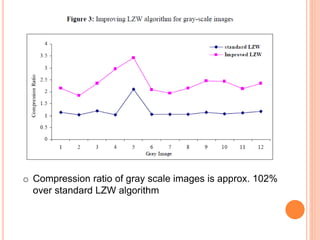
o Compression ratio of gray scale images is approx. 102%
over standard LZW algorithm
Compression ratio of colored images is approx. 55.6% over
standard LZW algorithm
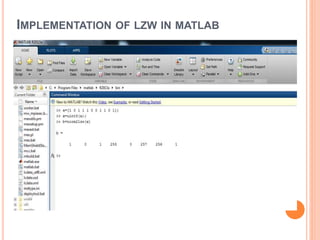
IMPLEMENTATION OF LZW IN MATLAB
APPLICATIONS
 Medical science
 ECG [4]
 Used in GIF, TIFF and PDF files
 Used in programs like PKZIP
 Hardware devices
REFERENCES
[1] Dheemanth H N ,“LZW Data Compression”, American
Journal of Engineering Research (AJER) e-ISSN : 2320-0847 p-
ISSN : 2320-0936 Volume-03, Issue-02, pp-22-26
[2] Simrandeep kaur, Student and V.Sulochana Verma ,Project
Consultant, “Design and Implementation of LZW Data
Compression”, International Journal of Information Sciences and
Techniques (IJIST) Vol.2, No.4, July 2012
[3] Sawsan A. Abu Taleb, Hossam M.J. Musafa, Asma’a M.
Khtoom, Islah K. Gharaybih, “Improving LZW Image
Compression”, European Journal of Scientific Research ISSN
1450-216X Vol.44 No.3 (2010), pp.502-509
[4] Mridul Kumar Mathur, Dr. Akhil Ranjan Garg , Prof. Mukesh
Upadhayay, “Application of LZW Technique for ECG Data
Compression”, International Journal of Advances in Computer
Networks and its Security.
Lzw compression ppt

Lzw compression ppt

  • 1.
    LZW COMPRESSION Presented By: RabiaNazir 12-Mtech-2015 DEPARTMENT OF COMPUTER SCIENCE & IT
  • 2.
    CONTENTS  Introduction  Implementationof lzw compression  Improving lzw compression  Advantages  Limitations  Applications  Implementation in matlab  References
  • 3.
    ABOUT LZW COMPRESSION Abraham Lempel, Jakob Ziv and Terry Welch  Adaptive dictionary based technique  If dictionary overflows, add a bit to each code  Uses greedy approach to divide text  Encoding: dictionary initialized to contain single character strings  Scanning successively larger substrings untill no match found
  • 4.
    AMERICAN JOURNAL OFENGINEERING RESEARCH LZW DATA COMPRESSION [1]
  • 5.
  • 6.
    ADVANTAGES  Most popularLossless compression  Reduces file size containing repetitive data  No need to pass string table to decompression  Table can be recreated  Fast and simple
  • 7.
    INTERNATIONAL JOURNAL OFINFORMATION SCIENCES AND TECHNIQUES DESIGN AND IMPLEMENTATION OF LZW IMAGE COMPRESSION[2] o Evaluated by finite state machine in VHDL o Dictionary based on content access memory o Each character replaced by less number of bits than its ASCII value  Simulations by Xilinix ISE simulator synthesises HDL  Reduction of storage by 60.25% & increased compression rate by 30.3%
  • 8.
    ARCHITECTURE Finite state machinearchitecture Generate code
  • 9.
    LIMITATIONS OF LZWCOMPRESSION  Suitable for repetitive data only  Type of image & number of colors must be considered  Can’t be used in images with shadows or gradient
  • 10.
    EUROPEAN JOURNAL OFSCIENTIFIC RESEARCH IMPROVING LZW IMAGE COMPRESSION [3] o Focuses on LZW, Adaptive Huffman Coding and Bit Plane Slicing o Adaptive Huffman builds frequency table according to data statistics o Bit plane slicing highlights contribution of each bit in appearance of image o Slice gray scale images into 8 binary images using bit plane slicing o Initialize dictionary with 0 & 1 o Each output associates frequency counter to phase in with binary codes; to decrease number of bits o Results show improvement depends on type of image; correlation between intensities
  • 11.
    o Compression ratioof gray scale images is approx. 102% over standard LZW algorithm
  • 12.
    Compression ratio ofcolored images is approx. 55.6% over standard LZW algorithm
  • 13.
  • 14.
    APPLICATIONS  Medical science ECG [4]  Used in GIF, TIFF and PDF files  Used in programs like PKZIP  Hardware devices
  • 15.
    REFERENCES [1] Dheemanth HN ,“LZW Data Compression”, American Journal of Engineering Research (AJER) e-ISSN : 2320-0847 p- ISSN : 2320-0936 Volume-03, Issue-02, pp-22-26 [2] Simrandeep kaur, Student and V.Sulochana Verma ,Project Consultant, “Design and Implementation of LZW Data Compression”, International Journal of Information Sciences and Techniques (IJIST) Vol.2, No.4, July 2012 [3] Sawsan A. Abu Taleb, Hossam M.J. Musafa, Asma’a M. Khtoom, Islah K. Gharaybih, “Improving LZW Image Compression”, European Journal of Scientific Research ISSN 1450-216X Vol.44 No.3 (2010), pp.502-509 [4] Mridul Kumar Mathur, Dr. Akhil Ranjan Garg , Prof. Mukesh Upadhayay, “Application of LZW Technique for ECG Data Compression”, International Journal of Advances in Computer Networks and its Security.