International Research Journal of Engineering and Technology (IRJET) e-ISSN: 2395-0056
Volume: 04 Issue: 12 | Dec-2017 www.irjet.net p-ISSN: 2395-0072
© 2017, IRJET | Impact Factor value: 6.171 | ISO 9001:2008 Certified Journal | Page 1522
“LUNG CANCER DETECTION USING IMAGE PROCESSING TECHNIQUES”
Shradha fule
Student, M.Tech 1st year, Dept. of Electronics and Communication Engineering, Anjuman College of Engineering &
Technology, Nagpur, Maharashtra, India
---------------------------------------------------------------------***---------------------------------------------------------------------
Abstract – As per the technical evolution and latest trend
taken into consideration, we have decided to make research
over biomedical term i.e. Lungs cancer detection. Recently,
image processing techniques are widely used in several
medical areas for image improvement in earlier detectionand
treatment stages. There are various types of cancers i.e. lungs
cancer, Breast cancer, blood cancer, throat cancer, brain
cancer, tongs cancer, mouth cancer etc. Lung cancer is a
disease of abnormal cells multiplying and growing into a
tumor. Cancer cells can be carried away from the lungs in
blood, or lymph fluid that surrounds lung tissue. In thisproject
we access cancer image into MATLAB collected from different
hospitals where present work is going on and this available
image was color image we have access that image into
MATLAB and followed conversion. Imagequalityandaccuracy
is the core factors of this research, image quality assessment
as well as improvement are depending on the enhancement
stage where low pre-processing techniques is used based on
Gabor filter within Gaussian rules. The segmentation and
enhancement procedure is used to obtain the feature
extraction of normal and abnormal image. Relying on general
features, a normality comparison is made. In this research,the
main detected features for accurate images comparison are
pixels percentage and mask-labelling.
Key Words: Enhancement, Segmentation,Feature
extraction, Binarization , Filtering etc.
1.INTRODUCTION –
Lung cancer is of disease of abnormal cells multiplying and
growing into a tumor. Cancer cellscan be carried away from
the lungs in blood, or lymph fluid that surroundslung tissue.
Lymph flows through lymphatic vessels, which drain into
lymph nodes located in the lungs and in the centre of the
chest. Lung cancer often spreads toward the centre of the
chest because the natural flow of lymph out of the lung is
towards the centre of the chest. Metastasis occurs when a
cancer cell leaves the site where it began and moves into a
lymph node or to another part of the body through theblood
streams. Cancer that starts in the lung is called a primary
lung cancer. There are various types of lung cancer such as
Carcinoma, Adenocarcinoma and Squamouscellcarcinomas.
The rank order of cancersfor both malesand femalesamong
Jordanians in 2008 indicated that were 356 cases of lung
cancer accounting for (7.7%) of all newly diagnosed cancer
cases in 2008. Lung cancer affected 297 (13.1%) males and
59 (2.5%) females with a male to female ratio of 5:1 with a
lung cancer ranked second among males and 10th among
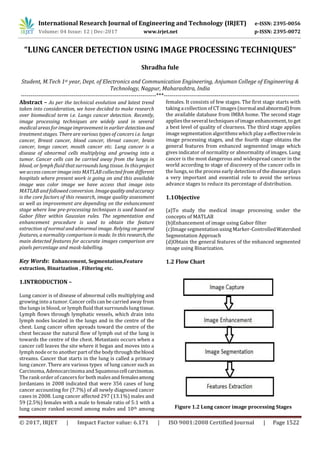
females. It consists of few stages. The first stage starts with
taking a collection of CT images(normalandabnormal)from
the available database from IMBA home. The second stage
appliesthe several techniquesof image enhancement, to get
a best level of quality of clearness. The third stage applies
image segmentation algorithmswhich play a effectiverolein
image processing stages, and the fourth stage obtains the
general features from enhanced segmented image which
gives indicator of normality or abnormality of images. Lung
cancer is the most dangerous and widespread cancer in the
world according to stage of discovery of the cancer cells in
the lungs, so the process early detection of the disease plays
a very important and essential role to avoid the serious
advance stages to reduce its percentage of distribution.
1.1Objective
(a)To study the medical image processing under the
concepts of MATLAB
(b)Enhancement of image using Gabor filter
(c)Image segmentation using Marker-ControlledWatershed
Segmentation Approach
(d)Obtain the general features of the enhanced segmented
image using Binarization.
1.2 Flow Chart
Figure 1.2 Lung cancer image processing Stages
International Research Journal of Engineering and Technology (IRJET) e-ISSN: 2395-0056
Volume: 04 Issue: 12 | Dec-2017 www.irjet.net p-ISSN: 2395-0072
© 2017, IRJET | Impact Factor value: 6.171 | ISO 9001:2008 Certified Journal | Page 1523
1.3 Images used for Database
The presented work uses a set of digital imagesconsistingof
20 small-cell types of lung cancer images, 20 non-small-cell
types of lung cancer images, a total of 40 images (samples)
each of 200 X 200 pixels in size. The images are obtained by
collecting from private hospitals, and browsing the public
database JSRT (Japanese Society of RadiologicalTechnology)
from internet. The digitized images are stored in the JPEG
format with a resolution of 8 bits per plane. All images are
stored as 200 X 200 X 256 JPEG raw data.
2. Image Enhancement
Image enhacement is the processof sharpeningorsmoothen
the image. It improves the image quality and remove the
noise from the image.It provides the better input for the
digital image processing. Image enhancement belongs to
image preprocessing methods. Objective of image
enhancement – process the image (e.g. contrast
improvement, image sharpening ,…) so thatitisbettersuited
for further processing or analysis
Image enhancement techniniques classified into two main
parts:
1.Spatial domain methods- which directlyoperatesonapixel
of a digital image.
2.Frequency domain method-which operates on a fourior
transform of a image. it is the low level processingtechnique.
Image enhancement methodsare based on imagequality.No
mathematical criteria are used for optimizing processing
results. In the image enhancement stage following three
techniques are used: Gabor filter, Auto-enhancement and
Fast Fourier transform techniques
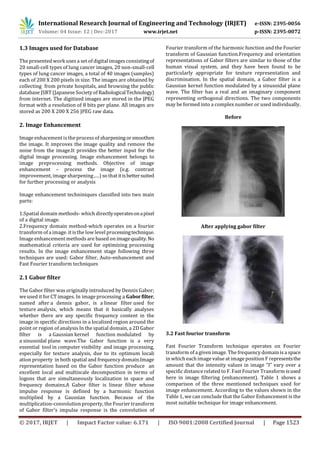
2.1 Gabor filter
The Gabor filter was originally introduced by Dennis Gabor;
we used it for CT images. In image processing a Gaborfilter,
named after a dennis gabor, is a linear filter used for
texture analysis, which means that it basically analyses
whether there are any specific frequency content in the
image in specific directions in a localized region around the
point or region of analysis In the spatial domain, a 2D Gabor
filter is a Gaussian kernel function modulated by
a sinusoidal plane wave.The Gabor function is a very
essential tool in computer visibility and image processing,
especially for texture analysis, due to its optimum locali
ation property in both spatial and frequency domain.Image
representation based on the Gabor function produce an
excellent local and multiscale decomposition in terms of
logons that are simultaneously localization in space and
frequency domains.A Gabor filter is linear filter whose
impulse response is defined by a harmonic function
multiplied by a Gaussian function. Because of the
multiplication-convolution property, the Fourier transform
of Gabor filter’s impulse response is the convolution of
Fourier transform of the harmonic function and the Fourier
transform of Gaussian function.Frequency and orientation
representations of Gabor filters are similar to those of the
human visual system, and they have been found to be
particularly appropriate for texture representation and
discrimination. In the spatial domain, a Gabor filter is a
Gaussian kernel function modulated by a sinusoidal plane
wave. The filter has a real and an imaginary component
representing orthogonal directions. The two components
may be formed into a complex number or used individually.
Before
After applying gabor filter
3.2 Fast fourior transform
Fast Fourier Transform technique operates on Fourier
transform of a given image. The frequency domain is a space
in which each image value at image position F representsthe
amount that the intensity values in image “I” vary over a
specific distance related to F. Fast Fourier Transform isused
here in image filtering (enhancement). Table 1 shows a
comparison of the three mentioned techniques used for
image enhancement. According to the values shown in the
Table 1, we can conclude that the Gabor Enhancement is the
most suitable technique for image enhancement.
International Research Journal of Engineering and Technology (IRJET) e-ISSN: 2395-0056
Volume: 04 Issue: 12 | Dec-2017 www.irjet.net p-ISSN: 2395-0072
© 2017, IRJET | Impact Factor value: 6.171 | ISO 9001:2008 Certified Journal | Page 1524
3.3 Auto-enhancement
Auto enhancement methos is based on the subjective
observation and stastical operation.In this operationsuchas
mean and variance are calculated. The enhancement
percentage in this research was equal to 38.025%.
Table 1
Gabor filter Auto-enhancement FFT filter
80.735% 38.025% 27.51%
3.Image Segmentation
Image segmentation is the process of distribute a digital
image into various segments such as sets of pixels, also
known as super-pixels. The main aim of segmentation is to
change the representation of an image into somethingthatis
easier to analyze . In image segmentation used to locate
objects,edges and boundaries inimages.imagesegmentation
include the process of assigning a label to every pixel in an
image so that pixels with the same label share certain
characteristics.
The output of image segmentation is a set of segments that
collectively cover the entire image, or a set of edges and
boundaries extracted from the image.some of the pixelsina
perticuar region are similar with some characteristic or
property, such as color, intensity, or texture. Adjacent
regions are different with respect to the same
characteristic.there are two techniques used for image
segmentation that are thresholding and watershed masking
approach.
3.1Thresholding Approach
Thresholding is one of the most powerful tools for image
segmentation. The segmented image obtained from
thresholding has the advantages of smaller storage space,
fast processing speed and ease in manipulation, compared
with gray level image which usually contains 256 levels. In
this we have a gray scale image given for a thresholding
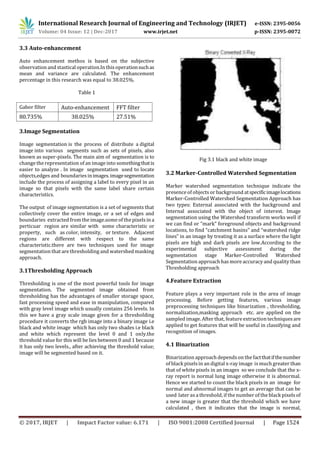
procedure it converts the rgb image into a binary image i.e
black and white image which has only two shades i.e black
and white which represent the level 0 and 1 only.the
threshold value for this will be lies between 0 and 1 because
it has only two levels., after achieving the threshold value;
image will be segmented based on it.
Fig 3.1 black and white image
3.2 Marker-Controlled Watershed Segmentation
Marker watershed segmentation technique indicate the
presence of objects or background atspecificimagelocations
Marker-Controlled Watershed Segmentation Approach has
two types: External associated with the background and
Internal associated with the object of interest. Image
segmentation using the Watershed transform works well if
we can find or “mark” foreground objects and background
locations, to find “catchment basins” and “watershed ridge
lines” in an image by treating it as a surface where the light
pixels are high and dark pixels are low.According to the
experimental subjective assessment during the
segmentation stage Marker-Controlled Watershed
Segmentation approach hasmore accuracy and quality than
Thresholding approach
4.Feature Extraction
Feature plays a very important role in the area of image
processing. Before getting features, various image
preprocessing techniques like binarization , thresholding,
normalization,masking approach etc. are applied on the
sampled image. After that, feature extraction techniquesare
applied to get features that will be useful in classifying and
recognition of images.
4.1 Binarization
Binarization approach dependson the factthatifthenumber
of black pixelsin an digital x-ray image ismuch greater than
that of white pixels in an images so we conclude that the x-
ray report is normal lung image otherwise it is abnormal.
Hence we started to count the black pixels in an image for
normal and abnormal images to get an average that can be
used later as a threshold, if the number of the black pixelsof
a new image is greater that the threshold which we have
calculated , then it indicates that the image is normal,
International Research Journal of Engineering and Technology (IRJET) e-ISSN: 2395-0056
Volume: 04 Issue: 12 | Dec-2017 www.irjet.net p-ISSN: 2395-0072
© 2017, IRJET | Impact Factor value: 6.171 | ISO 9001:2008 Certified Journal | Page 1525
otherwise, if the number of the black pixels is smaller than
the specified value of a threshold, it indicates that the image
is abnormal.
Fig 4.1flowchart for white and black pixel
4.2 Masking approach
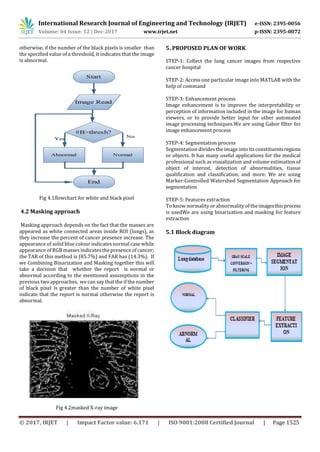
Masking approach depends on the fact that the masses are
appeared as white connected areas inside ROI (lungs), as
they increase the percent of cancer presence increase. The
appearance of solid blue colour indicates normal case while
appearance of RGB massesindicatesthe presence of cancer;
the TAR of this method is (85.7%) and FAR has (14.3%). If
we Combining Binarization and Masking together this will
take a decision that whether the report is normal or
abnormal according to the mentioned assumptions in the
previous two approaches, we can say that the if the number
of black pixel is greater than the number of white pixel
indicate that the report is normal otherwise the report is
abnormal.
Fig 4.2masked X-ray image
5. PROPOSED PLAN OF WORK
STEP-1: Collect the lung cancer images from respective
cancer hospital
STEP-2: Access one particular image into MATLAB with the
help of command
STEP-3: Enhancement process
Image enhancement is to improve the interpretability or
perception of information included in the image for human
viewers, or to provide better input for other automated
image processing techniques.We are using Gabor filter for
image enhancement process
STEP-4: Segmentation process
Segmentation dividesthe image into itsconstituentsregions
or objects. It has many useful applications for the medical
professional such as visualization and volume estimation of
object of interest, detection of abnormalities, tissue
qualification and classification, and more. We are using
Marker-Controlled Watershed Segmentation Approach for
segmentation
STEP-5: Features extraction
To know normality or abnormality of theimagesthisprocess
is usedWe are using binarization and masking for feature
extraction
5.1 Block diagram
International Research Journal of Engineering and Technology (IRJET) e-ISSN: 2395-0056
Volume: 04 Issue: 12 | Dec-2017 www.irjet.net p-ISSN: 2395-0072
© 2017, IRJET | Impact Factor value: 6.171 | ISO 9001:2008 Certified Journal | Page 1526
Fig 5.1result for detected image
Fig 5.2 result for normal image
6. Advantages
(a) Early detection of cancer greatly increases the chances
for successful treatment.
(b) With the use of this treatment is often simpler and more
likely to be effective.
(c)The proposed systems are more efficient and give the
better result.
(d)Provides better image quality and accuracy
7. Applications
[1]It is widely used in many medical areasforearlydetection
of cancer .so the the proper treatment will beprovidedtothe
patient.
[1] Febr Mokhled S. AL-TARAWNEH,“LungCancerDetection
Using Image Processing Techniques”, Leonardo Electronic
Journal of Practices and Technologies, June 2012.
[2] Muhammad Usman, Muhammad Shoaib and Mohamad
Rahal, “Lung Cancer Detection Using Digital Image
Processing”, PIERS Proceedings, Stockholm, Sweden, Aug.
12-15, 2013.
[3] Anita Chaudhary and Sonit Sukhraj Singh, “Multi-
resolution Analysis Technique for Lung Cancer Detection in
Computed Tomographic Images”, International Journal of
Research in Engineering & Applied Sciences, IJREAS Volume
2, Issue 2 January 2012
[2]This image processing technique can also be used to
detect other cancer such as breast cancer and tumor in
our body part.
8.Conclusion
An image processing technique is built to detect diseases at
early stage of cancer so the patient can take the treatment at
early stages.The time factor is major factor to discover the
abnormal tissue in target x-ray images.The accuracy andthe
quality of image is one the major core factor of this
research.Image quality as well as image enhancement stage
were adopted as low pre-processing techniques based on
gabor filter.This technique is efficient forsegmentationstage
so the region of interest for feature extraction obtaining.on
the basis of general features a normality and abnormality
comparison is made.the main feature for detection of
accurate image comparison are pixel percentage and mask
labeling which gives us the indication that the process of
detection this disease plays a very important and essential
role to avoid serious stages and to reduce its percentage
distribution in the world. To obtain moreaccurateresultswe
three stages: Image Enhancementstage,ImageSegmentation
stage and Features Extraction stage.
ACKNOWLEDGEMENT
The success of any work depends on efforts of many
individuals. We would like to take this opportunity to
express our deep gratitude to those who extended their
support and have guided us to complete this project work.
I liketo thank Prof.Mohd.Nasiruddin (HOD)forprovidingus
the necessary information about topic. I would again like to
thank Prof.Dr. Sajid Anwar, Principal of the College, for
providing us the necessary help and facilities we needed.
I express my thanks to all the staff members of Electronics&
communication Engineering department who have directly
or indirectly extended their kind co-operation in the
completion of my reaserch paper.
REFERENCES

Lung Cancer Detection using Image Processing Techniques

  • 1.
    International Research Journalof Engineering and Technology (IRJET) e-ISSN: 2395-0056 Volume: 04 Issue: 12 | Dec-2017 www.irjet.net p-ISSN: 2395-0072 © 2017, IRJET | Impact Factor value: 6.171 | ISO 9001:2008 Certified Journal | Page 1522 “LUNG CANCER DETECTION USING IMAGE PROCESSING TECHNIQUES” Shradha fule Student, M.Tech 1st year, Dept. of Electronics and Communication Engineering, Anjuman College of Engineering & Technology, Nagpur, Maharashtra, India ---------------------------------------------------------------------***--------------------------------------------------------------------- Abstract – As per the technical evolution and latest trend taken into consideration, we have decided to make research over biomedical term i.e. Lungs cancer detection. Recently, image processing techniques are widely used in several medical areas for image improvement in earlier detectionand treatment stages. There are various types of cancers i.e. lungs cancer, Breast cancer, blood cancer, throat cancer, brain cancer, tongs cancer, mouth cancer etc. Lung cancer is a disease of abnormal cells multiplying and growing into a tumor. Cancer cells can be carried away from the lungs in blood, or lymph fluid that surrounds lung tissue. In thisproject we access cancer image into MATLAB collected from different hospitals where present work is going on and this available image was color image we have access that image into MATLAB and followed conversion. Imagequalityandaccuracy is the core factors of this research, image quality assessment as well as improvement are depending on the enhancement stage where low pre-processing techniques is used based on Gabor filter within Gaussian rules. The segmentation and enhancement procedure is used to obtain the feature extraction of normal and abnormal image. Relying on general features, a normality comparison is made. In this research,the main detected features for accurate images comparison are pixels percentage and mask-labelling. Key Words: Enhancement, Segmentation,Feature extraction, Binarization , Filtering etc. 1.INTRODUCTION – Lung cancer is of disease of abnormal cells multiplying and growing into a tumor. Cancer cellscan be carried away from the lungs in blood, or lymph fluid that surroundslung tissue. Lymph flows through lymphatic vessels, which drain into lymph nodes located in the lungs and in the centre of the chest. Lung cancer often spreads toward the centre of the chest because the natural flow of lymph out of the lung is towards the centre of the chest. Metastasis occurs when a cancer cell leaves the site where it began and moves into a lymph node or to another part of the body through theblood streams. Cancer that starts in the lung is called a primary lung cancer. There are various types of lung cancer such as Carcinoma, Adenocarcinoma and Squamouscellcarcinomas. The rank order of cancersfor both malesand femalesamong Jordanians in 2008 indicated that were 356 cases of lung cancer accounting for (7.7%) of all newly diagnosed cancer cases in 2008. Lung cancer affected 297 (13.1%) males and 59 (2.5%) females with a male to female ratio of 5:1 with a lung cancer ranked second among males and 10th among females. It consists of few stages. The first stage starts with taking a collection of CT images(normalandabnormal)from the available database from IMBA home. The second stage appliesthe several techniquesof image enhancement, to get a best level of quality of clearness. The third stage applies image segmentation algorithmswhich play a effectiverolein image processing stages, and the fourth stage obtains the general features from enhanced segmented image which gives indicator of normality or abnormality of images. Lung cancer is the most dangerous and widespread cancer in the world according to stage of discovery of the cancer cells in the lungs, so the process early detection of the disease plays a very important and essential role to avoid the serious advance stages to reduce its percentage of distribution. 1.1Objective (a)To study the medical image processing under the concepts of MATLAB (b)Enhancement of image using Gabor filter (c)Image segmentation using Marker-ControlledWatershed Segmentation Approach (d)Obtain the general features of the enhanced segmented image using Binarization. 1.2 Flow Chart Figure 1.2 Lung cancer image processing Stages
  • 2.
    International Research Journalof Engineering and Technology (IRJET) e-ISSN: 2395-0056 Volume: 04 Issue: 12 | Dec-2017 www.irjet.net p-ISSN: 2395-0072 © 2017, IRJET | Impact Factor value: 6.171 | ISO 9001:2008 Certified Journal | Page 1523 1.3 Images used for Database The presented work uses a set of digital imagesconsistingof 20 small-cell types of lung cancer images, 20 non-small-cell types of lung cancer images, a total of 40 images (samples) each of 200 X 200 pixels in size. The images are obtained by collecting from private hospitals, and browsing the public database JSRT (Japanese Society of RadiologicalTechnology) from internet. The digitized images are stored in the JPEG format with a resolution of 8 bits per plane. All images are stored as 200 X 200 X 256 JPEG raw data. 2. Image Enhancement Image enhacement is the processof sharpeningorsmoothen the image. It improves the image quality and remove the noise from the image.It provides the better input for the digital image processing. Image enhancement belongs to image preprocessing methods. Objective of image enhancement – process the image (e.g. contrast improvement, image sharpening ,…) so thatitisbettersuited for further processing or analysis Image enhancement techniniques classified into two main parts: 1.Spatial domain methods- which directlyoperatesonapixel of a digital image. 2.Frequency domain method-which operates on a fourior transform of a image. it is the low level processingtechnique. Image enhancement methodsare based on imagequality.No mathematical criteria are used for optimizing processing results. In the image enhancement stage following three techniques are used: Gabor filter, Auto-enhancement and Fast Fourier transform techniques 2.1 Gabor filter The Gabor filter was originally introduced by Dennis Gabor; we used it for CT images. In image processing a Gaborfilter, named after a dennis gabor, is a linear filter used for texture analysis, which means that it basically analyses whether there are any specific frequency content in the image in specific directions in a localized region around the point or region of analysis In the spatial domain, a 2D Gabor filter is a Gaussian kernel function modulated by a sinusoidal plane wave.The Gabor function is a very essential tool in computer visibility and image processing, especially for texture analysis, due to its optimum locali ation property in both spatial and frequency domain.Image representation based on the Gabor function produce an excellent local and multiscale decomposition in terms of logons that are simultaneously localization in space and frequency domains.A Gabor filter is linear filter whose impulse response is defined by a harmonic function multiplied by a Gaussian function. Because of the multiplication-convolution property, the Fourier transform of Gabor filter’s impulse response is the convolution of Fourier transform of the harmonic function and the Fourier transform of Gaussian function.Frequency and orientation representations of Gabor filters are similar to those of the human visual system, and they have been found to be particularly appropriate for texture representation and discrimination. In the spatial domain, a Gabor filter is a Gaussian kernel function modulated by a sinusoidal plane wave. The filter has a real and an imaginary component representing orthogonal directions. The two components may be formed into a complex number or used individually. Before After applying gabor filter 3.2 Fast fourior transform Fast Fourier Transform technique operates on Fourier transform of a given image. The frequency domain is a space in which each image value at image position F representsthe amount that the intensity values in image “I” vary over a specific distance related to F. Fast Fourier Transform isused here in image filtering (enhancement). Table 1 shows a comparison of the three mentioned techniques used for image enhancement. According to the values shown in the Table 1, we can conclude that the Gabor Enhancement is the most suitable technique for image enhancement.
  • 3.
    International Research Journalof Engineering and Technology (IRJET) e-ISSN: 2395-0056 Volume: 04 Issue: 12 | Dec-2017 www.irjet.net p-ISSN: 2395-0072 © 2017, IRJET | Impact Factor value: 6.171 | ISO 9001:2008 Certified Journal | Page 1524 3.3 Auto-enhancement Auto enhancement methos is based on the subjective observation and stastical operation.In this operationsuchas mean and variance are calculated. The enhancement percentage in this research was equal to 38.025%. Table 1 Gabor filter Auto-enhancement FFT filter 80.735% 38.025% 27.51% 3.Image Segmentation Image segmentation is the process of distribute a digital image into various segments such as sets of pixels, also known as super-pixels. The main aim of segmentation is to change the representation of an image into somethingthatis easier to analyze . In image segmentation used to locate objects,edges and boundaries inimages.imagesegmentation include the process of assigning a label to every pixel in an image so that pixels with the same label share certain characteristics. The output of image segmentation is a set of segments that collectively cover the entire image, or a set of edges and boundaries extracted from the image.some of the pixelsina perticuar region are similar with some characteristic or property, such as color, intensity, or texture. Adjacent regions are different with respect to the same characteristic.there are two techniques used for image segmentation that are thresholding and watershed masking approach. 3.1Thresholding Approach Thresholding is one of the most powerful tools for image segmentation. The segmented image obtained from thresholding has the advantages of smaller storage space, fast processing speed and ease in manipulation, compared with gray level image which usually contains 256 levels. In this we have a gray scale image given for a thresholding procedure it converts the rgb image into a binary image i.e black and white image which has only two shades i.e black and white which represent the level 0 and 1 only.the threshold value for this will be lies between 0 and 1 because it has only two levels., after achieving the threshold value; image will be segmented based on it. Fig 3.1 black and white image 3.2 Marker-Controlled Watershed Segmentation Marker watershed segmentation technique indicate the presence of objects or background atspecificimagelocations Marker-Controlled Watershed Segmentation Approach has two types: External associated with the background and Internal associated with the object of interest. Image segmentation using the Watershed transform works well if we can find or “mark” foreground objects and background locations, to find “catchment basins” and “watershed ridge lines” in an image by treating it as a surface where the light pixels are high and dark pixels are low.According to the experimental subjective assessment during the segmentation stage Marker-Controlled Watershed Segmentation approach hasmore accuracy and quality than Thresholding approach 4.Feature Extraction Feature plays a very important role in the area of image processing. Before getting features, various image preprocessing techniques like binarization , thresholding, normalization,masking approach etc. are applied on the sampled image. After that, feature extraction techniquesare applied to get features that will be useful in classifying and recognition of images. 4.1 Binarization Binarization approach dependson the factthatifthenumber of black pixelsin an digital x-ray image ismuch greater than that of white pixels in an images so we conclude that the x- ray report is normal lung image otherwise it is abnormal. Hence we started to count the black pixels in an image for normal and abnormal images to get an average that can be used later as a threshold, if the number of the black pixelsof a new image is greater that the threshold which we have calculated , then it indicates that the image is normal,
  • 4.
    International Research Journalof Engineering and Technology (IRJET) e-ISSN: 2395-0056 Volume: 04 Issue: 12 | Dec-2017 www.irjet.net p-ISSN: 2395-0072 © 2017, IRJET | Impact Factor value: 6.171 | ISO 9001:2008 Certified Journal | Page 1525 otherwise, if the number of the black pixels is smaller than the specified value of a threshold, it indicates that the image is abnormal. Fig 4.1flowchart for white and black pixel 4.2 Masking approach Masking approach depends on the fact that the masses are appeared as white connected areas inside ROI (lungs), as they increase the percent of cancer presence increase. The appearance of solid blue colour indicates normal case while appearance of RGB massesindicatesthe presence of cancer; the TAR of this method is (85.7%) and FAR has (14.3%). If we Combining Binarization and Masking together this will take a decision that whether the report is normal or abnormal according to the mentioned assumptions in the previous two approaches, we can say that the if the number of black pixel is greater than the number of white pixel indicate that the report is normal otherwise the report is abnormal. Fig 4.2masked X-ray image 5. PROPOSED PLAN OF WORK STEP-1: Collect the lung cancer images from respective cancer hospital STEP-2: Access one particular image into MATLAB with the help of command STEP-3: Enhancement process Image enhancement is to improve the interpretability or perception of information included in the image for human viewers, or to provide better input for other automated image processing techniques.We are using Gabor filter for image enhancement process STEP-4: Segmentation process Segmentation dividesthe image into itsconstituentsregions or objects. It has many useful applications for the medical professional such as visualization and volume estimation of object of interest, detection of abnormalities, tissue qualification and classification, and more. We are using Marker-Controlled Watershed Segmentation Approach for segmentation STEP-5: Features extraction To know normality or abnormality of theimagesthisprocess is usedWe are using binarization and masking for feature extraction 5.1 Block diagram
  • 5.
    International Research Journalof Engineering and Technology (IRJET) e-ISSN: 2395-0056 Volume: 04 Issue: 12 | Dec-2017 www.irjet.net p-ISSN: 2395-0072 © 2017, IRJET | Impact Factor value: 6.171 | ISO 9001:2008 Certified Journal | Page 1526 Fig 5.1result for detected image Fig 5.2 result for normal image 6. Advantages (a) Early detection of cancer greatly increases the chances for successful treatment. (b) With the use of this treatment is often simpler and more likely to be effective. (c)The proposed systems are more efficient and give the better result. (d)Provides better image quality and accuracy 7. Applications [1]It is widely used in many medical areasforearlydetection of cancer .so the the proper treatment will beprovidedtothe patient. [1] Febr Mokhled S. AL-TARAWNEH,“LungCancerDetection Using Image Processing Techniques”, Leonardo Electronic Journal of Practices and Technologies, June 2012. [2] Muhammad Usman, Muhammad Shoaib and Mohamad Rahal, “Lung Cancer Detection Using Digital Image Processing”, PIERS Proceedings, Stockholm, Sweden, Aug. 12-15, 2013. [3] Anita Chaudhary and Sonit Sukhraj Singh, “Multi- resolution Analysis Technique for Lung Cancer Detection in Computed Tomographic Images”, International Journal of Research in Engineering & Applied Sciences, IJREAS Volume 2, Issue 2 January 2012 [2]This image processing technique can also be used to detect other cancer such as breast cancer and tumor in our body part. 8.Conclusion An image processing technique is built to detect diseases at early stage of cancer so the patient can take the treatment at early stages.The time factor is major factor to discover the abnormal tissue in target x-ray images.The accuracy andthe quality of image is one the major core factor of this research.Image quality as well as image enhancement stage were adopted as low pre-processing techniques based on gabor filter.This technique is efficient forsegmentationstage so the region of interest for feature extraction obtaining.on the basis of general features a normality and abnormality comparison is made.the main feature for detection of accurate image comparison are pixel percentage and mask labeling which gives us the indication that the process of detection this disease plays a very important and essential role to avoid serious stages and to reduce its percentage distribution in the world. To obtain moreaccurateresultswe three stages: Image Enhancementstage,ImageSegmentation stage and Features Extraction stage. ACKNOWLEDGEMENT The success of any work depends on efforts of many individuals. We would like to take this opportunity to express our deep gratitude to those who extended their support and have guided us to complete this project work. I liketo thank Prof.Mohd.Nasiruddin (HOD)forprovidingus the necessary information about topic. I would again like to thank Prof.Dr. Sajid Anwar, Principal of the College, for providing us the necessary help and facilities we needed. I express my thanks to all the staff members of Electronics& communication Engineering department who have directly or indirectly extended their kind co-operation in the completion of my reaserch paper. REFERENCES