IOT IN MEDICAL SYSTYEM
Prepared By
Rayies Ul Ashraf
M Tech, CS&E,
SVCE Bengaluru
Guided By
Mr. Prakasha G
Asst. Professor,
SVCE Bengaluru
OVERVIEW
 Why IoT
 Introduction
 Vision
 Communication channel
 IoMT Applications
 Technologies Enduring IoMT Implementation
 Market Landscape
 Future Prospects and Conclusion
 Advantages
 Disadvantages
 References
WHY IOT?
 The Internet of Things (IoT) ecosystem has a very
complex architecture, in which multiple components
interact with each other to enable various solutions
for the end user.
 This is an interdependent system, which enables
real-time data acquisition, device connectivity, data
transfers, and analytics to control end user
applications.
 IoT provides the connected environment,
comprising the cyber physical systems, which
integrates human intervention with computer-based
systems and facilitates data-driven decision
processes.
INTRODUCTION
 IoMT enables M2M interaction.
 Real time intervention solutions which will
radically transform the healthcare delivery,
affordability and reliability in near future.
 This Technology adoption rate will increase
in coming years to grow this market to reach
$156 Billion by 2020.
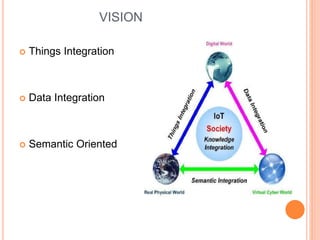
VISION
 Things Integration
 Data Integration
 Semantic Oriented
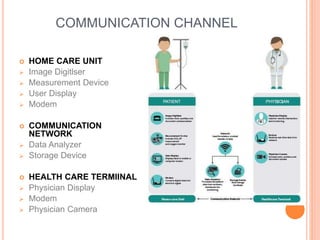
COMMUNICATION CHANNEL
 HOME CARE UNIT
 Image Digitlser
 Measurement Device
 User Display
 Modem
 COMMUNICATION
NETWORK
 Data Analyzer
 Storage Device
 HEALTH CARE TERMIINAL
 Physician Display
 Modem
 Physician Camera
IOMT APPLICATIONS
 Chronic Disease Management
 Remote Assisted Living
 Wellness and Preventive Care
 Remote Intervention
 Improved Drug Management
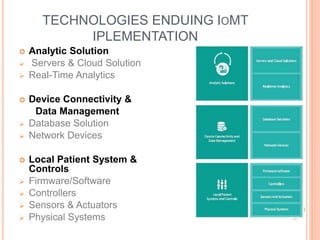
TECHNOLOGIES ENDUING IOMT
IPLEMENTATION
 Analytic Solution
 Servers & Cloud Solution
 Real-Time Analytics
 Device Connectivity &
Data Management
 Database Solution
 Network Devices
 Local Patient System &
Controls
 Firmware/Software
 Controllers
 Sensors & Actuators
 Physical Systems
MARKET LANDSCAPE
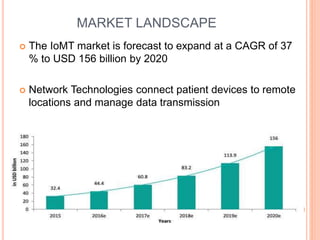
 The IoMT market is forecast to expand at a CAGR of 37
% to USD 156 billion by 2020
 Network Technologies connect patient devices to remote
locations and manage data transmission
FUTURE PROSPECTS AND CONCLUSIONS
 While IoT-based medical technology applications are
still in a nascent stage of development, the
implementation of connected devices could significantly
improve healthcare delivery.
 Considering the benefits and associated challenges,
IoMT seems a promising solution to improve healthcare
monitoring and treatment outcomes
 Recent research and developments in sensors,
networks, cloud storage & computing, as well as
mobility, and big data analytics have evolved enough to
enable the creation of affordable smart medical devices
and a connected healthcare ecosystem.
ADVANTAGES
 Improved Disease Management
 Homecare
 Better Patient Experience
 Decreased Cost
 Keep Patient Safe and Healthy
DISADVANTAGES
 Difficult for hospitals to manage IoT devices.
 Using IoT devices requires Cyber Security
 Costly Equipments
REFERENCES
 Buckley, J. (2006). From RFID to the Internet of Things :
Pervasive networked systems. In Report on the Conference
organized by DG Information Society and Media Networks
and Communication Technologies Directorate , Brussels,
March 6-7.
 Complete RFID Analysis and Forecasts, 2008
2018,www.idtechex.com/researchreports/.
 WANG Hong,Key technology of telemedicine based on 3G
network,//Chinese Hospitals.-2010,14(7):47-50
 T. Kriplean et al., "Physical Access Control for Captured RFID
Data,“ IEEE Pervasive Computing, vol. 6, no. 4, 2007, pp. 48-
55.
 Michael Chui, Markus Löffler, and Roger Roberts, The Internet
of Things; http://tc.indymedia.org/files/bigbrother/internet-spy-
all.pdf
THANK YOU

IoT on Medical System

  • 1.
    IOT IN MEDICALSYSTYEM Prepared By Rayies Ul Ashraf M Tech, CS&E, SVCE Bengaluru Guided By Mr. Prakasha G Asst. Professor, SVCE Bengaluru
  • 2.
    OVERVIEW  Why IoT Introduction  Vision  Communication channel  IoMT Applications  Technologies Enduring IoMT Implementation  Market Landscape  Future Prospects and Conclusion  Advantages  Disadvantages  References
  • 3.
    WHY IOT?  TheInternet of Things (IoT) ecosystem has a very complex architecture, in which multiple components interact with each other to enable various solutions for the end user.  This is an interdependent system, which enables real-time data acquisition, device connectivity, data transfers, and analytics to control end user applications.  IoT provides the connected environment, comprising the cyber physical systems, which integrates human intervention with computer-based systems and facilitates data-driven decision processes.
  • 4.
    INTRODUCTION  IoMT enablesM2M interaction.  Real time intervention solutions which will radically transform the healthcare delivery, affordability and reliability in near future.  This Technology adoption rate will increase in coming years to grow this market to reach $156 Billion by 2020.
  • 5.
    VISION  Things Integration Data Integration  Semantic Oriented
  • 6.
    COMMUNICATION CHANNEL  HOMECARE UNIT  Image Digitlser  Measurement Device  User Display  Modem  COMMUNICATION NETWORK  Data Analyzer  Storage Device  HEALTH CARE TERMIINAL  Physician Display  Modem  Physician Camera
  • 7.
    IOMT APPLICATIONS  ChronicDisease Management  Remote Assisted Living  Wellness and Preventive Care  Remote Intervention  Improved Drug Management
  • 8.
    TECHNOLOGIES ENDUING IOMT IPLEMENTATION Analytic Solution  Servers & Cloud Solution  Real-Time Analytics  Device Connectivity & Data Management  Database Solution  Network Devices  Local Patient System & Controls  Firmware/Software  Controllers  Sensors & Actuators  Physical Systems
  • 9.
    MARKET LANDSCAPE  TheIoMT market is forecast to expand at a CAGR of 37 % to USD 156 billion by 2020  Network Technologies connect patient devices to remote locations and manage data transmission
  • 10.
    FUTURE PROSPECTS ANDCONCLUSIONS  While IoT-based medical technology applications are still in a nascent stage of development, the implementation of connected devices could significantly improve healthcare delivery.  Considering the benefits and associated challenges, IoMT seems a promising solution to improve healthcare monitoring and treatment outcomes  Recent research and developments in sensors, networks, cloud storage & computing, as well as mobility, and big data analytics have evolved enough to enable the creation of affordable smart medical devices and a connected healthcare ecosystem.
  • 11.
    ADVANTAGES  Improved DiseaseManagement  Homecare  Better Patient Experience  Decreased Cost  Keep Patient Safe and Healthy
  • 12.
    DISADVANTAGES  Difficult forhospitals to manage IoT devices.  Using IoT devices requires Cyber Security  Costly Equipments
  • 13.
    REFERENCES  Buckley, J.(2006). From RFID to the Internet of Things : Pervasive networked systems. In Report on the Conference organized by DG Information Society and Media Networks and Communication Technologies Directorate , Brussels, March 6-7.  Complete RFID Analysis and Forecasts, 2008 2018,www.idtechex.com/researchreports/.  WANG Hong,Key technology of telemedicine based on 3G network,//Chinese Hospitals.-2010,14(7):47-50  T. Kriplean et al., "Physical Access Control for Captured RFID Data,“ IEEE Pervasive Computing, vol. 6, no. 4, 2007, pp. 48- 55.  Michael Chui, Markus Löffler, and Roger Roberts, The Internet of Things; http://tc.indymedia.org/files/bigbrother/internet-spy- all.pdf
  • 14.