LUNG CANCER DETECTION FROM CT IMAGES
A PROJECT
ON
BACHELOR OF TECHNOLOGY ( ELECTRONICS & COMMUNICATION)
VEER BAHADUR SINGH PURVANCHAL UNIVERSITY,JAUNPUR
PRESENTING BY,
(Aviral Chaurasia, Prashant Kr Rai & Ayush Singh)
UNDER THE SUPERVISION OF,
Mr. PC YADAV
(Assistant Professor)
SR.NO INDEX PAGE NO.
1 INTRODUCTION
- Cancerous & Non-Cancerous Cell
- Deep Learning Approach
2
3
2 SYSTEM REQUIREMENT
▪ Software & Hardware Required 5
3 DESIGN AND ANALYSIS 6
4 PROPOSED METHODOLOGY
▪ PREPROCESSING
▪ IMAGE ENHANCEMENT
▪ IMAGE SEGMENTATION
-Thresholding
▪ FEATURE EXTRACTION
7-18
5 OBJECTIVES 19
6 RESULT & CONCLUSION 20
7 FUTURE WORK 21
8 SOURCES AND REFERENCES 22
1
INTRODUCTION
• Cancer is a condition in which cells in the body become uncontrolled.
• Lung Cancer starts in the lungs and spread to lymph nodes or the organs such as brain
inside the body.
• Cancer can potential spread to the lung from the other organs. Various CT Scan
image were obtained from various sources.
Lung Cancer may be divided into two sub categories :-
1.Non Cancerous Tumor 2.Cancerous Tumor
Description
Fig1. Cancerous & Non Cancerous Cell
2
1.2 DEEP LEARNING APPROACH
IT is a sub set of machine learning that uses neural network with at least 3 layers compare to a
network with just one layer can delivermore accurate result. BOTH RNN and CNN are used in
deep learning dependingon the application.
This project consists of four major stages, the first stage is Image acquisition, the second stage is Image
Processing Techniques, third stage is consists of Image Segmentation operations & the fourth or the last
stage is Feature Extraction of any image
CT Scan
Images
Preprocessing Segmentation Feature
Extraction
Classification
Cancerous
Non-
Cancerous
Fig2. Deep Learning based general algorithm for classification
3
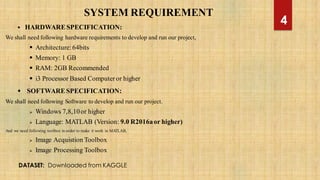
⦁ HARDWARESPECIFICATION:
We shall need following hardware requirements to develop and run our project,
▪ Architecture:64bits
▪ Memory: 1 GB
▪ RAM: 2GB Recommended
▪ i3 Processor Based Computer or higher
⦁ SOFTWARESPECIFICATION:
We shall need following Software to develop and run our project.
➢ Windows 7,8,10or higher
➢ Language: MATLAB (Version: 9.0 R2016aor higher)
And we need following toolbox in order to make it work in MATLAB,
➢ Image Acquistion Toolbox
➢ Image Processing Toolbox
SYSTEM REQUIREMENT
DATASET: Downloaded from KAGGLE
4
DESIGN & ANALYSIS
5
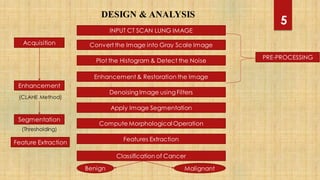
INPUT CT SCAN LUNG IMAGE
Convert the Image into Gray Scale Image
Plot the Histogram & Detect the Noise
Enhancement & Restoration the Image
Denoising Image using Filters
Apply Image Segmentation
Compute Morphological Operation
Features Extraction
Classification of Cancer
PRE-PROCESSING
Acquisition
Enhancement
Segmentation
Feature Extraction
Benign Malignant
(CLAHE Method)
(Thresholding)
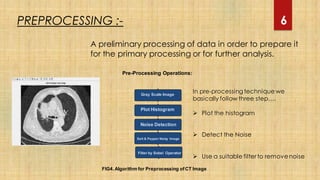
PREPROCESSING :-
A preliminary processing of data in order to prepare it
for the primary processing or for further analysis.
Plot Histogram
Noise Detection
Salt & Pepper Noisy Image
Filter by Sobel Operator
Gray Scale Image
Pre-Processing Operations:
FIG4.Algorithm for Preprocessing ofCT Image
In pre-processing technique we
basically follow three step….
➢ Plot the histogram
➢ Detect the Noise
➢ Use a suitable filter to removenoise
6
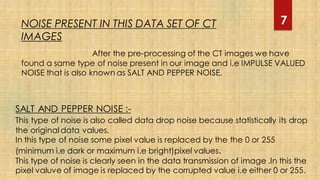
NOISE PRESENT IN THIS DATA SET OF CT
IMAGES
After the pre-processing of the CT images we have
found a same type of noise present in our image and i.e IMPULSE VALUED
NOISE that is also known as SALT AND PEPPER NOISE.
SALT AND PEPPER NOISE :-
This type of noise is also called data drop noise because statistically its drop
the original data values.
In this type of noise some pixel value is replaced by the the 0 or 255
(minimum i.e dark or maximum i.e bright)pixel values.
This type of noise is clearly seen in the data transmission of image .In this the
pixel valuve of image is replaced by the corrupted value i.e either 0 or 255.
7
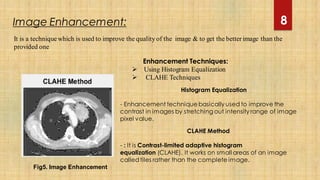
Image Enhancement:
Enhancement Techniques:
➢ Using Histogram Equalization
➢ CLAHE Techniques
Histogram Equalization
- Enhancement technique basically used to improve the
contrast in images by stretching out intensity range of image
pixel value.
It is a techniquewhich is used to improve the quality of the image & to get the betterimage than the
provided one
CLAHE Method
- : It is Contrast-limited adaptive histogram
equalization (CLAHE). It works on small areas of an image
calledtiles rather than the complete image.
8
Fig5. Image Enhancement
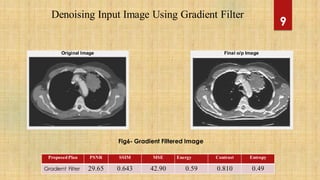
Denoising Input Image Using Gradient Filter
Fig6- Gradient Filtered Image
ProposedPlan PSNR SSIM MSE Energy Contrast Entropy
Gradient Filter 29.65 0.643 42.90 0.59 0.810 0.49
9
Denoising Input Image Using Convolution Filter
Fig7-Convolution Filter
ProposedPlan PSNR SSIM MSE Energy Contrast Entropy
Convolution 27.97 0.624 38.97 0.56 1.098 0.42
10
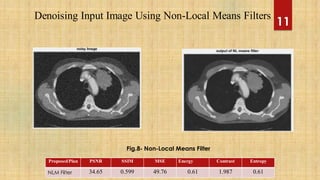
Fig.8- Non-Local Means Filter
ProposedPlan PSNR SSIM MSE Energy Contrast Entropy
NLM Filter 34.65 0.599 49.76 0.61 1.987 0.61
Denoising Input Image Using Non-Local Means Filters
11
Denoising Input Image Using Sobel Filters
Fig9-Sobel Filtered Image
ProposedPlan PSNR SSIM MSE Energy Contrast Entropy
Sobel Filter 38.99 0.494 51.87 0.64 2.011 0.68
12
Our Proposed Method
Sobel filter
“THE SOBEL METHOD or SOBEL FILTER IS A GRADIENT BASED METHOD THAT LOOKS FOR STRONG CHANGES IN
THE FIRST DERIVATIVE OF AN IMAGE.”
The sobel filter edge detectoruses a pair of 3*3 convolutionmasks, one estimating the gradient in the
x - direction and the otherin theY – direction.
13
Performance Analysis of Parameters
Proposed Plan PSNR SSIM MSE Energy Contrast Entropy
Mean Filter 32.65 0.765 47.76 0.50 0.991 0.51
GradientFilter 29.65 0.643 42.90 0.59 0.810 0.49
ConvolutionFilter 27.97 0.624 38.97 0.56 1.098 0.42
NLM Filter 34.65 0.599 49.76 0.61 1.987 0.61
ProposedSobel Filter 38.99 0.494 51.87 0.64 2.011 0.68
14
Performance Analysis of Parameters
1. PSNR: The PSNR computes the peak signal-to-noise ratio, in decibels, between two images.
2. SSIM: The Structural Similarity Index (SSIM) is a perceptual metric that quantifies image quality degradation caused
by processing such as data compression or by losses in data transmission.
3. MSE: The MSE represents the cumulative squared error between the compressed and
the original image, whereas PSNR represents a measure of the peak error.
4. Energy: The term energy describes the local change of a certain quality of the image. An example of quality
would be brightness or intensity. Energy is specifically important for applications such as image compression
5. Contrast: It is created by the difference in luminance reflected from two adjacent surfaces. In other words,
contrast is the difference in visual properties that makes an object distinguishable from other objects and the
background.
6. Entropy: The entropy or average information of an image is a measure of the degree of randomness in the
image.
15
Graphical Representation of Parameters
32.65
29.65
27.97
34.65
38.99
0.765
0.643
0.624
0.599
0.494
47.76
42.9
38.97
49.76
51.87
0.5
0.59
0.56
0.61
0.64
0.991 0.81
1.098
1.987
2.011
0.51 0.49
0.42
0.61
0.68
MEAN FILTER GRADIENT FILTER CONVOLUTION FILTER NLM FILTER PROPOSED SOBEL FILTER
Performance Analysis
PSNR SSIM MSE Energy Contrast Entropy
16
SEGMENTATION :-
➢ Segmentation is basically defined as sub
division of image into its constituent regions
or object. The level of detail to which the
subdivision is carried depends on the
problem being solved.
➢ THRESHOLDING:it converts the RGB image into a
Binary image i.e. black and white image which has only
two shades which represent the level 0 and 1 only the
thresholdvalue for this will be lies between 0 and 1
because it has only two levels., after achieving the
thresholdvalue; image will be segmented based on it.
17
Fig10. Algorithm for Preprocessing of CT Image
OBJECTIVE
This Project is mainly based on Image Processing using Deep Learning Techniques. In this work MATLAB have
been used through every proceduremade.
- To study the medical image processing underthe conceptsof MATLAB
- The Main Objective of this project is to find out the early stage of lung cancer and explorethe accuracy levels
of various deep learning algorithms.
- Removing noises from several CT Scan Image using several denoising filters
- Image Enhancement using Histogram Equalization/CLAHE Method
- Image segmentation using ThresholdingApproach.
- Extractingthe necessary information from the resultant output images.
18
RESULT & CONCLUSION
As we know Lung Cancer is one of the dangerous Diseases in the world. An image improvement technique in developing for
earlier disease detection and treatment stages. Correct Diagnosis and curly detection of lung cancer can increase the survival rate.
19
FUTURE WORK
We are aiming to get the more accurate results by using various enhancement and segmentation technique, different
segmentation strategies and calculations are the root idea of digital image. processing the more accurate rent will be more
helpful and good for the diagnosis solution and the penon can have more chances of survival from this dangerous disease and
we can do one more thing apart from using different strategies we can use a fusion method of all this techniques or the hybrid
methods to get the more accurate result. We can also develop the system as a real time system in future It means the system will
work at the time of diagnosis as well as with the time when we take the (CT) images, the advantage of the real time system
will be that it helps the person to cure the disease as soon as possible and provides a help for curly treatment so the survival
chance can be increase. In future by parameter and area calculation of the tumor at the time of detection we can also find that
tumor has been in which stage.
I will work to find several other parameters in detection of cancerous cell while extracting the features of the resultant images
of lung. Parameters are as follows:
Classification of different cell using deep learning approach
20
REFERENCES
1. https://www.kaggle.com/datasets/mohamedhanyyy/chest-ctscan-
images
2. https://www.academia.edu/4147898/Digital_image_processing_by_Rafa
el_C_Gonzalez_Richard_E_Woods_2nd_Edition
3. Gonzalez R C and Woods R E 2008 Digital Image Processing Upper Saddle
River(New Jersey: Prentice Hall)
4. Kajal N et al 2015 Early Detectionof Lung Cancer Using Image Processing
Technique: Review International Journal of Advent Research in Computer
and Electronics (IJARCE) 2(2), E-ISSN: 2348-5523
5. Allaoui A E and Nasri M 2019 Medical Image Segmentationby Marker
Controlled Threshold and Mathematical Morphology 1LABO MATSI, ESTO,
B.P 473, University Mohammed I OUJDA, Maroko
6. R. D. Karthikeyan, R. G, V. V, G. B. C and K. M, "A Review of Lung Cancer
Detectionusing Image Processing," 2021 Smart Technologies,
Communication and Robotics (STCR), Sathyamangalam, India, 2021, pp.
1-4, doi: 10.1109/STCR51658.2021.9588835.
21
THANK YOU
😊

Lung Tumour Detection using Image Processing

  • 1.
    LUNG CANCER DETECTIONFROM CT IMAGES A PROJECT ON BACHELOR OF TECHNOLOGY ( ELECTRONICS & COMMUNICATION) VEER BAHADUR SINGH PURVANCHAL UNIVERSITY,JAUNPUR PRESENTING BY, (Aviral Chaurasia, Prashant Kr Rai & Ayush Singh) UNDER THE SUPERVISION OF, Mr. PC YADAV (Assistant Professor)
  • 2.
    SR.NO INDEX PAGENO. 1 INTRODUCTION - Cancerous & Non-Cancerous Cell - Deep Learning Approach 2 3 2 SYSTEM REQUIREMENT ▪ Software & Hardware Required 5 3 DESIGN AND ANALYSIS 6 4 PROPOSED METHODOLOGY ▪ PREPROCESSING ▪ IMAGE ENHANCEMENT ▪ IMAGE SEGMENTATION -Thresholding ▪ FEATURE EXTRACTION 7-18 5 OBJECTIVES 19 6 RESULT & CONCLUSION 20 7 FUTURE WORK 21 8 SOURCES AND REFERENCES 22 1
  • 3.
    INTRODUCTION • Cancer isa condition in which cells in the body become uncontrolled. • Lung Cancer starts in the lungs and spread to lymph nodes or the organs such as brain inside the body. • Cancer can potential spread to the lung from the other organs. Various CT Scan image were obtained from various sources. Lung Cancer may be divided into two sub categories :- 1.Non Cancerous Tumor 2.Cancerous Tumor Description Fig1. Cancerous & Non Cancerous Cell 2
  • 4.
    1.2 DEEP LEARNINGAPPROACH IT is a sub set of machine learning that uses neural network with at least 3 layers compare to a network with just one layer can delivermore accurate result. BOTH RNN and CNN are used in deep learning dependingon the application. This project consists of four major stages, the first stage is Image acquisition, the second stage is Image Processing Techniques, third stage is consists of Image Segmentation operations & the fourth or the last stage is Feature Extraction of any image CT Scan Images Preprocessing Segmentation Feature Extraction Classification Cancerous Non- Cancerous Fig2. Deep Learning based general algorithm for classification 3
  • 5.
    ⦁ HARDWARESPECIFICATION: We shallneed following hardware requirements to develop and run our project, ▪ Architecture:64bits ▪ Memory: 1 GB ▪ RAM: 2GB Recommended ▪ i3 Processor Based Computer or higher ⦁ SOFTWARESPECIFICATION: We shall need following Software to develop and run our project. ➢ Windows 7,8,10or higher ➢ Language: MATLAB (Version: 9.0 R2016aor higher) And we need following toolbox in order to make it work in MATLAB, ➢ Image Acquistion Toolbox ➢ Image Processing Toolbox SYSTEM REQUIREMENT DATASET: Downloaded from KAGGLE 4
  • 6.
    DESIGN & ANALYSIS 5 INPUTCT SCAN LUNG IMAGE Convert the Image into Gray Scale Image Plot the Histogram & Detect the Noise Enhancement & Restoration the Image Denoising Image using Filters Apply Image Segmentation Compute Morphological Operation Features Extraction Classification of Cancer PRE-PROCESSING Acquisition Enhancement Segmentation Feature Extraction Benign Malignant (CLAHE Method) (Thresholding)
  • 7.
    PREPROCESSING :- A preliminaryprocessing of data in order to prepare it for the primary processing or for further analysis. Plot Histogram Noise Detection Salt & Pepper Noisy Image Filter by Sobel Operator Gray Scale Image Pre-Processing Operations: FIG4.Algorithm for Preprocessing ofCT Image In pre-processing technique we basically follow three step…. ➢ Plot the histogram ➢ Detect the Noise ➢ Use a suitable filter to removenoise 6
  • 8.
    NOISE PRESENT INTHIS DATA SET OF CT IMAGES After the pre-processing of the CT images we have found a same type of noise present in our image and i.e IMPULSE VALUED NOISE that is also known as SALT AND PEPPER NOISE. SALT AND PEPPER NOISE :- This type of noise is also called data drop noise because statistically its drop the original data values. In this type of noise some pixel value is replaced by the the 0 or 255 (minimum i.e dark or maximum i.e bright)pixel values. This type of noise is clearly seen in the data transmission of image .In this the pixel valuve of image is replaced by the corrupted value i.e either 0 or 255. 7
  • 9.
    Image Enhancement: Enhancement Techniques: ➢Using Histogram Equalization ➢ CLAHE Techniques Histogram Equalization - Enhancement technique basically used to improve the contrast in images by stretching out intensity range of image pixel value. It is a techniquewhich is used to improve the quality of the image & to get the betterimage than the provided one CLAHE Method - : It is Contrast-limited adaptive histogram equalization (CLAHE). It works on small areas of an image calledtiles rather than the complete image. 8 Fig5. Image Enhancement
  • 10.
    Denoising Input ImageUsing Gradient Filter Fig6- Gradient Filtered Image ProposedPlan PSNR SSIM MSE Energy Contrast Entropy Gradient Filter 29.65 0.643 42.90 0.59 0.810 0.49 9
  • 11.
    Denoising Input ImageUsing Convolution Filter Fig7-Convolution Filter ProposedPlan PSNR SSIM MSE Energy Contrast Entropy Convolution 27.97 0.624 38.97 0.56 1.098 0.42 10
  • 12.
    Fig.8- Non-Local MeansFilter ProposedPlan PSNR SSIM MSE Energy Contrast Entropy NLM Filter 34.65 0.599 49.76 0.61 1.987 0.61 Denoising Input Image Using Non-Local Means Filters 11
  • 13.
    Denoising Input ImageUsing Sobel Filters Fig9-Sobel Filtered Image ProposedPlan PSNR SSIM MSE Energy Contrast Entropy Sobel Filter 38.99 0.494 51.87 0.64 2.011 0.68 12
  • 14.
    Our Proposed Method Sobelfilter “THE SOBEL METHOD or SOBEL FILTER IS A GRADIENT BASED METHOD THAT LOOKS FOR STRONG CHANGES IN THE FIRST DERIVATIVE OF AN IMAGE.” The sobel filter edge detectoruses a pair of 3*3 convolutionmasks, one estimating the gradient in the x - direction and the otherin theY – direction. 13
  • 15.
    Performance Analysis ofParameters Proposed Plan PSNR SSIM MSE Energy Contrast Entropy Mean Filter 32.65 0.765 47.76 0.50 0.991 0.51 GradientFilter 29.65 0.643 42.90 0.59 0.810 0.49 ConvolutionFilter 27.97 0.624 38.97 0.56 1.098 0.42 NLM Filter 34.65 0.599 49.76 0.61 1.987 0.61 ProposedSobel Filter 38.99 0.494 51.87 0.64 2.011 0.68 14
  • 16.
    Performance Analysis ofParameters 1. PSNR: The PSNR computes the peak signal-to-noise ratio, in decibels, between two images. 2. SSIM: The Structural Similarity Index (SSIM) is a perceptual metric that quantifies image quality degradation caused by processing such as data compression or by losses in data transmission. 3. MSE: The MSE represents the cumulative squared error between the compressed and the original image, whereas PSNR represents a measure of the peak error. 4. Energy: The term energy describes the local change of a certain quality of the image. An example of quality would be brightness or intensity. Energy is specifically important for applications such as image compression 5. Contrast: It is created by the difference in luminance reflected from two adjacent surfaces. In other words, contrast is the difference in visual properties that makes an object distinguishable from other objects and the background. 6. Entropy: The entropy or average information of an image is a measure of the degree of randomness in the image. 15
  • 17.
    Graphical Representation ofParameters 32.65 29.65 27.97 34.65 38.99 0.765 0.643 0.624 0.599 0.494 47.76 42.9 38.97 49.76 51.87 0.5 0.59 0.56 0.61 0.64 0.991 0.81 1.098 1.987 2.011 0.51 0.49 0.42 0.61 0.68 MEAN FILTER GRADIENT FILTER CONVOLUTION FILTER NLM FILTER PROPOSED SOBEL FILTER Performance Analysis PSNR SSIM MSE Energy Contrast Entropy 16
  • 18.
    SEGMENTATION :- ➢ Segmentationis basically defined as sub division of image into its constituent regions or object. The level of detail to which the subdivision is carried depends on the problem being solved. ➢ THRESHOLDING:it converts the RGB image into a Binary image i.e. black and white image which has only two shades which represent the level 0 and 1 only the thresholdvalue for this will be lies between 0 and 1 because it has only two levels., after achieving the thresholdvalue; image will be segmented based on it. 17 Fig10. Algorithm for Preprocessing of CT Image
  • 19.
    OBJECTIVE This Project ismainly based on Image Processing using Deep Learning Techniques. In this work MATLAB have been used through every proceduremade. - To study the medical image processing underthe conceptsof MATLAB - The Main Objective of this project is to find out the early stage of lung cancer and explorethe accuracy levels of various deep learning algorithms. - Removing noises from several CT Scan Image using several denoising filters - Image Enhancement using Histogram Equalization/CLAHE Method - Image segmentation using ThresholdingApproach. - Extractingthe necessary information from the resultant output images. 18
  • 20.
    RESULT & CONCLUSION Aswe know Lung Cancer is one of the dangerous Diseases in the world. An image improvement technique in developing for earlier disease detection and treatment stages. Correct Diagnosis and curly detection of lung cancer can increase the survival rate. 19
  • 21.
    FUTURE WORK We areaiming to get the more accurate results by using various enhancement and segmentation technique, different segmentation strategies and calculations are the root idea of digital image. processing the more accurate rent will be more helpful and good for the diagnosis solution and the penon can have more chances of survival from this dangerous disease and we can do one more thing apart from using different strategies we can use a fusion method of all this techniques or the hybrid methods to get the more accurate result. We can also develop the system as a real time system in future It means the system will work at the time of diagnosis as well as with the time when we take the (CT) images, the advantage of the real time system will be that it helps the person to cure the disease as soon as possible and provides a help for curly treatment so the survival chance can be increase. In future by parameter and area calculation of the tumor at the time of detection we can also find that tumor has been in which stage. I will work to find several other parameters in detection of cancerous cell while extracting the features of the resultant images of lung. Parameters are as follows: Classification of different cell using deep learning approach 20
  • 22.
    REFERENCES 1. https://www.kaggle.com/datasets/mohamedhanyyy/chest-ctscan- images 2. https://www.academia.edu/4147898/Digital_image_processing_by_Rafa el_C_Gonzalez_Richard_E_Woods_2nd_Edition 3.Gonzalez R C and Woods R E 2008 Digital Image Processing Upper Saddle River(New Jersey: Prentice Hall) 4. Kajal N et al 2015 Early Detectionof Lung Cancer Using Image Processing Technique: Review International Journal of Advent Research in Computer and Electronics (IJARCE) 2(2), E-ISSN: 2348-5523 5. Allaoui A E and Nasri M 2019 Medical Image Segmentationby Marker Controlled Threshold and Mathematical Morphology 1LABO MATSI, ESTO, B.P 473, University Mohammed I OUJDA, Maroko 6. R. D. Karthikeyan, R. G, V. V, G. B. C and K. M, "A Review of Lung Cancer Detectionusing Image Processing," 2021 Smart Technologies, Communication and Robotics (STCR), Sathyamangalam, India, 2021, pp. 1-4, doi: 10.1109/STCR51658.2021.9588835. 21
  • 23.