LUNG CANCER
PRESENTED BY,
ANU JAMES. MSc (N)
10/27/2013
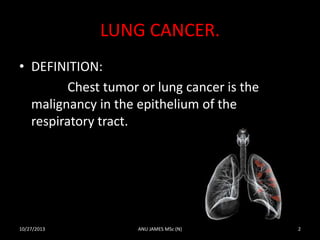
LUNG CANCER.
• DEFINITION:
Chest tumor or lung cancer is the
malignancy in the epithelium of the
respiratory tract.

10/27/2013

ANU JAMES MSc (N)

2
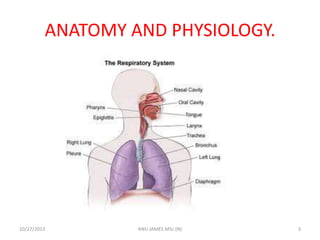
ANATOMY AND PHYSIOLOGY.

10/27/2013

ANU JAMES MSc (N)

3
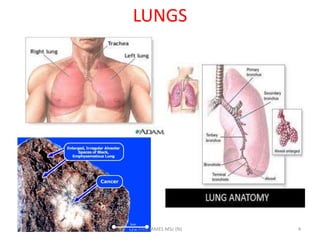
LUNGS

10/27/2013

ANU JAMES MSc (N)

4
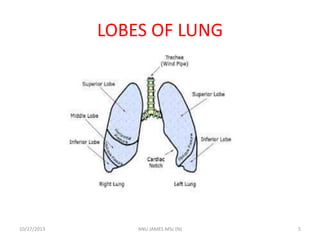
LOBES OF LUNG

10/27/2013

ANU JAMES MSc (N)

5
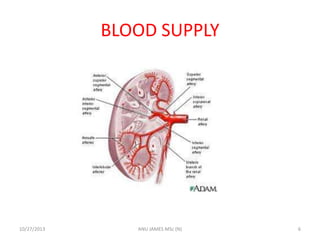
BLOOD SUPPLY

10/27/2013

ANU JAMES MSc (N)

6
FUNCTIONS
BRONCHI AND BRONCHIOLES:• Control of air entry.
• Warming and humidity
• Support and patency.
• Cough reflex
RESPIRATORY BRONCHIOLES:• External respiration.
• Defense against microbes.
• Warming and humidifying.
10/27/2013

ANU JAMES MSc (N)

7
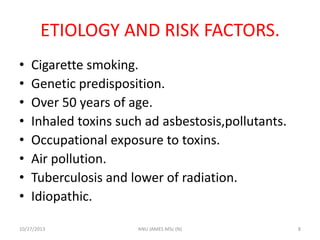
ETIOLOGY AND RISK FACTORS.
•
•
•
•
•
•
•
•

Cigarette smoking.
Genetic predisposition.
Over 50 years of age.
Inhaled toxins such ad asbestosis,pollutants.
Occupational exposure to toxins.
Air pollution.
Tuberculosis and lower of radiation.
Idiopathic.

10/27/2013

ANU JAMES MSc (N)

8
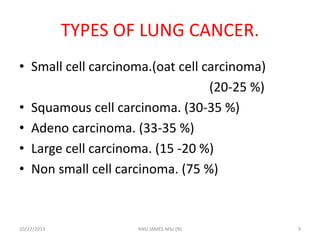
TYPES OF LUNG CANCER.
• Small cell carcinoma.(oat cell carcinoma)
(20-25 %)
• Squamous cell carcinoma. (30-35 %)
• Adeno carcinoma. (33-35 %)
• Large cell carcinoma. (15 -20 %)
• Non small cell carcinoma. (75 %)

10/27/2013

ANU JAMES MSc (N)

9
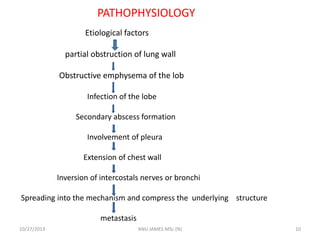
PATHOPHYSIOLOGY
Etiological factors
partial obstruction of lung wall

Obstructive emphysema of the lob
Infection of the lobe
Secondary abscess formation
Involvement of pleura
Extension of chest wall
Inversion of intercostals nerves or bronchi
Spreading into the mechanism and compress the underlying structure
metastasis
10/27/2013

ANU JAMES MSc (N)

10
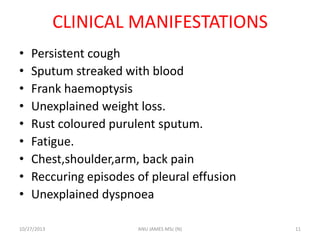
CLINICAL MANIFESTATIONS
•
•
•
•
•
•
•
•
•

Persistent cough
Sputum streaked with blood
Frank haemoptysis
Unexplained weight loss.
Rust coloured purulent sputum.
Fatigue.
Chest,shoulder,arm, back pain
Reccuring episodes of pleural effusion
Unexplained dyspnoea

10/27/2013

ANU JAMES MSc (N)

11
DIAGNOSTIC EVALUATIONS
•
•
•
•
•
•
•
•
•
•
•
•
•
•

History collection
Physical examination.
Blood examination
Sputum cytology.
Chest x-ray
Bronchoscopy
CT thorax and abdomen.
MRI
Positron emission tomography.
Thoracentesis.
ABG analysis.
Pulmonary angiography
Lung scan
Fine needle aspiration

10/27/2013

ANU JAMES MSc (N)

12
MANAGEMENT
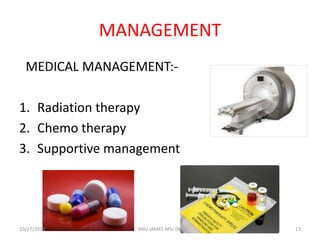
MEDICAL MANAGEMENT:1. Radiation therapy
2. Chemo therapy
3. Supportive management

10/27/2013

ANU JAMES MSc (N)

13
RADIATION THERAPY
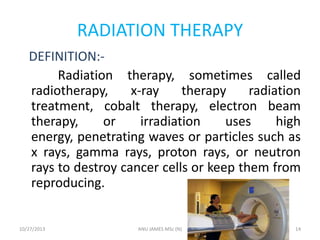
DEFINITION:Radiation therapy, sometimes called
radiotherapy,
x-ray
therapy
radiation
treatment, cobalt therapy, electron beam
therapy,
or
irradiation
uses
high
energy, penetrating waves or particles such as
x rays, gamma rays, proton rays, or neutron
rays to destroy cancer cells or keep them from
reproducing.

10/27/2013

ANU JAMES MSc (N)

14
PURPOSE:• The purpose of radiation therapy is to kill or damage
cancer cells. Radiation therapy is a common form of
cancer therapy. It is used in more than half of all cancer
cases. Radiation therapy can be used:
• alone to kill cancer
• before surgery to shrink a tumour and make it easier to
remove
• during surgery to kill cancer cells that may remain in
surrounding tissue after the surgery (called intra
operative radiation)
• after surgery to kill cancer cells remaining in the body
• to shrink an inoperable tumour in order to and
reduce pain and improve quality of life.
• in combination with chemotherapy.
10/27/2013

ANU JAMES MSc (N)

15
•

•
•
•

TYPES OF RADIATION
External beam radiation:it is a delivery of radiation from a source placed at
some distance from the target site.
Internal radiation:placement of specially prepared radio isotopes
directly to tumor itself.
Sealed source radiation:usually cesium 137 or radium 226 is used. This is
used for both intracavity and interstitial therapy.
Unsealed source of radiation:its used for internal radio therapy or colloid
suspensions that come in to direct contact with body
tissue.

10/27/2013

ANU JAMES MSc (N)

16
CHEMOTHERAPY
Definition :it’s a treatment of cancer with anticancer
drugs.
TYPES:• Adjuvant chemotherapy:Used after initial treatment with either surgery or
radiation therapy.
• Neoadjuvant chemotherapy:It refers to the pre operative treatment of
chemotherapy to reduce the bulk and the lower the
stage of tumor, making it amenable to surgery.
10/27/2013

ANU JAMES MSc (N)

17
SURGICAL MANAGEMENT
1. Laser surgery:
Its used as a palliative for relief of endotracheal
obstruction that are not reactable . The tumor
measurement is accessible only by bronchoscopy.
2. Pulmonary resection:Complete resection of tumor remains the best
chance of cure.
3. Wedge resection:it is the removal of a localized area of diseased
tissue near the surface of the lung.
4. Segamental resection:It’s the removal of the one or more lung segment
10/27/2013

ANU JAMES MSc (N)

18
Contd……
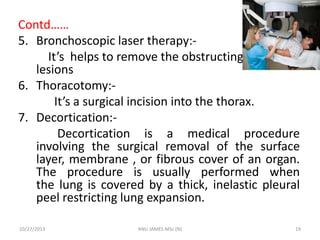
5. Bronchoscopic laser therapy:It’s helps to remove the obstructing bronchial
lesions
6. Thoracotomy:It’s a surgical incision into the thorax.
7. Decortication:Decortication is a medical procedure
involving the surgical removal of the surface
layer, membrane , or fibrous cover of an organ.
The procedure is usually performed when
the lung is covered by a thick, inelastic pleural
peel restricting lung expansion.
10/27/2013

ANU JAMES MSc (N)

19
Contd……….

8. Lobectomy:it’s a removal of the lobe of the lung.
9. Pneumonectomy:it’s a partial or total removal of the lungs.
10.Thoracoplasty:it’s a repair of the thoracic cavity.

10/27/2013

ANU JAMES MSc (N)

20
NURSING MANAGEMENT
1.
•
•
•
•
•
2.
•
•
•
•

Airway control:Assess the patency of airway.
Assess the respiratory status of the patient.
Provide high fowlers position.
Teach deep breathing and coughing exercises.
Administration of O2 therapy.
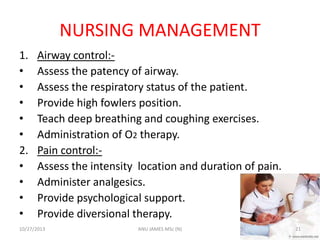
Pain control:Assess the intensity location and duration of pain.
Administer analgesics.
Provide psychological support.
Provide diversional therapy.

10/27/2013

ANU JAMES MSc (N)

21
3.
•
•
•
•
•
•
4.
•
•
•

Provide balanced nutrition:Assess the nutrition status of the patient.
Provide small and frequent diet.
Check the weight regulerly.
Avoid to cold and too hot items.
Avoid spicy foods and beverages.
Provide frequent oral care.
Reduce anxiety:Assess the anxiety level of the patient.
Reassure the patient.
Encourage the patient to do some diversional
activities.

10/27/2013

ANU JAMES MSc (N)

22
NURSING DIAGNOSIS
• Ineffective airway clearance related to increased
trachio bronchial secretion and presence of
tumor as manifested by persistent cough and
dyspnoea.
• Acute pain related to metastasis of the tumor
tissue as manifested by facial expression and pain
score.
• Activity intolerance related to decreased O2
supply and demand as manifested by dyspnoea
and fatigue.
• Imbalanced nutritional status less than body
requirement related to anorexia as manifested by
decreased food intake and the ,condition of the
body weight.
10/27/2013

ANU JAMES MSc (N)

23
COMPLICATIONS
•
•
•
•
•

Haemoptysis
Nerve damage.
Superior venecava syndrome.
Metastasis.
Pleural effusion.

10/27/2013

ANU JAMES MSc (N)

24
HEALTH EDUCATION
•
•
•
•
•

Personal hygiene
Avoid exposure to irritants
Nutrition
Exercise
Medication

10/27/2013

ANU JAMES MSc (N)

25
BIBLIOGRAPHY
• Lewis S. The textbook of medical surgical
nursing. 2nd edition . Mosby publication. New
York 2002
• Robbins and Cortan. Pathologic basic of
disease 8th edition Elsevier. India 2010
• Siddarth and burner’s textbook of
medicine/surgical nursing 10th edition.
Lippincott Wilkims and Wilkims New york
2004
10/27/2013

ANU JAMES MSc (N)

26

Lung cancer

  • 1.
    LUNG CANCER PRESENTED BY, ANUJAMES. MSc (N) 10/27/2013
  • 2.
    LUNG CANCER. • DEFINITION: Chesttumor or lung cancer is the malignancy in the epithelium of the respiratory tract. 10/27/2013 ANU JAMES MSc (N) 2
  • 3.
  • 4.
  • 5.
  • 6.
  • 7.
    FUNCTIONS BRONCHI AND BRONCHIOLES:•Control of air entry. • Warming and humidity • Support and patency. • Cough reflex RESPIRATORY BRONCHIOLES:• External respiration. • Defense against microbes. • Warming and humidifying. 10/27/2013 ANU JAMES MSc (N) 7
  • 8.
    ETIOLOGY AND RISKFACTORS. • • • • • • • • Cigarette smoking. Genetic predisposition. Over 50 years of age. Inhaled toxins such ad asbestosis,pollutants. Occupational exposure to toxins. Air pollution. Tuberculosis and lower of radiation. Idiopathic. 10/27/2013 ANU JAMES MSc (N) 8
  • 9.
    TYPES OF LUNGCANCER. • Small cell carcinoma.(oat cell carcinoma) (20-25 %) • Squamous cell carcinoma. (30-35 %) • Adeno carcinoma. (33-35 %) • Large cell carcinoma. (15 -20 %) • Non small cell carcinoma. (75 %) 10/27/2013 ANU JAMES MSc (N) 9
  • 10.
    PATHOPHYSIOLOGY Etiological factors partial obstructionof lung wall Obstructive emphysema of the lob Infection of the lobe Secondary abscess formation Involvement of pleura Extension of chest wall Inversion of intercostals nerves or bronchi Spreading into the mechanism and compress the underlying structure metastasis 10/27/2013 ANU JAMES MSc (N) 10
  • 11.
    CLINICAL MANIFESTATIONS • • • • • • • • • Persistent cough Sputumstreaked with blood Frank haemoptysis Unexplained weight loss. Rust coloured purulent sputum. Fatigue. Chest,shoulder,arm, back pain Reccuring episodes of pleural effusion Unexplained dyspnoea 10/27/2013 ANU JAMES MSc (N) 11
  • 12.
    DIAGNOSTIC EVALUATIONS • • • • • • • • • • • • • • History collection Physicalexamination. Blood examination Sputum cytology. Chest x-ray Bronchoscopy CT thorax and abdomen. MRI Positron emission tomography. Thoracentesis. ABG analysis. Pulmonary angiography Lung scan Fine needle aspiration 10/27/2013 ANU JAMES MSc (N) 12
  • 13.
    MANAGEMENT MEDICAL MANAGEMENT:1. Radiationtherapy 2. Chemo therapy 3. Supportive management 10/27/2013 ANU JAMES MSc (N) 13
  • 14.
    RADIATION THERAPY DEFINITION:Radiation therapy,sometimes called radiotherapy, x-ray therapy radiation treatment, cobalt therapy, electron beam therapy, or irradiation uses high energy, penetrating waves or particles such as x rays, gamma rays, proton rays, or neutron rays to destroy cancer cells or keep them from reproducing. 10/27/2013 ANU JAMES MSc (N) 14
  • 15.
    PURPOSE:• The purposeof radiation therapy is to kill or damage cancer cells. Radiation therapy is a common form of cancer therapy. It is used in more than half of all cancer cases. Radiation therapy can be used: • alone to kill cancer • before surgery to shrink a tumour and make it easier to remove • during surgery to kill cancer cells that may remain in surrounding tissue after the surgery (called intra operative radiation) • after surgery to kill cancer cells remaining in the body • to shrink an inoperable tumour in order to and reduce pain and improve quality of life. • in combination with chemotherapy. 10/27/2013 ANU JAMES MSc (N) 15
  • 16.
    • • • • TYPES OF RADIATION Externalbeam radiation:it is a delivery of radiation from a source placed at some distance from the target site. Internal radiation:placement of specially prepared radio isotopes directly to tumor itself. Sealed source radiation:usually cesium 137 or radium 226 is used. This is used for both intracavity and interstitial therapy. Unsealed source of radiation:its used for internal radio therapy or colloid suspensions that come in to direct contact with body tissue. 10/27/2013 ANU JAMES MSc (N) 16
  • 17.
    CHEMOTHERAPY Definition :it’s atreatment of cancer with anticancer drugs. TYPES:• Adjuvant chemotherapy:Used after initial treatment with either surgery or radiation therapy. • Neoadjuvant chemotherapy:It refers to the pre operative treatment of chemotherapy to reduce the bulk and the lower the stage of tumor, making it amenable to surgery. 10/27/2013 ANU JAMES MSc (N) 17
  • 18.
    SURGICAL MANAGEMENT 1. Lasersurgery: Its used as a palliative for relief of endotracheal obstruction that are not reactable . The tumor measurement is accessible only by bronchoscopy. 2. Pulmonary resection:Complete resection of tumor remains the best chance of cure. 3. Wedge resection:it is the removal of a localized area of diseased tissue near the surface of the lung. 4. Segamental resection:It’s the removal of the one or more lung segment 10/27/2013 ANU JAMES MSc (N) 18
  • 19.
    Contd…… 5. Bronchoscopic lasertherapy:It’s helps to remove the obstructing bronchial lesions 6. Thoracotomy:It’s a surgical incision into the thorax. 7. Decortication:Decortication is a medical procedure involving the surgical removal of the surface layer, membrane , or fibrous cover of an organ. The procedure is usually performed when the lung is covered by a thick, inelastic pleural peel restricting lung expansion. 10/27/2013 ANU JAMES MSc (N) 19
  • 20.
    Contd………. 8. Lobectomy:it’s aremoval of the lobe of the lung. 9. Pneumonectomy:it’s a partial or total removal of the lungs. 10.Thoracoplasty:it’s a repair of the thoracic cavity. 10/27/2013 ANU JAMES MSc (N) 20
  • 21.
    NURSING MANAGEMENT 1. • • • • • 2. • • • • Airway control:Assessthe patency of airway. Assess the respiratory status of the patient. Provide high fowlers position. Teach deep breathing and coughing exercises. Administration of O2 therapy. Pain control:Assess the intensity location and duration of pain. Administer analgesics. Provide psychological support. Provide diversional therapy. 10/27/2013 ANU JAMES MSc (N) 21
  • 22.
    3. • • • • • • 4. • • • Provide balanced nutrition:Assessthe nutrition status of the patient. Provide small and frequent diet. Check the weight regulerly. Avoid to cold and too hot items. Avoid spicy foods and beverages. Provide frequent oral care. Reduce anxiety:Assess the anxiety level of the patient. Reassure the patient. Encourage the patient to do some diversional activities. 10/27/2013 ANU JAMES MSc (N) 22
  • 23.
    NURSING DIAGNOSIS • Ineffectiveairway clearance related to increased trachio bronchial secretion and presence of tumor as manifested by persistent cough and dyspnoea. • Acute pain related to metastasis of the tumor tissue as manifested by facial expression and pain score. • Activity intolerance related to decreased O2 supply and demand as manifested by dyspnoea and fatigue. • Imbalanced nutritional status less than body requirement related to anorexia as manifested by decreased food intake and the ,condition of the body weight. 10/27/2013 ANU JAMES MSc (N) 23
  • 24.
    COMPLICATIONS • • • • • Haemoptysis Nerve damage. Superior venecavasyndrome. Metastasis. Pleural effusion. 10/27/2013 ANU JAMES MSc (N) 24
  • 25.
    HEALTH EDUCATION • • • • • Personal hygiene Avoidexposure to irritants Nutrition Exercise Medication 10/27/2013 ANU JAMES MSc (N) 25
  • 26.
    BIBLIOGRAPHY • Lewis S.The textbook of medical surgical nursing. 2nd edition . Mosby publication. New York 2002 • Robbins and Cortan. Pathologic basic of disease 8th edition Elsevier. India 2010 • Siddarth and burner’s textbook of medicine/surgical nursing 10th edition. Lippincott Wilkims and Wilkims New york 2004 10/27/2013 ANU JAMES MSc (N) 26