PRESENTATION
 CHEST TUMORS ;
 LUNG CANCER
 MEDIASTINAL TUMOR
 BRONCHOGENIC CYST

BY : RESHIE NASIR NAZIR
B.Sc. NURSING 2ND YEAR
 CHEST TUMOURS
 Tumours Of The Chest May Be Benign Or
Malignant.
 A Malignant Chest Tumour Can Be Primary ,
Arising Within The Lung, Chest Wall Or
Mediastinum Or It Can Be A Metastasis From A
Primary Site Elsewhere In The Body .
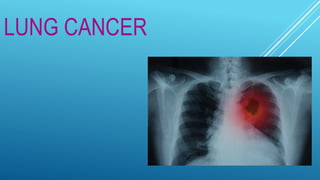
LUNG CANCER
 DEFINITION :
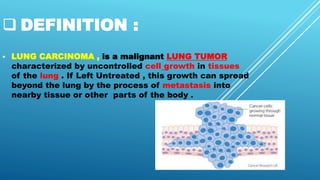
 LUNG CARCINOMA , is a malignant LUNG TUMOR
characterized by uncontrolled cell growth in tissues
of the lung . If Left Untreated , this growth can spread
beyond the lung by the process of metastasis into
nearby tissue or other parts of the body .
 INCIDENCE & PREVALENCE OF
LUNG CANCER :
 Lung Cancer Is The Leading Cancer Killer Among Men And
Women In The US .
 Lung Cancer Mainly Occurs In Older People . About 2 Out Of
3 People Diagnosed With Lung Cancer Are 65 Or Older
 About 15 % Of All New Cancers Are Lung Cancers.
 Approximately 2,13,000 New Cases Of Lung Cancer Are
Diagnosed Annually.
 The Long Time Survival Rate Is Low . Overall The 5 Year
Survival Rate Is 16 %.
 In India, Lung Cancer Constitutes 6.9 % Of
All Cancer Cases
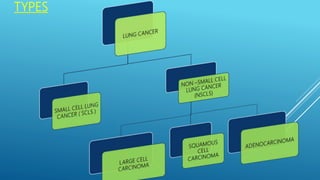
TYPES
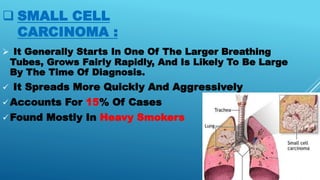
 SMALL CELL
CARCINOMA :
 It Generally Starts In One Of The Larger Breathing
Tubes, Grows Fairly Rapidly, And Is Likely To Be Large
By The Time Of Diagnosis.
 It Spreads More Quickly And Aggressively
 Accounts For 15% Of Cases
 Found Mostly In Heavy Smokers
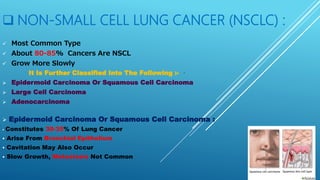
 NON-SMALL CELL LUNG CANCER (NSCLC) :
 Most Common Type
 About 80-85% Cancers Are NSCL
 Grow More Slowly
It Is Further Classified Into The Following :-
 Epidermoid Carcinoma Or Squamous Cell Carcinoma
 Large Cell Carcinoma
 Adenocarcinoma
 Epidermoid Carcinoma Or Squamous Cell Carcinoma :
 Constitutes 30-35% Of Lung Cancer
 Arise From Bronchial Epithelium
 Cavitation May Also Occur
 Slow Growth, Metastasis Not Common
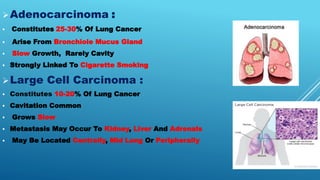
Adenocarcinoma :
 Constitutes 25-30% Of Lung Cancer
 Arise From Bronchiole Mucus Gland
 Slow Growth, Rarely Cavity
 Strongly Linked To Cigarette Smoking
Large Cell Carcinoma :
 Constitutes 10-20% Of Lung Cancer
 Cavitation Common
 Grows Slow
 Metastasis May Occur To Kidney, Liver And Adrenals
 May Be Located Centrally, Mid Lung Or Peripherally
 NON-SMALL CELL LUNG CANCER
STAGING
 Non-small Cell Lung Cancer Staging Uses The TNM
System:
 Tumour (T) Describes The Size Of The Original Tumour.
 Lymph Node (N) Indicates Whether The Cancer Is Present In The Lymph Nodes.
 Metastasis (M) Refers To Whether Cancer Has Spread To Other Parts Of The
Body, Usually The Liver, Bones Or Brain.
 A Number (0-4) Or The Letter X Is Assigned To Each Factor. A Higher Number
Indicates Increasing Severity. The Letter X Means The Information Could Not Be
Assessed. For Instance, A T1 Score Indicates A Smaller Tumour Than A T2 Score.
Once The T, N And M Scores Have Been Assigned, An Overall Stage Is Assigned.
 STAGES OF NON-SMALL CELL LUNG
CANCER:
Occult Stage : Cancer Cells Are Found In Sputum, But No Tumour
Can Be Found In The Lung By Imaging Tests Or Bronchoscopy, Or
The Tumour Is Too Small To Be Checked.
Stage 0 : Cancer At This Stage Is Also Known As Carcinoma In
Situ. The Cancer Is Tiny In Size And Has Not Spread Into Deeper
Lung Tissues Or Outside The Lungs.
Stage I : Cancer May Be Present In The Underlying Lung Tissues,
But The Lymph Nodes Remain Unaffected.
Stage II : The Cancer May Have Spread To Nearby Lymph Nodes Or
Into The Chest Wall.
 Stage III : The Cancer Is Continuing To Spread From The Lungs To The
Lymph Nodes Or To Nearby Structures And Organs, Such As The Heart,
Trachea And Oesophagus.
Stage IV : The Cancer Has Metastasized Throughout The Body And
May Now Affect The Liver, Bones Or Brain.
Small cell lung cancer staging
Small Cell Lung Cancer Stages Are Classified In Two Ways:
Limited Stage: The Cancer Is Found In One Lung, Sometimes
Including Nearby Lymph Nodes.
Extensive Stage: Cancer Has Spread To The Other Lung, The Fluid
Around The Lung (The Pleura) Or To Other Organs In The Body.
ETIOLOGY :
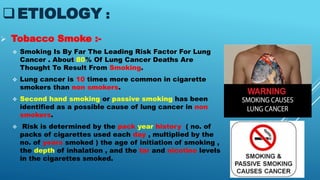
 Tobacco Smoke :-
 Smoking Is By Far The Leading Risk Factor For Lung
Cancer . About 80% Of Lung Cancer Deaths Are
Thought To Result From Smoking.
 Lung cancer is 10 times more common in cigarette
smokers than non smokers.
 Second hand smoking or passive smoking has been
identified as a possible cause of lung cancer in non
smokers.
 Risk is determined by the pack year history ( no. of
packs of cigarettes used each day , multiplied by the
no. of years smoked ) the age of initiation of smoking ,
the depth of inhalation , and the tar and nicotine levels
in the cigarettes smoked.
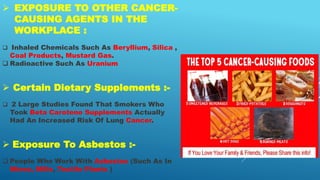
 EXPOSURE TO OTHER CANCER-
CAUSING AGENTS IN THE
WORKPLACE :
 Inhaled Chemicals Such As Beryllium, Silica ,
Coal Products, Mustard Gas.
 Radioactive Such As Uranium
 Certain Dietary Supplements :-
 2 Large Studies Found That Smokers Who
Took Beta Carotene Supplements Actually
Had An Increased Risk Of Lung Cancer.
 Exposure To Asbestos :-
 People Who Work With Asbestos (Such As In
Mines, Mills, Textile Plants )
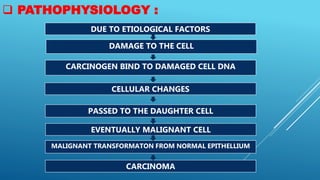
 PATHOPHYSIOLOGY :
DUE TO ETIOLOGICAL FACTORS
DAMAGE TO THE CELL
CARCINOGEN BIND TO DAMAGED CELL DNA
PASSED TO THE DAUGHTER CELL
EVENTUALLY MALIGNANT CELL
MALIGNANT TRANSFORMATON FROM NORMAL EPITHELLIUM
CELLULAR CHANGES
CARCINOMA
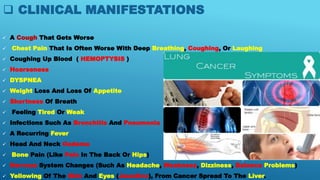
 CLINICAL MANIFESTATIONS
 A Cough That Gets Worse
 Chest Pain That Is Often Worse With Deep Breathing, Coughing, Or Laughing
 Coughing Up Blood ( HEMOPTYSIS )
 Hoarseness
 DYSPNEA
 Weight Loss And Loss Of Appetite
 Shortness Of Breath
 Feeling Tired Or Weak
 Infections Such As Bronchitis And Pneumonia
 A Recurring Fever
 Head And Neck Oedema
 Bone Pain (Like Pain In The Back Or Hips)
 Nervous System Changes (Such As Headache, Weakness, Dizziness, Balance Problems)
 Yellowing Of The Skin And Eyes (Jaundice), From Cancer Spread To The Liver.
 DIAGNOSTIC EVALUATION
Medical History And Physical Examination
Blood Tests :-
• A Complete Blood Count (CBC) Looks At Whether Patient
Blood Has Normal Numbers Of Different Types Of Blood
Cells.
• Blood Chemistry Tests Can Help Spot Abnormalities In
Some Of Patient Organs, Such As The Liver Or Kidneys. For
Example, High Level Of Lactate Dehydrogenase (LDH).
 IMAGING TESTS :-
 Chest X-ray :-
• THIS IS Often The First Test Will Do To Look For Any Abnormal Areas
In The Lungs
 Computed Tomography (CT) Scan:-
• A CT Scan Uses To Make Detailed Cross-sectional Images Of Patient
Body
• IT Can Show The Size, Shape, And Position Of Any Lung Tumours And
Can Help Find Enlarged Lymph Nodes
 CT-Guided Needle Biopsy :-
• If A Suspected Area Of Cancer Is Deep Within Patient Body, A CT
Scan Can Be Used To Guide A Biopsy Needle Into The Suspected
Area
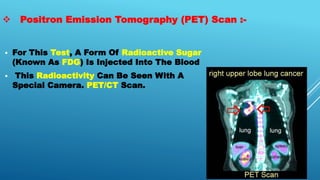
 Positron Emission Tomography (PET) Scan :-
 For This Test, A Form Of Radioactive Sugar
(Known As FDG) Is Injected Into The Blood
 This Radioactivity Can Be Seen With A
Special Camera. PET/CT Scan.
Needle Biopsy :-
 It Can Often Use A Hollow Needle To Get A Small Sample From A
Suspicious Area (Mass).
• Fine Needle Aspiration (FNAC) Biopsy,
• Core Biopsy.
 Bronchoscopy :-
• Bronchoscopy Can Help In Finding Some Tumours Or Blockages In
The Lungs.
 Thoracoscopy :-
• It Can Help In Examining The Tumours In Pleural And
Thoracic Cavity
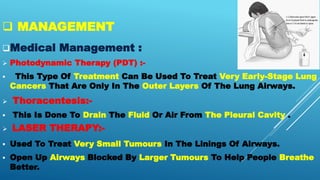
 MANAGEMENT
Medical Management :
 Photodynamic Therapy (PDT) :-
 This Type Of Treatment Can Be Used To Treat Very Early-Stage Lung
Cancers That Are Only In The Outer Layers Of The Lung Airways.
 Thoracentesis:-
 This Is Done To Drain The Fluid Or Air From The Pleural Cavity .
 LASER THERAPY:-
 Used To Treat Very Small Tumours In The Linings Of Airways.
 Open Up Airways Blocked By Larger Tumours To Help People Breathe
Better.
 CHEMOTHERAPY
 For Lung Cancer , Chemotherapy (Chemo) Is Treatment With Anti-
cancer Drugs ( cisplatin ,docetaxel , navelbine , vinblastine etc. )
Injected Into A Vein Or Taken By Mouth.
 SURGICAL MANAGEMENT :-
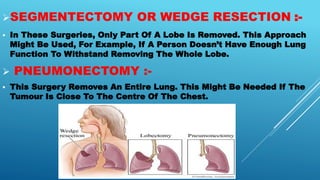
LOBECTOMY :-
 In This Surgery, The Entire Lobe Containing The Tumor Is
Removed.
SEGMENTECTOMY OR WEDGE RESECTION :-
 In These Surgeries, Only Part Of A Lobe Is Removed. This Approach
Might Be Used, For Example, If A Person Doesn’t Have Enough Lung
Function To Withstand Removing The Whole Lobe.
 PNEUMONECTOMY :-
 This Surgery Removes An Entire Lung. This Might Be Needed If The
Tumour Is Close To The Centre Of The Chest.
 PALLIATIVE PROCEDURES FOR LUNG
CANCER
 Palliative, or supportive care, is aimed at relieving
symptoms and improving a person’s quality of life.
 Issues Addressed In Palliative Care :-
 Physical.
 Emotional and coping.
 Spiritual.
 NURSING MANAGEMENT
 Assessment :
 Monitor S/S Of Respiratory Failure
 Administer Chemotherapy And Other Desired Medications
 Educate Patient With Their Disease And Its Progression
 Respiratory Assessment
 Lab Investigations And Other Diagnostic Tests
 Patient’s Knowledge And Understanding Of Diagnosis And Treatment,
 Patient’s Anxiety Level And Support System,
 Exposure To Carcinogen
 Nursing Diagnosis :
 Ineffective Airway Clearance Related To Increased
Tracheobronchial Secretion
 Ineffective Breathing Pattern Related To Decreased Lung
Capacity
 Altered Nutrition Less Then Body Requirement Related To
Increased Metabolic Demand And Decreased Food Intake
 Anxiety Related To Lack Of Knowledge
 Pain Related To The Pressure Of The Tumour
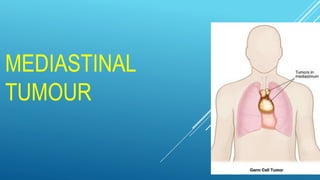
MEDIASTINAL
TUMOUR
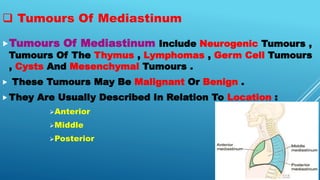
 Tumours Of Mediastinum
Tumours Of Mediastinum Include Neurogenic Tumours ,
Tumours Of The Thymus , Lymphomas , Germ Cell Tumours
, Cysts And Mesenchymal Tumours .
 These Tumours May Be Malignant Or Benign .
They Are Usually Described In Relation To Location :
Anterior
Middle
Posterior
 Clinical Manifestations
 Cough
 Wheezing Dyspnea
 Anterior Chest Or Neck Pain
 Bulging Of The Chest Wall
 Heart Palpitations
 Angina
 Circulatory Disturbances
 Central Cyanosis
 SUPERIOR VENACAVA Syndrome (i.e., Swelling IN FACE,NECK AND UPPER
EXTREMITIES)
 Marked Distention Of The Veins Of The Neck And Chest Wall
 Dysphagia
 Weight Loss
 ASSESSMENT AND DIAGNOSTIC
FINDINGS
 CHEST X-RAYS
 COMPUTED SCAN (CT scan)
 MAGNETIC RESONANCE IMAGING ( MRI )
 POSITRON EMISSION TOMOGRAPHY ( PET )
 MANAGEMENT
Medical MANAGEMENT :-
 Radiation Therapy
 Chemotherapy , OR
 Both
Surgical Managementm :-
 Median Sternotomy
 Thoracotomy
 Video Assisted Thoracoscopic Surgery
 Bilateral Anterior Thoracotomy
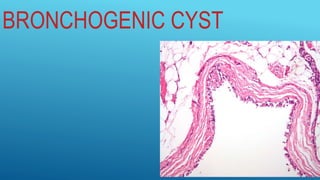
BRONCHOGENIC CYST
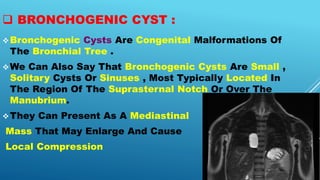
 BRONCHOGENIC CYST :
Bronchogenic Cysts Are Congenital Malformations Of
The Bronchial Tree .
We Can Also Say That Bronchogenic Cysts Are Small ,
Solitary Cysts Or Sinuses , Most Typically Located In
The Region Of The Suprasternal Notch Or Over The
Manubrium.
They Can Present As A Mediastinal
Mass That May Enlarge And Cause
Local Compression
 EPIDEMIOLOGY
Bronchogenic Cysts Account For About 20% To 30% Of
Congenital Bronchopulmonary Foregut Cystic
Malformations
These Account For 7% To 15% Of Paediatric Mediastinal
Masses
The Incidence Of Mediastinal Cysts Is Equal Between The
Sexes Whereas Intrapulmonary Cysts Are Reported To Have
A Male Predilection
 PATHOPHYSIOLOGY :-
 Bronchogenic Cysts Form As A Result Of Abnormal Budding Of The
Bronchial Tree During Embryogenesis (Between 4th-6th Weeks) 1, And
As Such, They Are Lined By Secretory Respiratory Epithelium (Cuboid
Or Columnar Ciliated Epithelium) 1,4. The Wall Is Made Up Of Tissues
Similar To That Of The Normal Bronchial Tree, Including Cartilage,
Elastic Tissues, Mucous Glands And Smooth Muscle 1.
 They Do Not Usually Communicate With The Bronchial Tree, And Are
Therefore Typically Not Air Filled. Rather, They Contain Fluid (Water),
Variable Amounts Of Proteinaeceous Material, Blood Products, And
Calcium Oxalate 4. It Is The Latter Three Components That Result In
Increased Attenuation Mimicking Solid Lesions. They Are Rarely
Multiple.
 CLINICAL MANIFESTATIONS
 Six Of The 12 Patients With Bronchogenic Cysts Were Asymptomatic.
 Chest Pain And Dysphagia Are The Most Common Symptoms In Adults
With Bronchogenic Cysts.
 Recurrent Infections May Be The Clinical Presentation In Some
Children
 In Infants, Symptoms Are Most Often Produced As A Result Of Airway
Or Oesophageal Compression.
 The Majority Are Asymptomatic, But They May Occasionally Cause
Symptoms Secondary To Compression Of Adjacent Structures.
 These Symptoms Include Chest Pain, Cough, Dyspnea, Fever, And
Purulent Sputum.
DIAGNOSIS :
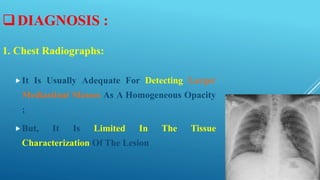
1. Chest Radiographs:
It Is Usually Adequate For Detecting Larger
Mediastinal Masses As A Homogeneous Opacity
;
But, It Is Limited In The Tissue
Characterization Of The Lesion
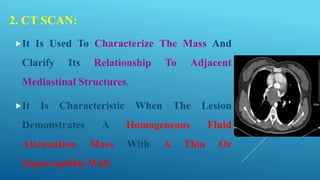
2. CT SCAN:
It Is Used To Characterize The Mass And
Clarify Its Relationship To Adjacent
Mediastinal Structures.
It Is Characteristic When The Lesion
Demonstrates A Homogeneous Fluid
Attenuation Mass With A Thin Or
Imperceptible Wall.
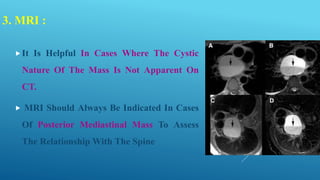
3. MRI :
It Is Helpful In Cases Where The Cystic
Nature Of The Mass Is Not Apparent On
CT.
 MRI Should Always Be Indicated In Cases
Of Posterior Mediastinal Mass To Assess
The Relationship With The Spine
 TREATMENT
The choice of treatment is controversial.
Some authors advocate surgical excision of all cysts
given their tendency to become infected or rarely, to
undergo malignant transformation.
 Increasingly, these lesions are treated with
transbronchial or percutaneous aspiration under CT
guidance to both confirm the diagnosis and to treat
them.
Small lesions can be followed.
 COMPLICATIONS
Fistula Formation With The Bronchial Tree
Ulceration Of The Cyst Wall
Secondary Bronchial Atresia
Superimposed Infection
Haemorrhage
 CONCLUSION :
Lung Cancer Is The Leading Cause Of Deaths.
Only Prevention Is Not To Smoke
Most Diagnosed At Advanced Stage
Overall 5-year Survival Rate Is 15 %
Treatment Depends On Histology And Stage
 CONCLUSION
A Cystic Mediastinal Mass With A Thin Or Imperceptible Wall In
A Subcarinal Location Should Be A Bronchogenic Cyst.
In Cases Where The Cystic Nature Is Not Apparent On Ct, The
High Signal Intensity On T2-weighted Images Should Confirm The
Cystic Nature.
Presentation by nasir

Presentation by nasir

  • 1.
    PRESENTATION  CHEST TUMORS;  LUNG CANCER  MEDIASTINAL TUMOR  BRONCHOGENIC CYST  BY : RESHIE NASIR NAZIR B.Sc. NURSING 2ND YEAR
  • 2.
     CHEST TUMOURS Tumours Of The Chest May Be Benign Or Malignant.  A Malignant Chest Tumour Can Be Primary , Arising Within The Lung, Chest Wall Or Mediastinum Or It Can Be A Metastasis From A Primary Site Elsewhere In The Body .
  • 3.
  • 4.
     DEFINITION : LUNG CARCINOMA , is a malignant LUNG TUMOR characterized by uncontrolled cell growth in tissues of the lung . If Left Untreated , this growth can spread beyond the lung by the process of metastasis into nearby tissue or other parts of the body .
  • 5.
     INCIDENCE &PREVALENCE OF LUNG CANCER :  Lung Cancer Is The Leading Cancer Killer Among Men And Women In The US .  Lung Cancer Mainly Occurs In Older People . About 2 Out Of 3 People Diagnosed With Lung Cancer Are 65 Or Older  About 15 % Of All New Cancers Are Lung Cancers.  Approximately 2,13,000 New Cases Of Lung Cancer Are Diagnosed Annually.  The Long Time Survival Rate Is Low . Overall The 5 Year Survival Rate Is 16 %.  In India, Lung Cancer Constitutes 6.9 % Of All Cancer Cases
  • 6.
  • 7.
     SMALL CELL CARCINOMA:  It Generally Starts In One Of The Larger Breathing Tubes, Grows Fairly Rapidly, And Is Likely To Be Large By The Time Of Diagnosis.  It Spreads More Quickly And Aggressively  Accounts For 15% Of Cases  Found Mostly In Heavy Smokers
  • 8.
     NON-SMALL CELLLUNG CANCER (NSCLC) :  Most Common Type  About 80-85% Cancers Are NSCL  Grow More Slowly It Is Further Classified Into The Following :-  Epidermoid Carcinoma Or Squamous Cell Carcinoma  Large Cell Carcinoma  Adenocarcinoma  Epidermoid Carcinoma Or Squamous Cell Carcinoma :  Constitutes 30-35% Of Lung Cancer  Arise From Bronchial Epithelium  Cavitation May Also Occur  Slow Growth, Metastasis Not Common
  • 9.
    Adenocarcinoma :  Constitutes25-30% Of Lung Cancer  Arise From Bronchiole Mucus Gland  Slow Growth, Rarely Cavity  Strongly Linked To Cigarette Smoking Large Cell Carcinoma :  Constitutes 10-20% Of Lung Cancer  Cavitation Common  Grows Slow  Metastasis May Occur To Kidney, Liver And Adrenals  May Be Located Centrally, Mid Lung Or Peripherally
  • 10.
     NON-SMALL CELLLUNG CANCER STAGING  Non-small Cell Lung Cancer Staging Uses The TNM System:  Tumour (T) Describes The Size Of The Original Tumour.  Lymph Node (N) Indicates Whether The Cancer Is Present In The Lymph Nodes.  Metastasis (M) Refers To Whether Cancer Has Spread To Other Parts Of The Body, Usually The Liver, Bones Or Brain.  A Number (0-4) Or The Letter X Is Assigned To Each Factor. A Higher Number Indicates Increasing Severity. The Letter X Means The Information Could Not Be Assessed. For Instance, A T1 Score Indicates A Smaller Tumour Than A T2 Score. Once The T, N And M Scores Have Been Assigned, An Overall Stage Is Assigned.
  • 11.
     STAGES OFNON-SMALL CELL LUNG CANCER: Occult Stage : Cancer Cells Are Found In Sputum, But No Tumour Can Be Found In The Lung By Imaging Tests Or Bronchoscopy, Or The Tumour Is Too Small To Be Checked. Stage 0 : Cancer At This Stage Is Also Known As Carcinoma In Situ. The Cancer Is Tiny In Size And Has Not Spread Into Deeper Lung Tissues Or Outside The Lungs. Stage I : Cancer May Be Present In The Underlying Lung Tissues, But The Lymph Nodes Remain Unaffected. Stage II : The Cancer May Have Spread To Nearby Lymph Nodes Or Into The Chest Wall.
  • 12.
     Stage III: The Cancer Is Continuing To Spread From The Lungs To The Lymph Nodes Or To Nearby Structures And Organs, Such As The Heart, Trachea And Oesophagus. Stage IV : The Cancer Has Metastasized Throughout The Body And May Now Affect The Liver, Bones Or Brain. Small cell lung cancer staging Small Cell Lung Cancer Stages Are Classified In Two Ways: Limited Stage: The Cancer Is Found In One Lung, Sometimes Including Nearby Lymph Nodes. Extensive Stage: Cancer Has Spread To The Other Lung, The Fluid Around The Lung (The Pleura) Or To Other Organs In The Body.
  • 13.
    ETIOLOGY :  TobaccoSmoke :-  Smoking Is By Far The Leading Risk Factor For Lung Cancer . About 80% Of Lung Cancer Deaths Are Thought To Result From Smoking.  Lung cancer is 10 times more common in cigarette smokers than non smokers.  Second hand smoking or passive smoking has been identified as a possible cause of lung cancer in non smokers.  Risk is determined by the pack year history ( no. of packs of cigarettes used each day , multiplied by the no. of years smoked ) the age of initiation of smoking , the depth of inhalation , and the tar and nicotine levels in the cigarettes smoked.
  • 14.
     EXPOSURE TOOTHER CANCER- CAUSING AGENTS IN THE WORKPLACE :  Inhaled Chemicals Such As Beryllium, Silica , Coal Products, Mustard Gas.  Radioactive Such As Uranium  Certain Dietary Supplements :-  2 Large Studies Found That Smokers Who Took Beta Carotene Supplements Actually Had An Increased Risk Of Lung Cancer.  Exposure To Asbestos :-  People Who Work With Asbestos (Such As In Mines, Mills, Textile Plants )
  • 15.
     PATHOPHYSIOLOGY : DUETO ETIOLOGICAL FACTORS DAMAGE TO THE CELL CARCINOGEN BIND TO DAMAGED CELL DNA PASSED TO THE DAUGHTER CELL EVENTUALLY MALIGNANT CELL MALIGNANT TRANSFORMATON FROM NORMAL EPITHELLIUM CELLULAR CHANGES CARCINOMA
  • 16.
     CLINICAL MANIFESTATIONS A Cough That Gets Worse  Chest Pain That Is Often Worse With Deep Breathing, Coughing, Or Laughing  Coughing Up Blood ( HEMOPTYSIS )  Hoarseness  DYSPNEA  Weight Loss And Loss Of Appetite  Shortness Of Breath  Feeling Tired Or Weak  Infections Such As Bronchitis And Pneumonia  A Recurring Fever  Head And Neck Oedema  Bone Pain (Like Pain In The Back Or Hips)  Nervous System Changes (Such As Headache, Weakness, Dizziness, Balance Problems)  Yellowing Of The Skin And Eyes (Jaundice), From Cancer Spread To The Liver.
  • 17.
     DIAGNOSTIC EVALUATION MedicalHistory And Physical Examination Blood Tests :- • A Complete Blood Count (CBC) Looks At Whether Patient Blood Has Normal Numbers Of Different Types Of Blood Cells. • Blood Chemistry Tests Can Help Spot Abnormalities In Some Of Patient Organs, Such As The Liver Or Kidneys. For Example, High Level Of Lactate Dehydrogenase (LDH).
  • 18.
     IMAGING TESTS:-  Chest X-ray :- • THIS IS Often The First Test Will Do To Look For Any Abnormal Areas In The Lungs  Computed Tomography (CT) Scan:- • A CT Scan Uses To Make Detailed Cross-sectional Images Of Patient Body • IT Can Show The Size, Shape, And Position Of Any Lung Tumours And Can Help Find Enlarged Lymph Nodes  CT-Guided Needle Biopsy :- • If A Suspected Area Of Cancer Is Deep Within Patient Body, A CT Scan Can Be Used To Guide A Biopsy Needle Into The Suspected Area
  • 19.
     Positron EmissionTomography (PET) Scan :-  For This Test, A Form Of Radioactive Sugar (Known As FDG) Is Injected Into The Blood  This Radioactivity Can Be Seen With A Special Camera. PET/CT Scan.
  • 20.
    Needle Biopsy :- It Can Often Use A Hollow Needle To Get A Small Sample From A Suspicious Area (Mass). • Fine Needle Aspiration (FNAC) Biopsy, • Core Biopsy.  Bronchoscopy :- • Bronchoscopy Can Help In Finding Some Tumours Or Blockages In The Lungs.  Thoracoscopy :- • It Can Help In Examining The Tumours In Pleural And Thoracic Cavity
  • 21.
     MANAGEMENT Medical Management:  Photodynamic Therapy (PDT) :-  This Type Of Treatment Can Be Used To Treat Very Early-Stage Lung Cancers That Are Only In The Outer Layers Of The Lung Airways.  Thoracentesis:-  This Is Done To Drain The Fluid Or Air From The Pleural Cavity .  LASER THERAPY:-  Used To Treat Very Small Tumours In The Linings Of Airways.  Open Up Airways Blocked By Larger Tumours To Help People Breathe Better.
  • 22.
     CHEMOTHERAPY  ForLung Cancer , Chemotherapy (Chemo) Is Treatment With Anti- cancer Drugs ( cisplatin ,docetaxel , navelbine , vinblastine etc. ) Injected Into A Vein Or Taken By Mouth.  SURGICAL MANAGEMENT :- LOBECTOMY :-  In This Surgery, The Entire Lobe Containing The Tumor Is Removed.
  • 23.
    SEGMENTECTOMY OR WEDGERESECTION :-  In These Surgeries, Only Part Of A Lobe Is Removed. This Approach Might Be Used, For Example, If A Person Doesn’t Have Enough Lung Function To Withstand Removing The Whole Lobe.  PNEUMONECTOMY :-  This Surgery Removes An Entire Lung. This Might Be Needed If The Tumour Is Close To The Centre Of The Chest.
  • 24.
     PALLIATIVE PROCEDURESFOR LUNG CANCER  Palliative, or supportive care, is aimed at relieving symptoms and improving a person’s quality of life.  Issues Addressed In Palliative Care :-  Physical.  Emotional and coping.  Spiritual.
  • 25.
     NURSING MANAGEMENT Assessment :  Monitor S/S Of Respiratory Failure  Administer Chemotherapy And Other Desired Medications  Educate Patient With Their Disease And Its Progression  Respiratory Assessment  Lab Investigations And Other Diagnostic Tests  Patient’s Knowledge And Understanding Of Diagnosis And Treatment,  Patient’s Anxiety Level And Support System,  Exposure To Carcinogen
  • 26.
     Nursing Diagnosis:  Ineffective Airway Clearance Related To Increased Tracheobronchial Secretion  Ineffective Breathing Pattern Related To Decreased Lung Capacity  Altered Nutrition Less Then Body Requirement Related To Increased Metabolic Demand And Decreased Food Intake  Anxiety Related To Lack Of Knowledge  Pain Related To The Pressure Of The Tumour
  • 27.
  • 28.
     Tumours OfMediastinum Tumours Of Mediastinum Include Neurogenic Tumours , Tumours Of The Thymus , Lymphomas , Germ Cell Tumours , Cysts And Mesenchymal Tumours .  These Tumours May Be Malignant Or Benign . They Are Usually Described In Relation To Location : Anterior Middle Posterior
  • 29.
     Clinical Manifestations Cough  Wheezing Dyspnea  Anterior Chest Or Neck Pain  Bulging Of The Chest Wall  Heart Palpitations  Angina  Circulatory Disturbances  Central Cyanosis  SUPERIOR VENACAVA Syndrome (i.e., Swelling IN FACE,NECK AND UPPER EXTREMITIES)  Marked Distention Of The Veins Of The Neck And Chest Wall  Dysphagia  Weight Loss
  • 30.
     ASSESSMENT ANDDIAGNOSTIC FINDINGS  CHEST X-RAYS  COMPUTED SCAN (CT scan)  MAGNETIC RESONANCE IMAGING ( MRI )  POSITRON EMISSION TOMOGRAPHY ( PET )
  • 31.
     MANAGEMENT Medical MANAGEMENT:-  Radiation Therapy  Chemotherapy , OR  Both Surgical Managementm :-  Median Sternotomy  Thoracotomy  Video Assisted Thoracoscopic Surgery  Bilateral Anterior Thoracotomy
  • 32.
  • 33.
     BRONCHOGENIC CYST: Bronchogenic Cysts Are Congenital Malformations Of The Bronchial Tree . We Can Also Say That Bronchogenic Cysts Are Small , Solitary Cysts Or Sinuses , Most Typically Located In The Region Of The Suprasternal Notch Or Over The Manubrium. They Can Present As A Mediastinal Mass That May Enlarge And Cause Local Compression
  • 34.
     EPIDEMIOLOGY Bronchogenic CystsAccount For About 20% To 30% Of Congenital Bronchopulmonary Foregut Cystic Malformations These Account For 7% To 15% Of Paediatric Mediastinal Masses The Incidence Of Mediastinal Cysts Is Equal Between The Sexes Whereas Intrapulmonary Cysts Are Reported To Have A Male Predilection
  • 35.
     PATHOPHYSIOLOGY :- Bronchogenic Cysts Form As A Result Of Abnormal Budding Of The Bronchial Tree During Embryogenesis (Between 4th-6th Weeks) 1, And As Such, They Are Lined By Secretory Respiratory Epithelium (Cuboid Or Columnar Ciliated Epithelium) 1,4. The Wall Is Made Up Of Tissues Similar To That Of The Normal Bronchial Tree, Including Cartilage, Elastic Tissues, Mucous Glands And Smooth Muscle 1.  They Do Not Usually Communicate With The Bronchial Tree, And Are Therefore Typically Not Air Filled. Rather, They Contain Fluid (Water), Variable Amounts Of Proteinaeceous Material, Blood Products, And Calcium Oxalate 4. It Is The Latter Three Components That Result In Increased Attenuation Mimicking Solid Lesions. They Are Rarely Multiple.
  • 36.
     CLINICAL MANIFESTATIONS Six Of The 12 Patients With Bronchogenic Cysts Were Asymptomatic.  Chest Pain And Dysphagia Are The Most Common Symptoms In Adults With Bronchogenic Cysts.  Recurrent Infections May Be The Clinical Presentation In Some Children  In Infants, Symptoms Are Most Often Produced As A Result Of Airway Or Oesophageal Compression.  The Majority Are Asymptomatic, But They May Occasionally Cause Symptoms Secondary To Compression Of Adjacent Structures.  These Symptoms Include Chest Pain, Cough, Dyspnea, Fever, And Purulent Sputum.
  • 37.
    DIAGNOSIS : 1. ChestRadiographs: It Is Usually Adequate For Detecting Larger Mediastinal Masses As A Homogeneous Opacity ; But, It Is Limited In The Tissue Characterization Of The Lesion
  • 38.
    2. CT SCAN: ItIs Used To Characterize The Mass And Clarify Its Relationship To Adjacent Mediastinal Structures. It Is Characteristic When The Lesion Demonstrates A Homogeneous Fluid Attenuation Mass With A Thin Or Imperceptible Wall.
  • 39.
    3. MRI : ItIs Helpful In Cases Where The Cystic Nature Of The Mass Is Not Apparent On CT.  MRI Should Always Be Indicated In Cases Of Posterior Mediastinal Mass To Assess The Relationship With The Spine
  • 40.
     TREATMENT The choiceof treatment is controversial. Some authors advocate surgical excision of all cysts given their tendency to become infected or rarely, to undergo malignant transformation.  Increasingly, these lesions are treated with transbronchial or percutaneous aspiration under CT guidance to both confirm the diagnosis and to treat them. Small lesions can be followed.
  • 41.
     COMPLICATIONS Fistula FormationWith The Bronchial Tree Ulceration Of The Cyst Wall Secondary Bronchial Atresia Superimposed Infection Haemorrhage
  • 42.
     CONCLUSION : LungCancer Is The Leading Cause Of Deaths. Only Prevention Is Not To Smoke Most Diagnosed At Advanced Stage Overall 5-year Survival Rate Is 15 % Treatment Depends On Histology And Stage
  • 43.
     CONCLUSION A CysticMediastinal Mass With A Thin Or Imperceptible Wall In A Subcarinal Location Should Be A Bronchogenic Cyst. In Cases Where The Cystic Nature Is Not Apparent On Ct, The High Signal Intensity On T2-weighted Images Should Confirm The Cystic Nature.