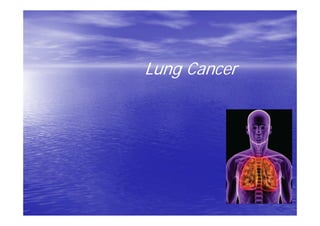
Lung Cancer
Objectives
To provide a general overview of lung physiology
To explore the types and classifications of lung cancer
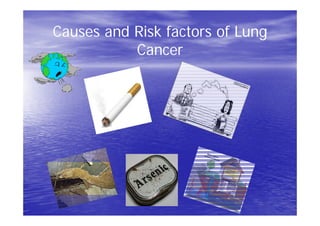
To provide causes and risk factors of lung cancer
To present the signs and symptoms of lung cancer in throughout
its progression
To explore assessment and diagnostic information of lung cancer
To introduce diagnostic staging specific to lung cancer
To discuss treatments and side effects of lung cancer
To present post-op complications for cases with lung cancer
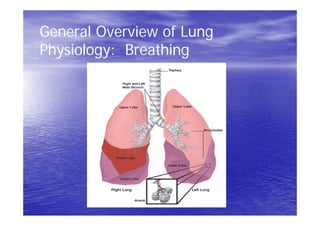
General Overview of Lung
Physiology: Breathing
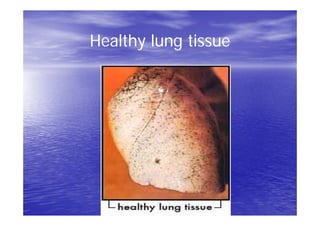
Healthy lung tissue
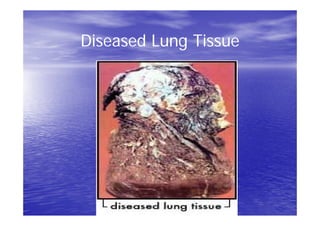
Diseased Lung Tissue
Types of Lung Cancer
Two main Types of Lung Cancer:
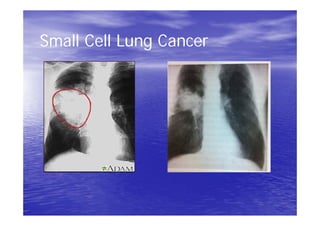
Small Cell Lung Cancer (20-25% of all lung cancers)
Non Small Cell Lung Cancer (most common ~80%)
Small Cell Lung Cancer
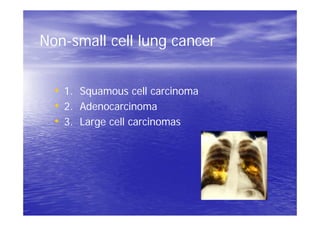
Non-small cell lung cancer
• 1. Squamous cell carcinoma
• 2. Adenocarcinoma
• 3. Large cell carcinomas
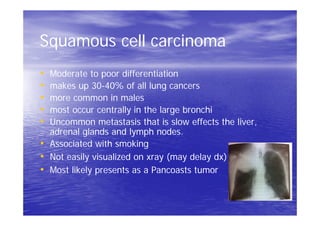
Squamous cell carcinoma
• Moderate to poor differentiation
• makes up 30-40% of all lung cancers
• more common in males
• most occur centrally in the large bronchi
• Uncommon metastasis that is slow effects the liver,
adrenal glands and lymph nodes.
• Associated with smoking
• Not easily visualized on xray (may delay dx)
• Most likely presents as a Pancoasts tumor
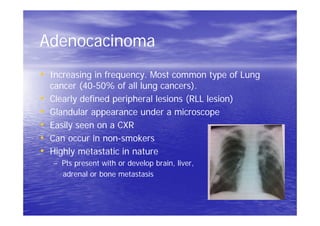
Adenocacinoma
• Increasing in frequency. Most common type of Lung
cancer (40-50% of all lung cancers).
• Clearly defined peripheral lesions (RLL lesion)
• Glandular appearance under a microscope
• Easily seen on a CXR
• Can occur in non-smokers
• Highly metastatic in nature
– Pts present with or develop brain, liver,
adrenal or bone metastasis
Large cell carcinomas
• makes up 15-20% of all lung cancers
• Poorly differentiated cells
• Tends to occur in the outer part (periphery) of lung,
invading sub-segmental bronchi or larger airways
• Metastasis is slow BUT
• Early metastasis occurs to the kidney, liver organs as
well as the adrenal glands
http://www.youtube.com/watch?v=3wzjqbh
besI.
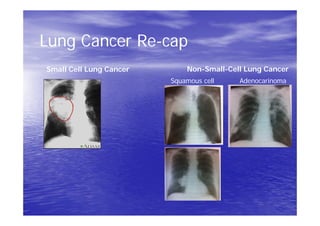
Lung Cancer Re-cap
Small Cell Lung Cancer Non-Small-Cell Lung Cancer
Squamous cell Adenocarinoma
Causes and Risk factors of Lung
Cancer
Signs and Symptoms of Lung
Cancer
Sometimes lung cancer does not cause any symptoms and is only
found in a routine x-ray.
If a person with lung cancer does have symptoms, they will depend
on the location of the tumour in their lung.
It is also imperative to note that the same symptoms can be caused
by other conditions, so may not necessarily mean cancer.
Therefore it is important to consult a doctor when symptoms are
present.
Signs and symptoms also depend upon the location, size of the
tumor, degree of obstruction and existence of metastases
Signs and Symptoms of Lung
Cancer
There are two types of signs and
symptoms of lung cancer:
) Localized – involving the lung.
) Generalized – involves other areas
throughout the body if the cancer has
ocalized Signs and Symptoms
ugh
eathing Problems, SOB, stridor
ange in phlegm
ng infection, hemoptysis
oarseness, Hiccups
t loss
est Pain and tightness
ncoats Syndrome
orner’s Syndrome
eural Effusion
perior Vena Cava Syndrome
tigue
Generalized Signs and
Symptoms
Bone pain
Headaches, mental status changes or neurologic
findings
Abdominal pain, elevated liver function tests,
enlarged liver, gastrointestinal disturbances
(anorexia, cachexia), jaundice, hepatomegaly r/t
liver involvement
Weight loss
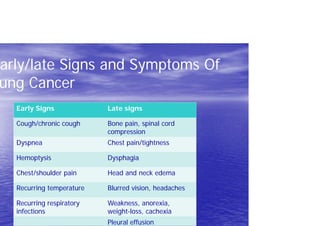
arly/late Signs and Symptoms Of
ung Cancer
Early Signs Late signs
Cough/chronic cough Bone pain, spinal cord
compression
Dyspnea Chest pain/tightness
Hemoptysis Dysphagia
Chest/shoulder pain Head and neck edema
Recurring temperature Blurred vision, headaches
Recurring respiratory Weakness, anorexia,
infections weight-loss, cachexia
Pleural effusion
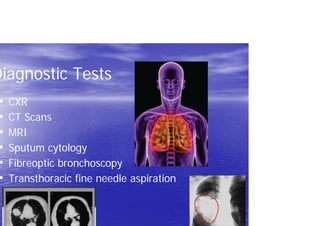
Diagnostic Tests
• CXR
• CT Scans
• MRI
• Sputum cytology
• Fibreoptic bronchoscopy
• Transthoracic fine needle aspiration
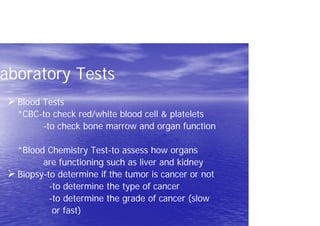
aboratory Tests
Blood Tests
*CBC-to check red/white blood cell & platelets
-to check bone marrow and organ function
*Blood Chemistry Test-to assess how organs
are functioning such as liver and kidney
Biopsy-to determine if the tumor is cancer or not
-to determine the type of cancer
-to determine the grade of cancer (slow
or fast)
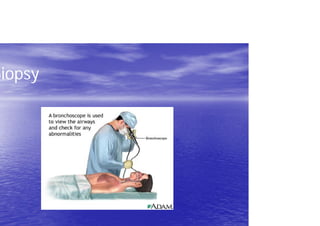
Biopsy
Endoscopy
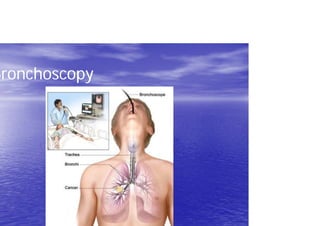
Bronchoscopy
Mediastinoscopy
VATS (video assisted thoracoscopic surgery)
Bronchoscopy
Mediastinoscopy
VATS (video assisted
horacoscopic surgery)
o
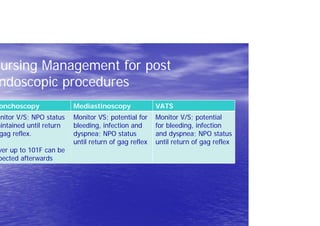
ursing Management for post
ndoscopic procedures
onchoscopy Mediastinoscopy VATS
nitor V/S; NPO status
aintained until return
gag reflex.
ver up to 101F can be
pected afterwards
Monitor VS; potential for
bleeding, infection and
dyspnea; NPO status
until return of gag reflex
Monitor V/S; potential
for bleeding, infection
and dyspnea; NPO status
until return of gag reflex
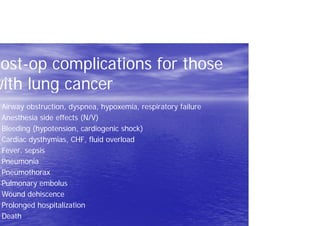
Post-op complications for those
with lung cancer
Airway obstruction, dyspnea, hypoxemia, respiratory failure
Anesthesia side effects (N/V)
Bleeding (hypotension, cardiogenic shock)
Cardiac dysthymias, CHF, fluid overload
Fever, sepsis
Pneumonia
Pneumothorax
Pulmonary embolus
Wound dehiscence
Prolonged hospitalization
Death
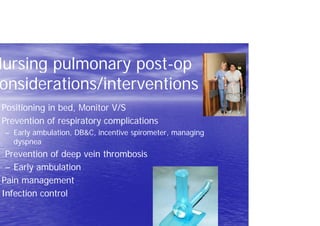
Nursing pulmonary post-op
onsiderations/interventions
Positioning in bed, Monitor V/S
Prevention of respiratory complications
– Early ambulation, DB&C, incentive spirometer, managing
dyspnea
Prevention of deep vein thrombosis
– Early ambulation
Pain management
Infection control
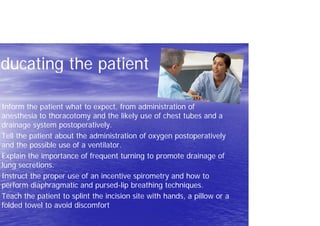
Educating the patient
Inform the patient what to expect, from administration of
anesthesia to thoracotomy and the likely use of chest tubes and a
drainage system postoperatively.
Tell the patient about the administration of oxygen postoperatively
and the possible use of a ventilator.
Explain the importance of frequent turning to promote drainage of
lung secretions.
Instruct the proper use of an incentive spirometry and how to
perform diaphragmatic and pursed-lip breathing techniques.
Teach the patient to splint the incision site with hands, a pillow or a
folded towel to avoid discomfort
t
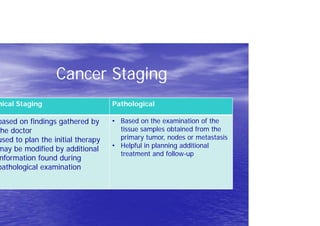
Cancer Staging
nical Staging Pathological
• Based on the examination of the
tissue samples obtained from the
based on findings gathered by
he doctor
primary tumor, nodes or metastasis
used to plan the initial therapy
• Helpful in planning additional
may be modified by additional
treatment and follow-up
nformation found during
pathological examination
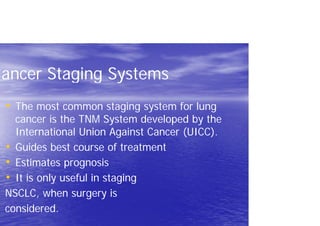
Cancer Staging Systems
• The most common staging system for lung
cancer is the TNM System developed by the
International Union Against Cancer (UICC).
• Guides best course of treatment
• Estimates prognosis
• It is only useful in staging
NSCLC, when surgery is
considered.
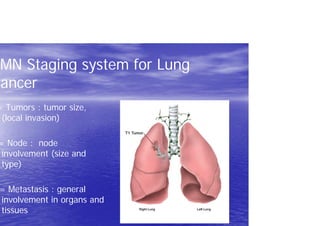
TMN Staging system for Lung
Cancer
= Tumors : tumor size,
(local invasion)
= Node : node
involvement (size and
type)
= Metastasis : general
involvement in organs and
tissues
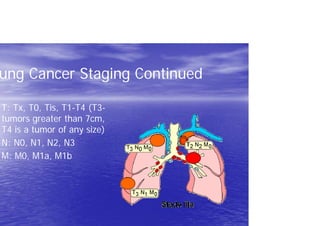
ung Cancer Staging Continued
T: Tx, T0, Tis, T1-T4 (T3-
tumors greater than 7cm,
T4 is a tumor of any size)
N: N0, N1, N2, N3
M: M0, M1a, M1b
Medical Management
The three main cancer treatments
are:
*surgery (lung resections)
*radiation therapy
*chemotherapy
Other types of treatment that are
used to treat certain cancers are
hormonal therapy, biological
therapy or stem cell transplant.
s
s
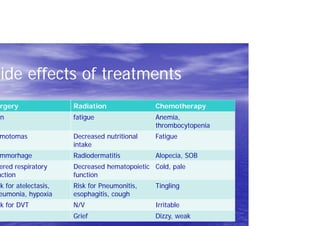
Side effects of treatments
rgery Radiation Chemotherapy
n fatigue Anemia,
thrombocytopenia
motomas Decreased nutritional
intake
Fatigue
mmorhage Radiodermatitis Alopecia, SOB
ered respiratory
nction
Decreased hematopoietic
function
Cold, pale
k for atelectasis,
eumonia, hypoxia
Risk for Pneumonitis,
esophagitis, cough
Tingling
k for DVT N/V Irritable
Grief Dizzy, weak
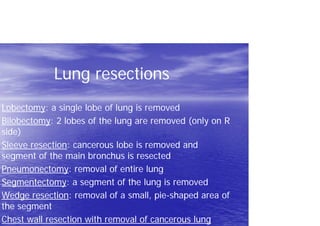
Lung resections
Lobectomy: a single lobe of lung is removed
Bilobectomy: 2 lobes of the lung are removed (only on R
side)
Sleeve resection: cancerous lobe is removed and
segment of the main bronchus is resected
Pneumonectomy: removal of entire lung
Segmentectomy: a segment of the lung is removed
Wedge resection: removal of a small, pie-shaped area of
the segment
Chest wall resection with removal of cancerous lung
Prognostic Factors
The best estimate on how a patient will do based on:
*type of cancer cells
*grade of the cancer
*size or location of the tumor
*stage of the cancer at the time of diagnosis
*age of the person
*gender
*results of blood or other tests
*a persons specific response to treatment
*overall health and physical condition
Prevention: Primary
Avoid the use of tobacco smoke
Personal and family hx are important risk factors
Know environmental carcinogens that increase risk
Chemoprevention:
Consuming carotenoids, Vit A, retinoids Vit E, selenium, Vit C, fat
Prevention: Secondary
Aim is to early diagnose high risk
populations via screening
CXR, MRI, CT scans, sputum cytology
Prevention: Tertiary
Targeted at people who survived a cancer
disease
Assists them to retain an optimal level of
functioning regardless of their potential
debilitating disease

Lung Cancer presentation final.pdf

  • 1.
  • 2.
    Objectives To provide ageneral overview of lung physiology To explore the types and classifications of lung cancer To provide causes and risk factors of lung cancer To present the signs and symptoms of lung cancer in throughout its progression To explore assessment and diagnostic information of lung cancer To introduce diagnostic staging specific to lung cancer To discuss treatments and side effects of lung cancer To present post-op complications for cases with lung cancer
  • 3.
    General Overview ofLung Physiology: Breathing
  • 4.
  • 5.
  • 6.
    Types of LungCancer Two main Types of Lung Cancer: Small Cell Lung Cancer (20-25% of all lung cancers) Non Small Cell Lung Cancer (most common ~80%)
  • 7.
  • 8.
    Non-small cell lungcancer • 1. Squamous cell carcinoma • 2. Adenocarcinoma • 3. Large cell carcinomas
  • 9.
    Squamous cell carcinoma •Moderate to poor differentiation • makes up 30-40% of all lung cancers • more common in males • most occur centrally in the large bronchi • Uncommon metastasis that is slow effects the liver, adrenal glands and lymph nodes. • Associated with smoking • Not easily visualized on xray (may delay dx) • Most likely presents as a Pancoasts tumor
  • 10.
    Adenocacinoma • Increasing infrequency. Most common type of Lung cancer (40-50% of all lung cancers). • Clearly defined peripheral lesions (RLL lesion) • Glandular appearance under a microscope • Easily seen on a CXR • Can occur in non-smokers • Highly metastatic in nature – Pts present with or develop brain, liver, adrenal or bone metastasis
  • 11.
    Large cell carcinomas •makes up 15-20% of all lung cancers • Poorly differentiated cells • Tends to occur in the outer part (periphery) of lung, invading sub-segmental bronchi or larger airways • Metastasis is slow BUT • Early metastasis occurs to the kidney, liver organs as well as the adrenal glands http://www.youtube.com/watch?v=3wzjqbh besI.
  • 12.
    Lung Cancer Re-cap SmallCell Lung Cancer Non-Small-Cell Lung Cancer Squamous cell Adenocarinoma
  • 13.
    Causes and Riskfactors of Lung Cancer
  • 14.
    Signs and Symptomsof Lung Cancer Sometimes lung cancer does not cause any symptoms and is only found in a routine x-ray. If a person with lung cancer does have symptoms, they will depend on the location of the tumour in their lung. It is also imperative to note that the same symptoms can be caused by other conditions, so may not necessarily mean cancer. Therefore it is important to consult a doctor when symptoms are present. Signs and symptoms also depend upon the location, size of the tumor, degree of obstruction and existence of metastases


  • 15.
    Signs and Symptomsof Lung Cancer There are two types of signs and symptoms of lung cancer: ) Localized – involving the lung. ) Generalized – involves other areas throughout the body if the cancer has
  • 16.
    ocalized Signs andSymptoms ugh eathing Problems, SOB, stridor ange in phlegm ng infection, hemoptysis oarseness, Hiccups t loss est Pain and tightness ncoats Syndrome orner’s Syndrome eural Effusion perior Vena Cava Syndrome tigue
  • 17.
    Generalized Signs and Symptoms Bonepain Headaches, mental status changes or neurologic findings Abdominal pain, elevated liver function tests, enlarged liver, gastrointestinal disturbances (anorexia, cachexia), jaundice, hepatomegaly r/t liver involvement Weight loss
  • 18.
    arly/late Signs andSymptoms Of ung Cancer Early Signs Late signs Cough/chronic cough Bone pain, spinal cord compression Dyspnea Chest pain/tightness Hemoptysis Dysphagia Chest/shoulder pain Head and neck edema Recurring temperature Blurred vision, headaches Recurring respiratory Weakness, anorexia, infections weight-loss, cachexia Pleural effusion
  • 19.
    Diagnostic Tests • CXR •CT Scans • MRI • Sputum cytology • Fibreoptic bronchoscopy • Transthoracic fine needle aspiration
  • 20.
    aboratory Tests Blood Tests *CBC-tocheck red/white blood cell & platelets -to check bone marrow and organ function *Blood Chemistry Test-to assess how organs are functioning such as liver and kidney Biopsy-to determine if the tumor is cancer or not -to determine the type of cancer -to determine the grade of cancer (slow or fast)
  • 21.
  • 22.
  • 23.
  • 24.
  • 25.
  • 26.
    o ursing Management forpost ndoscopic procedures onchoscopy Mediastinoscopy VATS nitor V/S; NPO status aintained until return gag reflex. ver up to 101F can be pected afterwards Monitor VS; potential for bleeding, infection and dyspnea; NPO status until return of gag reflex Monitor V/S; potential for bleeding, infection and dyspnea; NPO status until return of gag reflex
  • 27.
    Post-op complications forthose with lung cancer Airway obstruction, dyspnea, hypoxemia, respiratory failure Anesthesia side effects (N/V) Bleeding (hypotension, cardiogenic shock) Cardiac dysthymias, CHF, fluid overload Fever, sepsis Pneumonia Pneumothorax Pulmonary embolus Wound dehiscence Prolonged hospitalization Death
  • 28.
    Nursing pulmonary post-op onsiderations/interventions Positioningin bed, Monitor V/S Prevention of respiratory complications – Early ambulation, DB&C, incentive spirometer, managing dyspnea Prevention of deep vein thrombosis – Early ambulation Pain management Infection control
  • 29.
    Educating the patient Informthe patient what to expect, from administration of anesthesia to thoracotomy and the likely use of chest tubes and a drainage system postoperatively. Tell the patient about the administration of oxygen postoperatively and the possible use of a ventilator. Explain the importance of frequent turning to promote drainage of lung secretions. Instruct the proper use of an incentive spirometry and how to perform diaphragmatic and pursed-lip breathing techniques. Teach the patient to splint the incision site with hands, a pillow or a folded towel to avoid discomfort
  • 30.
    t Cancer Staging nical StagingPathological • Based on the examination of the tissue samples obtained from the based on findings gathered by he doctor primary tumor, nodes or metastasis used to plan the initial therapy • Helpful in planning additional may be modified by additional treatment and follow-up nformation found during pathological examination
  • 31.
    Cancer Staging Systems •The most common staging system for lung cancer is the TNM System developed by the International Union Against Cancer (UICC). • Guides best course of treatment • Estimates prognosis • It is only useful in staging NSCLC, when surgery is considered.
  • 32.
    TMN Staging systemfor Lung Cancer = Tumors : tumor size, (local invasion) = Node : node involvement (size and type) = Metastasis : general involvement in organs and tissues
  • 33.
    ung Cancer StagingContinued T: Tx, T0, Tis, T1-T4 (T3- tumors greater than 7cm, T4 is a tumor of any size) N: N0, N1, N2, N3 M: M0, M1a, M1b
  • 34.
    Medical Management The threemain cancer treatments are: *surgery (lung resections) *radiation therapy *chemotherapy Other types of treatment that are used to treat certain cancers are hormonal therapy, biological therapy or stem cell transplant.
  • 35.
    s s Side effects oftreatments rgery Radiation Chemotherapy n fatigue Anemia, thrombocytopenia motomas Decreased nutritional intake Fatigue mmorhage Radiodermatitis Alopecia, SOB ered respiratory nction Decreased hematopoietic function Cold, pale k for atelectasis, eumonia, hypoxia Risk for Pneumonitis, esophagitis, cough Tingling k for DVT N/V Irritable Grief Dizzy, weak
  • 36.
    Lung resections Lobectomy: asingle lobe of lung is removed Bilobectomy: 2 lobes of the lung are removed (only on R side) Sleeve resection: cancerous lobe is removed and segment of the main bronchus is resected Pneumonectomy: removal of entire lung Segmentectomy: a segment of the lung is removed Wedge resection: removal of a small, pie-shaped area of the segment Chest wall resection with removal of cancerous lung
  • 37.
    Prognostic Factors The bestestimate on how a patient will do based on: *type of cancer cells *grade of the cancer *size or location of the tumor *stage of the cancer at the time of diagnosis *age of the person *gender *results of blood or other tests *a persons specific response to treatment *overall health and physical condition
  • 38.
    Prevention: Primary Avoid theuse of tobacco smoke Personal and family hx are important risk factors Know environmental carcinogens that increase risk Chemoprevention: Consuming carotenoids, Vit A, retinoids Vit E, selenium, Vit C, fat
  • 39.
    Prevention: Secondary Aim isto early diagnose high risk populations via screening CXR, MRI, CT scans, sputum cytology
  • 40.
    Prevention: Tertiary Targeted atpeople who survived a cancer disease Assists them to retain an optimal level of functioning regardless of their potential debilitating disease