Lung Cancer
Submitted to-Dr.Uma Bhandari ma’am
Submitted by-Arbeena Shakir
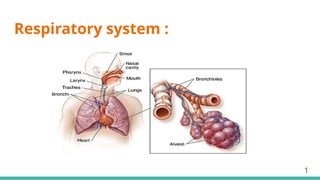
Respiratory system :
1
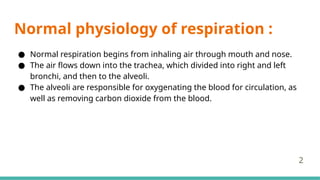
Normal physiology of respiration :
● Normal respiration begins from inhaling air through mouth and nose.
● The air flows down into the trachea, which divided into right and left
bronchi, and then to the alveoli.
● The alveoli are responsible for oxygenating the blood for circulation, as
well as removing carbon dioxide from the blood.
2
What is cancer
An abnormal growth of cell which tend to proliferate in an uncontrolled way
and, in some cases, to metastasize (spread).
Cancer is not one disease, it is a group of more than 100 different and
distinctive diseases.
3
Lung cancer
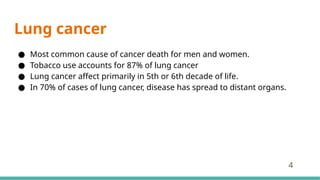
● Most common cause of cancer death for men and women.
● Tobacco use accounts for 87% of lung cancer
● Lung cancer affect primarily in 5th or 6th decade of life.
● In 70% of cases of lung cancer, disease has spread to distant organs.
4
Types of Lung Cancer
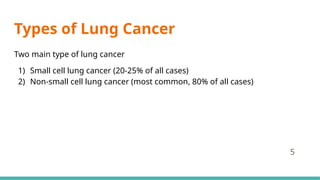
Two main type of lung cancer
1) Small cell lung cancer (20-25% of all cases)
2) Non-small cell lung cancer (most common, 80% of all cases)
5
Small cell lung cancer
Small cell lung cancer is the most aggressive form of cancer.
It usually stars in the bronchi and then affect the whole lung.
These cancer cells are small and quite aggressive in nature, and they have a
large growth factors.

Because of these reasons at the time of diagnosis (60% of the time) these
tumors have often metastasized to other part of the body (brain, liver, bone
marrow)
Small cell lung cancer accounts for 20-25% of all lung cancers.
6
Non-small cell lung cancer
It is a type of epithelial lung cancer other than small cell lung cancer.
This type of cancer grows and spreads more slowly than small cell lung
cancer
7
Types of non-small cell lung cancer :
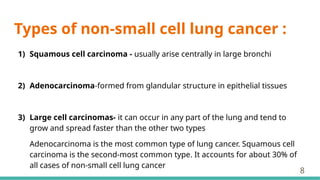
1) Squamous cell carcinoma - usually arise centrally in large bronchi
2) Adenocarcinoma-formed from glandular structure in epithelial tissues
3) Large cell carcinomas- it can occur in any part of the lung and tend to
grow and spread faster than the other two types
Adenocarcinoma is the most common type of lung cancer. Squamous cell
carcinoma is the second-most common type. It accounts for about 30% of
all cases of non-small cell lung cancer
8
Squamous cell carcinoma
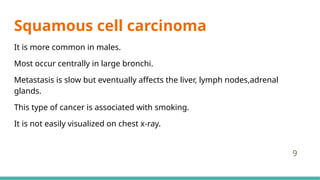
It is more common in males.
Most occur centrally in large bronchi.
Metastasis is slow but eventually affects the liver, lymph nodes,adrenal
glands.
This type of cancer is associated with smoking.
It is not easily visualized on chest x-ray.
9
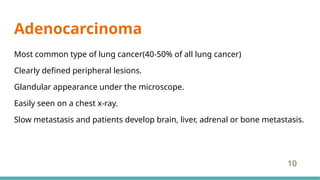
Adenocarcinoma
Most common type of lung cancer(40-50% of all lung cancer)
Clearly defined peripheral lesions.
Glandular appearance under the microscope.
Easily seen on a chest x-ray.
Slow metastasis and patients develop brain, liver, adrenal or bone metastasis.
10
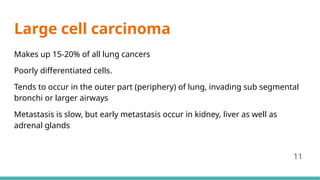
Large cell carcinoma
Makes up 15-20% of all lung cancers
Poorly differentiated cells.
Tends to occur in the outer part (periphery) of lung, invading sub segmental
bronchi or larger airways
Metastasis is slow, but early metastasis occur in kidney, liver as well as
adrenal glands
11
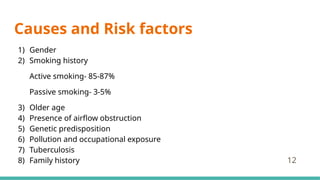
Causes and Risk factors
1) Gender
2) Smoking history
Active smoking- 85-87%
Passive smoking- 3-5%
3) Older age
4) Presence of airflow obstruction
5) Genetic predisposition
6) Pollution and occupational exposure
7) Tuberculosis
8) Family history 12
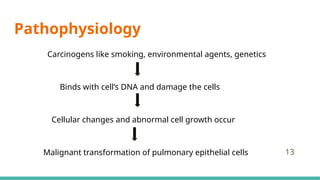
Pathophysiology
Carcinogens like smoking, environmental agents, genetics
Binds with cell’s DNA and damage the cells
Cellular changes and abnormal cell growth occur
Malignant transformation of pulmonary epithelial cells 13
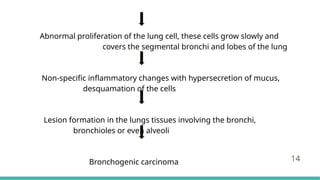
Abnormal proliferation of the lung cell, these cells grow slowly and
c covers the segmental bronchi and lobes of the lung
Non-specific inflammatory changes with hypersecretion of mucus, d d
desquamation of the cells
Lesion formation in the lungs tissues involving the bronchi, b b b
bronchioles or even alveoli
Bronchogenic carcinoma 14
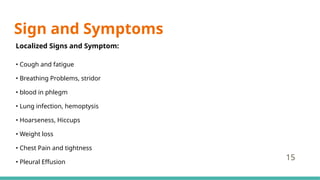
Sign and Symptoms
Localized Signs and Symptom:
• Cough and fatigue
• Breathing Problems, stridor
• blood in phlegm
• Lung infection, hemoptysis
• Hoarseness, Hiccups
• Weight loss
• Chest Pain and tightness
• Pleural Effusion
15
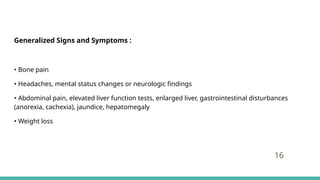
Generalized Signs and Symptoms :
• Bone pain
• Headaches, mental status changes or neurologic findings
• Abdominal pain, elevated liver function tests, enlarged liver, gastrointestinal disturbances
(anorexia, cachexia), jaundice, hepatomegaly
• Weight loss
16
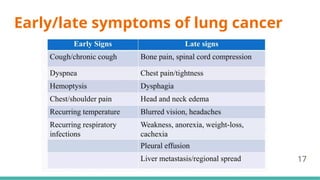
Early/late symptoms of lung cancer
17
Diagnostic test
● Chest X-ray
● CT scans
● MRI
● Sputum cytology
● Fiberoptic bronchoscopy
● Transthoracic fine needle aspiration
18
Laboratory tests
Blood Tests
CBC- to check red/white blood cell & platelets -to check bone marrow and
organ function
Blood Chemistry Test- to assess how organs are functioning, such as liver
and kidney
Biopsy-to determine if the tumor is cancer or not -to determine the type of
cancer -to determine the grade of cancer (slow or fast)
19
Bronchoscopy
20
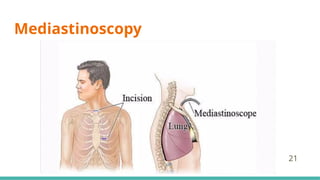
Mediastinoscopy
21
Video assisted thoracoscopic surgery (VATS)
Video-assisted thoracoscopic surgery (VATS) is a minimally invasive surgical
technique used to diagnose and treat problems in the chest.
During a VATS procedure, a tiny camera and surgical tools are inserted into
the chest through one or more small cuts in the chest wall. The camera,
called a thoracoscope, sends images of the inside of the chest to a video
monitor. These images guide the surgeon during the procedure.
22
Post-operative complications for those with lung cancer
• Airway obstruction, dyspnea, hypoxemia, respiratory failure
• Anesthesia side effects (N/V)
• Bleeding (hypotension, cardiogenic shock)
• Cardiac dysrhythmias, CHF, fluid overload
• Fever, sepsis
• Pneumonia
• Pneumothorax
• Pulmonary embolism
• Wound dehiscence
• Prolonged hospitalization
• Death
23
Medical management
The three main cancer treatments are:
surgery (lung resections)
Radiation therapy
chemotherapy
Other types of treatment that are used to treat certain cancers are hormonal
therapy, biological therapy or stem cell transplant.
24
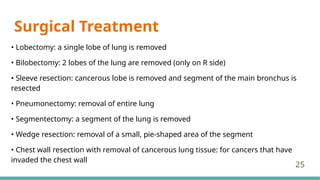
Surgical Treatment
• Lobectomy: a single lobe of lung is removed
• Bilobectomy: 2 lobes of the lung are removed (only on R side)
• Sleeve resection: cancerous lobe is removed and segment of the main bronchus is
resected
• Pneumonectomy: removal of entire lung
• Segmentectomy: a segment of the lung is removed
• Wedge resection: removal of a small, pie-shaped area of the segment
• Chest wall resection with removal of cancerous lung tissue: for cancers that have
invaded the chest wall
25
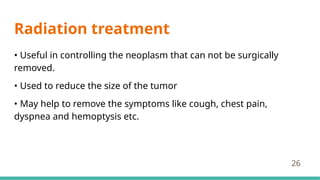
Radiation treatment
• Useful in controlling the neoplasm that can not be surgically
removed.
• Used to reduce the size of the tumor
• May help to remove the symptoms like cough, chest pain,
dyspnea and hemoptysis etc.
26
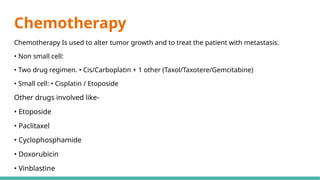
Chemotherapy
Chemotherapy Is used to alter tumor growth and to treat the patient with metastasis.
• Non small cell:
• Two drug regimen. • Cis/Carboplatin + 1 other (Taxol/Taxotere/Gemcitabine)
• Small cell: • Cisplatin / Etoposide
Other drugs involved like-
• Etoposide
• Paclitaxel
• Cyclophosphamide
• Doxorubicin
• Vinblastine
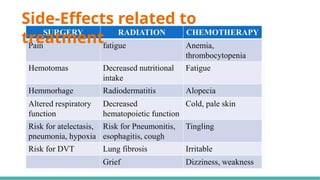
Side-Effects related to
treatment
Complementary therapies
• Mind-body: help to reduce anxiety, mood disturbance, or chronic pain in cancer
patients (audiotapes, videotapes, books, music, relaxation, yoga, meditation).
• Acupuncture
• Hypnosis
•Massage therapy
Prognostic factors
The best estimate on how a patient will do based on:
• Type of cancer cells
• Size or location of the tumor
• Stage of the cancer at the time of diagnosis
• Age of the person
• Gender
• Results of blood or other tests
• A person's specific response to treatment
• Overall health and physical condition
Prevention : primary
Avoid the use of tobacco smoke
Know environmental carcinogens that increase risk
Chemoprevention
Consuming Vit A,E,C
Prevention : secondary
Aim to early diagnose high risk populations via screening
Chest X-Ray, MRI, CT scan, sputum cytology.
Prevention : tertiary
Targeted at people who survived a cancer disease
Assists them to retain an optimal level of functioning regardless of their
potential debilitating disease.
Thank you…

lung cancer with types and pathophysiology

  • 1.
    Lung Cancer Submitted to-Dr.UmaBhandari ma’am Submitted by-Arbeena Shakir
  • 2.
  • 3.
    Normal physiology ofrespiration : ● Normal respiration begins from inhaling air through mouth and nose. ● The air flows down into the trachea, which divided into right and left bronchi, and then to the alveoli. ● The alveoli are responsible for oxygenating the blood for circulation, as well as removing carbon dioxide from the blood. 2
  • 4.
    What is cancer Anabnormal growth of cell which tend to proliferate in an uncontrolled way and, in some cases, to metastasize (spread). Cancer is not one disease, it is a group of more than 100 different and distinctive diseases. 3
  • 5.
    Lung cancer ● Mostcommon cause of cancer death for men and women. ● Tobacco use accounts for 87% of lung cancer ● Lung cancer affect primarily in 5th or 6th decade of life. ● In 70% of cases of lung cancer, disease has spread to distant organs. 4
  • 6.
    Types of LungCancer Two main type of lung cancer 1) Small cell lung cancer (20-25% of all cases) 2) Non-small cell lung cancer (most common, 80% of all cases) 5
  • 7.
    Small cell lungcancer Small cell lung cancer is the most aggressive form of cancer. It usually stars in the bronchi and then affect the whole lung. These cancer cells are small and quite aggressive in nature, and they have a large growth factors. Because of these reasons at the time of diagnosis (60% of the time) these tumors have often metastasized to other part of the body (brain, liver, bone marrow) Small cell lung cancer accounts for 20-25% of all lung cancers. 6
  • 8.
    Non-small cell lungcancer It is a type of epithelial lung cancer other than small cell lung cancer. This type of cancer grows and spreads more slowly than small cell lung cancer 7
  • 9.
    Types of non-smallcell lung cancer : 1) Squamous cell carcinoma - usually arise centrally in large bronchi 2) Adenocarcinoma-formed from glandular structure in epithelial tissues 3) Large cell carcinomas- it can occur in any part of the lung and tend to grow and spread faster than the other two types Adenocarcinoma is the most common type of lung cancer. Squamous cell carcinoma is the second-most common type. It accounts for about 30% of all cases of non-small cell lung cancer 8
  • 10.
    Squamous cell carcinoma Itis more common in males. Most occur centrally in large bronchi. Metastasis is slow but eventually affects the liver, lymph nodes,adrenal glands. This type of cancer is associated with smoking. It is not easily visualized on chest x-ray. 9
  • 11.
    Adenocarcinoma Most common typeof lung cancer(40-50% of all lung cancer) Clearly defined peripheral lesions. Glandular appearance under the microscope. Easily seen on a chest x-ray. Slow metastasis and patients develop brain, liver, adrenal or bone metastasis. 10
  • 12.
    Large cell carcinoma Makesup 15-20% of all lung cancers Poorly differentiated cells. Tends to occur in the outer part (periphery) of lung, invading sub segmental bronchi or larger airways Metastasis is slow, but early metastasis occur in kidney, liver as well as adrenal glands 11
  • 13.
    Causes and Riskfactors 1) Gender 2) Smoking history Active smoking- 85-87% Passive smoking- 3-5% 3) Older age 4) Presence of airflow obstruction 5) Genetic predisposition 6) Pollution and occupational exposure 7) Tuberculosis 8) Family history 12
  • 14.
    Pathophysiology Carcinogens like smoking,environmental agents, genetics Binds with cell’s DNA and damage the cells Cellular changes and abnormal cell growth occur Malignant transformation of pulmonary epithelial cells 13
  • 15.
    Abnormal proliferation ofthe lung cell, these cells grow slowly and c covers the segmental bronchi and lobes of the lung Non-specific inflammatory changes with hypersecretion of mucus, d d desquamation of the cells Lesion formation in the lungs tissues involving the bronchi, b b b bronchioles or even alveoli Bronchogenic carcinoma 14
  • 16.
    Sign and Symptoms LocalizedSigns and Symptom: • Cough and fatigue • Breathing Problems, stridor • blood in phlegm • Lung infection, hemoptysis • Hoarseness, Hiccups • Weight loss • Chest Pain and tightness • Pleural Effusion 15
  • 17.
    Generalized Signs andSymptoms : • Bone pain • Headaches, mental status changes or neurologic findings • Abdominal pain, elevated liver function tests, enlarged liver, gastrointestinal disturbances (anorexia, cachexia), jaundice, hepatomegaly • Weight loss 16
  • 18.
    Early/late symptoms oflung cancer 17
  • 19.
    Diagnostic test ● ChestX-ray ● CT scans ● MRI ● Sputum cytology ● Fiberoptic bronchoscopy ● Transthoracic fine needle aspiration 18
  • 20.
    Laboratory tests Blood Tests CBC-to check red/white blood cell & platelets -to check bone marrow and organ function Blood Chemistry Test- to assess how organs are functioning, such as liver and kidney Biopsy-to determine if the tumor is cancer or not -to determine the type of cancer -to determine the grade of cancer (slow or fast) 19
  • 21.
  • 22.
  • 23.
    Video assisted thoracoscopicsurgery (VATS) Video-assisted thoracoscopic surgery (VATS) is a minimally invasive surgical technique used to diagnose and treat problems in the chest. During a VATS procedure, a tiny camera and surgical tools are inserted into the chest through one or more small cuts in the chest wall. The camera, called a thoracoscope, sends images of the inside of the chest to a video monitor. These images guide the surgeon during the procedure. 22
  • 24.
    Post-operative complications forthose with lung cancer • Airway obstruction, dyspnea, hypoxemia, respiratory failure • Anesthesia side effects (N/V) • Bleeding (hypotension, cardiogenic shock) • Cardiac dysrhythmias, CHF, fluid overload • Fever, sepsis • Pneumonia • Pneumothorax • Pulmonary embolism • Wound dehiscence • Prolonged hospitalization • Death 23
  • 25.
    Medical management The threemain cancer treatments are: surgery (lung resections) Radiation therapy chemotherapy Other types of treatment that are used to treat certain cancers are hormonal therapy, biological therapy or stem cell transplant. 24
  • 26.
    Surgical Treatment • Lobectomy:a single lobe of lung is removed • Bilobectomy: 2 lobes of the lung are removed (only on R side) • Sleeve resection: cancerous lobe is removed and segment of the main bronchus is resected • Pneumonectomy: removal of entire lung • Segmentectomy: a segment of the lung is removed • Wedge resection: removal of a small, pie-shaped area of the segment • Chest wall resection with removal of cancerous lung tissue: for cancers that have invaded the chest wall 25
  • 27.
    Radiation treatment • Usefulin controlling the neoplasm that can not be surgically removed. • Used to reduce the size of the tumor • May help to remove the symptoms like cough, chest pain, dyspnea and hemoptysis etc. 26
  • 28.
    Chemotherapy Chemotherapy Is usedto alter tumor growth and to treat the patient with metastasis. • Non small cell: • Two drug regimen. • Cis/Carboplatin + 1 other (Taxol/Taxotere/Gemcitabine) • Small cell: • Cisplatin / Etoposide Other drugs involved like- • Etoposide • Paclitaxel • Cyclophosphamide • Doxorubicin • Vinblastine
  • 29.
  • 30.
    Complementary therapies • Mind-body:help to reduce anxiety, mood disturbance, or chronic pain in cancer patients (audiotapes, videotapes, books, music, relaxation, yoga, meditation). • Acupuncture • Hypnosis •Massage therapy
  • 31.
    Prognostic factors The bestestimate on how a patient will do based on: • Type of cancer cells • Size or location of the tumor • Stage of the cancer at the time of diagnosis • Age of the person • Gender • Results of blood or other tests • A person's specific response to treatment • Overall health and physical condition
  • 32.
    Prevention : primary Avoidthe use of tobacco smoke Know environmental carcinogens that increase risk Chemoprevention Consuming Vit A,E,C
  • 33.
    Prevention : secondary Aimto early diagnose high risk populations via screening Chest X-Ray, MRI, CT scan, sputum cytology.
  • 34.
    Prevention : tertiary Targetedat people who survived a cancer disease Assists them to retain an optimal level of functioning regardless of their potential debilitating disease.
  • 35.