



Malik Jauhar
Pre-Final MBBS
Dept. of ENT, ASCOMS
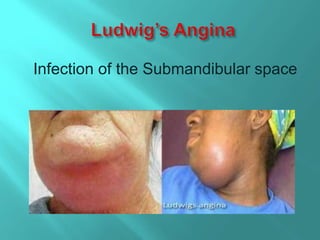
Infection of the Submandibular space
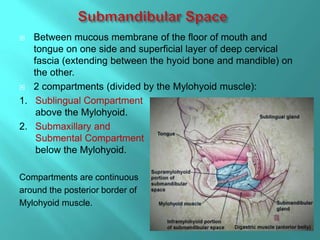
 Between mucous membrane of the floor of mouth and
tongue on one side and superficial layer of deep cervical
fascia (extending between the hyoid bone and mandible) on
the other.
 2 compartments (divided by the Mylohyoid muscle):
1. Sublingual Compartment
above the Mylohyoid.
2. Submaxillary and
Submental Compartment
below the Mylohyoid.
Compartments are continuous
around the posterior border of
Mylohyoid muscle.
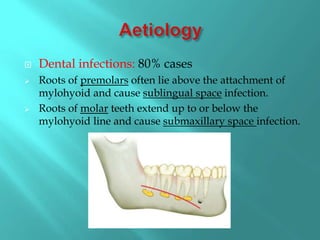
 Dental infections: 80% cases
 Roots of premolars often lie above the attachment of
mylohyoid and cause sublingual space infection.
 Roots of molar teeth extend up to or below the
mylohyoid line and cause submaxillary space infection.
 Submandibular sialadenitis
 Injuries of oral mucosa
 Fractures of the mandible
 Commonly mixed infections involving both
aerobes and anaerobes
 Commonly Alpha-hemolytic Streptococci,
Staphylococci and bacteroides group
 Rarely Haemophilus influenzae, Escherichia coli
and Pseudomonas
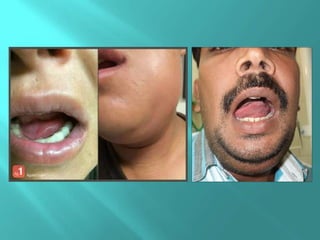
 Odynophagia with varying degrees of trismus.
 In localized sublingual infection:
Structures in the floor of mouth are swollen
and tongue seems to be pushed up and back.
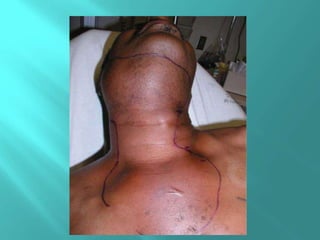
 In submaxillary space involvement:
Submental and submandibular regions become
swollen and tender, and impart woody-hard feel.
 Usually there is cellulitis rather than frank abscess.
 Tongue is pushed upwards and backwards
threatening the airway.
 Laryngeal oedema.
1. Systemic antibiotics
2. Incision and drainage of abscess.
Intraoral—if infection is still localized
to sublingual space.
External– if infection involves
submaxillary space. A transverse incision
extending from one angle of mandible to the
other is made with vertical opening of midline
musculature of tongue with a blunt haemostat.
Very often it is serous fluid rather than frank
pus that is encountered.
3. Tracheostomy, if airway is endangered.
 Spread of infection to parapharyngeal and
retropharyngeal spaces and thence to
mediastinum.
 Airway obstruction due to laryngeal oedema,
or swelling and pushing back of the tongue.
 Septicaemia.
 Aspiration pneumonia.
Thank You

Ludwig's Angina

  • 1.
  • 2.
    Infection of theSubmandibular space
  • 3.
     Between mucousmembrane of the floor of mouth and tongue on one side and superficial layer of deep cervical fascia (extending between the hyoid bone and mandible) on the other.  2 compartments (divided by the Mylohyoid muscle): 1. Sublingual Compartment above the Mylohyoid. 2. Submaxillary and Submental Compartment below the Mylohyoid. Compartments are continuous around the posterior border of Mylohyoid muscle.
  • 4.
     Dental infections:80% cases  Roots of premolars often lie above the attachment of mylohyoid and cause sublingual space infection.  Roots of molar teeth extend up to or below the mylohyoid line and cause submaxillary space infection.
  • 5.
     Submandibular sialadenitis Injuries of oral mucosa  Fractures of the mandible
  • 6.
     Commonly mixedinfections involving both aerobes and anaerobes  Commonly Alpha-hemolytic Streptococci, Staphylococci and bacteroides group  Rarely Haemophilus influenzae, Escherichia coli and Pseudomonas
  • 7.
     Odynophagia withvarying degrees of trismus.  In localized sublingual infection: Structures in the floor of mouth are swollen and tongue seems to be pushed up and back.  In submaxillary space involvement: Submental and submandibular regions become swollen and tender, and impart woody-hard feel.  Usually there is cellulitis rather than frank abscess.  Tongue is pushed upwards and backwards threatening the airway.  Laryngeal oedema.
  • 9.
    1. Systemic antibiotics 2.Incision and drainage of abscess. Intraoral—if infection is still localized to sublingual space. External– if infection involves submaxillary space. A transverse incision extending from one angle of mandible to the other is made with vertical opening of midline musculature of tongue with a blunt haemostat. Very often it is serous fluid rather than frank pus that is encountered. 3. Tracheostomy, if airway is endangered.
  • 10.
     Spread ofinfection to parapharyngeal and retropharyngeal spaces and thence to mediastinum.  Airway obstruction due to laryngeal oedema, or swelling and pushing back of the tongue.  Septicaemia.  Aspiration pneumonia.
  • 12.