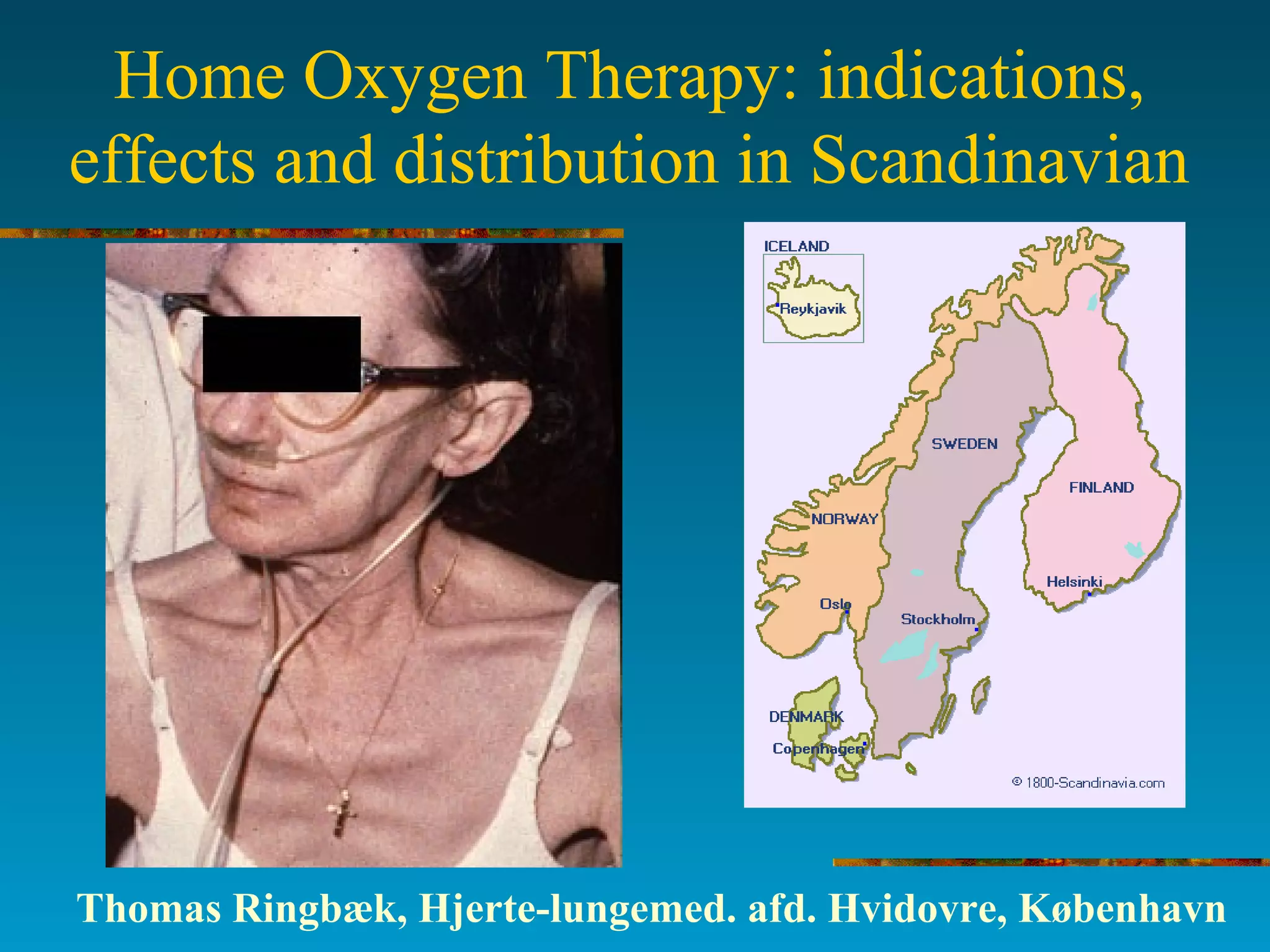
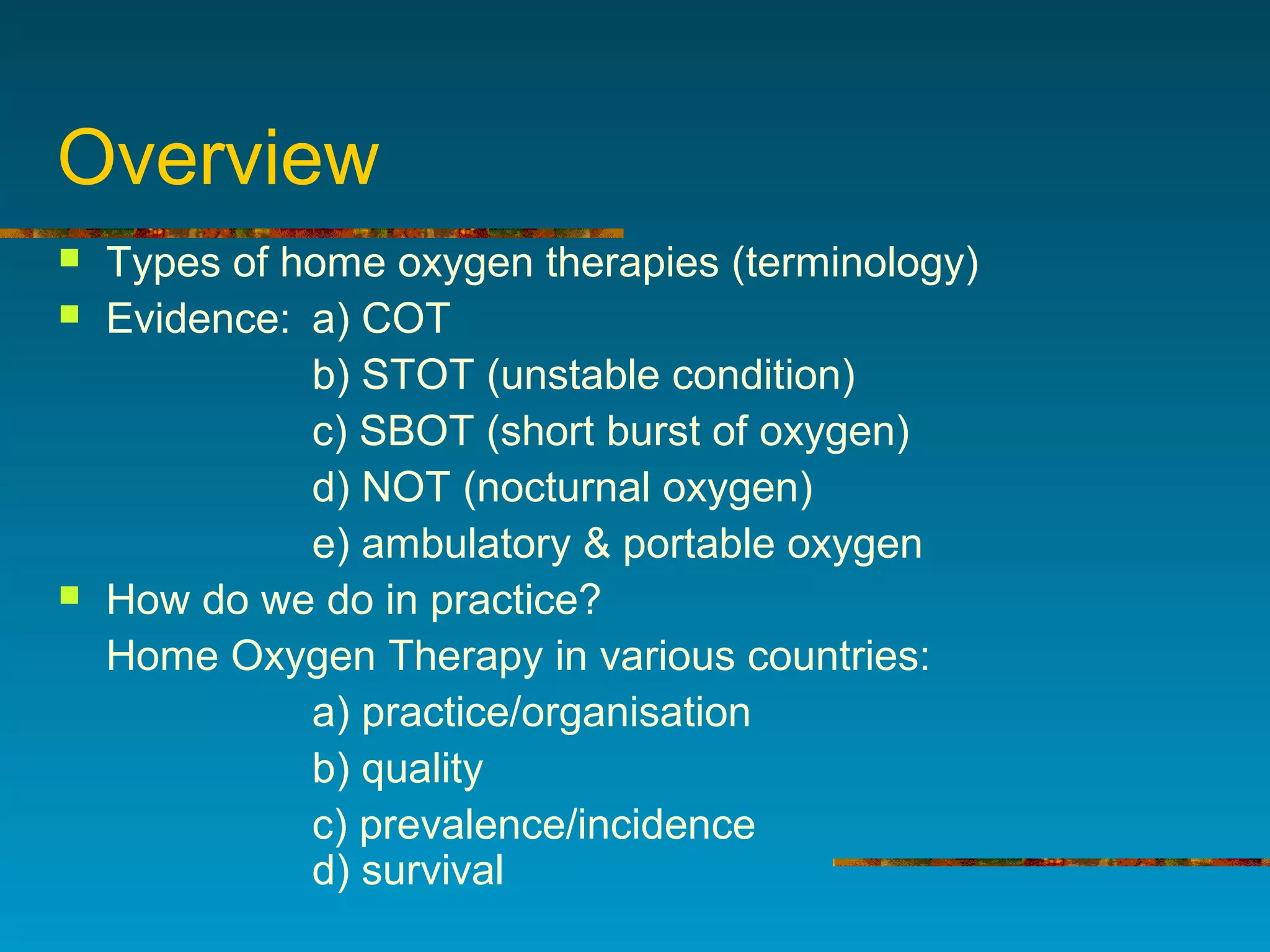
Home Oxygen Therapy: indications,
effects and distribution in Scandinavian
Thomas Ringbæk, Hjerte-lungemed. afd. Hvidovre, København
Overview
 Types of home oxygen therapies (terminology)
 Evidence: a) COT
b) STOT (unstable condition)
c) SBOT (short burst of oxygen)
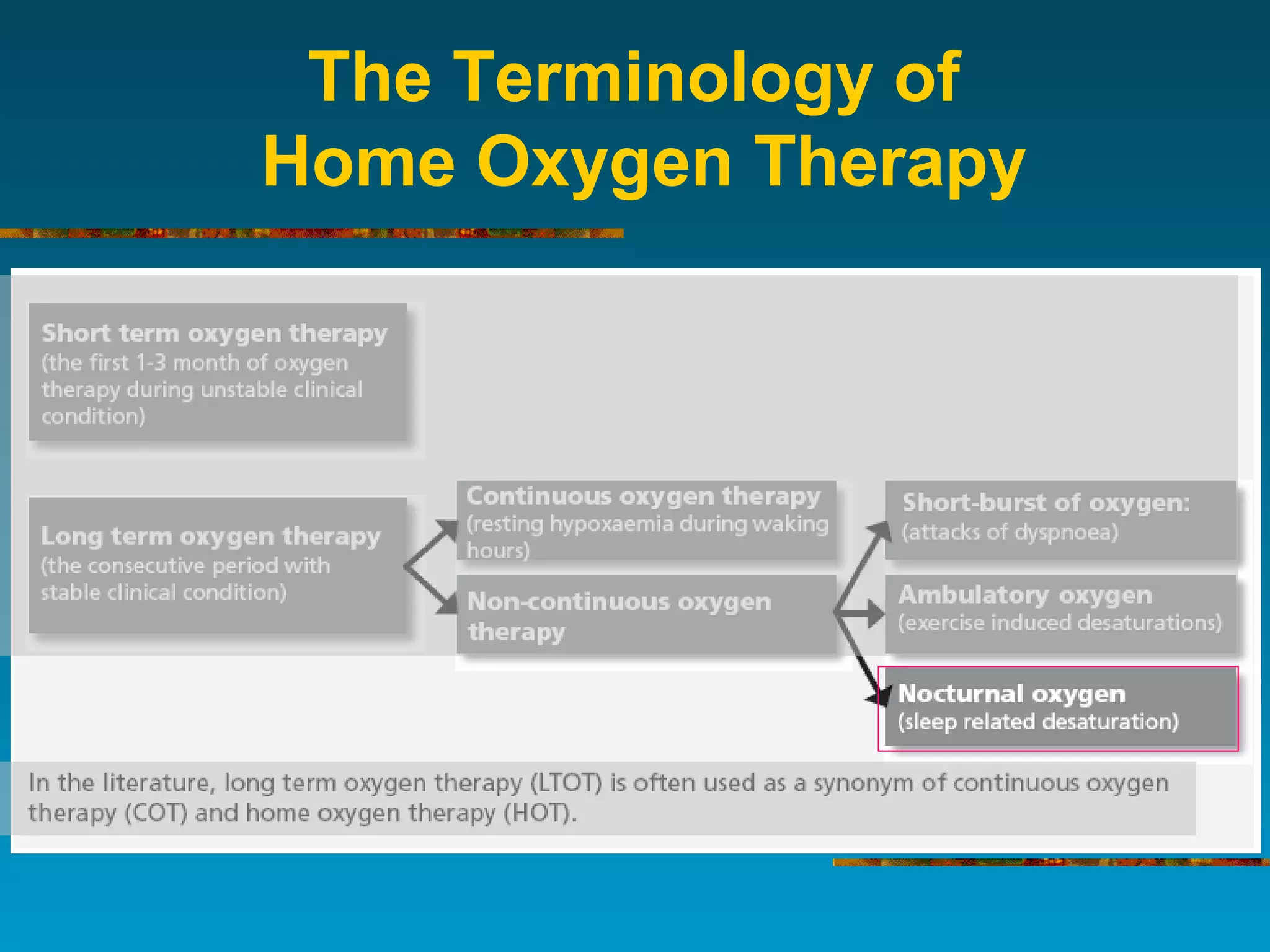
d) NOT (nocturnal oxygen)
e) ambulatory & portable oxygen
 How do we do in practice?
Home Oxygen Therapy in various countries:
a) practice/organisation
b) quality
c) prevalence/incidence
d) survival
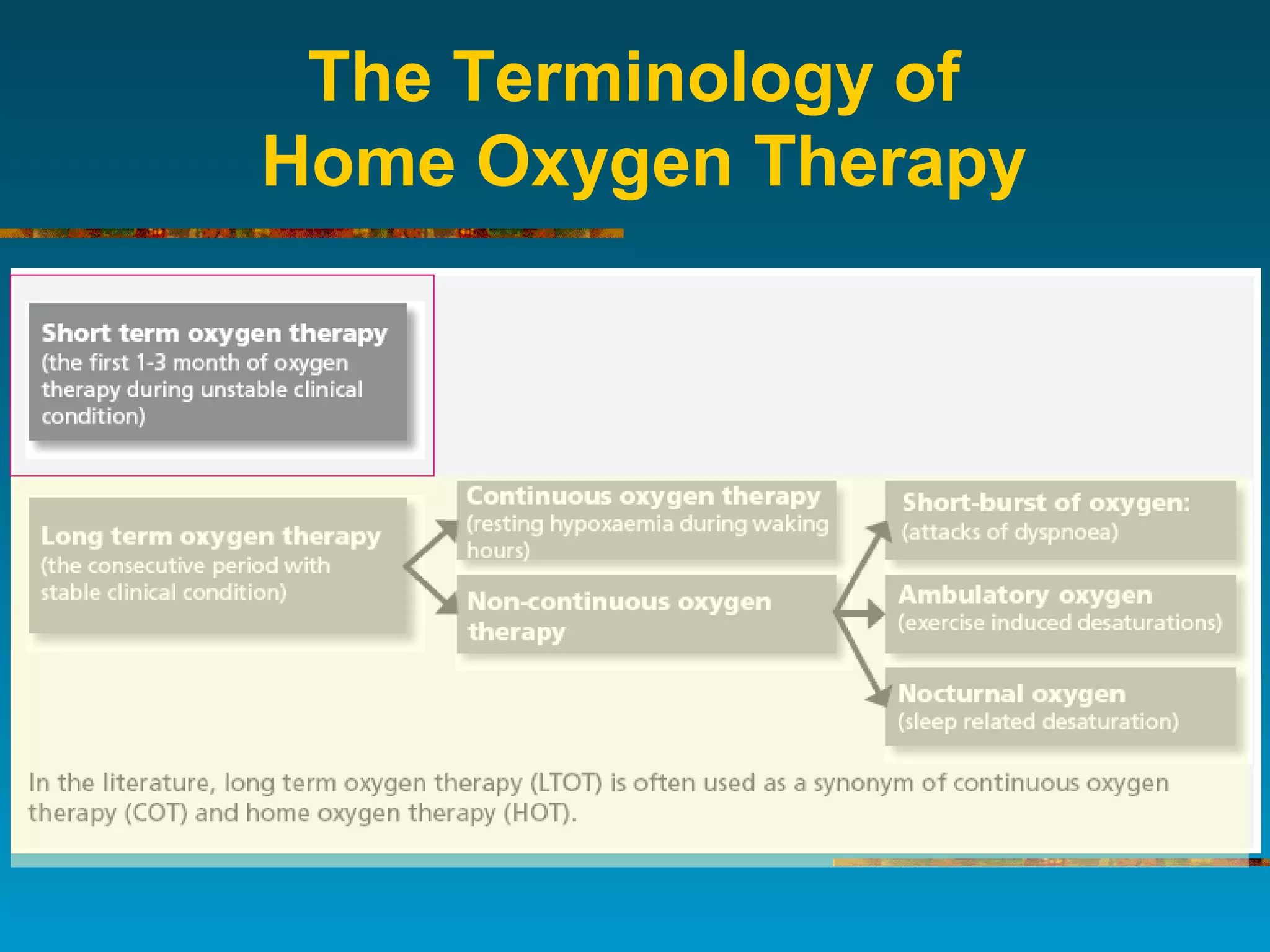
The Terminology of
Home Oxygen Therapy
The Terminology of
Home Oxygen Therapy
COT in COPD: effect on survival
PaO2 <7.3 kPa;7.3-8.0: EVF>55% or cor pulmonale)
Post-PaO2 >8.6 kPa; Stabile and optimal treated; Non-smokers
MRC NOTT
N 87 203
Age 58 66
Men% 76 80
FEV1% 30 30
PO2, 6.8 6.8 kPa
PCO2 7.2 6.9 kPa
Htc.% 52 47
Smoking 45% ?
Flow 2 1-3+1
Hours 13.5 17.7/12
Mobile - +/-
Effects of COT
 ↓ventilatory work
 ↑hemodynamic ↓PAP
 ↓Htc.: 4-8%
 FEV1: unchanged
 ↑PO2?
 ↑kidney function (↓oedema)
 ↓dyspnoea
 ↑physical capacity
 ↓tiered
 ↑sleep
 ↑cognitive performance
 ↑QoL
 ↑survival: 2 → 4 år
 ↓hospitalisation: 25%
COT in non-COPD
Lung fibrosis: 62 patients. No effect on survival.
Unpublished data.
Crockett AJ et al. Domiciliary oxygen for interstitial lung
disease. Cochrane Database Syst Rev 2001; 3:CD002883
RCT on moderate hypoxaemic
COPD patients
 1987-92 in Poland1987-92 in Poland
 135 COPD patients with P135 COPD patients with PaaOO22 7.4-8.7 kPa.7.4-8.7 kPa.
 Post-PO2 >8.7 kPa (mean 9.9 kPa)Post-PO2 >8.7 kPa (mean 9.9 kPa)
 >17 hrs/day vs. no oxygen (used 13½ hrs)>17 hrs/day vs. no oxygen (used 13½ hrs)
 Only concentratorOnly concentrator
 Not assessed:Not assessed:
QoLQoL
Daily activity/exerciseDaily activity/exercise
HospitalisationHospitalisation
RCT on moderate hypoxaemic
COPD patients (planned study)
 3.200 COPD pts. in USA3.200 COPD pts. in USA
Usual careUsual care
 Sat.OSat.O22 89-93%:89-93%:
LTOT+ portable oxygenLTOT+ portable oxygen
 Outcomes: QoLOutcomes: QoL
Daily activity/exerciseDaily activity/exercise
SurvivalSurvival
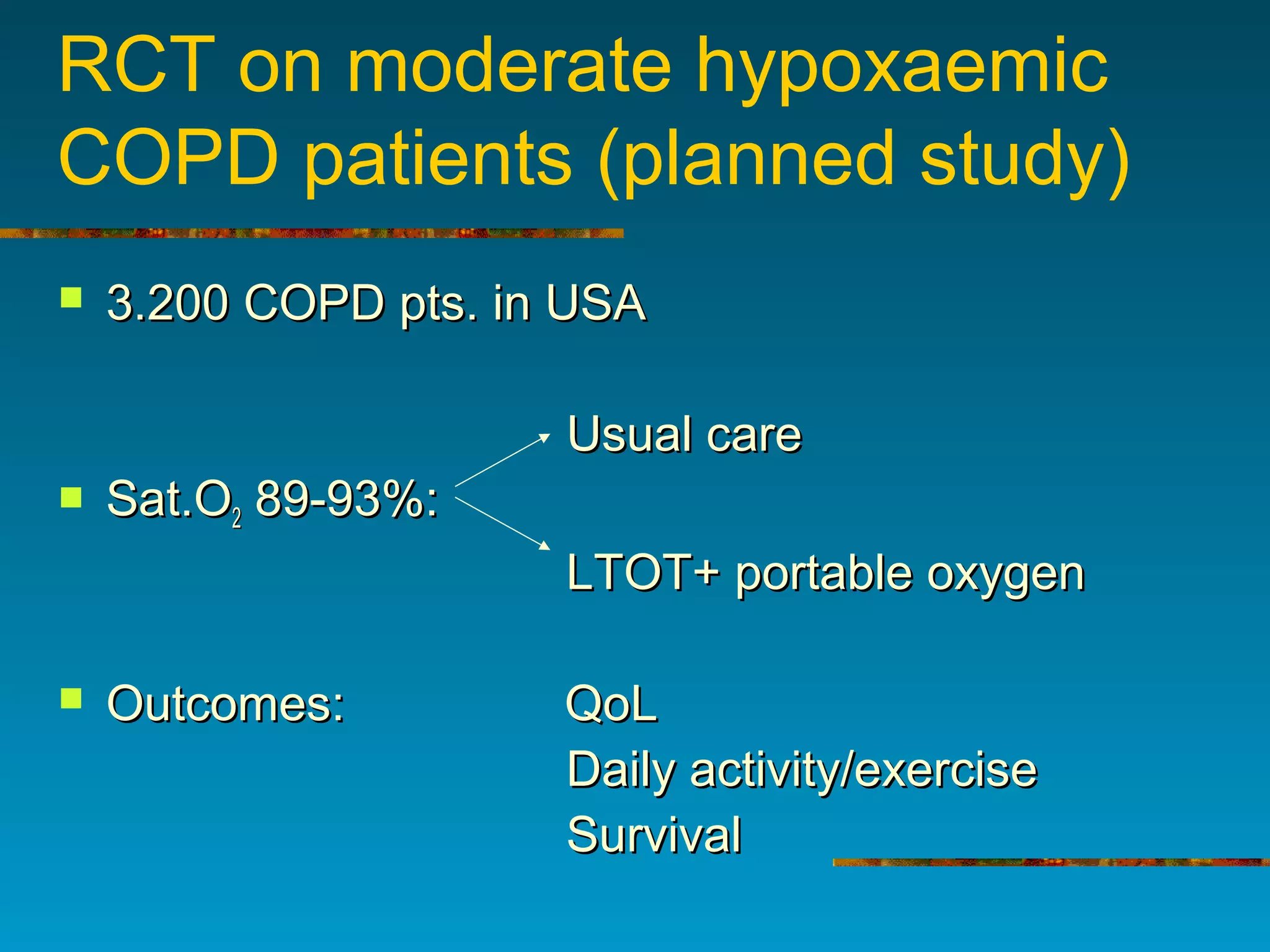
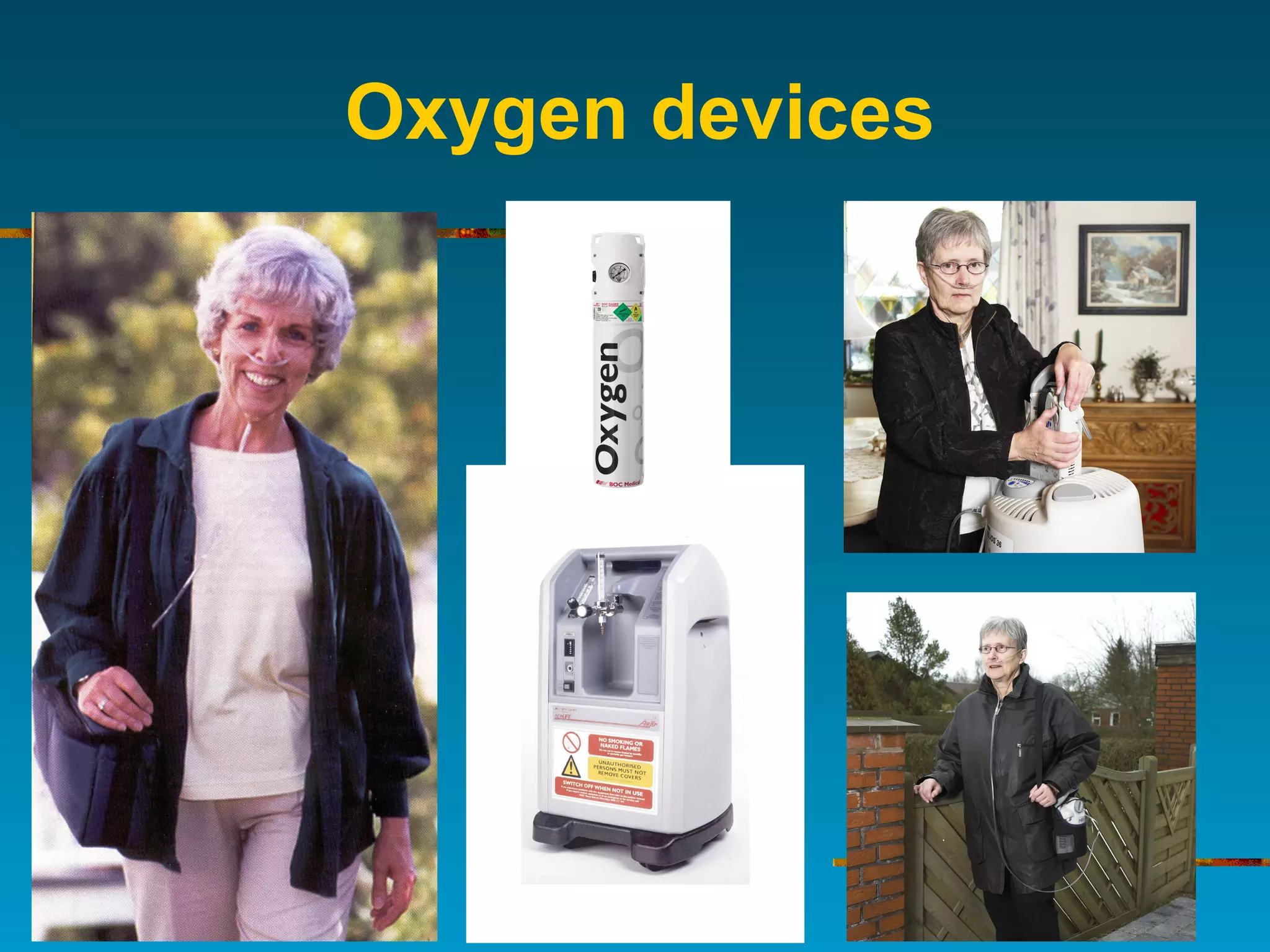
Oxygen devices
Portable Oxygen devices
 Concentrator
 Cylinders
 Liquid ”on-demand” valves
Aims of portable and ambulatory oxygen
 Portable Oxygen (hypoxaemic at rest)
↑hrs on oxygen
↑daily activity
 Ambulatory Oxygen (normoxaemic at rest)
Desaturate and/or dyspnoea during exercise
↑exercise tolerance/daily activity
Portable oxygen in 159 COPD pts on COT
France 1984-6; presc. >15 hrs/day; 12 MWD>200 m
Flow: 1.7 L/min at rest and 2.2 L/min during exercise. Randomised.
Gr.A=75Gr.A=75 Gr.B=84Gr.B=84
CConc.onc. Conc+small cyl.*(51)Conc+small cyl.*(51) Liquid(33)Liquid(33)
12MWD –O12MWD –O22 407 m407 m 423423
12MWD+O12MWD+O22 485 m485 m 478478
Hrs/day:Hrs/day: 14 hrs14 hrs 17 hrs17 hrs (B1 = B2) <0,01(B1 = B2) <0,01
Outdoor with OOutdoor with O22:: 55%55% 67%67%
Activity outdoor:Activity outdoor: equalequal
 25% did not use portable oxygen, and 15% only indoor.25% did not use portable oxygen, and 15% only indoor.
 Too heavy according to the patient: Cyl.: 50%, Liquid: 33%Too heavy according to the patient: Cyl.: 50%, Liquid: 33%
*) 2½ L cyl. + stroller (used by 10% of the pts) Vergeret J. Eur Respir J
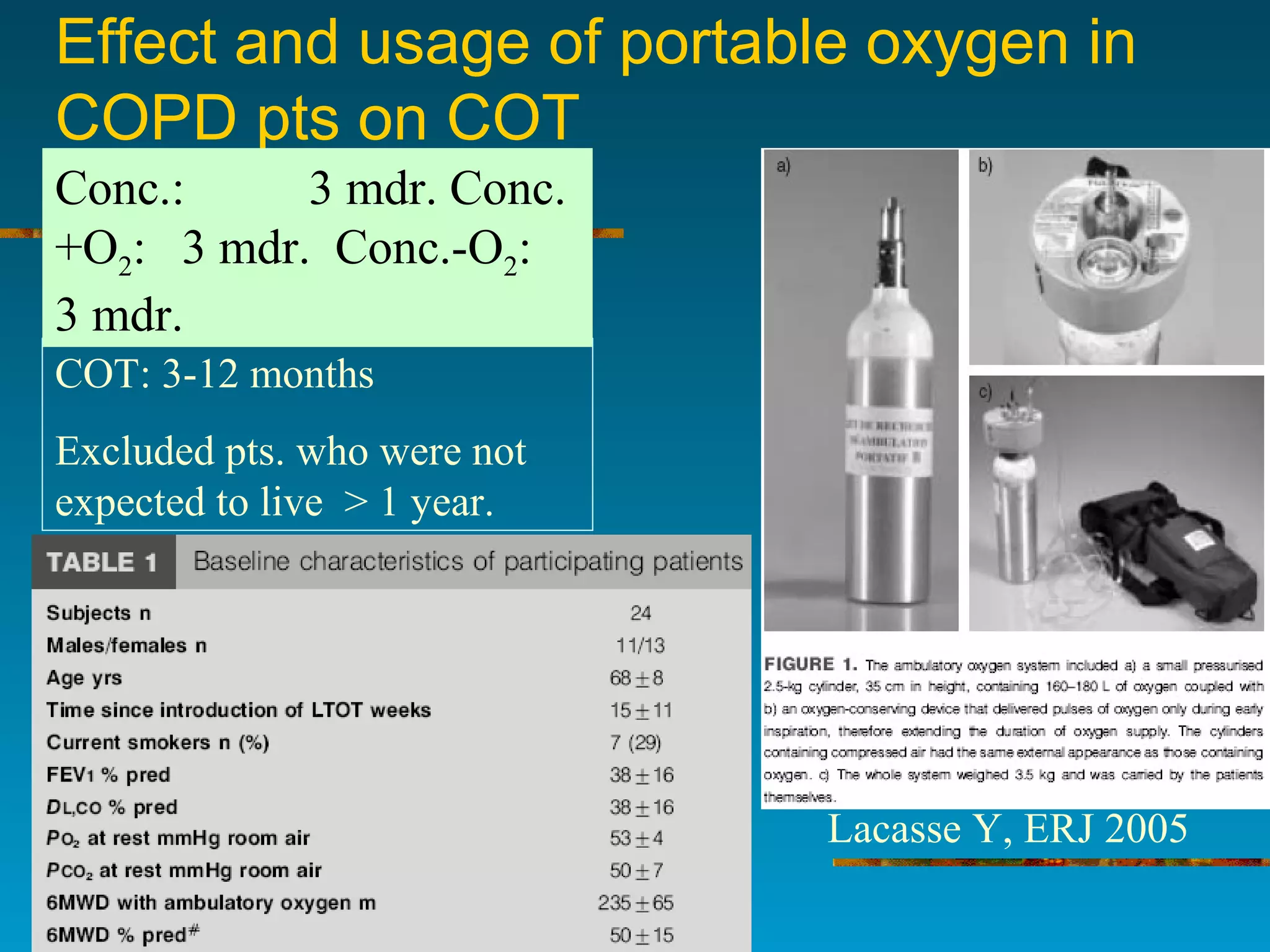
Effect and usage of portable oxygen in
COPD pts on COT
COT: 3-12 months
Excluded pts. who were not
expected to live > 1 year.
Conc.: 3 mdr. Conc.
+O2: 3 mdr. Conc.-O2:
3 mdr.
Lacasse Y, ERJ 2005
Effects and use of portable (3½ kg) oxygen in
24 COPD pts on LTOT. 3 x 3 months
•No effect on QoL and 6 MWD
Lacasse Y, ERJ 2005
Portable oxygen in 930 COPD pts on COT
France before 1996; Presc. 16 hrs/day; COT >3 months
 Portable oxygen to 30% of 893 ptt. with a concentrator.
 Only used by 52% in a 3 months period
 Only used outdoor by 4% –
especially those with liquid oxygen
Pepin JL et al. Chest 1996
The Terminology of
Home Oxygen Therapy
STOT (oxygen at home while unstable)
 Re-evaluation:
1 month later: normalised in 30%1
and 70%2
2-3 months later: 30-50% normalised1,3
 PO2<6.7 kPa: only 1 of 23 normalised1
 Despite LTOT: 17% died <2 months4
 No RCT
1) Levi-Valensi et al. Am Rev Respir Dis 1986
2) Andersson et al. Respir Med 2002
3) NOTT study
4) Eaton et al. Respir Med 2001
The Terminology of
Home Oxygen Therapy
SBOT
(palliation of attacks of dyspnoea)
 Very few studies1,2
 Only mentioned superficially in BTS, ATS, GOLD
 COPD: 6-12 wks: 4 studies (PO2 8.5-10 kPa):
2 showed a small effect compared to air.
 Cancer:
+hypoxaemia at rest: 5 L O2/min > air.
- hypoxaemia at rest: 4 L O2/min= 4 L air/min
1) Booth S et al.Respir Med 2004
2) Booth S et al. Am J Respir Crit Care Med 1996
The Terminology of
Home Oxygen Therapy
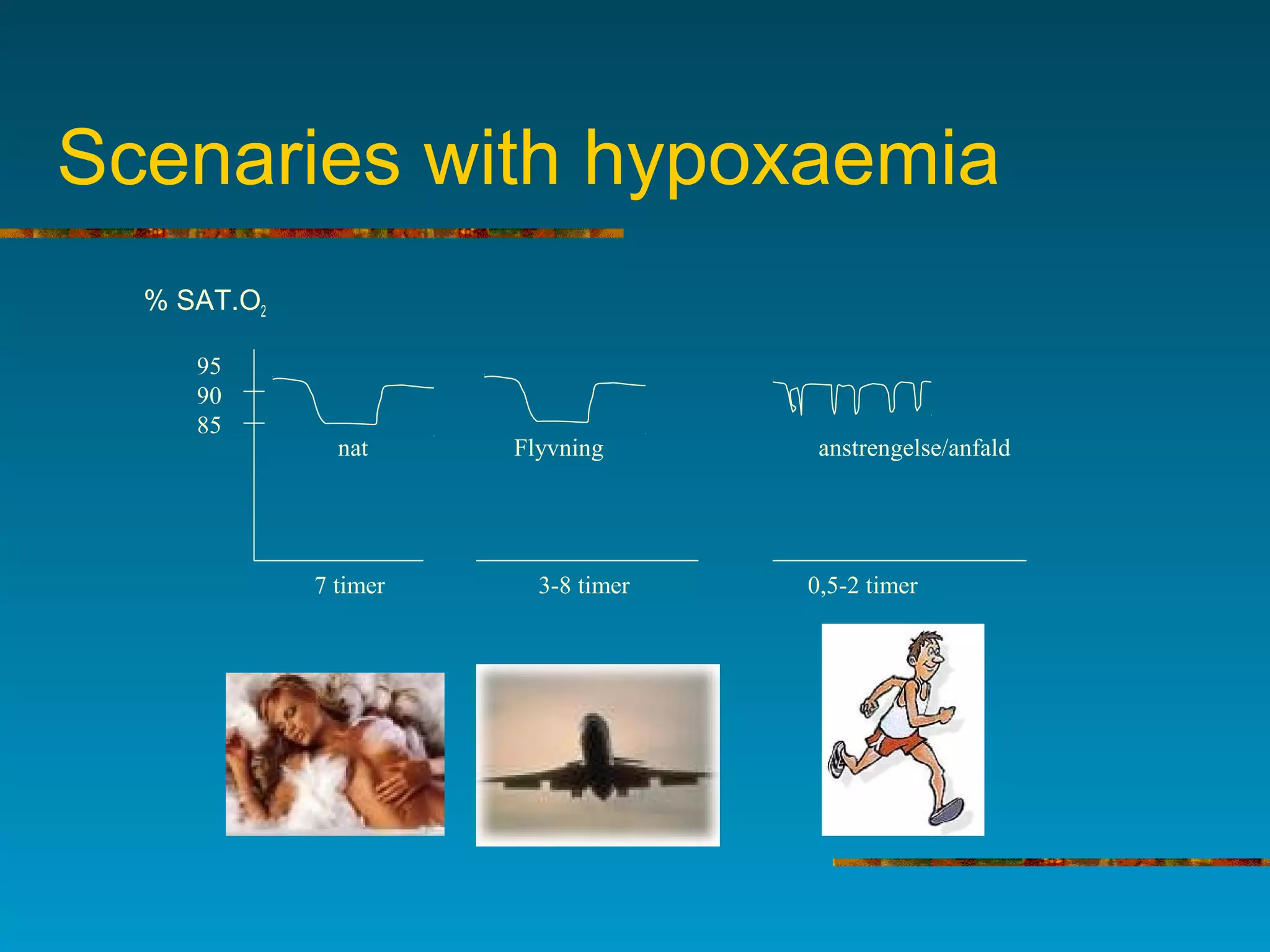
Scenaries with hypoxaemia
% SAT.O2
95
90
85
nat Flyvning anstrengelse/anfald
7 timer 3-8 timer 0,5-2 timer
The Terminology of
Home Oxygen Therapy
Ambulatory oxygen to pts with desat.
and/or dyspnoea. Prevalence in COPD
 10% desaturate ≥4%10% desaturate ≥4%
5.926 COPD pts with FEV5.926 COPD pts with FEV11 1.5-2 L (1)1.5-2 L (1)
 32% desaturate ≥4% and32% desaturate ≥4% and ≤≤88%88%
81 COPD pts with FEV81 COPD pts with FEV11 =1,29 (2)=1,29 (2)
1. Hadeli KO et al. Chest 2001;120;88-921. Hadeli KO et al. Chest 2001;120;88-92
2. Knower MT et al.2. Knower MT et al. Arch Intern Med 2001;161:732-6Arch Intern Med 2001;161:732-6
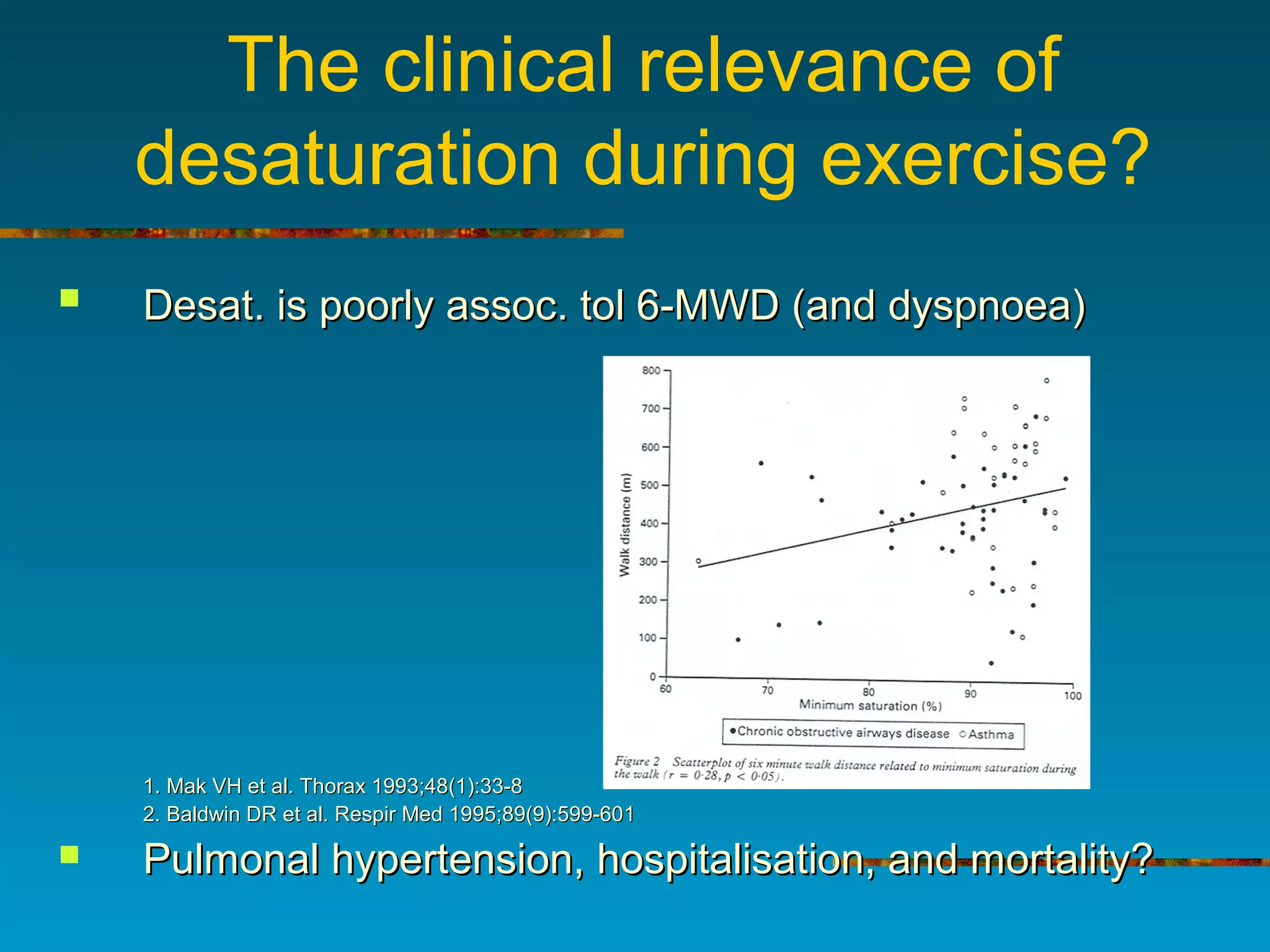
The clinical relevance of
desaturation during exercise?
 Desat. is poorly assoc. tol 6-MWD (and dyspnoea)Desat. is poorly assoc. tol 6-MWD (and dyspnoea)
1. Mak VH et al. Thorax 1993;48(1):33-81. Mak VH et al. Thorax 1993;48(1):33-8
2. Baldwin DR et al. Respir Med 1995;89(9):599-6012. Baldwin DR et al. Respir Med 1995;89(9):599-601
 Pulmonal hypertension, hospitalisation, and mortality?Pulmonal hypertension, hospitalisation, and mortality?
Acute effect of ambul.oxygen
↓Borg dyspnoea score 0.5-1.0
↑Physical tolerance 5-20%
+
Weight of device
Risk of stumbling over the tube
Ashamed
-
• No effect of oxygen pre- or post-exercise
Killen JWW, Thorax 2000
Lewis CA, ERJ 2003
McKeon JL, Thorax 1988
Stevenson NJ, Thorax. 2004
Effect of ambul. oxygen
Combination with rehabilitation
 No effect
 Garrod R, Thorax 2000
 Emtner M, AJRCCM 2003
 Rooyackers JM, ERJ 1997
 Wadell K, J Rehabil Med 2001
Puhan MA Respir Res 2004
International criteria for COT
 PaO2 <7.3 kPa (Sat. 88%)
(7.3-8.0: EVF>55% or cor pulmonale)
 Post-PaO2 >8.6 kPa
 Stabile and optimal treated
 Non-smokers
 Used >15 hours daily
 Follow-up after 3 months and then everyFollow-up after 3 months and then every
6 months.6 months.
Follow-up in different countries
Country Adherence
rate
Guidelines
Denmark1
60% 3 wks apart then every ½yr
UK2
61% The same
Norway ? 3 wks then every 3 months
Sweden3
39% 2 wks then every 6 months
1) Ringbaek et al. Respir Med 2006
2) Walshaw MJ et al. BMJ 1988
3) Utsättningsförsök hos KOL-pts startet ved
forsämring
Sat.O2 ≥ 92%: stop
Sat.O2: 89-91: a-puncture
Sat.O2 ≤ 88: continous
Home visits by a respiratory nurse?
Country Available?
Norway Yes
Denmark Most places with pulm.
physicians
Sweden Recommended
UK Recommended and
available many places
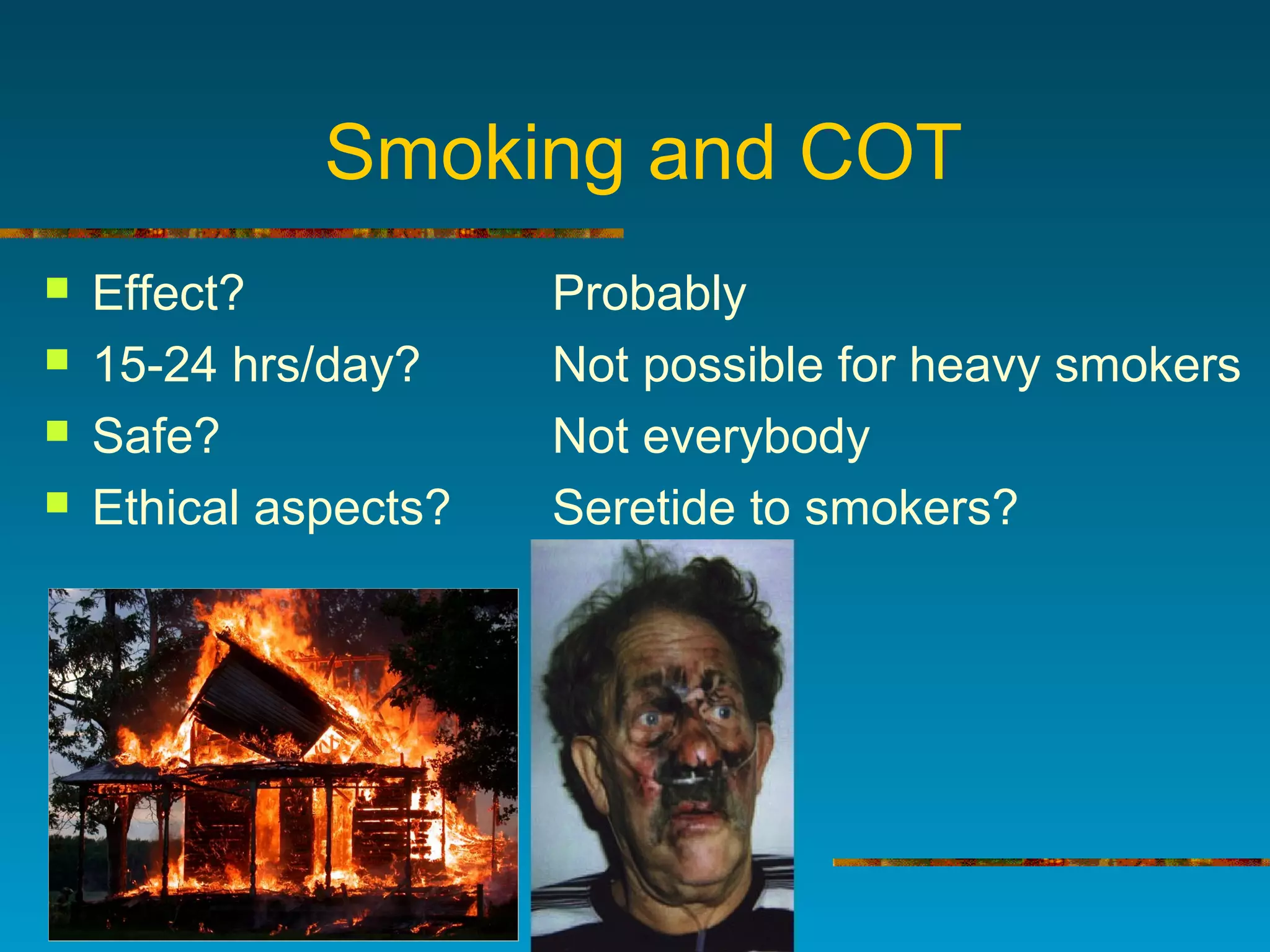
Smoking and COT
 Effect? Probably
 15-24 hrs/day? Not possible for heavy smokers
 Safe? Not everybody
 Ethical aspects? Seretide to smokers?
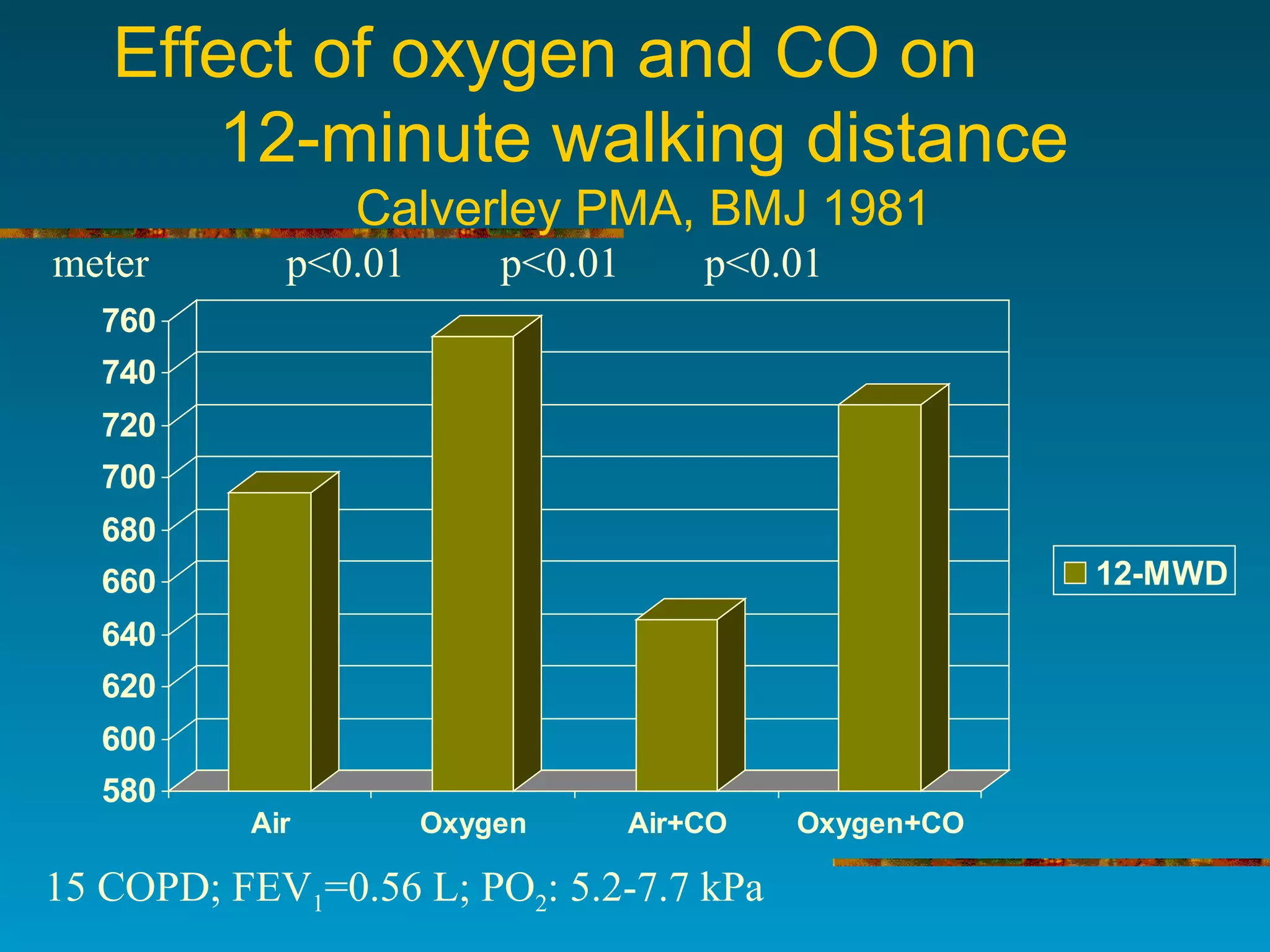
Effect of oxygen and CO on
12-minute walking distance
Calverley PMA, BMJ 1981
580
600
620
640
660
680
700
720
740
760
Air Oxygen Air+CO Oxygen+CO
12-MWD
meter p<0.01 p<0.01 p<0.01
15 COPD; FEV1=0.56 L; PO2: 5.2-7.7 kPa
Tobacco and COT
in different countries
Country Prev. Guidelines
Denmark 21% Consider if PO2<6.7 kPa and
max. 3 cig./day
Sweden 1.1% No
The Netherlands 26% No
Australia 14% No
UK 26% No
Norway ? No
Adhere to the hypoxaemic criteria
PPaaOO22 <7.3 kPa (Sat. 88%)<7.3 kPa (Sat. 88%)
(7.3-8.0: EVF>55% or cor pulmonale)(7.3-8.0: EVF>55% or cor pulmonale)
Country Adherence rate
Denmark 60-70%
France 55-80%
UK 60%
Norway1
2002
2004
2005
44% of 25 pts
66% of 32 pts
35% of 48%
Sweden (2006) 81%
1) Glittreklinikken; PO2 <7.3 kPa
Use/prescribed oxygen
16-24 hours daily
Country Adherence rate
Denmark 60/82%
UK 60%
Norway
Sweden (2006) ?/97%
Prevalence of HOT in
various countries (per 100.000)
0
10
20
30
40
50
60
70
80
90
100
1987 1993 2006
DK
SE
F
N
Oxygen devices in different countries
and economy
Country Concentrator Liquid Mobile
unite
Denmark 72 11 58
Sweden 69%
Norway 60% 40%
UK <10 <50%
 Appr. 10.000 Nkr. yearly per patient
Survival rates of new COPD patients on COT from
Denmark compared to patients from other countries
0
10
20
30
40
50
60
70
80
90
100
0 3 6 9 12 15 18 21 24 27 30 33 36 39
Months
Cumulativesurvivalproportion(%)%)
Denmark (n=5659)
Sweden (n=403)
Belgium (n=270)
France (n=252)
Australia (n=505)
NOTT, COT (n=101)
Japan (n=4552)
Conclusions
 COT improves survival in hypoxaemic
patients
 Most patients started after hospitalisation
 Only about 50% are followed up
 Portable oxygen is still too heavy
 In general, poor survival
Thank you for your attention

Ltot norge2008

  • 1.
    Home Oxygen Therapy:indications, effects and distribution in Scandinavian Thomas Ringbæk, Hjerte-lungemed. afd. Hvidovre, København
  • 2.
    Overview  Types ofhome oxygen therapies (terminology)  Evidence: a) COT b) STOT (unstable condition) c) SBOT (short burst of oxygen) d) NOT (nocturnal oxygen) e) ambulatory & portable oxygen  How do we do in practice? Home Oxygen Therapy in various countries: a) practice/organisation b) quality c) prevalence/incidence d) survival
  • 3.
  • 4.
  • 5.
    COT in COPD:effect on survival PaO2 <7.3 kPa;7.3-8.0: EVF>55% or cor pulmonale) Post-PaO2 >8.6 kPa; Stabile and optimal treated; Non-smokers MRC NOTT N 87 203 Age 58 66 Men% 76 80 FEV1% 30 30 PO2, 6.8 6.8 kPa PCO2 7.2 6.9 kPa Htc.% 52 47 Smoking 45% ? Flow 2 1-3+1 Hours 13.5 17.7/12 Mobile - +/-
  • 6.
    Effects of COT ↓ventilatory work  ↑hemodynamic ↓PAP  ↓Htc.: 4-8%  FEV1: unchanged  ↑PO2?  ↑kidney function (↓oedema)  ↓dyspnoea  ↑physical capacity  ↓tiered  ↑sleep  ↑cognitive performance  ↑QoL  ↑survival: 2 → 4 år  ↓hospitalisation: 25%
  • 7.
    COT in non-COPD Lungfibrosis: 62 patients. No effect on survival. Unpublished data. Crockett AJ et al. Domiciliary oxygen for interstitial lung disease. Cochrane Database Syst Rev 2001; 3:CD002883
  • 8.
    RCT on moderatehypoxaemic COPD patients  1987-92 in Poland1987-92 in Poland  135 COPD patients with P135 COPD patients with PaaOO22 7.4-8.7 kPa.7.4-8.7 kPa.  Post-PO2 >8.7 kPa (mean 9.9 kPa)Post-PO2 >8.7 kPa (mean 9.9 kPa)  >17 hrs/day vs. no oxygen (used 13½ hrs)>17 hrs/day vs. no oxygen (used 13½ hrs)  Only concentratorOnly concentrator  Not assessed:Not assessed: QoLQoL Daily activity/exerciseDaily activity/exercise HospitalisationHospitalisation
  • 9.
    RCT on moderatehypoxaemic COPD patients (planned study)  3.200 COPD pts. in USA3.200 COPD pts. in USA Usual careUsual care  Sat.OSat.O22 89-93%:89-93%: LTOT+ portable oxygenLTOT+ portable oxygen  Outcomes: QoLOutcomes: QoL Daily activity/exerciseDaily activity/exercise SurvivalSurvival
  • 10.
  • 11.
    Portable Oxygen devices Concentrator  Cylinders  Liquid ”on-demand” valves
  • 12.
    Aims of portableand ambulatory oxygen  Portable Oxygen (hypoxaemic at rest) ↑hrs on oxygen ↑daily activity  Ambulatory Oxygen (normoxaemic at rest) Desaturate and/or dyspnoea during exercise ↑exercise tolerance/daily activity
  • 13.
    Portable oxygen in159 COPD pts on COT France 1984-6; presc. >15 hrs/day; 12 MWD>200 m Flow: 1.7 L/min at rest and 2.2 L/min during exercise. Randomised. Gr.A=75Gr.A=75 Gr.B=84Gr.B=84 CConc.onc. Conc+small cyl.*(51)Conc+small cyl.*(51) Liquid(33)Liquid(33) 12MWD –O12MWD –O22 407 m407 m 423423 12MWD+O12MWD+O22 485 m485 m 478478 Hrs/day:Hrs/day: 14 hrs14 hrs 17 hrs17 hrs (B1 = B2) <0,01(B1 = B2) <0,01 Outdoor with OOutdoor with O22:: 55%55% 67%67% Activity outdoor:Activity outdoor: equalequal  25% did not use portable oxygen, and 15% only indoor.25% did not use portable oxygen, and 15% only indoor.  Too heavy according to the patient: Cyl.: 50%, Liquid: 33%Too heavy according to the patient: Cyl.: 50%, Liquid: 33% *) 2½ L cyl. + stroller (used by 10% of the pts) Vergeret J. Eur Respir J
  • 14.
    Effect and usageof portable oxygen in COPD pts on COT COT: 3-12 months Excluded pts. who were not expected to live > 1 year. Conc.: 3 mdr. Conc. +O2: 3 mdr. Conc.-O2: 3 mdr. Lacasse Y, ERJ 2005
  • 15.
    Effects and useof portable (3½ kg) oxygen in 24 COPD pts on LTOT. 3 x 3 months •No effect on QoL and 6 MWD Lacasse Y, ERJ 2005
  • 16.
    Portable oxygen in930 COPD pts on COT France before 1996; Presc. 16 hrs/day; COT >3 months  Portable oxygen to 30% of 893 ptt. with a concentrator.  Only used by 52% in a 3 months period  Only used outdoor by 4% – especially those with liquid oxygen Pepin JL et al. Chest 1996
  • 17.
  • 18.
    STOT (oxygen athome while unstable)  Re-evaluation: 1 month later: normalised in 30%1 and 70%2 2-3 months later: 30-50% normalised1,3  PO2<6.7 kPa: only 1 of 23 normalised1  Despite LTOT: 17% died <2 months4  No RCT 1) Levi-Valensi et al. Am Rev Respir Dis 1986 2) Andersson et al. Respir Med 2002 3) NOTT study 4) Eaton et al. Respir Med 2001
  • 19.
  • 20.
    SBOT (palliation of attacksof dyspnoea)  Very few studies1,2  Only mentioned superficially in BTS, ATS, GOLD  COPD: 6-12 wks: 4 studies (PO2 8.5-10 kPa): 2 showed a small effect compared to air.  Cancer: +hypoxaemia at rest: 5 L O2/min > air. - hypoxaemia at rest: 4 L O2/min= 4 L air/min 1) Booth S et al.Respir Med 2004 2) Booth S et al. Am J Respir Crit Care Med 1996
  • 21.
  • 22.
    Scenaries with hypoxaemia %SAT.O2 95 90 85 nat Flyvning anstrengelse/anfald 7 timer 3-8 timer 0,5-2 timer
  • 23.
  • 24.
    Ambulatory oxygen topts with desat. and/or dyspnoea. Prevalence in COPD  10% desaturate ≥4%10% desaturate ≥4% 5.926 COPD pts with FEV5.926 COPD pts with FEV11 1.5-2 L (1)1.5-2 L (1)  32% desaturate ≥4% and32% desaturate ≥4% and ≤≤88%88% 81 COPD pts with FEV81 COPD pts with FEV11 =1,29 (2)=1,29 (2) 1. Hadeli KO et al. Chest 2001;120;88-921. Hadeli KO et al. Chest 2001;120;88-92 2. Knower MT et al.2. Knower MT et al. Arch Intern Med 2001;161:732-6Arch Intern Med 2001;161:732-6
  • 25.
    The clinical relevanceof desaturation during exercise?  Desat. is poorly assoc. tol 6-MWD (and dyspnoea)Desat. is poorly assoc. tol 6-MWD (and dyspnoea) 1. Mak VH et al. Thorax 1993;48(1):33-81. Mak VH et al. Thorax 1993;48(1):33-8 2. Baldwin DR et al. Respir Med 1995;89(9):599-6012. Baldwin DR et al. Respir Med 1995;89(9):599-601  Pulmonal hypertension, hospitalisation, and mortality?Pulmonal hypertension, hospitalisation, and mortality?
  • 26.
    Acute effect ofambul.oxygen ↓Borg dyspnoea score 0.5-1.0 ↑Physical tolerance 5-20% + Weight of device Risk of stumbling over the tube Ashamed - • No effect of oxygen pre- or post-exercise Killen JWW, Thorax 2000 Lewis CA, ERJ 2003 McKeon JL, Thorax 1988 Stevenson NJ, Thorax. 2004
  • 27.
    Effect of ambul.oxygen Combination with rehabilitation  No effect  Garrod R, Thorax 2000  Emtner M, AJRCCM 2003  Rooyackers JM, ERJ 1997  Wadell K, J Rehabil Med 2001 Puhan MA Respir Res 2004
  • 28.
    International criteria forCOT  PaO2 <7.3 kPa (Sat. 88%) (7.3-8.0: EVF>55% or cor pulmonale)  Post-PaO2 >8.6 kPa  Stabile and optimal treated  Non-smokers  Used >15 hours daily  Follow-up after 3 months and then everyFollow-up after 3 months and then every 6 months.6 months.
  • 29.
    Follow-up in differentcountries Country Adherence rate Guidelines Denmark1 60% 3 wks apart then every ½yr UK2 61% The same Norway ? 3 wks then every 3 months Sweden3 39% 2 wks then every 6 months 1) Ringbaek et al. Respir Med 2006 2) Walshaw MJ et al. BMJ 1988 3) Utsättningsförsök hos KOL-pts startet ved forsämring Sat.O2 ≥ 92%: stop Sat.O2: 89-91: a-puncture Sat.O2 ≤ 88: continous
  • 30.
    Home visits bya respiratory nurse? Country Available? Norway Yes Denmark Most places with pulm. physicians Sweden Recommended UK Recommended and available many places
  • 31.
    Smoking and COT Effect? Probably  15-24 hrs/day? Not possible for heavy smokers  Safe? Not everybody  Ethical aspects? Seretide to smokers?
  • 32.
    Effect of oxygenand CO on 12-minute walking distance Calverley PMA, BMJ 1981 580 600 620 640 660 680 700 720 740 760 Air Oxygen Air+CO Oxygen+CO 12-MWD meter p<0.01 p<0.01 p<0.01 15 COPD; FEV1=0.56 L; PO2: 5.2-7.7 kPa
  • 33.
    Tobacco and COT indifferent countries Country Prev. Guidelines Denmark 21% Consider if PO2<6.7 kPa and max. 3 cig./day Sweden 1.1% No The Netherlands 26% No Australia 14% No UK 26% No Norway ? No
  • 34.
    Adhere to thehypoxaemic criteria PPaaOO22 <7.3 kPa (Sat. 88%)<7.3 kPa (Sat. 88%) (7.3-8.0: EVF>55% or cor pulmonale)(7.3-8.0: EVF>55% or cor pulmonale) Country Adherence rate Denmark 60-70% France 55-80% UK 60% Norway1 2002 2004 2005 44% of 25 pts 66% of 32 pts 35% of 48% Sweden (2006) 81% 1) Glittreklinikken; PO2 <7.3 kPa
  • 35.
    Use/prescribed oxygen 16-24 hoursdaily Country Adherence rate Denmark 60/82% UK 60% Norway Sweden (2006) ?/97%
  • 36.
    Prevalence of HOTin various countries (per 100.000) 0 10 20 30 40 50 60 70 80 90 100 1987 1993 2006 DK SE F N
  • 37.
    Oxygen devices indifferent countries and economy Country Concentrator Liquid Mobile unite Denmark 72 11 58 Sweden 69% Norway 60% 40% UK <10 <50%  Appr. 10.000 Nkr. yearly per patient
  • 38.
    Survival rates ofnew COPD patients on COT from Denmark compared to patients from other countries 0 10 20 30 40 50 60 70 80 90 100 0 3 6 9 12 15 18 21 24 27 30 33 36 39 Months Cumulativesurvivalproportion(%)%) Denmark (n=5659) Sweden (n=403) Belgium (n=270) France (n=252) Australia (n=505) NOTT, COT (n=101) Japan (n=4552)
  • 39.
    Conclusions  COT improvessurvival in hypoxaemic patients  Most patients started after hospitalisation  Only about 50% are followed up  Portable oxygen is still too heavy  In general, poor survival Thank you for your attention