Capacity Planning
in
Cellular Network
Presented by:- Shrutika Suresh Oswal
Outline
Introduction
Objective
Cellular Planning
 Classification of CP
Recent trends in planning future network
Challenges and opportunities in planning future cellular network -5G
Conclusion
References
Introduction
 Cell planning (CP) is the most important phase in the life cycle of a cellular system
 It determines the operational expenditure, capital expenditure, as well as the long-term
performance of the system
 The aim was to maximize the coverage by keeping the count of base station minimum.
It gave rise to the need for optimizing techniques of capacity planning.
 And also, the need of automated computer-aided cellular planning tools came into
existence, which mainly focuses on the industrial and academic research area.
Objective
 First generation of cellular systems were planned almost manually.
 Research in cellular planning (CP) is older than the cellular system itself .
 The gigantic subscription fees, low traffic loads, lack of competition and relative
abundance of spectrum at that time not need much effort for optimizing the network
plan.
 As the trend moved, the optimization objective was to maximize the coverage while
keeping the number of base stations at a minimum.
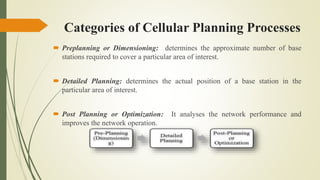
Categories of Cellular Planning Processes
 Preplanning or Dimensioning: determines the approximate number of base
stations required to cover a particular area of interest.
 Detailed Planning: determines the actual position of a base station in the
particular area of interest.
 Post Planning or Optimization: It analyses the network performance and
improves the network operation.
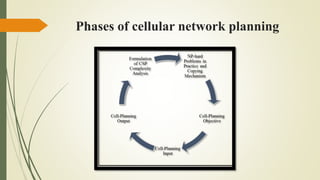
Phases of cellular network planning
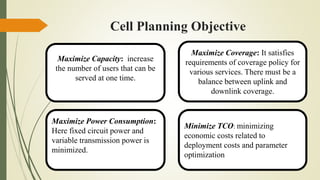
Cell Planning Objective
Maximize Capacity: increase
the number of users that can be
served at one time.
Maximize Coverage: It satisfies
requirements of coverage policy for
various services. There must be a
balance between uplink and
downlink coverage.
Maximize Power Consumption:
Here fixed circuit power and
variable transmission power is
minimized.
Minimize TCO: minimizing
economic costs related to
deployment costs and parameter
optimization
Cell Planning Inputs
 Traffic Model: User traffic distribution is a main factor that ultimately determines the
cellular system plan and, hence, is a key input in the CP process.
 Traffic Potential Site Location: Theoretically, a base station can be installed anywhere.
But practically constraints such as feasibility and availability of site(s), traffic density,
building heights and pre-existence of a site(s) taken into consideration
 Base Model: Parameters like receiver sensitivity, antenna type and height, load capacity,
transmit power and capital and operational costs defines BS model.
Cell Planning Outputs
 The optimal number of base station.
 The best stations to install base stations.
 The types of base station optimal for each station.
 The configuration of parameters such as antenna height, number of sectors
and sector orientation, tilt, power.
 Frequency reuse patterns.
 Capacity dimensioning, e.g. a number of carriers or carrier components per
sector.
Types of CP And Complexity
Roll Out CP:
In this CP no prior network exists. At this phase, traffic distribution is not
exactly known. For planning in this phase estimates of traffic based on geo-
marketing forecasts are used.
Incremental Planning:
To meet the increasing demand, it is carried out after the first roll-out
planning. This planning is bounded by additional constraints. Using measurements
from existing network reports, the traffic distribution is modelled with better
accuracy.
Coping with Np-Hard CP Problems in Practice
Easy Special Cases:. The problem becomes easier to solve and becomes
mathematically tractable
Somewhat Efficient Exponential Algorithm: One algorithm is designed to
solve the problem and it is faster than exhaustive search.
Approximation Algorithms: Here more efficient algorithms are obtained by
sacrificing the quality of the solution.
Heuristics: Algorithms are designed that works in many instances but not all
instances.
Continue….
Hybrid Approach:
Hybrid Approach consists of three stages :-
 In the first stage, by using constraint satisfaction technique a good feasible
solution to the problem is found.
 In the second stage, the solution is improved.
 In the third stage, the solution derived from the second stage is improved
further.
CLASSIFICATION OF CP
 Classic CP:
Multi-objective functions are defined to cope up with more than one CP
objective. The main concern of Classic CP is to optimize the number and location of
base stations.
Holistic CP:
Holistic CP provides the work done in terms of frequency, transmission power, base
station location, budget, height, interference, a number of sectors, tilt planning,
heterogeneous traffic, antennas, traffic uncertainties and analytical models.
Recent trends in planning future network
Energy Focused Planning: Green Planning:-
Recently improving Energy efficiency has become an integral part of CP.
It reduce carbon footprint and partly to reduce OPEX
Need for energy efficient cellular systems is growing more than ever.
 Mechanisms to incorporate energy efficiency in CP process :
 Energy Saving Through Optimal BS Positioning
 Energy Savings Through BS with Proportional Energy Model
 Energy Savings by Switching on/off BS
 Energy Saving Though Cell Size Adaptation
Continue…
 Energy Saving Through Optimal BS Positioning:
Main objective is to minimize the total transmitted power.
Local approaches: Reducing the energy consumption of individual network
components.
Global approaches: That consider the entire network energy consumption in
the network designing and planning
Continue…
 Energy Savings Through BS with Proportional Energy Model:
Analytical estimation of the energy savings that can be achieved for two BS
models:
 On-off BS energy model :
 Proportional energy model:
Key constraints:
Lowest BS density is possible with circular cells.
On/off model allows much more energy savings than the proportional model.
Continue…
 Energy Savings by Switching on/off BS:
It is a methodology to calculate the energy savings by switching off BSs.
They model energy consumption as a linear function of the number of BSs.
Traffic decreased by a factor X, when BSs is shut down, and consequently,
energy consumption will also be reduced by a factor X.
 Energy Saving Though Cell Size Adaptation:
Energy savings can be achieved by adaptively cell size according to the traffic
variation.
Challenges and Opportunities in Planning Future
Cellular Networks
New technology used in 5G:
C-RAN, D2D, M2M
Planning with Cloud-Ran (C-RAN) :
Centralized Co-ordination required to avoid inter-cell interference
Provide intelligent resource allocation
Planning with D2D:
uses LTE-Advanced
Allows a device to connect with other device
Large amount of data transfer is possible
Continue…
Planning in the Presence of M2M and IoT:
Trend of using IoT based applications increases tremendously. Major technology
challenge is to provide capabilities for M2M communications. Traditionally short range
technology like Bluetooth is used. But now large range applications require a broader
range for communications
Here we need to consider 2 main challenges in providing large range:
 Architecture Level Challenges: Includes heterogeneity in terms of device types and
traffic classes.
 Operational Challenges : It Includes resource management and optimization.
Conclusion
 As the traffic demands increasing the need of using new technologies of
capacity planning in cellular network also increased tremendously.
 For supporting IoT based application, Machine-to-Machine communications,
Device-to-Device communication there is need of new technologies like
M2M, D2D, C-RAN.
 The adaption of these new technologies will increase coverage area and also
provide an efficient utilization of the available coverage under a particular
base station.
 The capacity planning of future cellular network will provide tremendous
opportunities in industrial and research area.
Capacity planning in cellular network

Capacity planning in cellular network

  • 1.
  • 2.
    Outline Introduction Objective Cellular Planning  Classificationof CP Recent trends in planning future network Challenges and opportunities in planning future cellular network -5G Conclusion References
  • 3.
    Introduction  Cell planning(CP) is the most important phase in the life cycle of a cellular system  It determines the operational expenditure, capital expenditure, as well as the long-term performance of the system  The aim was to maximize the coverage by keeping the count of base station minimum. It gave rise to the need for optimizing techniques of capacity planning.  And also, the need of automated computer-aided cellular planning tools came into existence, which mainly focuses on the industrial and academic research area.
  • 4.
    Objective  First generationof cellular systems were planned almost manually.  Research in cellular planning (CP) is older than the cellular system itself .  The gigantic subscription fees, low traffic loads, lack of competition and relative abundance of spectrum at that time not need much effort for optimizing the network plan.  As the trend moved, the optimization objective was to maximize the coverage while keeping the number of base stations at a minimum.
  • 5.
    Categories of CellularPlanning Processes  Preplanning or Dimensioning: determines the approximate number of base stations required to cover a particular area of interest.  Detailed Planning: determines the actual position of a base station in the particular area of interest.  Post Planning or Optimization: It analyses the network performance and improves the network operation.
  • 6.
    Phases of cellularnetwork planning
  • 7.
    Cell Planning Objective MaximizeCapacity: increase the number of users that can be served at one time. Maximize Coverage: It satisfies requirements of coverage policy for various services. There must be a balance between uplink and downlink coverage. Maximize Power Consumption: Here fixed circuit power and variable transmission power is minimized. Minimize TCO: minimizing economic costs related to deployment costs and parameter optimization
  • 8.
    Cell Planning Inputs Traffic Model: User traffic distribution is a main factor that ultimately determines the cellular system plan and, hence, is a key input in the CP process.  Traffic Potential Site Location: Theoretically, a base station can be installed anywhere. But practically constraints such as feasibility and availability of site(s), traffic density, building heights and pre-existence of a site(s) taken into consideration  Base Model: Parameters like receiver sensitivity, antenna type and height, load capacity, transmit power and capital and operational costs defines BS model.
  • 9.
    Cell Planning Outputs The optimal number of base station.  The best stations to install base stations.  The types of base station optimal for each station.  The configuration of parameters such as antenna height, number of sectors and sector orientation, tilt, power.  Frequency reuse patterns.  Capacity dimensioning, e.g. a number of carriers or carrier components per sector.
  • 10.
    Types of CPAnd Complexity Roll Out CP: In this CP no prior network exists. At this phase, traffic distribution is not exactly known. For planning in this phase estimates of traffic based on geo- marketing forecasts are used. Incremental Planning: To meet the increasing demand, it is carried out after the first roll-out planning. This planning is bounded by additional constraints. Using measurements from existing network reports, the traffic distribution is modelled with better accuracy.
  • 11.
    Coping with Np-HardCP Problems in Practice Easy Special Cases:. The problem becomes easier to solve and becomes mathematically tractable Somewhat Efficient Exponential Algorithm: One algorithm is designed to solve the problem and it is faster than exhaustive search. Approximation Algorithms: Here more efficient algorithms are obtained by sacrificing the quality of the solution. Heuristics: Algorithms are designed that works in many instances but not all instances.
  • 12.
    Continue…. Hybrid Approach: Hybrid Approachconsists of three stages :-  In the first stage, by using constraint satisfaction technique a good feasible solution to the problem is found.  In the second stage, the solution is improved.  In the third stage, the solution derived from the second stage is improved further.
  • 13.
    CLASSIFICATION OF CP Classic CP: Multi-objective functions are defined to cope up with more than one CP objective. The main concern of Classic CP is to optimize the number and location of base stations. Holistic CP: Holistic CP provides the work done in terms of frequency, transmission power, base station location, budget, height, interference, a number of sectors, tilt planning, heterogeneous traffic, antennas, traffic uncertainties and analytical models.
  • 14.
    Recent trends inplanning future network Energy Focused Planning: Green Planning:- Recently improving Energy efficiency has become an integral part of CP. It reduce carbon footprint and partly to reduce OPEX Need for energy efficient cellular systems is growing more than ever.  Mechanisms to incorporate energy efficiency in CP process :  Energy Saving Through Optimal BS Positioning  Energy Savings Through BS with Proportional Energy Model  Energy Savings by Switching on/off BS  Energy Saving Though Cell Size Adaptation
  • 15.
    Continue…  Energy SavingThrough Optimal BS Positioning: Main objective is to minimize the total transmitted power. Local approaches: Reducing the energy consumption of individual network components. Global approaches: That consider the entire network energy consumption in the network designing and planning
  • 16.
    Continue…  Energy SavingsThrough BS with Proportional Energy Model: Analytical estimation of the energy savings that can be achieved for two BS models:  On-off BS energy model :  Proportional energy model: Key constraints: Lowest BS density is possible with circular cells. On/off model allows much more energy savings than the proportional model.
  • 17.
    Continue…  Energy Savingsby Switching on/off BS: It is a methodology to calculate the energy savings by switching off BSs. They model energy consumption as a linear function of the number of BSs. Traffic decreased by a factor X, when BSs is shut down, and consequently, energy consumption will also be reduced by a factor X.  Energy Saving Though Cell Size Adaptation: Energy savings can be achieved by adaptively cell size according to the traffic variation.
  • 18.
    Challenges and Opportunitiesin Planning Future Cellular Networks New technology used in 5G: C-RAN, D2D, M2M Planning with Cloud-Ran (C-RAN) : Centralized Co-ordination required to avoid inter-cell interference Provide intelligent resource allocation Planning with D2D: uses LTE-Advanced Allows a device to connect with other device Large amount of data transfer is possible
  • 19.
    Continue… Planning in thePresence of M2M and IoT: Trend of using IoT based applications increases tremendously. Major technology challenge is to provide capabilities for M2M communications. Traditionally short range technology like Bluetooth is used. But now large range applications require a broader range for communications Here we need to consider 2 main challenges in providing large range:  Architecture Level Challenges: Includes heterogeneity in terms of device types and traffic classes.  Operational Challenges : It Includes resource management and optimization.
  • 20.
    Conclusion  As thetraffic demands increasing the need of using new technologies of capacity planning in cellular network also increased tremendously.  For supporting IoT based application, Machine-to-Machine communications, Device-to-Device communication there is need of new technologies like M2M, D2D, C-RAN.  The adaption of these new technologies will increase coverage area and also provide an efficient utilization of the available coverage under a particular base station.  The capacity planning of future cellular network will provide tremendous opportunities in industrial and research area.