Long Term Control Plan Public Input September 16, 2004
Tonight’s Meeting Program Overview – Video What is a Long Term Control Plan? CSO Locations Waterway Uses  Input Breakout Sessions
What You Can Do Listen to the presentations and issues that are presented to you Offer your honest opinions on the issues Work with us to help find constructive solutions Help educate others on the project
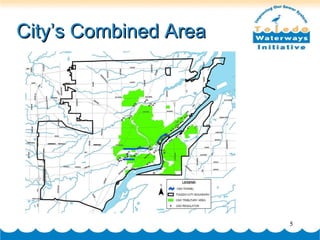
City of Toledo  Sewer System As indicated in the video, the City’s sewer system includes both separated and combined sewer systems Combined systems – carry both sewage and rainwater in the same pipe Separated systems – carry sewage and rainwater in separate pipes
City’s Combined Area
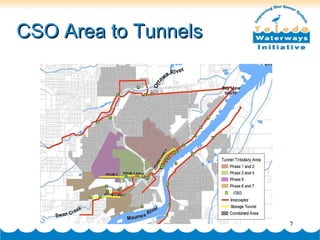
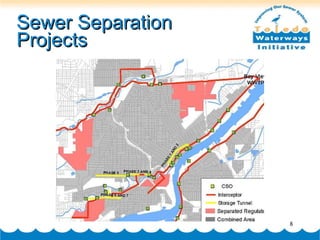
CSO Control Work  has been Performed The City constructed three major tunnel systems to store excess flow The City has implemented a number of sewer separation projects to build separate sewer systems
CSO Area to Tunnels
Sewer Separation Projects
Long Term Control Plan – Contents Actions  – projects or programs Schedules  – when projects will happen Where  – locations where projects will be constructed Costs  – project expenditures; financing plan
Obligations The LTCP must evaluate a range of CSO control alternatives based on: Pollution reduction benefits Instream water quality conditions Frequency of discharge Construction and operations costs
Consent Decree Requirements The Consent Decree requires the development of a Long Term Control Plan for Combined Sewer Overflows (LTCP).  A draft plan will be prepared by summer 2005.
CSO Regulations…. Call for: Control of CSOs New sewers to implement controls Reducing stormwater flow Systems to be properly maintained Minimizing CSO discharges   Do not call for: Elimination of CSOs Extensive replacement of the sewer system Improvements in drainage Control of basement backup Other actions that would improve water quality, that are not related to CSOs.
Primary Issue #1 –  Big Picture Goals Big picture goals define the hoped for achievements of the project.  The primary question relates to how residents want to be able to use the waterways.  Depending on the type of alternative selected, additional benefits are possible.  These include: improving the performance of the sewer system, and changed land use in the combined areas.
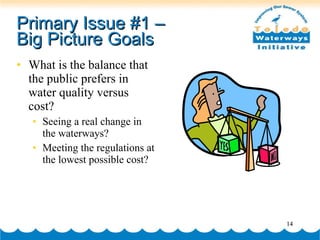
Primary Issue #1 –  Big Picture Goals What is the balance that the public prefers in water quality versus cost? Seeing a real change in the waterways? Meeting the regulations at the lowest possible cost?
Other Important Concerns You will be asked to provide input on other important concerns you have with the sewer system and water quality later in the program.  Please think about what is important to you.
Primary Issue #1 –  Big Picture Goals Input is requested on what the goals should be: Seeing a real change in (specify waterway, i.e. Maumee R, Swan Creek, Ottawa R) Having a sewer system that works well Meeting regulations for the lowest possible cost Helping to meet other City goals  Others
Primary Issue #2 –  Types of Alternatives Alternative selection is a combination of performance and suitability considerations.  There are a number of types of alternatives.
Principal Alternatives Flow storage and/ or treatment Storage basins and tunnels with screening and other treatment capability Sewer Separation Construction of new sewers for eliminating combined systems Flow reduction/rerouting Small scale measures to reduce the amount of flow to the sewer system
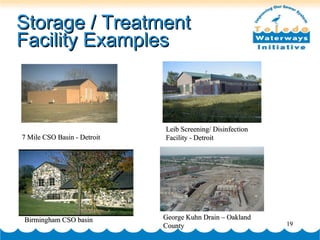
Storage / Treatment Facility Examples 7 Mile CSO Basin - Detroit Birmingham CSO basin Leib Screening/ Disinfection Facility - Detroit George Kuhn Drain – Oakland County
Storage / Treatment  Basic Information Type of facilities: either concrete tanks or tunnels Type of treatment: screening (minimum), potentially disinfection  Land area required: 3 – 10 acres Typical siting locations: waterfront property, parks, other vacant parcels near rivers Other requirements: some sewer work to bring flow to the site
Storage/ Treatment Facilities Pros and Cons Pros Most work is limited to one location and the adjacent areas are not disturbed Water is either stored (small storms) or partially treated (large storms) Cons Treatment generally requires construction of a relatively tall building. Construction activities are generally 2 – 3 years in duration limiting the use of sites during that period.
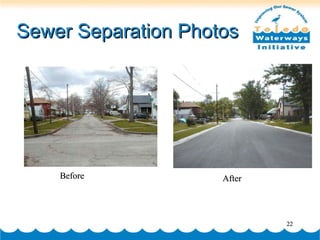
Sewer Separation Photos Before After
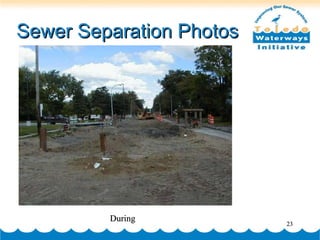
Sewer Separation Photos During
Sewer Separation Basics Construct a new sewer to separate flow Generally requires 3 – 6 months to complete work on a street; 1 – 2 years to complete work in an area Generally doesn’t involve land acquisition
Sewer Separation  Pros and Cons Pros Upgrades the sewer system Eliminates CSO discharges Doesn’t require property Cons May increase total load of pollutants to the waterways Disruptive to individual property owner
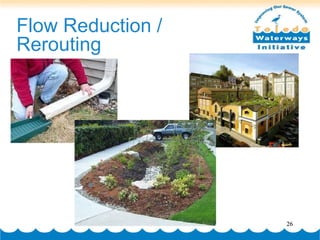
Flow Reduction / Rerouting
Flow Routing/  Reduction Basics Reduces the amount of stormwater runoff generated by rerouting flows to site storage areas. Implemented on either a site specific or area specific basis Relatively long time implementation and generally dependant on voluntary participation.
Flow Reduction /  Rerouting Pros and Cons Pros Addresses problem at the source Could be considered best environmentally Could reduce basement or surface flooding Cons Generally not adequate to solve the entire problem Most disruptive to individual property owner Administratively intensive program
Primary Issue #2 –  Types of Alternatives Input is requested on what alternative type is most acceptable? Examples: Whatever works best to limit sewer overflows Options that are not visible above ground Options that look good in the neighborhood Options that limit construction disruptions on the neighborhood streets Whatever costs the least Whatever each neighborhood prefers Others
Waterway Uses Determining Current Waterway Uses 2003 survey of 600 residents Community Program Advisory Committee Interviews with waterway users/experts Boaters/fisherman Parks & Recreation staff Maumee RAP Your input
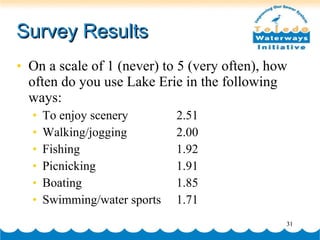
Survey Results On a scale of 1 (never) to 5 (very often), how often do you use Lake Erie in the following ways: To enjoy scenery 2.51 Walking/jogging 2.00 Fishing 1.92 Picnicking 1.91 Boating 1.85 Swimming/water sports 1.71
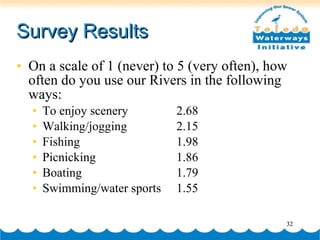
Survey Results  On a scale of 1 (never) to 5 (very often), how often do you use our Rivers in the following ways: To enjoy scenery 2.68 Walking/jogging 2.15 Fishing 1.98 Picnicking 1.86 Boating 1.79 Swimming/water sports 1.55
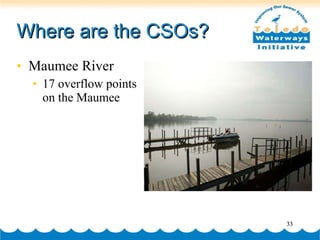
Where are the CSOs? Maumee River   17 overflow points on the Maumee
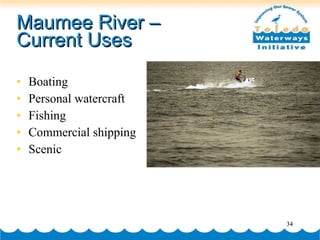
Maumee River –  Current Uses Boating Personal watercraft Fishing Commercial shipping Scenic
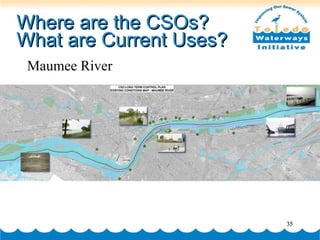
Where are the CSOs? What are Current Uses? Maumee River
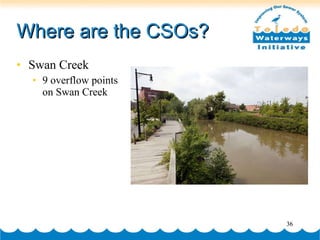
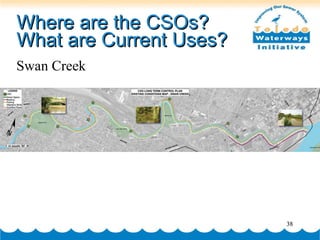
Where are the CSOs? Swan Creek 9 overflow points on Swan Creek
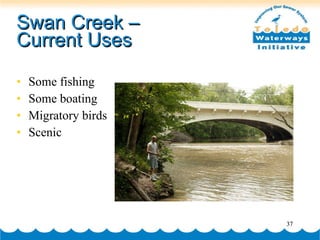
Swan Creek –  Current Uses Some fishing Some boating Migratory birds Scenic
Where are the CSOs? What are Current Uses? Swan Creek
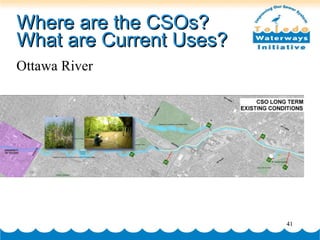
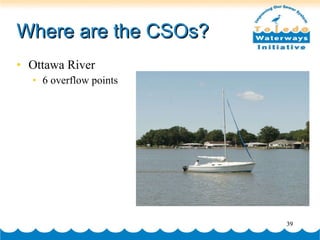
Where are the CSOs? Ottawa River 6 overflow points
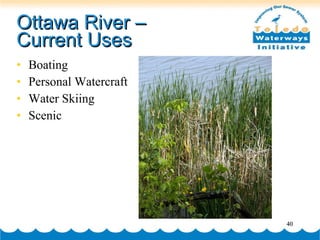
Ottawa River –  Current Uses Boating Personal Watercraft Water Skiing Scenic
Where are the CSOs?  What are Current Uses? Ottawa River
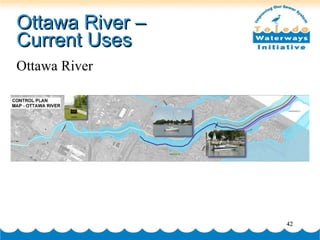
Ottawa River –  Current Uses Ottawa River
Feedback –  What You Can Do! Participate in a breakout group Choose a session: Ottawa River – Downstairs “Sky Left” East Side Maumee River – Downstairs “Sky Right” West Side Maumee River & Swan Creek -- Here Fill out questionnaire and sign up for future meetings
Areas for Input Waterway uses Are there any priority areas? What should be the goals of the program? What are the Preferred Alternatives?
Things to Remember The Long Term Control Plan Must: Meet the criteria required by the EPA Must be a solution the community can afford
Next Steps Get public input on proposed alternatives at meetings for each waterway November 2004 – January 2005 Present draft plan for public comment March 2005
Future Meetings Ottawa River November 18, 2004 Location – To be discussed in breakout Maumee River East  To be scheduled – January 2005 Maumee River West/Swan Creek To be scheduled – January 2005

LTCP Meeting 9-16-04

  • 1.
    Long Term ControlPlan Public Input September 16, 2004
  • 2.
    Tonight’s Meeting ProgramOverview – Video What is a Long Term Control Plan? CSO Locations Waterway Uses Input Breakout Sessions
  • 3.
    What You CanDo Listen to the presentations and issues that are presented to you Offer your honest opinions on the issues Work with us to help find constructive solutions Help educate others on the project
  • 4.
    City of Toledo Sewer System As indicated in the video, the City’s sewer system includes both separated and combined sewer systems Combined systems – carry both sewage and rainwater in the same pipe Separated systems – carry sewage and rainwater in separate pipes
  • 5.
  • 6.
    CSO Control Work has been Performed The City constructed three major tunnel systems to store excess flow The City has implemented a number of sewer separation projects to build separate sewer systems
  • 7.
    CSO Area toTunnels
  • 8.
  • 9.
    Long Term ControlPlan – Contents Actions – projects or programs Schedules – when projects will happen Where – locations where projects will be constructed Costs – project expenditures; financing plan
  • 10.
    Obligations The LTCPmust evaluate a range of CSO control alternatives based on: Pollution reduction benefits Instream water quality conditions Frequency of discharge Construction and operations costs
  • 11.
    Consent Decree RequirementsThe Consent Decree requires the development of a Long Term Control Plan for Combined Sewer Overflows (LTCP). A draft plan will be prepared by summer 2005.
  • 12.
    CSO Regulations…. Callfor: Control of CSOs New sewers to implement controls Reducing stormwater flow Systems to be properly maintained Minimizing CSO discharges Do not call for: Elimination of CSOs Extensive replacement of the sewer system Improvements in drainage Control of basement backup Other actions that would improve water quality, that are not related to CSOs.
  • 13.
    Primary Issue #1– Big Picture Goals Big picture goals define the hoped for achievements of the project. The primary question relates to how residents want to be able to use the waterways. Depending on the type of alternative selected, additional benefits are possible. These include: improving the performance of the sewer system, and changed land use in the combined areas.
  • 14.
    Primary Issue #1– Big Picture Goals What is the balance that the public prefers in water quality versus cost? Seeing a real change in the waterways? Meeting the regulations at the lowest possible cost?
  • 15.
    Other Important ConcernsYou will be asked to provide input on other important concerns you have with the sewer system and water quality later in the program. Please think about what is important to you.
  • 16.
    Primary Issue #1– Big Picture Goals Input is requested on what the goals should be: Seeing a real change in (specify waterway, i.e. Maumee R, Swan Creek, Ottawa R) Having a sewer system that works well Meeting regulations for the lowest possible cost Helping to meet other City goals Others
  • 17.
    Primary Issue #2– Types of Alternatives Alternative selection is a combination of performance and suitability considerations. There are a number of types of alternatives.
  • 18.
    Principal Alternatives Flowstorage and/ or treatment Storage basins and tunnels with screening and other treatment capability Sewer Separation Construction of new sewers for eliminating combined systems Flow reduction/rerouting Small scale measures to reduce the amount of flow to the sewer system
  • 19.
    Storage / TreatmentFacility Examples 7 Mile CSO Basin - Detroit Birmingham CSO basin Leib Screening/ Disinfection Facility - Detroit George Kuhn Drain – Oakland County
  • 20.
    Storage / Treatment Basic Information Type of facilities: either concrete tanks or tunnels Type of treatment: screening (minimum), potentially disinfection Land area required: 3 – 10 acres Typical siting locations: waterfront property, parks, other vacant parcels near rivers Other requirements: some sewer work to bring flow to the site
  • 21.
    Storage/ Treatment FacilitiesPros and Cons Pros Most work is limited to one location and the adjacent areas are not disturbed Water is either stored (small storms) or partially treated (large storms) Cons Treatment generally requires construction of a relatively tall building. Construction activities are generally 2 – 3 years in duration limiting the use of sites during that period.
  • 22.
  • 23.
  • 24.
    Sewer Separation BasicsConstruct a new sewer to separate flow Generally requires 3 – 6 months to complete work on a street; 1 – 2 years to complete work in an area Generally doesn’t involve land acquisition
  • 25.
    Sewer Separation Pros and Cons Pros Upgrades the sewer system Eliminates CSO discharges Doesn’t require property Cons May increase total load of pollutants to the waterways Disruptive to individual property owner
  • 26.
  • 27.
    Flow Routing/ Reduction Basics Reduces the amount of stormwater runoff generated by rerouting flows to site storage areas. Implemented on either a site specific or area specific basis Relatively long time implementation and generally dependant on voluntary participation.
  • 28.
    Flow Reduction / Rerouting Pros and Cons Pros Addresses problem at the source Could be considered best environmentally Could reduce basement or surface flooding Cons Generally not adequate to solve the entire problem Most disruptive to individual property owner Administratively intensive program
  • 29.
    Primary Issue #2– Types of Alternatives Input is requested on what alternative type is most acceptable? Examples: Whatever works best to limit sewer overflows Options that are not visible above ground Options that look good in the neighborhood Options that limit construction disruptions on the neighborhood streets Whatever costs the least Whatever each neighborhood prefers Others
  • 30.
    Waterway Uses DeterminingCurrent Waterway Uses 2003 survey of 600 residents Community Program Advisory Committee Interviews with waterway users/experts Boaters/fisherman Parks & Recreation staff Maumee RAP Your input
  • 31.
    Survey Results Ona scale of 1 (never) to 5 (very often), how often do you use Lake Erie in the following ways: To enjoy scenery 2.51 Walking/jogging 2.00 Fishing 1.92 Picnicking 1.91 Boating 1.85 Swimming/water sports 1.71
  • 32.
    Survey Results On a scale of 1 (never) to 5 (very often), how often do you use our Rivers in the following ways: To enjoy scenery 2.68 Walking/jogging 2.15 Fishing 1.98 Picnicking 1.86 Boating 1.79 Swimming/water sports 1.55
  • 33.
    Where are theCSOs? Maumee River 17 overflow points on the Maumee
  • 34.
    Maumee River – Current Uses Boating Personal watercraft Fishing Commercial shipping Scenic
  • 35.
    Where are theCSOs? What are Current Uses? Maumee River
  • 36.
    Where are theCSOs? Swan Creek 9 overflow points on Swan Creek
  • 37.
    Swan Creek – Current Uses Some fishing Some boating Migratory birds Scenic
  • 38.
    Where are theCSOs? What are Current Uses? Swan Creek
  • 39.
    Where are theCSOs? Ottawa River 6 overflow points
  • 40.
    Ottawa River – Current Uses Boating Personal Watercraft Water Skiing Scenic
  • 41.
    Where are theCSOs? What are Current Uses? Ottawa River
  • 42.
    Ottawa River – Current Uses Ottawa River
  • 43.
    Feedback – What You Can Do! Participate in a breakout group Choose a session: Ottawa River – Downstairs “Sky Left” East Side Maumee River – Downstairs “Sky Right” West Side Maumee River & Swan Creek -- Here Fill out questionnaire and sign up for future meetings
  • 44.
    Areas for InputWaterway uses Are there any priority areas? What should be the goals of the program? What are the Preferred Alternatives?
  • 45.
    Things to RememberThe Long Term Control Plan Must: Meet the criteria required by the EPA Must be a solution the community can afford
  • 46.
    Next Steps Getpublic input on proposed alternatives at meetings for each waterway November 2004 – January 2005 Present draft plan for public comment March 2005
  • 47.
    Future Meetings OttawaRiver November 18, 2004 Location – To be discussed in breakout Maumee River East To be scheduled – January 2005 Maumee River West/Swan Creek To be scheduled – January 2005

Editor's Notes

  • #3 Bob Williams Welcome guests Acknowledge elected officials/VIPS Introduce Carol/Dave Tell them agenda/introduce video
  • #4 BOB Explain what they can do. Stress importance of involvement Turn it over to Carol
  • #5 Carol
  • #6 Carol
  • #7 carol
  • #8 Carol
  • #9 Carol
  • #10 Carol
  • #11 Carol
  • #12 Carol
  • #13 Carol
  • #14 carol
  • #15 carol
  • #16 carol
  • #17 carol
  • #18 carol
  • #19 carol
  • #20 carol
  • #21 carol
  • #22 carol
  • #23 carol
  • #24 carol
  • #25 carol
  • #26 carol
  • #27 carol
  • #29 carol
  • #30 Carol TURN IT OVER TO DAVE
  • #31 dave
  • #32 dave
  • #33 dave
  • #34 dave
  • #35 dave
  • #36 Dave Overflows stretching from Columbus street (23) Jamie Farr Park to (33) near ???? Uses: Commercial Shipping from mouth of River up to the Andersons grain elevator Boating personal watercraft – entire length of the river (Blue) Crewing from Railroad bridge to I-75 (Pink) Fishing – pretty much anywhere there is river access – int’l park, boyer, high level bridge all the way down to about I-75 (Orange) Fishing even though there is a consumption advisory the length of the river
  • #37 dave
  • #38 dave
  • #39 Dave 9 overflows stretching from Erie Street to Highland Park Uses: Some boating from Maumee to I-75. (purple) Limited fishing along entire length where there is river access – a lot near highland park (orange) Migratory birds (light green) Potential for canoeing – although steep banks a concern in some areas
  • #40 dave
  • #41 dave
  • #42 Dave 6 overflows (61) across from Stickney-Tyler landfill near Mt. Carmel cemetery to Jermaine Park
  • #43 dave Uses: Boating/personal watercraft from Mouth to I-75 bridge (purple) Some fishing from mouth to Summit Street (orange) Very Limited swimming from mouth to summit street (red) Contact advisory from mouth to I-475 Turn over to Bob
  • #44 BOB Explain Breakouts Ask them to raise their hands to select a breakout so we can count
  • #45 BOB Review areas we’re seeking input
  • #46 Bob Stress that solution must be affordable
  • #47 Bob Review next steps
  • #48 Bob Review Future Meetings Turn it over to Dave for room designations/direction to breakouts