Green Infrastructure for Stormwater
Management in Syracuse, New York


 Atlantic States
 Legal Foundation, Inc.
SECTION I
Green Infrastructure Technologies
What is Green Infrastructure?
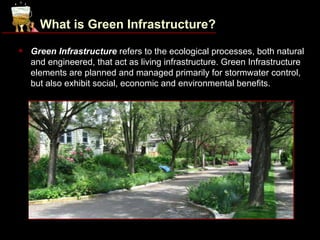
   Green Infrastructure refers to the ecological processes, both natural
    and engineered, that act as living infrastructure. Green Infrastructure
    elements are planned and managed primarily for stormwater control,
    but also exhibit social, economic and environmental benefits.
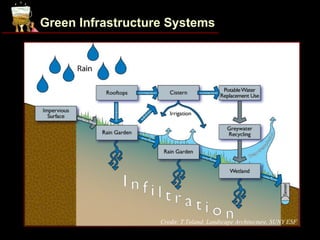
Green Infrastructure Systems


                   Credit: T.Toland, Landscape Architecture, SUNY ESF
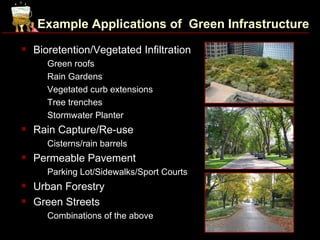
Example Applications of Green Infrastructure
   Bioretention/Vegetated Infiltration
    •   Green roofs
    •   Rain Gardens
    •   Vegetated curb extensions
    •   Tree trenches
    •   Stormwater Planter
   Rain Capture/Re-use
    •   Cisterns/rain barrels
   Permeable Pavement
    •   Parking Lot/Sidewalks/Sport Courts
   Urban Forestry
   Green Streets
    •   Combinations of the above
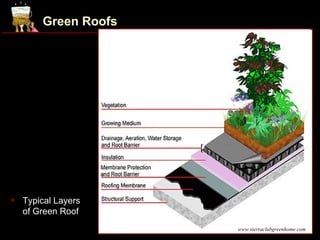
Green Roofs


   Typical Layers
    of Green Roof
                      www.sierraclubgreenhome.com
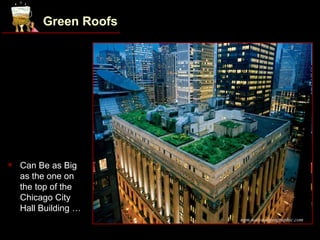
Green Roofs


   Can Be as Big
    as the one on
    the top of the
    Chicago City
    Hall Building …
                       ngm.nationalgeographic.com
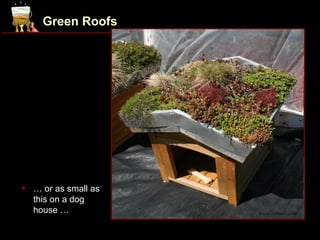
Green Roofs


   … or as small as
    this on a dog
    house …            www.remarc.com
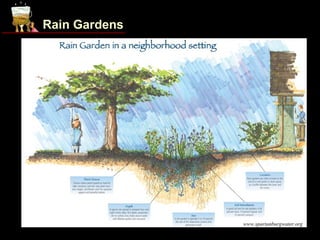
Rain Gardens


               www.spartanburgwater.org
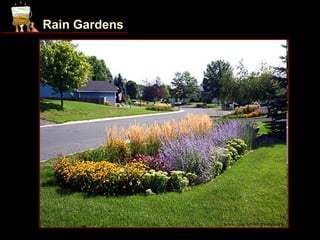
Rain Gardens


               www.spartanburgwater.org
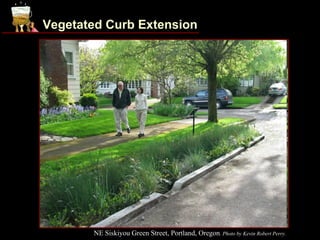
Vegetated Curb Extension


       NE Siskiyou Green Street, Portland, Oregon. Photo by Kevin Robert Perry.
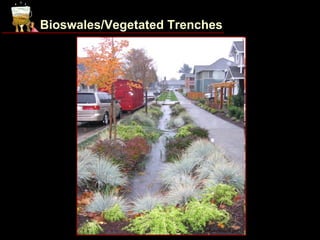
Bioswales/Vegetated Trenches


                       www.lakecountyil.gov
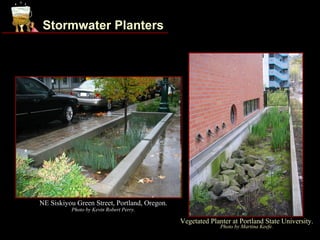
Stormwater Planters


NE Siskiyou Green Street, Portland, Oregon.
          Photo by Kevin Robert Perry.

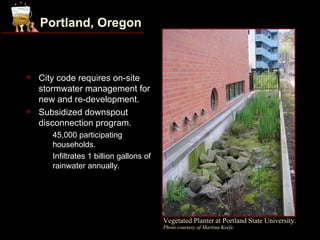
                                              Vegetated Planter at Portland State University.
                                                            Photo by Martina Keefe.
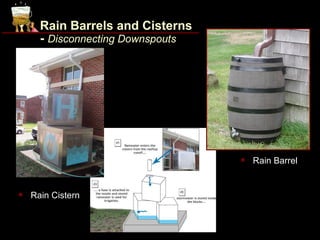
Rain Barrels and Cisterns
      - Disconnecting Downspouts


                                      Rain Barrel


   Rain Cistern
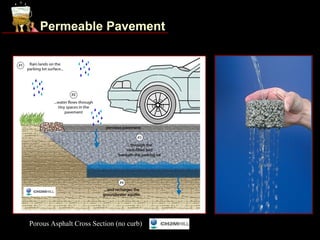
Permeable Pavement


                                            Rain Barrel

Porous Asphalt Cross Section (no curb)
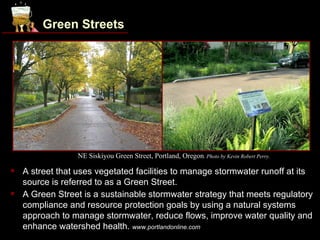
Green Streets


                  NE Siskiyou Green Street, Portland, Oregon. Photo by Kevin Robert Perry.

   A street that uses vegetated facilities to manage stormwater runoff at its
    source is referred to as a Green Street.
   A Green Street is a sustainable stormwater strategy that meets regulatory
    compliance and resource protection goals by using a natural systems
    approach to manage stormwater, reduce flows, improve water quality and
    enhance watershed health. www.portlandonline.com
SECTION II
How Can Green Infrastructure
Help Syracuse?
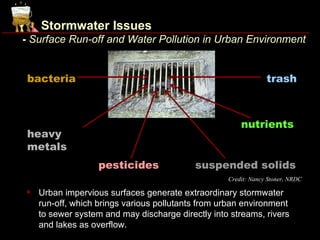
Stormwater Issues
- Surface Run-off and Water Pollution in Urban Environment


 bacteria                                                       trash


                                                       nutrients
 heavy
 metals
                   pesticides              suspended solids
                                                   Credit: Nancy Stoner, NRDC

   Urban impervious surfaces generate extraordinary stormwater
    run-off, which brings various pollutants from urban environment
    to sewer system and may discharge directly into streams, rivers
    and lakes as overflow.
Stormwater Issues - CSO
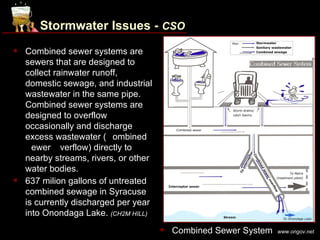
   Combined sewer systems are
    sewers that are designed to
    collect rainwater runoff,
    domestic sewage, and industrial
    wastewater in the same pipe.
    Combined sewer systems are
    designed to overflow
    occasionally and discharge
    excess wastewater (Combined
    Sewer Overflow) directly to
    nearby streams, rivers, or other
    water bodies.
   637 milion gallons of untreated
    combined sewage in Syracuse
    is currently discharged per year
    into Onondaga Lake. (CH2M HILL)
                                          Combined Sewer System   www.ongov.net
Stormwater Issues - CSO


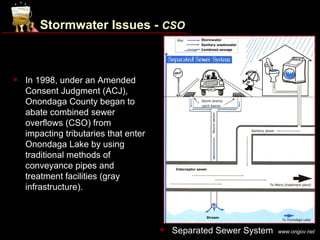
   In 1998, under an Amended
    Consent Judgment (ACJ),
    Onondaga County began to
    abate combined sewer
    overflows (CSO) from
    impacting tributaries that enter
    Onondaga Lake by using
    traditional methods of
    conveyance pipes and
    treatment facilities (gray
    infrastructure).


                                          Separated Sewer System   www.ongov.net
Gray Infrastructure for CSO Abatement


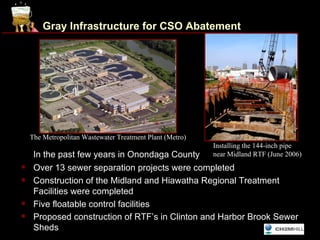
    The Metropolitan Wastewater Treatment Plant (Metro)                  www.ongov.net
                                                          Installing the 144-inch pipe
     In the past few years in Onondaga County             near Midland RTF (June 2006)
    Over 13 sewer separation projects were completed
    Construction of the Midland and Hiawatha Regional Treatment
     Facilities were completed
    Five floatable control facilities
    Proposed construction of RTF’s in Clinton and Harbor Brook Sewer
     Sheds
Green Infrastructure as a Component of
        Comprehensive Stormwater Management Plan


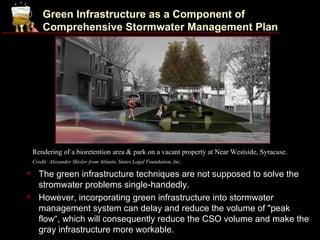
    Rendering of a bioretention area & park on a vacant property at Near Westside, Syracuse.
    Credit: Alexander Shisler from Atlantic States Legal Foundation, Inc.

     The green infrastructure techniques are not supposed to solve the
      stromwater problems single-handedly.
     However, incorporating green infrastructure into stormwater
      management system can delay and reduce the volume of "peak
      flow“, which will consequently reduce the CSO volume and make the
      gray infrastructure more workable.
Green Infrastructure as a Component of
         Comprehensive Stormwater Management Plan


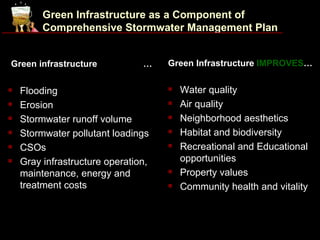
Green infrastructure REDUCES…        Green Infrastructure IMPROVES…

   Flooding                            Water quality
   Erosion                             Air quality
   Stormwater runoff volume            Neighborhood aesthetics
   Stormwater pollutant loadings       Habitat and biodiversity
   CSOs                                Recreational and Educational
   Gray infrastructure operation,       opportunities
    maintenance, energy and             Property values
    treatment costs                     Community health and vitality
Gray-Green Infrastructure
         Program for Onondaga County


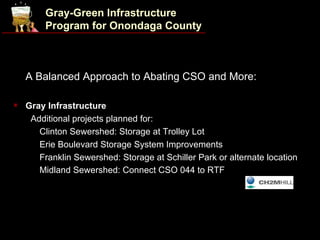
    A Balanced Approach to Abating CSO and More:

   Gray Infrastructure
      Additional projects planned for:
     • Clinton Sewershed: Storage at Trolley Lot

     • Erie Boulevard Storage System Improvements

     • Franklin Sewershed: Storage at Schiller Park or alternate location

     • Midland Sewershed: Connect CSO 044 to RTF
Gray-Green Infrastructure
      Program for Onondaga County

    A Balanced Approach to Abating CSO and More:

   Green Infrastructure
     • 26 individual demonstration project prototypes were developed

     • Design and Implementation processes are underway

     • Projects will demonstrate:

        - Green Infrastructure Designs that can be readily applied to
           Onondaga County and repeated
        - Benefit to Water Quality
            • Green Infrastructure manages pollutants “at the source”
              and prevents migration to the lake
        - Benefit to Community
            • Green Infrastructure improves neighborhood aesthetics,
              quality of life and is an investment that people desire
Gray-Green Infrastructure
             Program for Onondaga County

    Onondaga County’s approach to Implementing green infrastructure


   The Save-the-Rain program developed to implement green infrastructure
    throughout the community. Program highlights:
     •   Public Education and Outreach campaign
     •   Urban Forestry Grant in Clinton sewershed
     •   Demonstration Projects moving forward including green roofs, porous pavement,
         rain gardens, planter boxes, tree trenches and rain barrels
     •   Development of matching grant program for “green” projects on private properties
SECTION III Case Study
Green Infrastructure for Stormwater
Management in North America


  This section is adapted from the presentation, Rooftops to Rivers,
  by Nancy Stoner from Natural Resources Defense Council (NRDC)
Chicago, Illinois


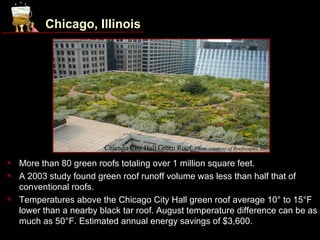
                         Chicago City Hall Green Roof. Photo courtesy of Roofscapes, Inc.

   More than 80 green roofs totaling over 1 million square feet.
   A 2003 study found green roof runoff volume was less than half that of
    conventional roofs.
   Temperatures above the Chicago City Hall green roof average 10° to 15°F
    lower than a nearby black tar roof. August temperature difference can be as
    much as 50°F. Estimated annual energy savings of $3,600.
Chicago, Illinois (cont.)


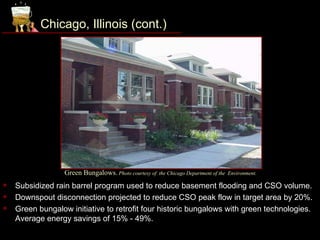
                  Green Bungalows. Photo courtesy of   the Chicago Department of the Environment.

   Subsidized rain barrel program used to reduce basement flooding and CSO volume.
   Downspout disconnection projected to reduce CSO peak flow in target area by 20%.
   Green bungalow initiative to retrofit four historic bungalows with green technologies.
    Average energy savings of 15% - 49%.
Milwaukee, Wisconsin


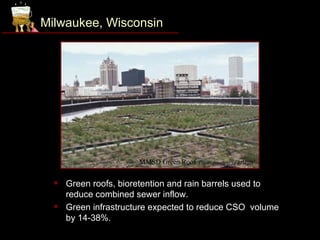
                       MMSD Green Roof. Photo courtesy of MMSD.

     Green roofs, bioretention and rain barrels used to
      reduce combined sewer inflow.
     Green infrastructure expected to reduce CSO volume
      by 14-38%.
Milwaukee, Wisconsin (cont.)
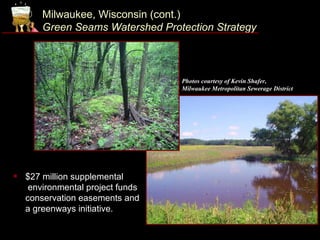
        Green Seams Watershed Protection Strategy


                                   Photos courtesy of Kevin Shafer,
                                   Milwaukee Metropolitan Sewerage District


   $27 million supplemental
     environmental project funds
    conservation easements and
    a greenways initiative.
Philadelphia, PA
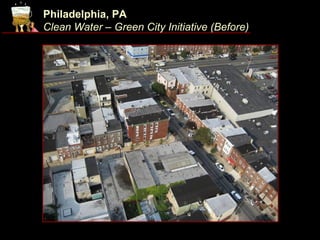
Clean Water – Green City Initiative (Before)
Philadelphia, PA
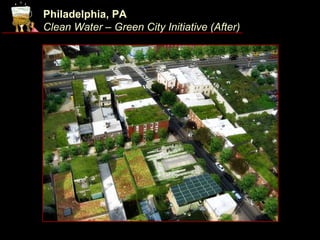
Clean Water – Green City Initiative (After)
Portland, Oregon


   City code requires on-site
    stormwater management for
    new and re-development.
   Subsidized downspout
    disconnection program.
    •   45,000 participating
        households.
    •   Infiltrates 1 billion gallons of
        rainwater annually.


                                           Vegetated Planter at Portland State University.
                                           Photo courtesy of Martina Keefe.
Portland, Oregon (cont.)


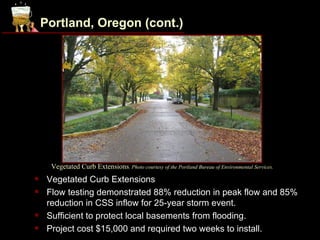
      Vegetated Curb Extensions. Photo courtesy of the Portland Bureau of Environmental Services.
    Vegetated Curb Extensions
    Flow testing demonstrated 88% reduction in peak flow and 85%
     reduction in CSS inflow for 25-year storm event.
    Sufficient to protect local basements from flooding.
    Project cost $15,000 and required two weeks to install.
Portland, Oregon (cont.)


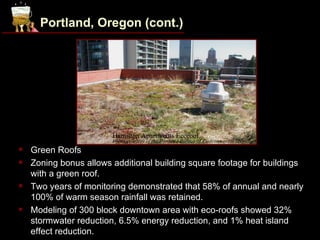
                        Hamilton Apartments Ecoroof.
                        Photo courtesy of the Portland Bureau of Environmental Services.
   Green Roofs
   Zoning bonus allows additional building square footage for buildings
    with a green roof.
   Two years of monitoring demonstrated that 58% of annual and nearly
    100% of warm season rainfall was retained.
   Modeling of 300 block downtown area with eco-roofs showed 32%
    stormwater reduction, 6.5% energy reduction, and 1% heat island
    effect reduction.
Seattle, Washington
      Natural Drainage Systems


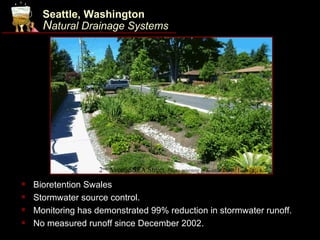
                    2nd Avenue SEA Street. Photo courtesy of Seattle Public Utilities.
   Bioretention Swales
   Stormwater source control.
   Monitoring has demonstrated 99% reduction in stormwater runoff.
   No measured runoff since December 2002.
Seattle, Washington (cont.)
    Natural Drainage Systems


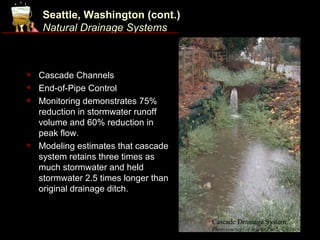
   Cascade Channels
   End-of-Pipe Control
   Monitoring demonstrates 75%
    reduction in stormwater runoff
    volume and 60% reduction in
    peak flow.
   Modeling estimates that cascade
    system retains three times as
    much stormwater and held
    stormwater 2.5 times longer than
    original drainage ditch.


                                       Cascade Drainage System.
                                       Photo courtesy of Seattle Public Utilities.
Seattle, Washington (cont.)
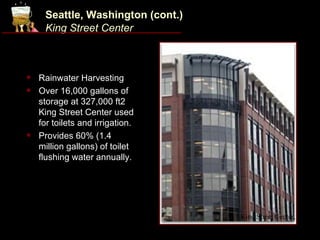
     King Street Center


   Rainwater Harvesting
   Over 16,000 gallons of
    storage at 327,000 ft2
    King Street Center used
    for toilets and irrigation.
   Provides 60% (1.4
    million gallons) of toilet
    flushing water annually.


                                   King Street Center.
Toronto, Ontario


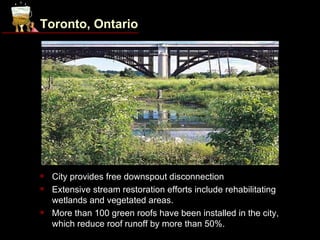
                     Chester Springs Marsh. Source: City of Toronto, www.toronto.ca.

   City provides free downspout disconnection
   Extensive stream restoration efforts include rehabilitating
    wetlands and vegetated areas.
   More than 100 green roofs have been installed in the city,
    which reduce roof runoff by more than 50%.
Toronto, Ontario (cont.)


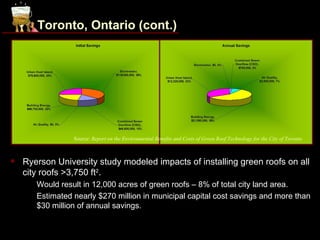
                   Source: Report on the Environmental Benefits and Costs of Green Roof Technology for the City of Toronto


   Ryerson University study modeled impacts of installing green roofs on all
    city roofs >3,750 ft2.
     •   Would result in 12,000 acres of green roofs – 8% of total city land area.
     •   Estimated nearly $270 million in municipal capital cost savings and more than
         $30 million of annual savings.
Vancouver, British Columbia


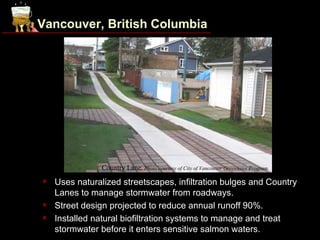
                Country Lane. Photo courtesy of City of Vancouver Greenways Program.
   Uses naturalized streetscapes, infiltration bulges and Country
    Lanes to manage stormwater from roadways.
   Street design projected to reduce annual runoff 90%.
   Installed natural biofiltration systems to manage and treat
    stormwater before it enters sensitive salmon waters.
Vancouver, British Columbia (cont.)


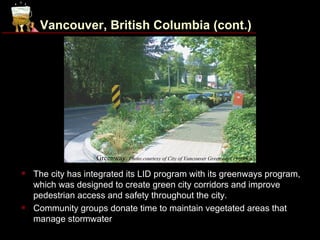
                   Greenway. Photo courtesy of City of Vancouver Greenways Program.

   The city has integrated its LID program with its greenways program,
    which was designed to create green city corridors and improve
    pedestrian access and safety throughout the city.
   Community groups donate time to maintain vegetated areas that
    manage stormwater
Washington, D.C.
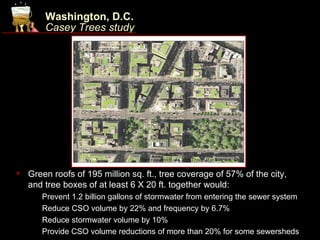
         Casey Trees study


                                    Photo courtesy of CaseyTrees, Washington, DC

   Green roofs of 195 million sq. ft., tree coverage of 57% of the city,
    and tree boxes of at least 6 X 20 ft. together would:
     •   Prevent 1.2 billion gallons of stormwater from entering the sewer system
     •   Reduce CSO volume by 22% and frequency by 6.7%
     •   Reduce stormwater volume by 10%
     •   Provide CSO volume reductions of more than 20% for some sewersheds
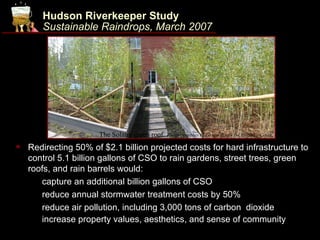
Hudson Riverkeeper Study
       Sustainable Raindrops, March 2007


                      The Solaire green roof. Photo courtesy of Green Roofs for Healthy Cities.
   Redirecting 50% of $2.1 billion projected costs for hard infrastructure to
    control 5.1 billion gallons of CSO to rain gardens, street trees, green
    roofs, and rain barrels would:
     • capture an additional billion gallons of CSO

     • reduce annual stormwater treatment costs by 50%

     • reduce air pollution, including 3,000 tons of carbon dioxide
     • increase property values, aesthetics, and sense of community

Green infrastructure on the fair

  • 1.
    Green Infrastructure forStormwater Management in Syracuse, New York Atlantic States Legal Foundation, Inc.
  • 2.
  • 3.
    What is GreenInfrastructure?  Green Infrastructure refers to the ecological processes, both natural and engineered, that act as living infrastructure. Green Infrastructure elements are planned and managed primarily for stormwater control, but also exhibit social, economic and environmental benefits.
  • 4.
    Green Infrastructure Systems Credit: T.Toland, Landscape Architecture, SUNY ESF
  • 5.
    Example Applications ofGreen Infrastructure  Bioretention/Vegetated Infiltration • Green roofs • Rain Gardens • Vegetated curb extensions • Tree trenches • Stormwater Planter  Rain Capture/Re-use • Cisterns/rain barrels  Permeable Pavement • Parking Lot/Sidewalks/Sport Courts  Urban Forestry  Green Streets • Combinations of the above
  • 6.
    Green Roofs  Typical Layers of Green Roof www.sierraclubgreenhome.com
  • 7.
    Green Roofs  Can Be as Big as the one on the top of the Chicago City Hall Building … ngm.nationalgeographic.com
  • 8.
    Green Roofs  … or as small as this on a dog house … www.remarc.com
  • 9.
    Rain Gardens www.spartanburgwater.org
  • 10.
    Rain Gardens www.spartanburgwater.org
  • 11.
    Vegetated Curb Extension NE Siskiyou Green Street, Portland, Oregon. Photo by Kevin Robert Perry.
  • 12.
    Bioswales/Vegetated Trenches www.lakecountyil.gov
  • 13.
    Stormwater Planters NE SiskiyouGreen Street, Portland, Oregon. Photo by Kevin Robert Perry. Vegetated Planter at Portland State University. Photo by Martina Keefe.
  • 14.
    Rain Barrels andCisterns - Disconnecting Downspouts  Rain Barrel  Rain Cistern
  • 15.
    Permeable Pavement  Rain Barrel Porous Asphalt Cross Section (no curb)
  • 16.
    Green Streets NE Siskiyou Green Street, Portland, Oregon. Photo by Kevin Robert Perry.  A street that uses vegetated facilities to manage stormwater runoff at its source is referred to as a Green Street.  A Green Street is a sustainable stormwater strategy that meets regulatory compliance and resource protection goals by using a natural systems approach to manage stormwater, reduce flows, improve water quality and enhance watershed health. www.portlandonline.com
  • 17.
    SECTION II How CanGreen Infrastructure Help Syracuse?
  • 18.
    Stormwater Issues - SurfaceRun-off and Water Pollution in Urban Environment bacteria trash nutrients heavy metals pesticides suspended solids Credit: Nancy Stoner, NRDC  Urban impervious surfaces generate extraordinary stormwater run-off, which brings various pollutants from urban environment to sewer system and may discharge directly into streams, rivers and lakes as overflow.
  • 19.
    Stormwater Issues -CSO  Combined sewer systems are sewers that are designed to collect rainwater runoff, domestic sewage, and industrial wastewater in the same pipe. Combined sewer systems are designed to overflow occasionally and discharge excess wastewater (Combined Sewer Overflow) directly to nearby streams, rivers, or other water bodies.  637 milion gallons of untreated combined sewage in Syracuse is currently discharged per year into Onondaga Lake. (CH2M HILL)  Combined Sewer System www.ongov.net
  • 20.
    Stormwater Issues -CSO  In 1998, under an Amended Consent Judgment (ACJ), Onondaga County began to abate combined sewer overflows (CSO) from impacting tributaries that enter Onondaga Lake by using traditional methods of conveyance pipes and treatment facilities (gray infrastructure).  Separated Sewer System www.ongov.net
  • 21.
    Gray Infrastructure forCSO Abatement The Metropolitan Wastewater Treatment Plant (Metro) www.ongov.net Installing the 144-inch pipe In the past few years in Onondaga County near Midland RTF (June 2006)  Over 13 sewer separation projects were completed  Construction of the Midland and Hiawatha Regional Treatment Facilities were completed  Five floatable control facilities  Proposed construction of RTF’s in Clinton and Harbor Brook Sewer Sheds
  • 22.
    Green Infrastructure asa Component of Comprehensive Stormwater Management Plan Rendering of a bioretention area & park on a vacant property at Near Westside, Syracuse. Credit: Alexander Shisler from Atlantic States Legal Foundation, Inc.  The green infrastructure techniques are not supposed to solve the stromwater problems single-handedly.  However, incorporating green infrastructure into stormwater management system can delay and reduce the volume of "peak flow“, which will consequently reduce the CSO volume and make the gray infrastructure more workable.
  • 23.
    Green Infrastructure asa Component of Comprehensive Stormwater Management Plan Green infrastructure REDUCES… Green Infrastructure IMPROVES…  Flooding  Water quality  Erosion  Air quality  Stormwater runoff volume  Neighborhood aesthetics  Stormwater pollutant loadings  Habitat and biodiversity  CSOs  Recreational and Educational  Gray infrastructure operation, opportunities maintenance, energy and  Property values treatment costs  Community health and vitality
  • 24.
    Gray-Green Infrastructure Program for Onondaga County A Balanced Approach to Abating CSO and More:  Gray Infrastructure Additional projects planned for: • Clinton Sewershed: Storage at Trolley Lot • Erie Boulevard Storage System Improvements • Franklin Sewershed: Storage at Schiller Park or alternate location • Midland Sewershed: Connect CSO 044 to RTF
  • 25.
    Gray-Green Infrastructure Program for Onondaga County A Balanced Approach to Abating CSO and More:  Green Infrastructure • 26 individual demonstration project prototypes were developed • Design and Implementation processes are underway • Projects will demonstrate: - Green Infrastructure Designs that can be readily applied to Onondaga County and repeated - Benefit to Water Quality • Green Infrastructure manages pollutants “at the source” and prevents migration to the lake - Benefit to Community • Green Infrastructure improves neighborhood aesthetics, quality of life and is an investment that people desire
  • 26.
    Gray-Green Infrastructure Program for Onondaga County Onondaga County’s approach to Implementing green infrastructure  The Save-the-Rain program developed to implement green infrastructure throughout the community. Program highlights: • Public Education and Outreach campaign • Urban Forestry Grant in Clinton sewershed • Demonstration Projects moving forward including green roofs, porous pavement, rain gardens, planter boxes, tree trenches and rain barrels • Development of matching grant program for “green” projects on private properties
  • 27.
    SECTION III CaseStudy Green Infrastructure for Stormwater Management in North America This section is adapted from the presentation, Rooftops to Rivers, by Nancy Stoner from Natural Resources Defense Council (NRDC)
  • 28.
    Chicago, Illinois Chicago City Hall Green Roof. Photo courtesy of Roofscapes, Inc.  More than 80 green roofs totaling over 1 million square feet.  A 2003 study found green roof runoff volume was less than half that of conventional roofs.  Temperatures above the Chicago City Hall green roof average 10° to 15°F lower than a nearby black tar roof. August temperature difference can be as much as 50°F. Estimated annual energy savings of $3,600.
  • 29.
    Chicago, Illinois (cont.) Green Bungalows. Photo courtesy of the Chicago Department of the Environment.  Subsidized rain barrel program used to reduce basement flooding and CSO volume.  Downspout disconnection projected to reduce CSO peak flow in target area by 20%.  Green bungalow initiative to retrofit four historic bungalows with green technologies. Average energy savings of 15% - 49%.
  • 30.
    Milwaukee, Wisconsin MMSD Green Roof. Photo courtesy of MMSD.  Green roofs, bioretention and rain barrels used to reduce combined sewer inflow.  Green infrastructure expected to reduce CSO volume by 14-38%.
  • 31.
    Milwaukee, Wisconsin (cont.) Green Seams Watershed Protection Strategy Photos courtesy of Kevin Shafer, Milwaukee Metropolitan Sewerage District  $27 million supplemental environmental project funds conservation easements and a greenways initiative.
  • 32.
    Philadelphia, PA Clean Water– Green City Initiative (Before)
  • 33.
    Philadelphia, PA Clean Water– Green City Initiative (After)
  • 34.
    Portland, Oregon  City code requires on-site stormwater management for new and re-development.  Subsidized downspout disconnection program. • 45,000 participating households. • Infiltrates 1 billion gallons of rainwater annually. Vegetated Planter at Portland State University. Photo courtesy of Martina Keefe.
  • 35.
    Portland, Oregon (cont.) Vegetated Curb Extensions. Photo courtesy of the Portland Bureau of Environmental Services.  Vegetated Curb Extensions  Flow testing demonstrated 88% reduction in peak flow and 85% reduction in CSS inflow for 25-year storm event.  Sufficient to protect local basements from flooding.  Project cost $15,000 and required two weeks to install.
  • 36.
    Portland, Oregon (cont.) Hamilton Apartments Ecoroof. Photo courtesy of the Portland Bureau of Environmental Services.  Green Roofs  Zoning bonus allows additional building square footage for buildings with a green roof.  Two years of monitoring demonstrated that 58% of annual and nearly 100% of warm season rainfall was retained.  Modeling of 300 block downtown area with eco-roofs showed 32% stormwater reduction, 6.5% energy reduction, and 1% heat island effect reduction.
  • 37.
    Seattle, Washington Natural Drainage Systems 2nd Avenue SEA Street. Photo courtesy of Seattle Public Utilities.  Bioretention Swales  Stormwater source control.  Monitoring has demonstrated 99% reduction in stormwater runoff.  No measured runoff since December 2002.
  • 38.
    Seattle, Washington (cont.) Natural Drainage Systems  Cascade Channels  End-of-Pipe Control  Monitoring demonstrates 75% reduction in stormwater runoff volume and 60% reduction in peak flow.  Modeling estimates that cascade system retains three times as much stormwater and held stormwater 2.5 times longer than original drainage ditch. Cascade Drainage System. Photo courtesy of Seattle Public Utilities.
  • 39.
    Seattle, Washington (cont.) King Street Center  Rainwater Harvesting  Over 16,000 gallons of storage at 327,000 ft2 King Street Center used for toilets and irrigation.  Provides 60% (1.4 million gallons) of toilet flushing water annually. King Street Center.
  • 40.
    Toronto, Ontario Chester Springs Marsh. Source: City of Toronto, www.toronto.ca.  City provides free downspout disconnection  Extensive stream restoration efforts include rehabilitating wetlands and vegetated areas.  More than 100 green roofs have been installed in the city, which reduce roof runoff by more than 50%.
  • 41.
    Toronto, Ontario (cont.) Source: Report on the Environmental Benefits and Costs of Green Roof Technology for the City of Toronto  Ryerson University study modeled impacts of installing green roofs on all city roofs >3,750 ft2. • Would result in 12,000 acres of green roofs – 8% of total city land area. • Estimated nearly $270 million in municipal capital cost savings and more than $30 million of annual savings.
  • 42.
    Vancouver, British Columbia Country Lane. Photo courtesy of City of Vancouver Greenways Program.  Uses naturalized streetscapes, infiltration bulges and Country Lanes to manage stormwater from roadways.  Street design projected to reduce annual runoff 90%.  Installed natural biofiltration systems to manage and treat stormwater before it enters sensitive salmon waters.
  • 43.
    Vancouver, British Columbia(cont.) Greenway. Photo courtesy of City of Vancouver Greenways Program.  The city has integrated its LID program with its greenways program, which was designed to create green city corridors and improve pedestrian access and safety throughout the city.  Community groups donate time to maintain vegetated areas that manage stormwater
  • 44.
    Washington, D.C. Casey Trees study Photo courtesy of CaseyTrees, Washington, DC  Green roofs of 195 million sq. ft., tree coverage of 57% of the city, and tree boxes of at least 6 X 20 ft. together would: • Prevent 1.2 billion gallons of stormwater from entering the sewer system • Reduce CSO volume by 22% and frequency by 6.7% • Reduce stormwater volume by 10% • Provide CSO volume reductions of more than 20% for some sewersheds
  • 45.
    Hudson Riverkeeper Study Sustainable Raindrops, March 2007 The Solaire green roof. Photo courtesy of Green Roofs for Healthy Cities.  Redirecting 50% of $2.1 billion projected costs for hard infrastructure to control 5.1 billion gallons of CSO to rain gardens, street trees, green roofs, and rain barrels would: • capture an additional billion gallons of CSO • reduce annual stormwater treatment costs by 50% • reduce air pollution, including 3,000 tons of carbon dioxide • increase property values, aesthetics, and sense of community