Water Quality Update Presented to CPAC January 12, 2003
Objectives of Presentation How tasks fit together to support the Long Term Control Plan What has been accomplished
Tools to Understand CSO Impacts Flow Characterization System Characterization and Flow Metering Hydraulic Sewer Model Water Quality Study Water Quality Model Long Term Control Plan
Consent Decree Requirements All study efforts required by consent decree CD included specific items each study must include Study work plans were approved April 7, 2003 Reports for Flow Characterization and Water Quality Study are due in April 2004. Long Term Control Plan Report due October 2005.
System Characterization
Flow Metering
Hydraulic Sewer Modeling
Water Quality Study
Water Quality Model
Long Term Control Plan
How Monitoring/ Models Are Used in Long Term Control Planning Monitoring Shows current conditions Helps identify unusual operating conditions Provide data to make sure models make sense Models Fill in the gaps where we can’t monitor Predicts what will happen with different rainfall conditions Allows evaluation of changes to the system
2003 Flow Metering Locations
2003 Flow Metering Program Meter Installation  Meters Installed May through August Site Visits – Site Check/Data Download weekly
Metering Locations – data set
Data Set 1999 City-wide Flow Monitoring Study – 48 meters SCADA data – 47 data collection locations 2003 Data – 36 metering locations Point Place - __ metering locations Overall – 130+ metering locations with consistent data analysis techniques
2003 Metering Period Rain Events Several Rain Events Greater than One Inch 88% 1.07 May 31, 2003 91% 3.57 September 1, 2003 73% 2.66 August 3, 2003 97% 1.58 July 7, 2003 97% 1.36 June 11, 2003 42% 2.01 May 9, 2003 Percentage of Meters Recording Data Amount of Rain (inches) Date of Wet Weather Event
Sanitary Area Flow Contributions Percent Capture – 1999 and 2003
Sanitary Area Flow Contributions Peaking Factor – 1999 and 2003
Sanitary Area Flow Contributions Separated portions of the sewer system will contribute significant flow in wet weather. There are a number of very wet areas of the system where flow reduction work is encouraged  The sanitary flow rates during wet weather are important to consider in evaluating CSO control alternatives and the overall impact on the plant
Combined Area Flow Contributions Combined Area Flow (Hydrologic) Response This is a critical parameter for modeling.  Values fall within typical ranges 73% of Combined Area Monitored
Estimated Capture Rates 2003
Combined Flow Summary Data collected to calibrate model Ability of flow to be delivered to the interceptor varies significantly by regulator Variability in frequency of discharge Overloading of interceptor system
Windermere Pump Station 9/1/03 Response
 
 
System Hydraulics - observations The system backs up during wet weather events The majority of the back up seems to start at the WWTP Because of the backups, flow reverses direction in the sewers.  More overflow to the waterways also occurs.
System Hydraulics - consequences Once the WWTP can process more flow System backup should be reduced Less CSO discharge to the waterways Less risk of basement backup
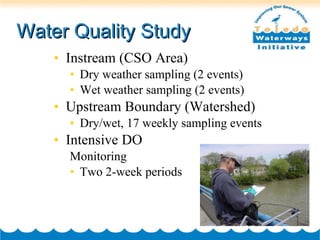
Water Quality Study Instream (CSO Area) Dry weather sampling (2 events) Wet weather sampling (2 events) Upstream Boundary (Watershed) Dry/wet, 17 weekly sampling events Intensive DO  Monitoring Two 2-week periods
2003 Sampling Locations
Wet Weather Event Monitoring May 1, 2003: Fast-moving spring storm (shown) 0.6” at Toledo Express CSO duration ~ 2 hours September 1, 2003 Slower-moving late summer storm 2.6” at Toledo Express CSO duration ~ 14 hours
WW Monitoring Results - Bacteria Ottawa River: WW1 – low concentrations, dominated by upstream WW2 – high upstream + significant in-stream contribution Decreased concentrations downstream due to Maumee Bay mixing Primary Contact  Recreational Standard Primary Contact  Recreational Standard
WW Monitoring Results – Dissolved Oxygen Maumee River WW1 – Aeration elevates DO WW2 – CSOs also reduce downstream DO
Consent Decree Requirements – Hydraulic Sewer Model Workplan, approved April 7, 2003 Develop sewer model to predict: Flows  Hydraulic grade lines and capacities  CSO frequencies and volumes Use in conjunction with WQ model to support Long Term Control Plan
Hydraulic Model Coverage
Status of Hydraulic Model East Side model is operational Calibrated to 2003 metering data Calibration is preliminary, pending: West Side and 10-Mile Creek calibrations - consistency Runs with complete model - reasonableness West Side calibration not far behind 10-Mile Creek to be calibrated in December
East Side Hydraulic Submodel
Calibration to 2003 Metering Data Also important to accurately estimate flows to interceptor (example: Eastside Interceptor)
Consent Decree Requirements – WQ Model Workplan, approved April 7, 2003 Model shall be capable of: Accurately modeling WQ in  the 3 streams Under wide range of conditions Assessing impacts of CSOs on WQ Assessing changes in CSO impact due to Long Term Control measures under evaluation
Summary Flow Characterization Study - close to completion Water Quality Study - on schedule Hydraulic Model - on schedule about ready to use Water Quality Model – will build off of hydraulic model Long Term Control Plan – will use the models as tools to develop alternatives
Next Steps Long Term Control Plan – begin evaluation of alternatives Gather input from stakeholders and the general public

CPAC Meeting 12-15-03

  • 1.
    Water Quality UpdatePresented to CPAC January 12, 2003
  • 2.
    Objectives of PresentationHow tasks fit together to support the Long Term Control Plan What has been accomplished
  • 3.
    Tools to UnderstandCSO Impacts Flow Characterization System Characterization and Flow Metering Hydraulic Sewer Model Water Quality Study Water Quality Model Long Term Control Plan
  • 4.
    Consent Decree RequirementsAll study efforts required by consent decree CD included specific items each study must include Study work plans were approved April 7, 2003 Reports for Flow Characterization and Water Quality Study are due in April 2004. Long Term Control Plan Report due October 2005.
  • 5.
  • 6.
  • 7.
  • 8.
  • 9.
  • 10.
  • 11.
    How Monitoring/ ModelsAre Used in Long Term Control Planning Monitoring Shows current conditions Helps identify unusual operating conditions Provide data to make sure models make sense Models Fill in the gaps where we can’t monitor Predicts what will happen with different rainfall conditions Allows evaluation of changes to the system
  • 12.
  • 13.
    2003 Flow MeteringProgram Meter Installation Meters Installed May through August Site Visits – Site Check/Data Download weekly
  • 14.
  • 15.
    Data Set 1999City-wide Flow Monitoring Study – 48 meters SCADA data – 47 data collection locations 2003 Data – 36 metering locations Point Place - __ metering locations Overall – 130+ metering locations with consistent data analysis techniques
  • 16.
    2003 Metering PeriodRain Events Several Rain Events Greater than One Inch 88% 1.07 May 31, 2003 91% 3.57 September 1, 2003 73% 2.66 August 3, 2003 97% 1.58 July 7, 2003 97% 1.36 June 11, 2003 42% 2.01 May 9, 2003 Percentage of Meters Recording Data Amount of Rain (inches) Date of Wet Weather Event
  • 17.
    Sanitary Area FlowContributions Percent Capture – 1999 and 2003
  • 18.
    Sanitary Area FlowContributions Peaking Factor – 1999 and 2003
  • 19.
    Sanitary Area FlowContributions Separated portions of the sewer system will contribute significant flow in wet weather. There are a number of very wet areas of the system where flow reduction work is encouraged The sanitary flow rates during wet weather are important to consider in evaluating CSO control alternatives and the overall impact on the plant
  • 20.
    Combined Area FlowContributions Combined Area Flow (Hydrologic) Response This is a critical parameter for modeling. Values fall within typical ranges 73% of Combined Area Monitored
  • 21.
  • 22.
    Combined Flow SummaryData collected to calibrate model Ability of flow to be delivered to the interceptor varies significantly by regulator Variability in frequency of discharge Overloading of interceptor system
  • 23.
    Windermere Pump Station9/1/03 Response
  • 24.
  • 25.
  • 26.
    System Hydraulics -observations The system backs up during wet weather events The majority of the back up seems to start at the WWTP Because of the backups, flow reverses direction in the sewers. More overflow to the waterways also occurs.
  • 27.
    System Hydraulics -consequences Once the WWTP can process more flow System backup should be reduced Less CSO discharge to the waterways Less risk of basement backup
  • 28.
    Water Quality StudyInstream (CSO Area) Dry weather sampling (2 events) Wet weather sampling (2 events) Upstream Boundary (Watershed) Dry/wet, 17 weekly sampling events Intensive DO Monitoring Two 2-week periods
  • 29.
  • 30.
    Wet Weather EventMonitoring May 1, 2003: Fast-moving spring storm (shown) 0.6” at Toledo Express CSO duration ~ 2 hours September 1, 2003 Slower-moving late summer storm 2.6” at Toledo Express CSO duration ~ 14 hours
  • 31.
    WW Monitoring Results- Bacteria Ottawa River: WW1 – low concentrations, dominated by upstream WW2 – high upstream + significant in-stream contribution Decreased concentrations downstream due to Maumee Bay mixing Primary Contact Recreational Standard Primary Contact Recreational Standard
  • 32.
    WW Monitoring Results– Dissolved Oxygen Maumee River WW1 – Aeration elevates DO WW2 – CSOs also reduce downstream DO
  • 33.
    Consent Decree Requirements– Hydraulic Sewer Model Workplan, approved April 7, 2003 Develop sewer model to predict: Flows Hydraulic grade lines and capacities CSO frequencies and volumes Use in conjunction with WQ model to support Long Term Control Plan
  • 34.
  • 35.
    Status of HydraulicModel East Side model is operational Calibrated to 2003 metering data Calibration is preliminary, pending: West Side and 10-Mile Creek calibrations - consistency Runs with complete model - reasonableness West Side calibration not far behind 10-Mile Creek to be calibrated in December
  • 36.
  • 37.
    Calibration to 2003Metering Data Also important to accurately estimate flows to interceptor (example: Eastside Interceptor)
  • 38.
    Consent Decree Requirements– WQ Model Workplan, approved April 7, 2003 Model shall be capable of: Accurately modeling WQ in the 3 streams Under wide range of conditions Assessing impacts of CSOs on WQ Assessing changes in CSO impact due to Long Term Control measures under evaluation
  • 39.
    Summary Flow CharacterizationStudy - close to completion Water Quality Study - on schedule Hydraulic Model - on schedule about ready to use Water Quality Model – will build off of hydraulic model Long Term Control Plan – will use the models as tools to develop alternatives
  • 40.
    Next Steps LongTerm Control Plan – begin evaluation of alternatives Gather input from stakeholders and the general public