


Community Flood Mitigation
Advisory Panel
• Allan P. Markin, P. Eng. Chair
• Tino DiManno, P. Eng. Senior Vice President, Canada West,
Stantec Consulting
• Richard Lindseth, MAA,FRAIC, Richard Lindseth Architecture
Inc.
Community Flood Mitigation
Advisory Panel Mandate
• Examine leading community flood prevention and protection practices
from around the world.
• Consult community flood mitigation managers and technical experts on
the ways to guard against or mitigate the impact of future flooding.
• Examine innovative solutions aimed at preventing future flood damage
on a community wide basis.
• Consider additional individual mitigation measures (at the homeowners
cost) that are above and beyond what is minimally required for future
Disaster Recovery Program funding.
• Provide observations about flood mitigation and best practices for
government to consider.
• Conduct follow-up information sessions with government ministries and
their invited stakeholders to discuss observations and clarify issues as
needed.
Community Flood Mitigation
Advisory Panel Mandate
Initial Priority: To focus on Mitigation in Elbow and
Highwood Basins, forming an initial
segment of an overall system
7 Elements of Mitigation :
• Overall Watershed Management for floods, drought, water supply,
environmental, etc...
• Flood Forecasting, Modelling and Warning Systems
• Flood Risk Management Policies (Mapping, Development Control, Etc...)
• Community Mitigation Panels, Teams and Advisors
• Erosion Control
• Local and Municipal Mitigation Plans and Initiatives
• Individual Mitigation Measures for Homes
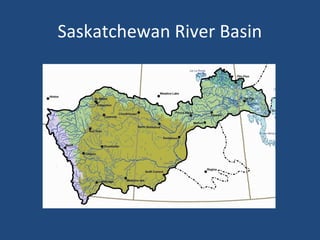
Saskatchewan River Basin
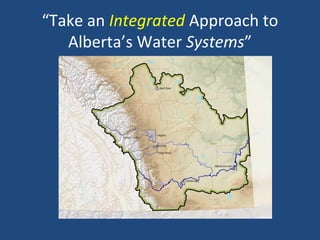
“Take an Integrated Approach to
Alberta’s Water Systems”
Community Flood Mitigation
Advisory Panel
“Have you thought of...?”
“I’m retired, but for several years consulted in....”
“I’d like to suggest...”
“Years ago, we did a proposal that may be of interest...”
“Would you consider...”
“It occurred to me that this might work...!”
“I have a proposal to help...”
Community Flood Mitigation
Advisory Panel
“..To hear from Albertans,
and find Alberta Solutions
to what is now recognized as...”
“...The Single Largest
Natural Disaster
in our Nation’s History...”
Community Flood Mitigation
Advisory Panel
(River) Flow Management –Reduce Volume of Flow
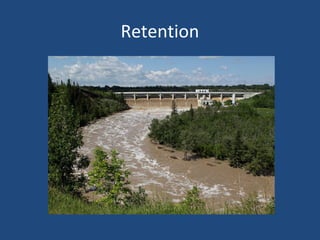
• Retention
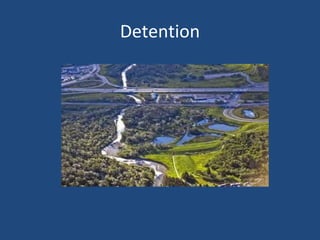
• Detention
Conveyance Improvement - Impact Reduction
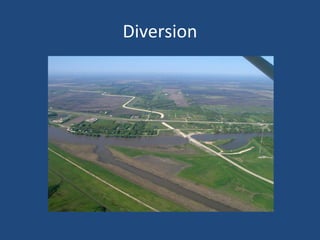
• Diversion
• Channel Improvements
Retention
Detention
Diversion
Channel Improvements
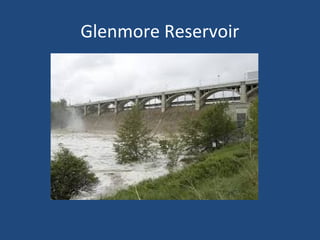
Glenmore Reservoir
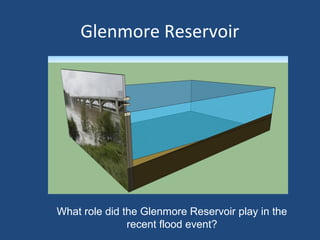
Glenmore Reservoir
What role did the Glenmore Reservoir play in the
recent flood event?
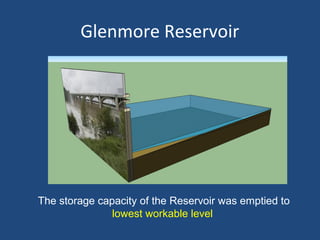
Glenmore Reservoir
The storage capacity of the Reservoir was emptied to
lowest workable level
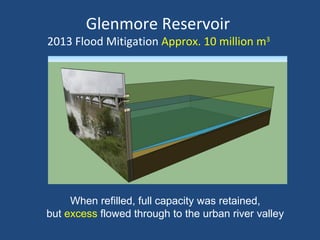
Glenmore Reservoir
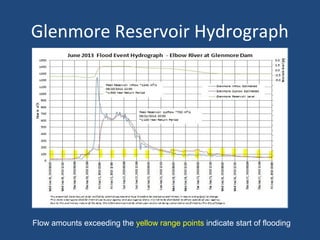
2013 Flood Mitigation Approx. 10 million m3
When refilled, full capacity was retained,
but excess flowed through to the urban river valley
Glenmore Reservoir Hydrograph
Flow amounts exceeding the yellow range points indicate start of flooding
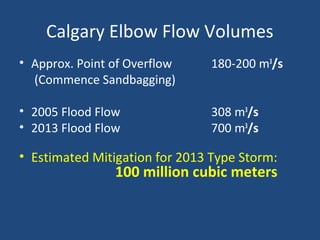
Calgary Elbow Flow Volumes
• Approx. Point of Overflow 180-200 m3
/s
(Commence Sandbagging)
• 2005 Flood Flow 308 m3
/s
• 2013 Flood Flow 700 m3
/s
• Estimated Mitigation for 2013 Type Storm:
100 million cubic meters
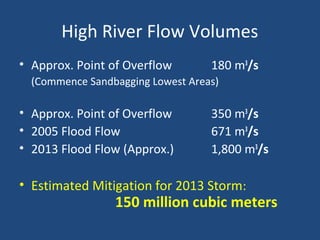
High River Flow Volumes
• Approx. Point of Overflow 180 m3
/s
(Commence Sandbagging Lowest Areas)
• Approx. Point of Overflow 350 m3
/s
• 2005 Flood Flow 671 m3
/s
• 2013 Flood Flow (Approx.) 1,800 m3
/s
• Estimated Mitigation for 2013 Storm:
150 million cubic meters
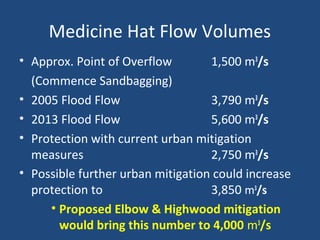
Medicine Hat Flow Volumes
• Approx. Point of Overflow 1,500 m3
/s
(Commence Sandbagging)
• 2005 Flood Flow 3,790 m3
/s
• 2013 Flood Flow 5,600 m3
/s
• Protection with current urban mitigation
measures 2,750 m3
/s
• Possible further urban mitigation could increase
protection to 3,850 m3
/s
• Proposed Elbow & Highwood mitigation
would bring this number to 4,000 m3
/s
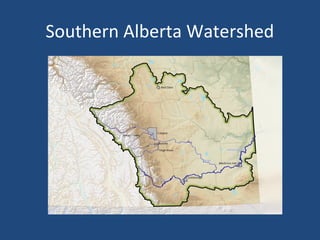
Southern Alberta Watershed
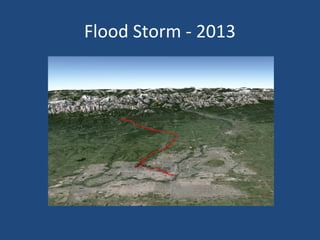
Flood Storm - 2013
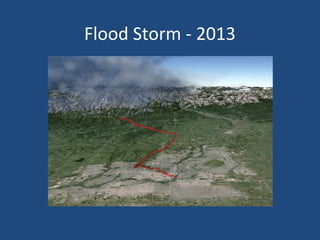
Flood Storm - 2013
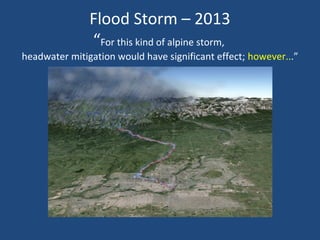
Flood Storm – 2013
“For this kind of alpine storm,
headwater mitigation would have significant effect; however...”
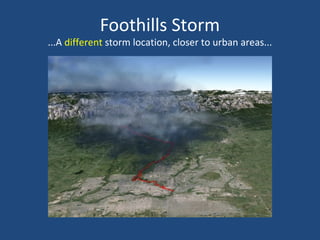
Foothills Storm
...A different storm location, closer to urban areas...
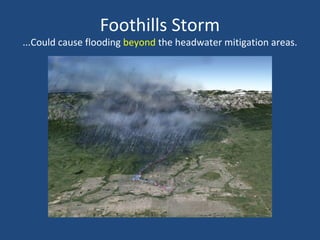
Foothills Storm
...Could cause flooding beyond the headwater mitigation areas.
“A ‘one in 100 year’ flood
may occur more than once
in 100 years...”
From “Flood 2005 Lessons Learned”
University of Calgary
Environmental Science 502,
June 2006
“It could have been worse...!”
Paraphrasing from Television Show “Daily Planet”
Program on University of Saskatchewan Centre For Hydrology
= the need to factor in a
‘margin of safety’
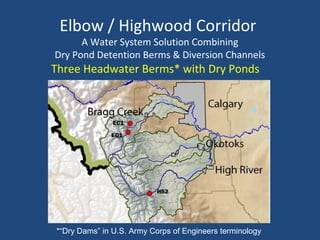
Elbow / Highwood Corridor
A Water System Solution Combining
Dry Pond Detention Berms & Diversion Channels
Three Headwater Berms* with Dry Ponds
*“Dry Dams” in U.S. Army Corps of Engineers terminology
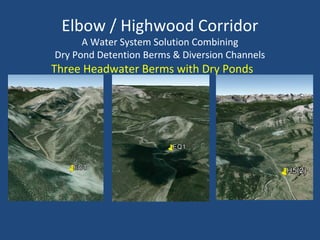
Elbow / Highwood Corridor
A Water System Solution Combining
Dry Pond Detention Berms & Diversion Channels
Three Headwater Berms with Dry Ponds
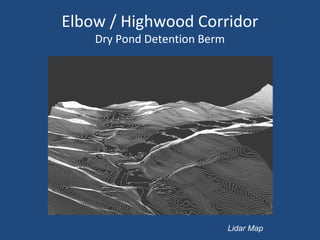
Elbow / Highwood Corridor
Dry Pond Detention Berm
Lidar Map
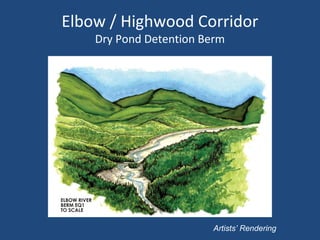
Elbow / Highwood Corridor
Dry Pond Detention Berm
Artists’ Rendering
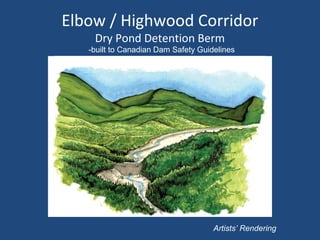
Elbow / Highwood Corridor
Dry Pond Detention Berm
Artists’ Rendering
-built to Canadian Dam Safety Guidelines
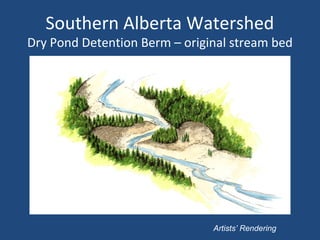
Southern Alberta Watershed
Dry Pond Detention Berm – original stream bed
Artists’ Rendering
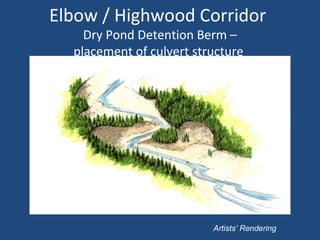
Elbow / Highwood Corridor
Dry Pond Detention Berm –
placement of culvert structure
Artists’ Rendering
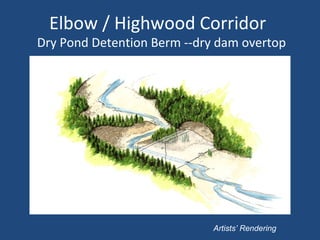
Elbow / Highwood Corridor
Dry Pond Detention Berm --dry dam overtop
Artists’ Rendering
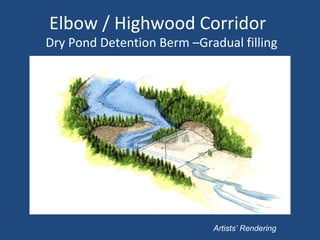
Elbow / Highwood Corridor
Dry Pond Detention Berm –Gradual filling
Artists’ Rendering
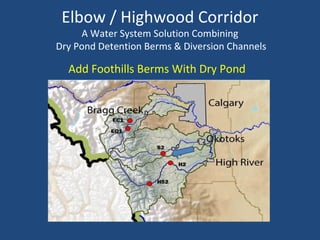
Elbow / Highwood Corridor
A Water System Solution Combining
Dry Pond Detention Berms & Diversion Channels
Add Foothills Berms With Dry Pond
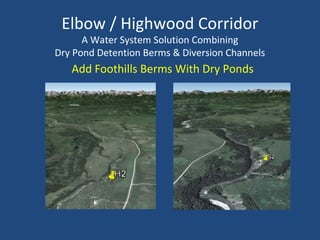
Elbow / Highwood Corridor
A Water System Solution Combining
Dry Pond Detention Berms & Diversion Channels
Add Foothills Berms With Dry Ponds
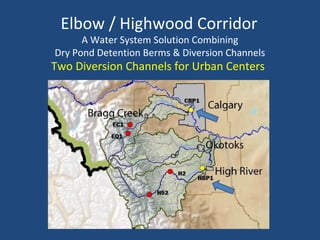
Elbow / Highwood Corridor
A Water System Solution Combining
Dry Pond Detention Berms & Diversion Channels
Two Diversion Channels for Urban Centers
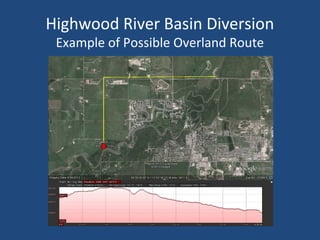
Highwood River Basin Diversion
Example of Possible Overland Route
58th
Avenue Bypass (CBP1)
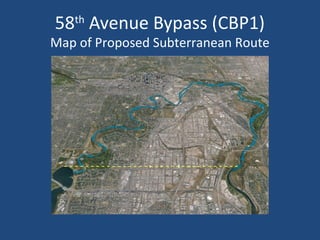
Map of Proposed Subterranean Route
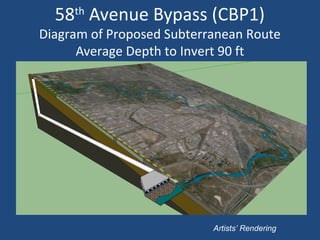
58th
Avenue Bypass (CBP1)
Diagram of Proposed Subterranean Route
Average Depth to Invert 90 ft
Artists’ Rendering
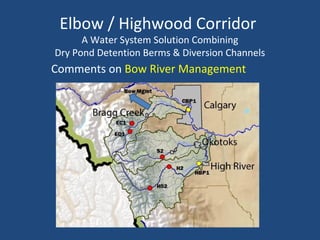
Elbow / Highwood Corridor
A Water System Solution Combining
Dry Pond Detention Berms & Diversion Channels
Comments on Bow River Management
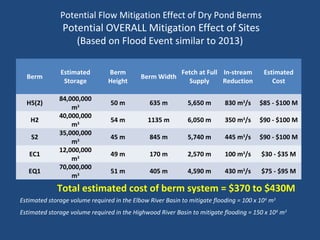
Potential Flow Mitigation Effect of Dry Pond Berms
Potential OVERALL Mitigation Effect of Sites
(Based on Flood Event similar to 2013)
Berm
Estimated
Storage
Berm
Height
Berm Width
Fetch at Full
Supply
In-stream
Reduction
Estimated
Cost
H5(2)
84,000,000
m3
50 m 635 m 5,650 m 830 m3
/s $85 - $100 M
H2
40,000,000
m3
54 m 1135 m 6,050 m 350 m3
/s $90 - $100 M
S2
35,000,000
m3
45 m 845 m 5,740 m 445 m3
/s $90 - $100 M
EC1
12,000,000
m3
49 m 170 m 2,570 m 100 m3
/s $30 - $35 M
EQ1
70,000,000
m3
51 m 405 m 4,590 m 430 m3
/s $75 - $95 M
Total estimated cost of berm system = $370 to $430M
Estimated storage volume required in the Elbow River Basin to mitigate flooding = 100 x 106
m3
Estimated storage volume required in the Highwood River Basin to mitigate flooding = 150 x 106
m3
Elbow / Highwood Corridor
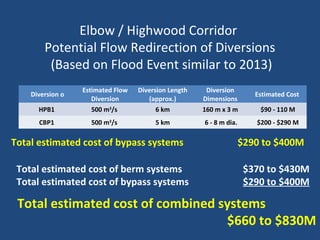
Potential Flow Redirection of Diversions
(Based on Flood Event similar to 2013)
Diversion o
Estimated Flow
Diversion
Diversion Length
(approx.)
Diversion
Dimensions
Estimated Cost
HPB1 500 m3
/s 6 km 160 m x 3 m $90 - 110 M
CBP1 500 m3
/s 5 km 6 - 8 m dia. $200 - $290 M
Total estimated cost of berm systems $370 to $430M
Total estimated cost of bypass systems $290 to $400M
Total estimated cost of combined systems
$660 to $830M
Elbow / Highwood Corridor
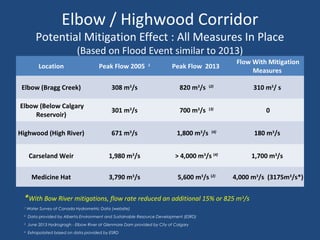
Potential Mitigation Effect : All Measures In Place
(Based on Flood Event similar to 2013)
Location Peak Flow 2005 1
Peak Flow 2013
Flow With Mitigation
Measures
Elbow (Bragg Creek) 308 m3
/s 820 m3
/s (2)
310 m3
/ s
Elbow (Below Calgary
Reservoir)
301 m3
/s 700 m3
/s (3)
0
Highwood (High River) 671 m3
/s 1,800 m3
/s (4)
180 m3
/s
Carseland Weir 1,980 m3
/s > 4,000 m3
/s (4)
1,700 m3
/s
Medicine Hat 3,790 m3
/s 5,600 m3
/s (2)
4,000 m3
/s (3175m3
/s*)
*With Bow River mitigations, flow rate reduced an additional 15% or 825 m3
/s
1
Water Survey of Canada Hydrometric Data (website)
2
Data provided by Alberta Environment and Sustainable Resource Development (ESRD)
3
June 2013 Hydrogragh - Elbow River at Glenmore Dam provided by City of Calgary
4
Extrapolated based on data provided by ESRD
Elbow / Highwood Corridor
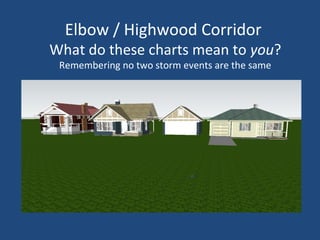
What do these charts mean to you?
Remembering no two storm events are the same
Elbow / Highwood Corridor
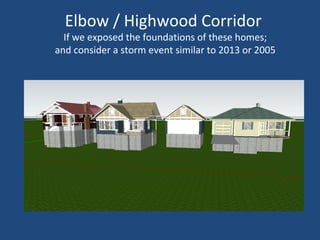
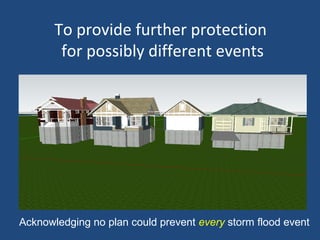
If we exposed the foundations of these homes;
and consider a storm event similar to 2013 or 2005
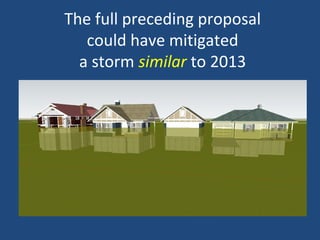
The full preceding proposal
could have mitigated
a storm similar to 2013
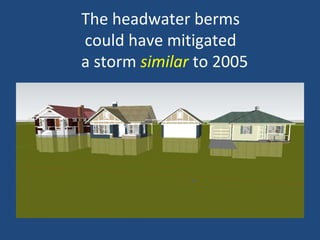
The headwater berms
could have mitigated
a storm similar to 2005
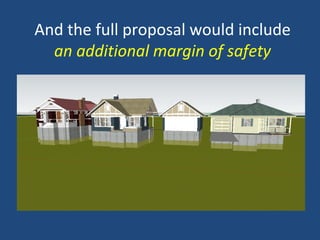
And the full proposal would include
an additional margin of safety
To provide further protection
for possibly different events
Acknowledging no plan could prevent every storm flood event
Timelines
• Provided all consultations have been completed
satisfactorily, and
• All approvals are in place,
• With construction proceeding on schedule,
• Three headwater facilities could be in place within
7-12 months from commencement
• The preceding system could be complete in 2-3
years
Timelines
• The consultation and approval process, if not managed
properly and expedited, could take months or years,
delaying the projects and diluting the impetus to
proceed.
• The Community Flood Mitigation Advisory Panel
recommends a thorough, active and expedited process
be completed, to ensure the future safety of Albertans
and reduce further flood losses within the Southern
Watershed.
In Closing
• This crucial part of the Alberta Flood Mitigation
System is achievable and necessary within an
expedited timeline.
• Communities should continue their action plans for
mitigation; in some cases the system relies on these
also being completed.
• Homeowners should review individual mitigation
measures and make prudent decisions.
• All of these measures are part of the overall solution.
Mitigation Symposium - Richard Lindseth

Mitigation Symposium - Richard Lindseth

  • 1.
    Community Flood Mitigation AdvisoryPanel • Allan P. Markin, P. Eng. Chair • Tino DiManno, P. Eng. Senior Vice President, Canada West, Stantec Consulting • Richard Lindseth, MAA,FRAIC, Richard Lindseth Architecture Inc.
  • 2.
    Community Flood Mitigation AdvisoryPanel Mandate • Examine leading community flood prevention and protection practices from around the world. • Consult community flood mitigation managers and technical experts on the ways to guard against or mitigate the impact of future flooding. • Examine innovative solutions aimed at preventing future flood damage on a community wide basis. • Consider additional individual mitigation measures (at the homeowners cost) that are above and beyond what is minimally required for future Disaster Recovery Program funding. • Provide observations about flood mitigation and best practices for government to consider. • Conduct follow-up information sessions with government ministries and their invited stakeholders to discuss observations and clarify issues as needed.
  • 3.
    Community Flood Mitigation AdvisoryPanel Mandate Initial Priority: To focus on Mitigation in Elbow and Highwood Basins, forming an initial segment of an overall system 7 Elements of Mitigation : • Overall Watershed Management for floods, drought, water supply, environmental, etc... • Flood Forecasting, Modelling and Warning Systems • Flood Risk Management Policies (Mapping, Development Control, Etc...) • Community Mitigation Panels, Teams and Advisors • Erosion Control • Local and Municipal Mitigation Plans and Initiatives • Individual Mitigation Measures for Homes
  • 4.
  • 5.
    “Take an IntegratedApproach to Alberta’s Water Systems”
  • 6.
    Community Flood Mitigation AdvisoryPanel “Have you thought of...?” “I’m retired, but for several years consulted in....” “I’d like to suggest...” “Years ago, we did a proposal that may be of interest...” “Would you consider...” “It occurred to me that this might work...!” “I have a proposal to help...”
  • 7.
    Community Flood Mitigation AdvisoryPanel “..To hear from Albertans, and find Alberta Solutions to what is now recognized as...” “...The Single Largest Natural Disaster in our Nation’s History...”
  • 8.
    Community Flood Mitigation AdvisoryPanel (River) Flow Management –Reduce Volume of Flow • Retention • Detention Conveyance Improvement - Impact Reduction • Diversion • Channel Improvements
  • 9.
  • 10.
  • 11.
  • 12.
  • 13.
  • 14.
    Glenmore Reservoir What roledid the Glenmore Reservoir play in the recent flood event?
  • 15.
    Glenmore Reservoir The storagecapacity of the Reservoir was emptied to lowest workable level
  • 16.
    Glenmore Reservoir 2013 FloodMitigation Approx. 10 million m3 When refilled, full capacity was retained, but excess flowed through to the urban river valley
  • 17.
    Glenmore Reservoir Hydrograph Flowamounts exceeding the yellow range points indicate start of flooding
  • 18.
    Calgary Elbow FlowVolumes • Approx. Point of Overflow 180-200 m3 /s (Commence Sandbagging) • 2005 Flood Flow 308 m3 /s • 2013 Flood Flow 700 m3 /s • Estimated Mitigation for 2013 Type Storm: 100 million cubic meters
  • 19.
    High River FlowVolumes • Approx. Point of Overflow 180 m3 /s (Commence Sandbagging Lowest Areas) • Approx. Point of Overflow 350 m3 /s • 2005 Flood Flow 671 m3 /s • 2013 Flood Flow (Approx.) 1,800 m3 /s • Estimated Mitigation for 2013 Storm: 150 million cubic meters
  • 20.
    Medicine Hat FlowVolumes • Approx. Point of Overflow 1,500 m3 /s (Commence Sandbagging) • 2005 Flood Flow 3,790 m3 /s • 2013 Flood Flow 5,600 m3 /s • Protection with current urban mitigation measures 2,750 m3 /s • Possible further urban mitigation could increase protection to 3,850 m3 /s • Proposed Elbow & Highwood mitigation would bring this number to 4,000 m3 /s
  • 21.
  • 22.
  • 23.
  • 24.
    Flood Storm –2013 “For this kind of alpine storm, headwater mitigation would have significant effect; however...”
  • 25.
    Foothills Storm ...A differentstorm location, closer to urban areas...
  • 26.
    Foothills Storm ...Could causeflooding beyond the headwater mitigation areas.
  • 27.
    “A ‘one in100 year’ flood may occur more than once in 100 years...” From “Flood 2005 Lessons Learned” University of Calgary Environmental Science 502, June 2006
  • 28.
    “It could havebeen worse...!” Paraphrasing from Television Show “Daily Planet” Program on University of Saskatchewan Centre For Hydrology = the need to factor in a ‘margin of safety’
  • 29.
    Elbow / HighwoodCorridor A Water System Solution Combining Dry Pond Detention Berms & Diversion Channels Three Headwater Berms* with Dry Ponds *“Dry Dams” in U.S. Army Corps of Engineers terminology
  • 30.
    Elbow / HighwoodCorridor A Water System Solution Combining Dry Pond Detention Berms & Diversion Channels Three Headwater Berms with Dry Ponds
  • 31.
    Elbow / HighwoodCorridor Dry Pond Detention Berm Lidar Map
  • 32.
    Elbow / HighwoodCorridor Dry Pond Detention Berm Artists’ Rendering
  • 33.
    Elbow / HighwoodCorridor Dry Pond Detention Berm Artists’ Rendering -built to Canadian Dam Safety Guidelines
  • 34.
    Southern Alberta Watershed DryPond Detention Berm – original stream bed Artists’ Rendering
  • 35.
    Elbow / HighwoodCorridor Dry Pond Detention Berm – placement of culvert structure Artists’ Rendering
  • 36.
    Elbow / HighwoodCorridor Dry Pond Detention Berm --dry dam overtop Artists’ Rendering
  • 37.
    Elbow / HighwoodCorridor Dry Pond Detention Berm –Gradual filling Artists’ Rendering
  • 38.
    Elbow / HighwoodCorridor A Water System Solution Combining Dry Pond Detention Berms & Diversion Channels Add Foothills Berms With Dry Pond
  • 39.
    Elbow / HighwoodCorridor A Water System Solution Combining Dry Pond Detention Berms & Diversion Channels Add Foothills Berms With Dry Ponds
  • 40.
    Elbow / HighwoodCorridor A Water System Solution Combining Dry Pond Detention Berms & Diversion Channels Two Diversion Channels for Urban Centers
  • 41.
    Highwood River BasinDiversion Example of Possible Overland Route
  • 42.
    58th Avenue Bypass (CBP1) Mapof Proposed Subterranean Route
  • 43.
    58th Avenue Bypass (CBP1) Diagramof Proposed Subterranean Route Average Depth to Invert 90 ft Artists’ Rendering
  • 44.
    Elbow / HighwoodCorridor A Water System Solution Combining Dry Pond Detention Berms & Diversion Channels Comments on Bow River Management
  • 45.
    Potential Flow MitigationEffect of Dry Pond Berms Potential OVERALL Mitigation Effect of Sites (Based on Flood Event similar to 2013) Berm Estimated Storage Berm Height Berm Width Fetch at Full Supply In-stream Reduction Estimated Cost H5(2) 84,000,000 m3 50 m 635 m 5,650 m 830 m3 /s $85 - $100 M H2 40,000,000 m3 54 m 1135 m 6,050 m 350 m3 /s $90 - $100 M S2 35,000,000 m3 45 m 845 m 5,740 m 445 m3 /s $90 - $100 M EC1 12,000,000 m3 49 m 170 m 2,570 m 100 m3 /s $30 - $35 M EQ1 70,000,000 m3 51 m 405 m 4,590 m 430 m3 /s $75 - $95 M Total estimated cost of berm system = $370 to $430M Estimated storage volume required in the Elbow River Basin to mitigate flooding = 100 x 106 m3 Estimated storage volume required in the Highwood River Basin to mitigate flooding = 150 x 106 m3
  • 46.
    Elbow / HighwoodCorridor Potential Flow Redirection of Diversions (Based on Flood Event similar to 2013) Diversion o Estimated Flow Diversion Diversion Length (approx.) Diversion Dimensions Estimated Cost HPB1 500 m3 /s 6 km 160 m x 3 m $90 - 110 M CBP1 500 m3 /s 5 km 6 - 8 m dia. $200 - $290 M Total estimated cost of berm systems $370 to $430M Total estimated cost of bypass systems $290 to $400M Total estimated cost of bypass systems $290 to $400M Total estimated cost of combined systems $660 to $830M
  • 47.
    Elbow / HighwoodCorridor Potential Mitigation Effect : All Measures In Place (Based on Flood Event similar to 2013) Location Peak Flow 2005 1 Peak Flow 2013 Flow With Mitigation Measures Elbow (Bragg Creek) 308 m3 /s 820 m3 /s (2) 310 m3 / s Elbow (Below Calgary Reservoir) 301 m3 /s 700 m3 /s (3) 0 Highwood (High River) 671 m3 /s 1,800 m3 /s (4) 180 m3 /s Carseland Weir 1,980 m3 /s > 4,000 m3 /s (4) 1,700 m3 /s Medicine Hat 3,790 m3 /s 5,600 m3 /s (2) 4,000 m3 /s (3175m3 /s*) *With Bow River mitigations, flow rate reduced an additional 15% or 825 m3 /s 1 Water Survey of Canada Hydrometric Data (website) 2 Data provided by Alberta Environment and Sustainable Resource Development (ESRD) 3 June 2013 Hydrogragh - Elbow River at Glenmore Dam provided by City of Calgary 4 Extrapolated based on data provided by ESRD
  • 48.
    Elbow / HighwoodCorridor What do these charts mean to you? Remembering no two storm events are the same
  • 49.
    Elbow / HighwoodCorridor If we exposed the foundations of these homes; and consider a storm event similar to 2013 or 2005
  • 50.
    The full precedingproposal could have mitigated a storm similar to 2013
  • 51.
    The headwater berms couldhave mitigated a storm similar to 2005
  • 52.
    And the fullproposal would include an additional margin of safety
  • 53.
    To provide furtherprotection for possibly different events Acknowledging no plan could prevent every storm flood event
  • 54.
    Timelines • Provided allconsultations have been completed satisfactorily, and • All approvals are in place, • With construction proceeding on schedule, • Three headwater facilities could be in place within 7-12 months from commencement • The preceding system could be complete in 2-3 years
  • 55.
    Timelines • The consultationand approval process, if not managed properly and expedited, could take months or years, delaying the projects and diluting the impetus to proceed. • The Community Flood Mitigation Advisory Panel recommends a thorough, active and expedited process be completed, to ensure the future safety of Albertans and reduce further flood losses within the Southern Watershed.
  • 56.
    In Closing • Thiscrucial part of the Alberta Flood Mitigation System is achievable and necessary within an expedited timeline. • Communities should continue their action plans for mitigation; in some cases the system relies on these also being completed. • Homeowners should review individual mitigation measures and make prudent decisions. • All of these measures are part of the overall solution.