Lower GI Bleed
Dr Vijay Kumar ; Associate Prof.
Definition
● Lower GI - bleeding is
defined as abnormal
hemorrhage into the
lumen of the bowel from a
source distal to the
ligament of Treitz.
● Normal faecal blood loss –
1.2 ml / day
● Significant - > 10 ml / day
Presentation
● Lower GI bleeding typically presents with
1. Hematochezia (which can range from bright-red blood to old clots)
2. Melena (If the bleeding is slower or from a more proximal source)
Massive Bleeding
● Presents as a large volume of
bright red blood PR
● Bleeding > 1.5 l / day
● Hemodynamic instability & shock
● ↓ in hematocrit level of 6 g / dL
● Common causes – D / A
● Transfusion of at least 2 units of
packed red blood cells
● Bleeding that continues for 3 days
Moderate Bleeding
● Presents as haematochezia
or malena
● Hemodynamically stable
● Causes – Ano-rectal / Cong./
Infla.& Neoplastic diseases
● Initial ↓ in hematocrit level
of 8 g / dL or less
Occult Blood
● Detected by routine chemical
tests of the stool, with or
without systemic evidence of
chronic blood loss.
● 10 ml. of blood loss / day is
necessary to have stool
occult blood positive.
Types
Aetiology
Site of Bleeding
Pain + / -
Classification
Aetiology – General causes
1. Congenital -
Polyp’s / Meckel’s diverticulum
2. Infammatory -
Ulcerative colitis / Infective /Amoebic / Crohn’s disease
3. Neoplastic –
Adenomas / Carcinomas / Polyps
4. Vascular –
Angiodysplasia / Ischaemic colitis / Vasculitis / Hamangioma
5. Clotting disorders -
Haemophilia / Leukaemia / Warfarin therapy / DIC
6. Miscellaneous –
Piles / Anal fissure / Injury to rectum
Site – Local causes
1. Small Intestine -
Polyp’s / Meckel’s diverticulum / Ulcers / Tumours
/ Intussusception
2. Large intestine -
Angiodysplasia / Carcinomas / Colitis / Diverticulitis
3. Perianal –
Injury / Rupture(Haematoma /Anorectal abscess)
/ Carcinoma / Condyloma
4. Anal -
Piles / Anal fissure / Carcinoma / Fistula-in-ano
With Pain
● Fissure in Ano
● Fistula in Ano
● Ca. Anal Canal
● Rup. perianal haematoma
● Rup. Ano Rectal abscess
● Endometriosis
● Injury
Without Pain
1. Blood Alone
a. Polyp
b. Villous Adenoma
c. Diverticular diseases
2. Blood After Defecation
a. Hemorrhoids
3. Blood with mucus
a. Ulcerative colitis
b. Intussusception
c. Ischaemic Colon
4. Blood Streaked on stool
a. Ca. Rectum
Common Causes
Acute Sub-acute / Chronic
Diverticular disease Anal disease
Mesenteric ischaemia Inflammatory bowel disease
Angiodysplasia Large polyps
Ischaemic colitis Carcinoma
Meckel’s diverticulum Solitary rectal ulcer
Intussusception Radiation enteritis
Differential Diagnosis
Clinical Presentations
Bleeding Per rectum –
-
-
-
-
-
-
-
Bright red blood
Altered blood
Maroon colour
Streaks of blood
Splash in pan
Red currant jelly
Blood with mucus
Piles / Polyps / Fissure
Ca / Ulcer / IBD / Dysentery
Meckel’s diverticulum
Anal fissure
Piles
Intussusception
Colitis / Ca / Dysentery
Note : Ask & Look for bleeding tendency
Relation to Defecation
● Streak of fresh blood – FIA
● At the time of passing stool –
Bright red & Splashes over the pan
- Piles
● Other than during defecation -
Polyps / Ca / UC
● Bleeding per anum in child –
Polyp
OTHERS
● Pain
● Altered bowel habits
● Anaemia / Malnutrition / LOW / LOA
● Mass palpable PA – Rt /Lt / MOI
● Per-rectal exam – Very important
Investigations
1. Blood Tests –
a. Hb% / PCV / LFT
b. Coag. Profile / RFT
2. Stool examination -
a. Ova / cyst / worms
b. Occult blood – FOBT
Investigations - Contd
Small Bowel Enema Barium Enema
Investigations - Contd
Proctoscopy Sigmoidoscopy
Investigations - Contd
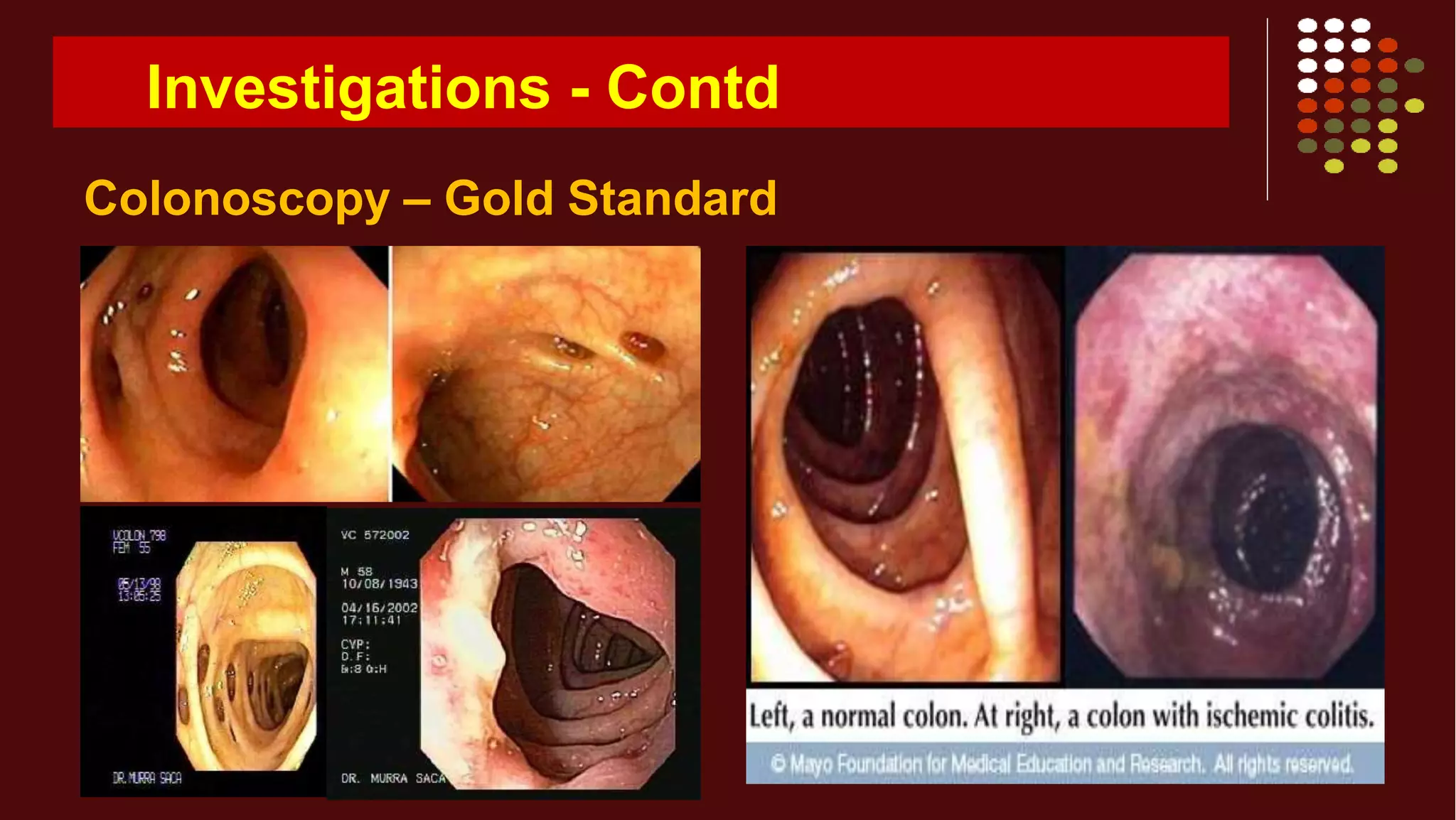
Colonoscopy – Gold Standard
Investigations - Contd
Colonoscopy – Gold Standard
Investigations - Contd
Colonoscopy – Gold Standard
Investigations - Contd
Colonoscopy – Gold Standard
Investigations - Contd
5. U/S abdomen –
6. Angiography –
Identifies bleeding rate of 0.5ml/mt
All 3 vessels – are used
Angiodysplasia / Tumours
/ Vasculitis – diagnosed
7. Radionuclear scanning –
Identifies 0.1ml / mt
Tc labelled sulphur colloid
/ tagged RBC scan
Investigations - Contd
Capsule Endoscopy CT / MRI - Angiography
TREATMENT
Treatment
Cause is treated
Proper exploration – lengthy midline incision – essential
Endoscopic polypectomy for polyps
Massive resection – small bowel – mesenteric ischemia
Surgical resection – colonic carcinoma
Sigmoid colectomy – sigmoid diverticula
Endoscopic fulguration / therapeutic embolization / Rt.hemicolectomy
for angiodysplasia
Drugs / Mesacol enema / Total proctocolectomy i IA anastomosis
for ulcerative colitis
Excision & ligation – piles
References
lower gi bleed.pptx

lower gi bleed.pptx

  • 1.
    Lower GI Bleed DrVijay Kumar ; Associate Prof.
  • 3.
    Definition ● Lower GI- bleeding is defined as abnormal hemorrhage into the lumen of the bowel from a source distal to the ligament of Treitz. ● Normal faecal blood loss – 1.2 ml / day ● Significant - > 10 ml / day
  • 5.
    Presentation ● Lower GIbleeding typically presents with 1. Hematochezia (which can range from bright-red blood to old clots) 2. Melena (If the bleeding is slower or from a more proximal source)
  • 8.
    Massive Bleeding ● Presentsas a large volume of bright red blood PR ● Bleeding > 1.5 l / day ● Hemodynamic instability & shock ● ↓ in hematocrit level of 6 g / dL ● Common causes – D / A ● Transfusion of at least 2 units of packed red blood cells ● Bleeding that continues for 3 days Moderate Bleeding ● Presents as haematochezia or malena ● Hemodynamically stable ● Causes – Ano-rectal / Cong./ Infla.& Neoplastic diseases ● Initial ↓ in hematocrit level of 8 g / dL or less
  • 9.
    Occult Blood ● Detectedby routine chemical tests of the stool, with or without systemic evidence of chronic blood loss. ● 10 ml. of blood loss / day is necessary to have stool occult blood positive.
  • 10.
  • 11.
    Aetiology – Generalcauses 1. Congenital - Polyp’s / Meckel’s diverticulum 2. Infammatory - Ulcerative colitis / Infective /Amoebic / Crohn’s disease 3. Neoplastic – Adenomas / Carcinomas / Polyps 4. Vascular – Angiodysplasia / Ischaemic colitis / Vasculitis / Hamangioma 5. Clotting disorders - Haemophilia / Leukaemia / Warfarin therapy / DIC 6. Miscellaneous – Piles / Anal fissure / Injury to rectum
  • 13.
    Site – Localcauses 1. Small Intestine - Polyp’s / Meckel’s diverticulum / Ulcers / Tumours / Intussusception 2. Large intestine - Angiodysplasia / Carcinomas / Colitis / Diverticulitis 3. Perianal – Injury / Rupture(Haematoma /Anorectal abscess) / Carcinoma / Condyloma 4. Anal - Piles / Anal fissure / Carcinoma / Fistula-in-ano
  • 14.
    With Pain ● Fissurein Ano ● Fistula in Ano ● Ca. Anal Canal ● Rup. perianal haematoma ● Rup. Ano Rectal abscess ● Endometriosis ● Injury
  • 15.
    Without Pain 1. BloodAlone a. Polyp b. Villous Adenoma c. Diverticular diseases 2. Blood After Defecation a. Hemorrhoids 3. Blood with mucus a. Ulcerative colitis b. Intussusception c. Ischaemic Colon 4. Blood Streaked on stool a. Ca. Rectum
  • 16.
    Common Causes Acute Sub-acute/ Chronic Diverticular disease Anal disease Mesenteric ischaemia Inflammatory bowel disease Angiodysplasia Large polyps Ischaemic colitis Carcinoma Meckel’s diverticulum Solitary rectal ulcer Intussusception Radiation enteritis
  • 17.
  • 21.
    Clinical Presentations Bleeding Perrectum – - - - - - - - Bright red blood Altered blood Maroon colour Streaks of blood Splash in pan Red currant jelly Blood with mucus Piles / Polyps / Fissure Ca / Ulcer / IBD / Dysentery Meckel’s diverticulum Anal fissure Piles Intussusception Colitis / Ca / Dysentery Note : Ask & Look for bleeding tendency
  • 25.
    Relation to Defecation ●Streak of fresh blood – FIA ● At the time of passing stool – Bright red & Splashes over the pan - Piles ● Other than during defecation - Polyps / Ca / UC ● Bleeding per anum in child – Polyp
  • 26.
    OTHERS ● Pain ● Alteredbowel habits ● Anaemia / Malnutrition / LOW / LOA ● Mass palpable PA – Rt /Lt / MOI ● Per-rectal exam – Very important
  • 27.
    Investigations 1. Blood Tests– a. Hb% / PCV / LFT b. Coag. Profile / RFT 2. Stool examination - a. Ova / cyst / worms b. Occult blood – FOBT
  • 28.
    Investigations - Contd SmallBowel Enema Barium Enema
  • 29.
  • 30.
  • 31.
  • 32.
  • 33.
  • 34.
    Investigations - Contd 5.U/S abdomen – 6. Angiography – Identifies bleeding rate of 0.5ml/mt All 3 vessels – are used Angiodysplasia / Tumours / Vasculitis – diagnosed 7. Radionuclear scanning – Identifies 0.1ml / mt Tc labelled sulphur colloid / tagged RBC scan
  • 35.
    Investigations - Contd CapsuleEndoscopy CT / MRI - Angiography
  • 36.
  • 37.
    Treatment Cause is treated Properexploration – lengthy midline incision – essential Endoscopic polypectomy for polyps Massive resection – small bowel – mesenteric ischemia Surgical resection – colonic carcinoma Sigmoid colectomy – sigmoid diverticula Endoscopic fulguration / therapeutic embolization / Rt.hemicolectomy for angiodysplasia Drugs / Mesacol enema / Total proctocolectomy i IA anastomosis for ulcerative colitis Excision & ligation – piles
  • 42.