Dr Vijay Kumar,
Asso. Prof.
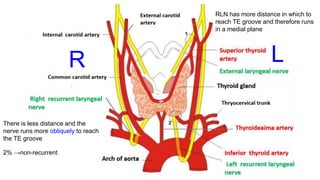
RLN has more distance in which to
reach TE groove and therefore runs
in a medial plane
There is less distance and the
nerve runs more obliquely to reach
the TE groove
2% →non-recurrent
R L
R
L
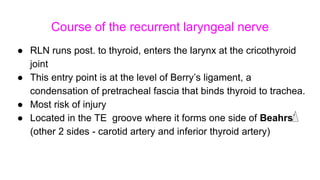
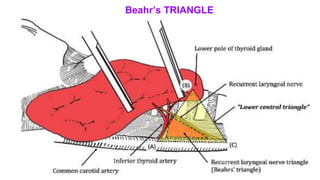
Course of the recurrent laryngeal nerve
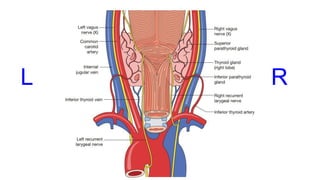
● RLN runs post. to thyroid, enters the larynx at the cricothyroid
joint
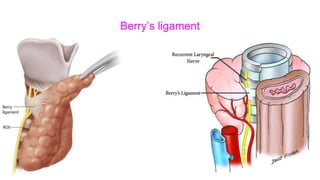
● This entry point is at the level of Berry’s ligament, a
condensation of pretracheal fascia that binds thyroid to trachea.
● Most risk of injury
● Located in the TE groove where it forms one side of Beahrs’
(other 2 sides - carotid artery and inferior thyroid artery)
Berry’s ligament
Beahr’s TRIANGLE
The pathway
T3 & T4 - bound to thyroglobulin within the colloid
Synthesis within the thyroglobulin complex-
● Trapping of iodide from blood;
● Oxidation of iodide to iodine;
● Binding of iodine with tyrosine to form iodotyrosine;
● Coupling of monoiodotyrosines and di-iodotyrosines to form T3 and
T4
When hormones are required, the complex → cell & thyroglobulin is
broken
T3 and T4 are liberated and enter the blood
The small amount of hormone that remains free in the serum is biologically
T3 / T4
● Effects of the thyroid hormones - d/t free T4 and T3 (0.03%
and 0.3%)
● T3 is the more important physiological hormone
● Periphery : T4 →T3
● T3 is quick acting (within a few hours), T4 acts more slowly
(4–14 days)
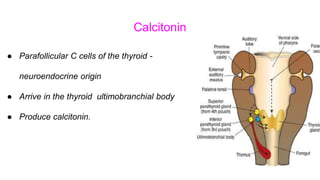
Calcitonin
● Parafollicular C cells of the thyroid -
neuroendocrine origin
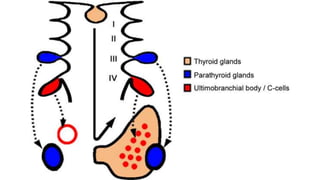
● Arrive in the thyroid ultimobranchial body
● Produce calcitonin.
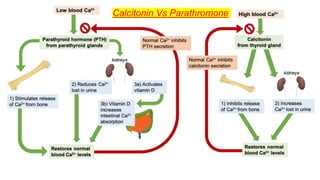
Calcitonin Vs Parathromone
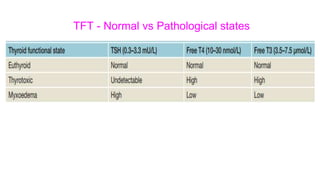
TFT - Normal vs Pathological states
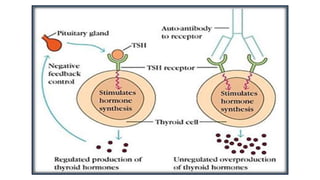
Thyroid-stimulating antibodies
● Bind with TSH receptor sites (TRAbs) and activate TSH
receptors on the follicular cell membrane
● Long action than TSH (16–24 versus 1.5–3 hours)
● Responsible for thyrotoxicosis in all cases of thyrotoxicosis not
due to autonomous toxic nodules
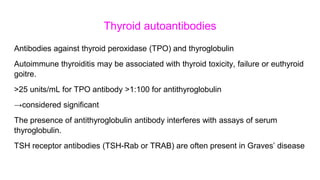
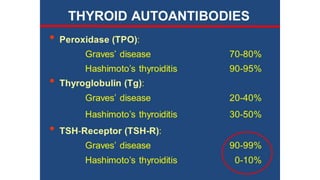
Thyroid autoantibodies
Antibodies against thyroid peroxidase (TPO) and thyroglobulin
Autoimmune thyroiditis may be associated with thyroid toxicity, failure or euthyroid
goitre.
>25 units/mL for TPO antibody >1:100 for antithyroglobulin
→considered significant
The presence of antithyroglobulin antibody interferes with assays of serum
thyroglobulin.
TSH receptor antibodies (TSH-Rab or TRAB) are often present in Graves’ disease
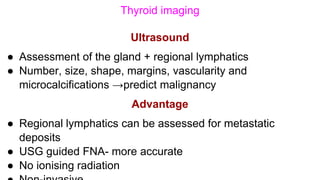
Thyroid imaging
Ultrasound
● Assessment of the gland + regional lymphatics
● Number, size, shape, margins, vascularity and
microcalcifications →predict malignancy
Advantage
● Regional lymphatics can be assessed for metastatic
deposits
● USG guided FNA- more accurate
● No ionising radiation
CT / MRI
● Retrosternal extension, requires CT Scan
● CECT can determine the extent of airway invasion
● MRI is superior at determining the presence of prevertebral
fascia invasion
Isotope scanning
Radiolabelled iodine (123I) / technetium (99mTc) will demonstrate activity in the
gland.
Routine isotope scanning is unnecessary ,majority (80%) of ‘cold’ swellings are
benign and some (5%) functioning or ‘warm’ swellings will be malignant.
Thyrotoxicosis + nodule or nodularity ?
Localisation of overactivity in the gland will differentiate between a toxic nodule
with and toxic MNG
Whole-body scanning →metastases(must have all normal thyroid ablated )
Metastatic thyroid cancer tissue cannot compete with normal thyroid tissue in the
uptake !
Fine-needle aspiration cytology
FNAC-investigation of choice
● Excellent patient compliance
● Simple and quick
● OPD procedure
● Readily repeated
Classification of FNAC reports
Thy1 Non-diagnostic
Thy1c Non-diagnostic cystic
Thy2 Non-neoplastic
Thy3 Follicular
Thy4 Suspicious of malignancy
Thy5 Malignant
THYROID ENLARGEMENT
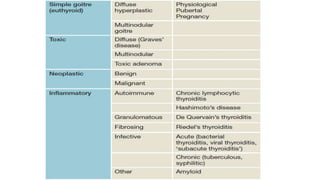
● GOITRE - generalised enlargement of the thyroid gland.
● SOLITARY swelling→Discrete swelling (nodule) in one lobe
with no palpable abnormality elsewhere isolated (or solitary)
● DOMINANT swelling→Discrete swellings with evidence of
abnormality elsewhere in the gland
Simple goitre
Aetiology
● Stimulation of the thyroid gland by TSH d/t T3 /T4
● The most important factor in endemic goitre - deficiency of iodine
● Defective hormone synthesis →sporadic goitres
● Other growth factors, including immunoglobulins, exert influence
IODINE DEFICIENCY
Daily requirement - 0.1–0.15mg
Endemic areas
● Mountain ranges → Rocky Mountains, Alps, Andes ,Himalayas
● UK- Derbyshire and Yorkshire.
Ca is also goitrogenic (goitre common in low-iodine areas on chalk
or limestone)
Failure of intestinal absorption
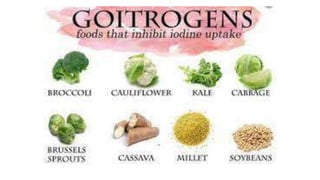
GOITROGENS
1. Vegetables of the brassica family e. Cabbage(contain
thiocyanate)
2. Drugs -para-aminosalicylic acid (PAS) and the antithyroid
drugs
3. Thiocyanates and perchlorates
4. Carbimazole and thiouracil compounds
Natural history - simple goitre
1. Growth stimulation → diffuse hyperplasia;(diffuse
hyperplastic goitre) reversible
2. F luctuating stimulation, a mixed pattern develops
3. Active lobules become more vascular →
haemorrhage occurs, causing central necrosis
and leaving only a surrounding ring of active
follicles
4. Necrotic lobules coalesce to form nodules
5. Continual repetition → nodular goitre
6. Nodules are inactive, and active follicles are
DIFFUSE HYPERPLASTIC GOITRE
● 1st stages
● The goitre appears in childhood in endemic areas
● Can occurs at puberty(metabolic demands)
● Goitre may regress
● Reappear at pregnancy
● Soft, diffuse
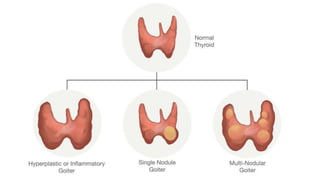
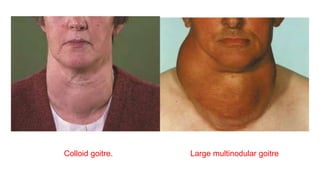
NODULAR GOITRE
● Nodules are multiple
● Occasionally, only one macroscopic nodule is found, but
microscopic changes will be present throughout the
gland(solitary)
● Appear early in endemic goitre and later in sporadic goitre,
● F>M (presence of oestrogen receptors in thyroid)
Colloid goitre. Large multinodular goitre
Diagnosis
● Straightforward
● Nodules are palpable
● They are smooth,firm painless and moves freely
● Hardness and irregularity, due to calcification,may simulate
carcinoma
Investigations
1. TFT
2. Thyroid antibodies (autoimmune thyroiditis)
3. Ultrasound - gold standard
4. FNAC → nodule of concern
5. USG guided Biopsy
6. CT scan
Complications
1. Tracheal obstruction
2. Secondary thyrotoxicosis - up to 30% of patients.
3. Carcinoma usually in endemic areas
4. Rapidly growing nodule is of concern and go for FNAC
Prevention and treatment of simple goitre
● Iodised salt
● Early stages,- thyroxine (diffuse hyperplastic)
● Nodular stage of simple goitre is irreversible,
● Most patients of MNG -asymptomatic (no surgery)
● Indication of Surgery→
○ Doubt of malignancy,pressure effects, cosmetic
Choice of surgical treatment in MNG
● Total thyroidectomy+lifelong replacement of thyroxine
● Subtotal thyroidectomy - involves partial resection leaving up to
8 g of relatively normal tissue B/L
● Hemithyroidectomy- total lobectomy on the more affected side
Adv. of total thyroidectomy
1. Reoperation for recurrent nodular goitre -hazardous - total
thyroidectomy in younger patients too
2. Additional advantage - therapeutic for incidental carcinoma
Clinically discrete swellings
● F>M
● 70% of discrete thyroid swellings isolated, 30% are dominant
● Clinically impalpable nodules - often detected on operation/ imaging
● Importance of discrete swelling= risk of neoplasia ( 15% →
malignant)
Investigation
● TFT -toxicity +nodularity = Isotope scanning
● AUTOANTIBODY TITRES- Chronic lymphocytic thyroiditis
● ISOTOPE SCAN- Toxicity associated with nodularity
● ULTRASONOGRAPHY-
○ Gold standard.Microcalcification and increased vascularity-
malignancy
○ Should be used as the primary investigation of any thyroid
nodule
● FNAC - papillary thyroid cancer (reliable), follicular (unreliable)
● Can’t distinguish between a follicular adenoma and carcinoma( capsular
+vascular invasion)
● RADIOLOGY- CT scanning - metastatic disease
● LARYNGOSCOPY - vocal cords
● CORE BIOPSY - rarely indicated d/t vascularity.
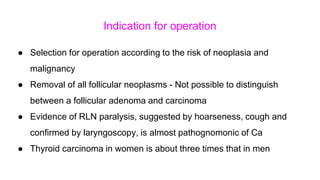
Indication for operation
● Selection for operation according to the risk of neoplasia and
malignancy
● Removal of all follicular neoplasms - Not possible to distinguish
between a follicular adenoma and carcinoma
● Evidence of RLN paralysis, suggested by hoarseness, cough and
confirmed by laryngoscopy, is almost pathognomonic of Ca
● Thyroid carcinoma in women is about three times that in men
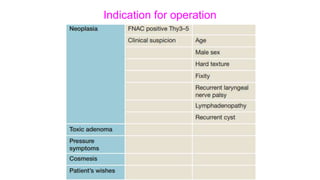
Indication for operation
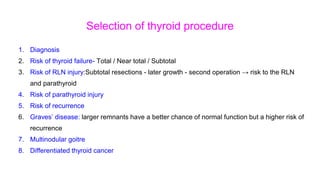
Selection of thyroid procedure
1. Diagnosis
2. Risk of thyroid failure- Total / Near total / Subtotal
3. Risk of RLN injury:Subtotal resections - later growth - second operation → risk to the RLN
and parathyroid
4. Risk of parathyroid injury
5. Risk of recurrence
6. Graves’ disease: larger remnants have a better chance of normal function but a higher risk of
recurrence
7. Multinodular goitre
8. Differentiated thyroid cancer
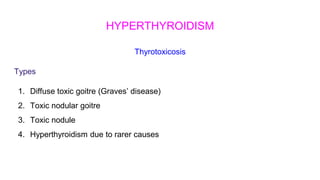
HYPERTHYROIDISM
Thyrotoxicosis
Types
1. Diffuse toxic goitre (Graves’ disease)
2. Toxic nodular goitre
3. Toxic nodule
4. Hyperthyroidism due to rarer causes
Diffuse toxic goitre(Graves’ disease)
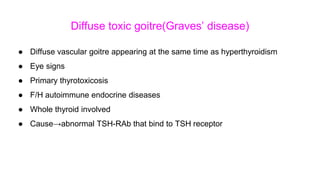
● Diffuse vascular goitre appearing at the same time as hyperthyroidism
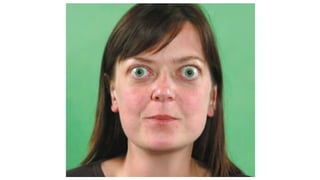
● Eye signs
● Primary thyrotoxicosis
● F/H autoimmune endocrine diseases
● Whole thyroid involved
● Cause→abnormal TSH-RAb that bind to TSH receptor
Toxic nodular goitre
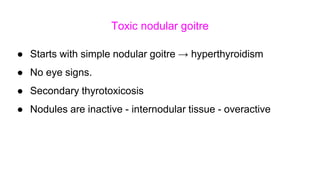
● Starts with simple nodular goitre → hyperthyroidism
● No eye signs.
● Secondary thyrotoxicosis
● Nodules are inactive - internodular tissue - overactive
Toxic nodule / toxic adenoma
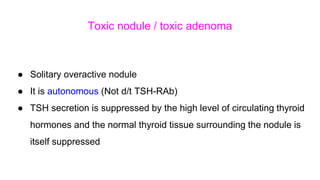
● Solitary overactive nodule
● It is autonomous (Not d/t TSH-RAb)
● TSH secretion is suppressed by the high level of circulating thyroid
hormones and the normal thyroid tissue surrounding the nodule is
itself suppressed
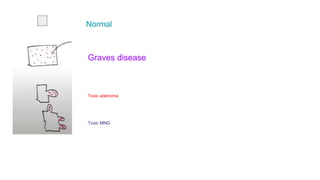
Graves disease
Toxic adenoma
Toxic MNG
Normal
Principles of treatment of thyrotoxicosis
Options :1.antithyroid drugs, 2. Surgery, 3. radioiodine
ANTITHYROID DRUGS
● Carbimazole, Propylthiouracil
● Cannot cure a toxic nodule (overactive thyroid tissue autonomous)
● Advantages: No surgery and no use of radioactive materials.
● Disadvantages: Tt prolonged, failure 50%
SURGERY
● In diffuse toxic goitre and toxic MNG -surgery cures by reducing the mass of
overactive tissue
● After subtotal thyroidectomy → euthyroid state
● Long-term risks of recurrence
● Total/ near total thyroidectomy - immediate thyroid failure and lifelong
thyroxine replacement
● Allows the suppressed normal tissue to function again
SURGERY
● Advantages
○ Goitre removed, cure rapid and high
● Disadvantages.
○ Recurrence (5%) when subtotal
○ Risk of permanent hypoparathyroidism and nerve injury
RADIOIODINE
● Destroys thyroid cells and reduces the mass of functioning thyroid
tissue to below a critical level.
● Advantages.
○ No surgery and no prolonged drug therapy.
● Disadvantages.
○ Isotope facilities must be available.
○ Must be quarantined while radiation levels are high and avoid pregnancy and
close physical contact
Choice of therapy
● DIFFUSE TOXIC GOITRE - antithyroid drugs with radioiodine for relapse
● TOXIC NODULAR GOITRE- should be treated surgically because it does not
respond as well or as rapidly to radioiodine or antithyroid drugs as does a
diffuse toxic goitre.
● TOXIC NODULE- Surgery or radioiodine treatment
● FAILURE OF ANTITHYROID DRUGS - surgery or radioiodine
thyroid.pptx

thyroid.pptx

  • 1.
  • 5.
    RLN has moredistance in which to reach TE groove and therefore runs in a medial plane There is less distance and the nerve runs more obliquely to reach the TE groove 2% →non-recurrent R L
  • 6.
  • 7.
    Course of therecurrent laryngeal nerve ● RLN runs post. to thyroid, enters the larynx at the cricothyroid joint ● This entry point is at the level of Berry’s ligament, a condensation of pretracheal fascia that binds thyroid to trachea. ● Most risk of injury ● Located in the TE groove where it forms one side of Beahrs’ (other 2 sides - carotid artery and inferior thyroid artery)
  • 8.
  • 9.
  • 10.
    The pathway T3 &T4 - bound to thyroglobulin within the colloid Synthesis within the thyroglobulin complex- ● Trapping of iodide from blood; ● Oxidation of iodide to iodine; ● Binding of iodine with tyrosine to form iodotyrosine; ● Coupling of monoiodotyrosines and di-iodotyrosines to form T3 and T4 When hormones are required, the complex → cell & thyroglobulin is broken T3 and T4 are liberated and enter the blood The small amount of hormone that remains free in the serum is biologically
  • 11.
    T3 / T4 ●Effects of the thyroid hormones - d/t free T4 and T3 (0.03% and 0.3%) ● T3 is the more important physiological hormone ● Periphery : T4 →T3 ● T3 is quick acting (within a few hours), T4 acts more slowly (4–14 days)
  • 12.
    Calcitonin ● Parafollicular Ccells of the thyroid - neuroendocrine origin ● Arrive in the thyroid ultimobranchial body ● Produce calcitonin.
  • 13.
  • 14.
    TFT - Normalvs Pathological states
  • 16.
    Thyroid-stimulating antibodies ● Bindwith TSH receptor sites (TRAbs) and activate TSH receptors on the follicular cell membrane ● Long action than TSH (16–24 versus 1.5–3 hours) ● Responsible for thyrotoxicosis in all cases of thyrotoxicosis not due to autonomous toxic nodules
  • 18.
    Thyroid autoantibodies Antibodies againstthyroid peroxidase (TPO) and thyroglobulin Autoimmune thyroiditis may be associated with thyroid toxicity, failure or euthyroid goitre. >25 units/mL for TPO antibody >1:100 for antithyroglobulin →considered significant The presence of antithyroglobulin antibody interferes with assays of serum thyroglobulin. TSH receptor antibodies (TSH-Rab or TRAB) are often present in Graves’ disease
  • 20.
    Thyroid imaging Ultrasound ● Assessmentof the gland + regional lymphatics ● Number, size, shape, margins, vascularity and microcalcifications →predict malignancy Advantage ● Regional lymphatics can be assessed for metastatic deposits ● USG guided FNA- more accurate ● No ionising radiation
  • 21.
    CT / MRI ●Retrosternal extension, requires CT Scan ● CECT can determine the extent of airway invasion ● MRI is superior at determining the presence of prevertebral fascia invasion
  • 22.
    Isotope scanning Radiolabelled iodine(123I) / technetium (99mTc) will demonstrate activity in the gland. Routine isotope scanning is unnecessary ,majority (80%) of ‘cold’ swellings are benign and some (5%) functioning or ‘warm’ swellings will be malignant. Thyrotoxicosis + nodule or nodularity ? Localisation of overactivity in the gland will differentiate between a toxic nodule with and toxic MNG Whole-body scanning →metastases(must have all normal thyroid ablated ) Metastatic thyroid cancer tissue cannot compete with normal thyroid tissue in the uptake !
  • 23.
    Fine-needle aspiration cytology FNAC-investigationof choice ● Excellent patient compliance ● Simple and quick ● OPD procedure ● Readily repeated Classification of FNAC reports Thy1 Non-diagnostic Thy1c Non-diagnostic cystic Thy2 Non-neoplastic Thy3 Follicular Thy4 Suspicious of malignancy Thy5 Malignant
  • 24.
    THYROID ENLARGEMENT ● GOITRE- generalised enlargement of the thyroid gland. ● SOLITARY swelling→Discrete swelling (nodule) in one lobe with no palpable abnormality elsewhere isolated (or solitary) ● DOMINANT swelling→Discrete swellings with evidence of abnormality elsewhere in the gland
  • 26.
    Simple goitre Aetiology ● Stimulationof the thyroid gland by TSH d/t T3 /T4 ● The most important factor in endemic goitre - deficiency of iodine ● Defective hormone synthesis →sporadic goitres ● Other growth factors, including immunoglobulins, exert influence
  • 27.
    IODINE DEFICIENCY Daily requirement- 0.1–0.15mg Endemic areas ● Mountain ranges → Rocky Mountains, Alps, Andes ,Himalayas ● UK- Derbyshire and Yorkshire. Ca is also goitrogenic (goitre common in low-iodine areas on chalk or limestone) Failure of intestinal absorption
  • 28.
    GOITROGENS 1. Vegetables ofthe brassica family e. Cabbage(contain thiocyanate) 2. Drugs -para-aminosalicylic acid (PAS) and the antithyroid drugs 3. Thiocyanates and perchlorates 4. Carbimazole and thiouracil compounds
  • 30.
    Natural history -simple goitre 1. Growth stimulation → diffuse hyperplasia;(diffuse hyperplastic goitre) reversible 2. F luctuating stimulation, a mixed pattern develops 3. Active lobules become more vascular → haemorrhage occurs, causing central necrosis and leaving only a surrounding ring of active follicles 4. Necrotic lobules coalesce to form nodules 5. Continual repetition → nodular goitre 6. Nodules are inactive, and active follicles are
  • 31.
    DIFFUSE HYPERPLASTIC GOITRE ●1st stages ● The goitre appears in childhood in endemic areas ● Can occurs at puberty(metabolic demands) ● Goitre may regress ● Reappear at pregnancy ● Soft, diffuse
  • 33.
    NODULAR GOITRE ● Nodulesare multiple ● Occasionally, only one macroscopic nodule is found, but microscopic changes will be present throughout the gland(solitary) ● Appear early in endemic goitre and later in sporadic goitre, ● F>M (presence of oestrogen receptors in thyroid)
  • 34.
    Colloid goitre. Largemultinodular goitre
  • 35.
    Diagnosis ● Straightforward ● Nodulesare palpable ● They are smooth,firm painless and moves freely ● Hardness and irregularity, due to calcification,may simulate carcinoma
  • 36.
    Investigations 1. TFT 2. Thyroidantibodies (autoimmune thyroiditis) 3. Ultrasound - gold standard 4. FNAC → nodule of concern 5. USG guided Biopsy 6. CT scan
  • 37.
    Complications 1. Tracheal obstruction 2.Secondary thyrotoxicosis - up to 30% of patients. 3. Carcinoma usually in endemic areas 4. Rapidly growing nodule is of concern and go for FNAC
  • 38.
    Prevention and treatmentof simple goitre ● Iodised salt ● Early stages,- thyroxine (diffuse hyperplastic) ● Nodular stage of simple goitre is irreversible, ● Most patients of MNG -asymptomatic (no surgery) ● Indication of Surgery→ ○ Doubt of malignancy,pressure effects, cosmetic
  • 39.
    Choice of surgicaltreatment in MNG ● Total thyroidectomy+lifelong replacement of thyroxine ● Subtotal thyroidectomy - involves partial resection leaving up to 8 g of relatively normal tissue B/L ● Hemithyroidectomy- total lobectomy on the more affected side Adv. of total thyroidectomy 1. Reoperation for recurrent nodular goitre -hazardous - total thyroidectomy in younger patients too 2. Additional advantage - therapeutic for incidental carcinoma
  • 40.
    Clinically discrete swellings ●F>M ● 70% of discrete thyroid swellings isolated, 30% are dominant ● Clinically impalpable nodules - often detected on operation/ imaging ● Importance of discrete swelling= risk of neoplasia ( 15% → malignant)
  • 41.
    Investigation ● TFT -toxicity+nodularity = Isotope scanning ● AUTOANTIBODY TITRES- Chronic lymphocytic thyroiditis ● ISOTOPE SCAN- Toxicity associated with nodularity ● ULTRASONOGRAPHY- ○ Gold standard.Microcalcification and increased vascularity- malignancy ○ Should be used as the primary investigation of any thyroid nodule
  • 42.
    ● FNAC -papillary thyroid cancer (reliable), follicular (unreliable) ● Can’t distinguish between a follicular adenoma and carcinoma( capsular +vascular invasion) ● RADIOLOGY- CT scanning - metastatic disease ● LARYNGOSCOPY - vocal cords ● CORE BIOPSY - rarely indicated d/t vascularity.
  • 43.
    Indication for operation ●Selection for operation according to the risk of neoplasia and malignancy ● Removal of all follicular neoplasms - Not possible to distinguish between a follicular adenoma and carcinoma ● Evidence of RLN paralysis, suggested by hoarseness, cough and confirmed by laryngoscopy, is almost pathognomonic of Ca ● Thyroid carcinoma in women is about three times that in men
  • 44.
  • 45.
    Selection of thyroidprocedure 1. Diagnosis 2. Risk of thyroid failure- Total / Near total / Subtotal 3. Risk of RLN injury:Subtotal resections - later growth - second operation → risk to the RLN and parathyroid 4. Risk of parathyroid injury 5. Risk of recurrence 6. Graves’ disease: larger remnants have a better chance of normal function but a higher risk of recurrence 7. Multinodular goitre 8. Differentiated thyroid cancer
  • 46.
    HYPERTHYROIDISM Thyrotoxicosis Types 1. Diffuse toxicgoitre (Graves’ disease) 2. Toxic nodular goitre 3. Toxic nodule 4. Hyperthyroidism due to rarer causes
  • 47.
    Diffuse toxic goitre(Graves’disease) ● Diffuse vascular goitre appearing at the same time as hyperthyroidism ● Eye signs ● Primary thyrotoxicosis ● F/H autoimmune endocrine diseases ● Whole thyroid involved ● Cause→abnormal TSH-RAb that bind to TSH receptor
  • 49.
    Toxic nodular goitre ●Starts with simple nodular goitre → hyperthyroidism ● No eye signs. ● Secondary thyrotoxicosis ● Nodules are inactive - internodular tissue - overactive
  • 50.
    Toxic nodule /toxic adenoma ● Solitary overactive nodule ● It is autonomous (Not d/t TSH-RAb) ● TSH secretion is suppressed by the high level of circulating thyroid hormones and the normal thyroid tissue surrounding the nodule is itself suppressed
  • 51.
  • 52.
    Principles of treatmentof thyrotoxicosis Options :1.antithyroid drugs, 2. Surgery, 3. radioiodine ANTITHYROID DRUGS ● Carbimazole, Propylthiouracil ● Cannot cure a toxic nodule (overactive thyroid tissue autonomous) ● Advantages: No surgery and no use of radioactive materials. ● Disadvantages: Tt prolonged, failure 50%
  • 53.
    SURGERY ● In diffusetoxic goitre and toxic MNG -surgery cures by reducing the mass of overactive tissue ● After subtotal thyroidectomy → euthyroid state ● Long-term risks of recurrence ● Total/ near total thyroidectomy - immediate thyroid failure and lifelong thyroxine replacement ● Allows the suppressed normal tissue to function again
  • 54.
    SURGERY ● Advantages ○ Goitreremoved, cure rapid and high ● Disadvantages. ○ Recurrence (5%) when subtotal ○ Risk of permanent hypoparathyroidism and nerve injury
  • 55.
    RADIOIODINE ● Destroys thyroidcells and reduces the mass of functioning thyroid tissue to below a critical level. ● Advantages. ○ No surgery and no prolonged drug therapy. ● Disadvantages. ○ Isotope facilities must be available. ○ Must be quarantined while radiation levels are high and avoid pregnancy and close physical contact
  • 56.
    Choice of therapy ●DIFFUSE TOXIC GOITRE - antithyroid drugs with radioiodine for relapse ● TOXIC NODULAR GOITRE- should be treated surgically because it does not respond as well or as rapidly to radioiodine or antithyroid drugs as does a diffuse toxic goitre. ● TOXIC NODULE- Surgery or radioiodine treatment ● FAILURE OF ANTITHYROID DRUGS - surgery or radioiodine