Low Vision aids
Vision Rehabilitation
• Are services provided to both who are
partially sighted and those who are blind.
These services include mobility training,
adaptive skills training, low vision instruction
career servicesand training, psychological
counseling and others.
• What Are Low Vision Aids?
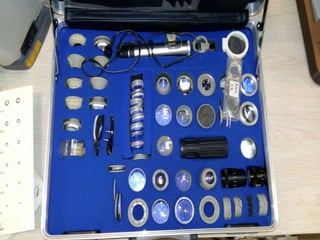
• Low vision aids are devices which help people
use their sight to better advantage. These aids
may be optical lenses, such as magnifiers or
telescopes, or non optical devices, such as
visors, filters, reading slits, stands, lamps and
large print.
• How do Low Vision Aids Work?
• Low vision aids may make things larger: they
may make things brighter, they may make
things clearer, and they may improve contrast.
Some may do more than one thing, but
generally, all low vision aids make it easier to
see something by magnifying it to the level
one can see.
Optical devices are of two kinds:
• Near
• Distance
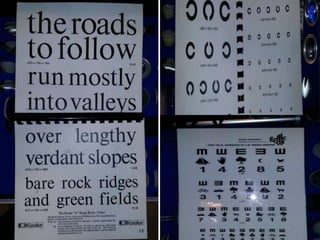
Near devices are designed for magnifying close
objects and print.
Distance devices are for magnifying things in
the distance (from about 3 meters to far
away).
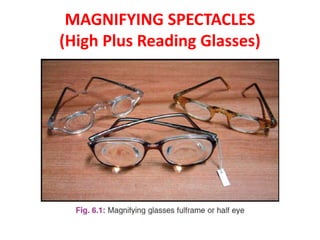
MAGNIFYING SPECTACLES
(High Plus Reading Glasses)
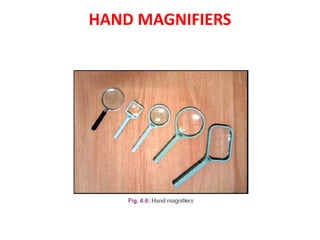
HAND MAGNIFIERS
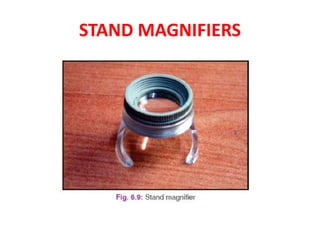
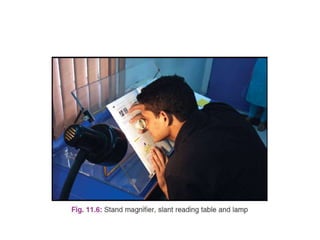
STAND MAGNIFIERS
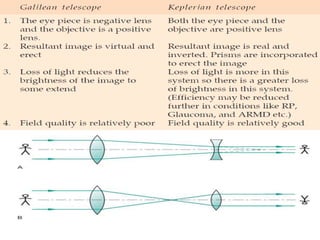
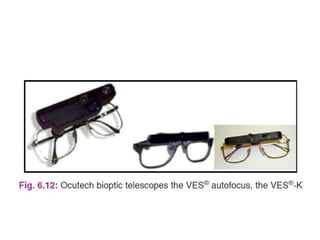
TELESCOPES
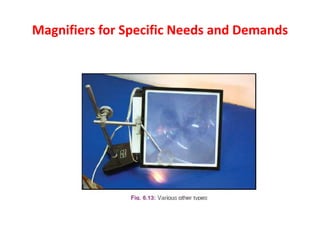
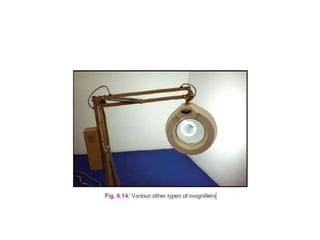
Magnifiers for Specific Needs and Demands
Nonoptical Devices
• Nonoptical Devices can be Grouped According
to Their Function
1. Enhances the images and reduces glare
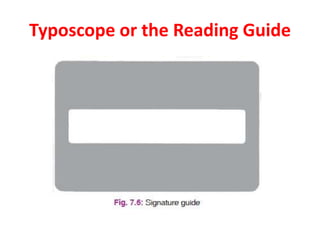
• Typoscope
2. Enhances contrast
• Good lighting on object or print
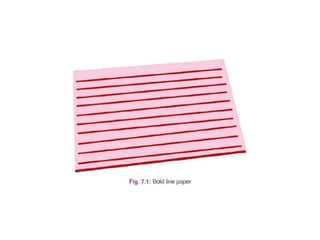
• Bold lined paper
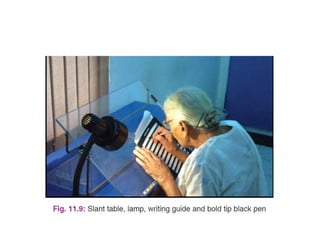
• Writing guide
Illumination
• Need for higher levels of illumination are seen in
patients
who have:
• a. Lost cone functions, like in macular degeneration or
ARMD
• b. Damaged nerve fibers layers like in glaucoma
• c. Diabetic retinopathy
• d. Patients on miotics
• e. Degenerative myopia
• f. Chorioretinitis
• g. Retinitis pigmentosa.
Eye diseases which requir reduce illumination:
• a. Albinism
• b. Aniridia
• c. Corneal opacity
• d Achromatopsia
Letter Writer/ Writing Guide
Typoscope or the Reading Guide
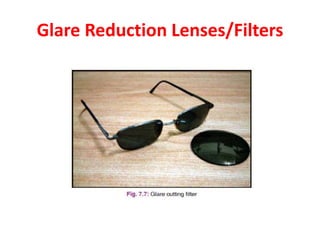
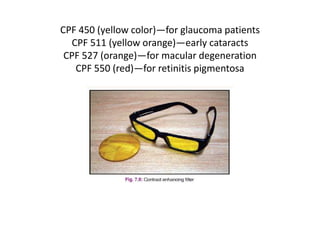
Glare Reduction Lenses/Filters
CPF 450 (yellow color)—for glaucoma patients
CPF 511 (yellow orange)—early cataracts
CPF 527 (orange)—for macular degeneration
CPF 550 (red)—for retinitis pigmentosa
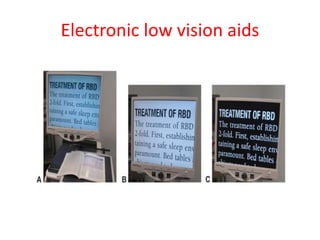
Electronic low vision aids
Thank you

low vision aids

  • 1.
  • 2.
    Vision Rehabilitation • Areservices provided to both who are partially sighted and those who are blind. These services include mobility training, adaptive skills training, low vision instruction career servicesand training, psychological counseling and others.
  • 3.
    • What AreLow Vision Aids? • Low vision aids are devices which help people use their sight to better advantage. These aids may be optical lenses, such as magnifiers or telescopes, or non optical devices, such as visors, filters, reading slits, stands, lamps and large print.
  • 4.
    • How doLow Vision Aids Work? • Low vision aids may make things larger: they may make things brighter, they may make things clearer, and they may improve contrast. Some may do more than one thing, but generally, all low vision aids make it easier to see something by magnifying it to the level one can see.
  • 5.
    Optical devices areof two kinds: • Near • Distance Near devices are designed for magnifying close objects and print. Distance devices are for magnifying things in the distance (from about 3 meters to far away).
  • 6.
  • 7.
  • 8.
  • 10.
  • 16.
    Magnifiers for SpecificNeeds and Demands
  • 18.
    Nonoptical Devices • NonopticalDevices can be Grouped According to Their Function 1. Enhances the images and reduces glare • Typoscope 2. Enhances contrast • Good lighting on object or print • Bold lined paper • Writing guide
  • 20.
    Illumination • Need forhigher levels of illumination are seen in patients who have: • a. Lost cone functions, like in macular degeneration or ARMD • b. Damaged nerve fibers layers like in glaucoma • c. Diabetic retinopathy • d. Patients on miotics • e. Degenerative myopia • f. Chorioretinitis • g. Retinitis pigmentosa.
  • 21.
    Eye diseases whichrequir reduce illumination: • a. Albinism • b. Aniridia • c. Corneal opacity • d Achromatopsia
  • 22.
  • 24.
    Typoscope or theReading Guide
  • 25.
  • 26.
    CPF 450 (yellowcolor)—for glaucoma patients CPF 511 (yellow orange)—early cataracts CPF 527 (orange)—for macular degeneration CPF 550 (red)—for retinitis pigmentosa
  • 27.
  • 29.