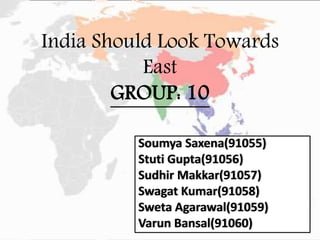
India Should Look Towards
East
GROUP: 10
Soumya Saxena(91055)
Stuti Gupta(91056)
Sudhir Makkar(91057)
Swagat Kumar(91058)
Sweta Agarawal(91059)
Varun Bansal(91060)
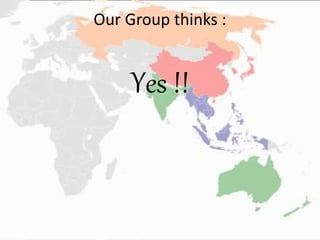
Our Group thinks :
Yes !!
Outline of the Presentation
Introduction
Review of literature
Evolution of Look east Policy
Factors driving LEP
Improving relations
Comparison between India and China
Different Trade Associations
Impact of LEP
Group’s views and issues to be resolved
Introduction
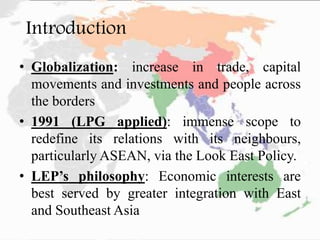
• Globalization: increase in trade, capital
movements and investments and people across
the borders
• 1991 (LPG applied): immense scope to
redefine its relations with its neighbours,
particularly ASEAN, via the Look East Policy.
• LEP’s philosophy: Economic interests are
best served by greater integration with East
and Southeast Asia
As Prime Minister Manmohan Singh said-
“ The Look East policy is not merely an external economic
policy. It is also a strategic shift in India’s vision of the world
and India’s place in the evolving global economy .”
Review of the Literature
Research Paper
“ India Looks East- Strategies And Impacts”
By: Dong Zhang, Asia Economic Section, Australian
Treasury, AusAID Public Affairs Group
 Four broad Objectives of LEP
 Impacts of LEP
 Obstacles to India
• REFORM AND LIBERALISATION:
• SUSTAINED RAPID GROWTH:
• REGIONAL ECONOMIC INTEGRATION:.
• EQUITY-BASED DEVELOPMENT:
Landlocked to land-linked, providing India with land routes to
Burma, Thailand and other peninsular South-East Asian countries.
Objectives of LEP
Impacts of India looking east
NEW SOURCES OF GROWTH : India’s trade with East Asia is now
25 per cent
IMPACTS ON ECONOMIC REFORM AND LIBERALISATION :
As India’s Prime Minister recalled in 2006:
When we first set the target of bringing India’s tariffs down to
‘ASEAN levels’, it was not just an exercise in tariff liberalisation
but an attempt to benchmark our economic performance against
some of the best performers in our neighbourhood.
(M Singh, ‘PM’s speech at the Asian corporate conference “Driving Global
Business: India’s New Priorities, Asia’s New Realities”’, Mumbai, 18 March
2006
http://pmindia.nic.in/speeches.htm)
IMPACTS ON INDIA’S SUBREGIONAL DEVELOPMENT STRATEGIES
INDIA’S IMPACT ON THE FORMATION OF AN ASIAN ECONOMIC
COMMUNITY
EAST ASIA EMBRACING INDIA :
country’s emerging status as an economic Superpower
huge consumer market
India opened up more import channels to ASEAN member
countries during the crisis
Some ASEAN member countries have adopted a policy of ‘Look
West’ to match India’s LEP.
ASEAN and India have many areas of common interest,
including information and communication technologies, public
health, medicine, trade, investment and agriculture.
OBSTACLES TO INDIA
Different economic structures and degrees of openness
ASEAN economies  more open Relying heavily on imports of raw
materials
Indian economy  Relying more on domestic inputs.
Image problem
 ASEAN countries believe India has
Indian traders are perceived to be ticklish to deal with and its trade
negotiators too tough.
Images are not necessarily accurate, but they affect decision-
making
For instance, Thailand thinks it is difficult to project its long-term
economic relations with India, while India feels ASEAN is a lot closer to
China than to India in terms of cultural affinity, managerial style and
business operation.
The areas of co-operation between India and these
countries include science and technology,
biotechnology, financial services, information
technology, human resources, education, transport and
tourism.
Likelihood of India’s economic interaction with China,
Japan and Korea which eventually would make it
possible to forge an Asian Economic Community on the
lines of European Union.
Research Paper:
“India and Globalization: Policy of look East and Beyond”
By : Sailaja Gullapalli, Indira Gandhi National Open University
Research paper
“ The Evolution of India–ASEAN Relations ”
By - TAN TAI YONG and SEE CHAK MUN
During the Cold War
 Political distance that India consciously kept from
the newly formed ASEAN
 Bilateral relations with individual countries rather
than with the association as a whole.
Now
 India’s trade : Risen from US$8 billion in 1990 to
US$67.6 billion in 2005( 30 percent of India’s total
external trade)
Singapore and Malaysia : Two major contributors
to bilateral trade between India and ASEAN.
 In contrast to China’s strategy of developing its
backward regions through greater economic ties
with ASEAN, India’s policy of strengthening its ties
with eastern neighbours has been limited to
counter insurgency efforts.
Research Paper
“ LOOK EAST, LOOK SOUTH: Backward Border Regions in India
and China ”
By : Sushil Khanna, IIM- Calcutta
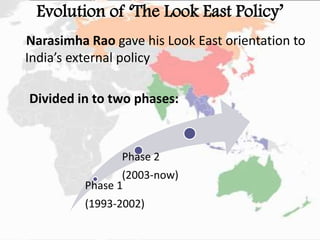
Evolution of ‘The Look East Policy’
Narasimha Rao gave his Look East orientation to
India’s external policy
Divided in to two phases:
Phase 1
(1993-2002)
Phase 2
(2003-now)
First phase:
Focus on ASEAN (trade and investment linkages)
• From a sectoral dialogue partner in March 1993 to a
Summit Level Partnership in 2002.
Second phase: (From 2003)
Extending from Australia to East Asia, with ASEAN as
its core.
• “Long Term Cooperative Partnership for Peace and
Prosperity” with ASEAN
• Wider economic and security cooperation, political
partnerships, physical connectivity through road and
rail links
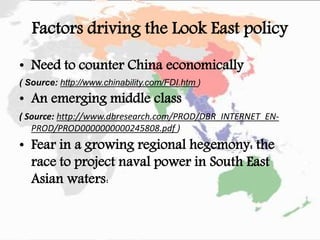
Factors driving the Look East policy
• Need to counter China economically
( Source: http://www.chinability.com/FDI.htm )
• An emerging middle class
( Source: http://www.dbresearch.com/PROD/DBR_INTERNET_EN-
PROD/PROD0000000000245808.pdf )
• Fear in a growing regional hegemony: the
race to project naval power in South East
Asian waters:
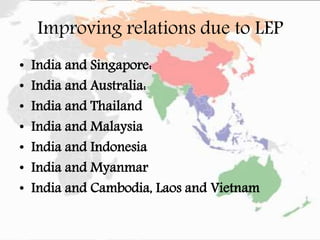
Improving relations due to LEP
• India and Singapore:
• India and Australia:
• India and Thailand
• India and Malaysia
• India and Indonesia
• India and Myanmar
• India and Cambodia, Laos and Vietnam
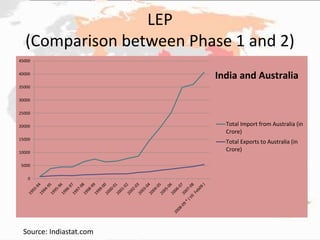
LEP
(Comparison between Phase 1 and 2)
0
5000
10000
15000
20000
25000
30000
35000
40000
45000
Total Import from Australia (in
Crore)
Total Exports to Australia (in
Crore)
India and Australia
Source: Indiastat.com
0
5000
10000
15000
20000
25000
30000
35000
40000
45000
Total Import from
Japan
Total Export to Japan (
in Crore)
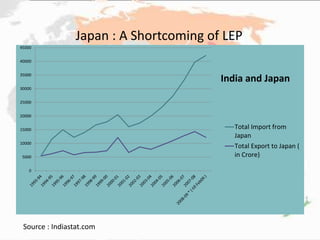
India and Japan
Source : Indiastat.com
Japan : A Shortcoming of LEP
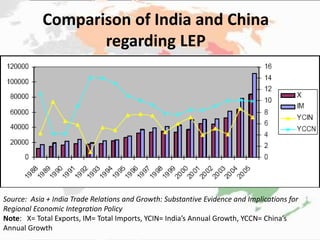
Comparison of India and China
regarding LEP
Source: Asia + India Trade Relations and Growth: Substantive Evidence and Implications for
Regional Economic Integration Policy
Note: X= Total Exports, IM= Total Imports, YCIN= India’s Annual Growth, YCCN= China’s
Annual Growth
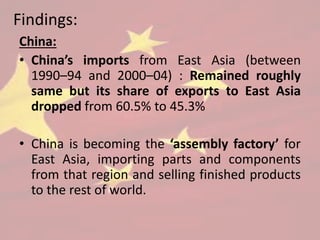
Findings:
China:
• China’s imports from East Asia (between
1990–94 and 2000–04) : Remained roughly
same but its share of exports to East Asia
dropped from 60.5% to 45.3%
• China is becoming the ‘assembly factory’ for
East Asia, importing parts and components
from that region and selling finished products
to the rest of world.
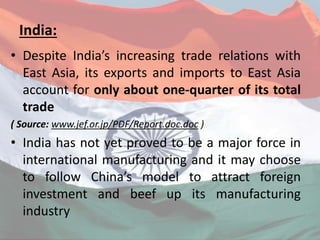
India:
• Despite India’s increasing trade relations with
East Asia, its exports and imports to East Asia
account for only about one-quarter of its total
trade
( Source: www.jef.or.jp/PDF/Report.doc.doc )
• India has not yet proved to be a major force in
international manufacturing and it may choose
to follow China’s model to attract foreign
investment and beef up its manufacturing
industry
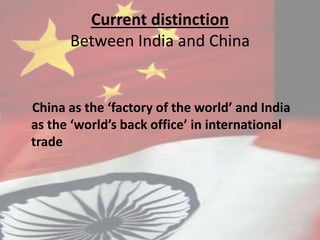
Current distinction
Between India and China
China as the ‘factory of the world’ and India
as the ‘world’s back office’ in international
trade
Different Associations
India and ASEAN
• Evolved relationship over the years
• The ASEAN–India Free Trade Area (AIFTA) is a free trade
area among the ten member states of the ASEAN and
India. The initial framework agreement was signed on 8
October 2003 in Bali, Indonesia.
• The free trade area came into effect on 1 January 2010
• Intra-ASEAN trade has increased from US$ 180.99 billion to
US$543.37 billion in 2008—an average annual increase of
18.6 per cent.
( Source: http://www.eastasiaforum.org/2009/10/02/india-
asean-fta/ )
• The India—ASEAN agreement may also strengthen the
Indian economy by reflecting positively on its trade in
goods. India—ASEAN trade was worth US$40 billion
during 2007-08, about a quarter that of Japan, China or the
EU’s trade volume with ASEAN.
( Source: http://www.eastasiaforum.org/2009/10/02/india-
asean-fta/ )
=> Scope of improvement.
India and APEC
• The region is likely to provide the main growth
springs in the global economy with over 40% of
global trade and more than half of world
production
• Unfortunately, India has been denied an entry
into APEC ever since the latter’s creation. India
has requested membership in APEC, and received
initial support from the United States, Japan and
Australia.
• Reason for Denying
ASEAN Economic Community (AEC)
• ASEAN has emphasised regional cooperation
in the “three pillars” of security, socio-cultural
and economic integration, aiming to create an
ASEAN Economic Community (AEC) by 2015.
( Source: http://www.asil.org/aseanevent/Sim_Intro_to_ASEAN.pdf)
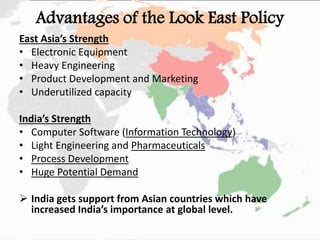
Advantages of the Look East Policy
East Asia’s Strength
• Electronic Equipment
• Heavy Engineering
• Product Development and Marketing
• Underutilized capacity
India’s Strength
• Computer Software (Information Technology)
• Light Engineering and Pharmaceuticals
• Process Development
• Huge Potential Demand
 India gets support from Asian countries which have
increased India’s importance at global level.
Shortcomings in the Policy
• Failure to involve Japan and build economic
relationship with it resulted in closing the
doors on Japanese foreign direct
investment.
• India received just 2 per cent of Japanese
FDI (China's share was 10 times higher at 22
per cent)
Reasons for poor Implementation of FTA
• The Indian industry doubts about its competitive
efficiency and it does not want competition at
home.
• Cheap exports and costlier imports prevent Indian
industries from these countries.
Current Scenario:
India has entered into a number of pacts,
agreements and FTAs but its record for
implementation of such accords has been poor as
can be seen from the follow up of the Indo-Thai FTA
and CECA with Singapore.
Problems and Issues to be resolved for
better trade
• Limited economic integration with East Asia
• Restrictive policies towards FDI
Such investment to India tends to concentrated in the service and IT
sectors, which are often less capital intensive than the manufacturing
sector.
• Different economic structures and degrees of openness
ASEAN economies  more open Relying heavily on imports of raw
materials
Indian economy  Relying more on domestic inputs.
Mounting pressure from India’s business sector for protection has also
tied the hands of Indian trade negotiators
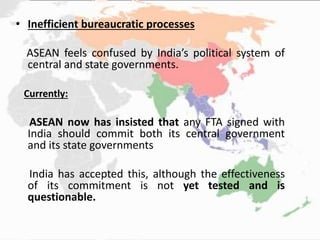
• Inefficient bureaucratic processes
ASEAN feels confused by India’s political system of
central and state governments.
Currently:
ASEAN now has insisted that any FTA signed with
India should commit both its central government
and its state governments
India has accepted this, although the effectiveness
of its commitment is not yet tested and is
questionable.
Group’s views
India has made itself a ‘member’ of the emerging Asian
economic community but yet to become a significant market for
most East Asian economies.
Need of the Hour
• Strong links with East Asia through a web of engagements at
bilateral and regional levels.
• Proper implementation of FTA
• Strong political will power and better cooperation between
central and state governments.
• Further trial to become a member of APEC
• Strengthening relationship with East- Asia neighbors ( China,
Bhutan etc.)
Strong links with East Asia through a web of
engagements at bilateral and regional levels.
Source
o The bilateral trade between India and the ten-
member ASEAN now stands at US$ 48 billion
annually.
o Indo-ASEAN trade, which has been growing at
a compounded annual growth rate (CAGR) of
27 per cent since 2000, stood at US$ 38.37
billion in 2007-08
o Need for further improvement.
http://www.ibef.org/india/indiaasean.aspx
Proper implementation of FTA
Source:
• India has Free Trade Agreement (FTA) with Thailand, Sri
Lanka, South Korea
• Cooperation Agreement (CECA) with Singapore and Japan
• India is a signatory to the Bangkok Agreement
• Negotiations for a possible FTA with China and Australia are
also on the cards.
Recent:
The India-ASEAN Free Trade Agreement was finally signed, on
13 August 2009 at Bangkok, after six years of negotiations :
First multilateral agreement entered into by India.
http://www.cacci.org.tw/Journal/2008%20Vol%201/Modi-Speech.pdf
Strong political will power and better cooperation between
central and state governments.
The case of POSCO : South Korean Steel giant
Source:
 After several rounds of discussions between POSCO and the Orissa
Government, the MoU was finally signed, clearing the way for the largest
foreign investment ever in India.
 As per the MoU, Government of Orissa was supposed to recommend to
the Central Government and facilitate granting of SEZ status as required
by the company.
 When POSCO requested grant of SEZ status, state government found it
difficult to keep this promise, as the Centre did not seem to be too lenient
with POSCO on SEZ.
http://www.icmrindia.org/CaseStudies/catalogue/Business%20Strategy3/BSTA130.htm
Further trial to become a member of APEC
Source:
• Western countries are behind moves to keep India
out of an Asia-Pacific grouping because they are
concerned that its entry would tip the balance of
power towards Asia.
Source:
• India should put forth two points while demanding
APEC membership:
a) Strong demographic complementarities
b) Ever growing strong economic linkages
http://afp.google.com/article/ALeqM5hZoirSNiHlYD3ZRa5JhKVsPbnKrA
India’s Membership: APEC’s Relevance by Mukul G. Asher and Rahul Sen
Strengthening relationship with East- Asia
neighbors ( For ex. China )
2009 EXPORTS IMPORTS BALANCE
TRADE 128977.7 176537.0 -47539.4
US Trade with Mexico (NAFTA)
NOTE: All figures are in millions of U.S. dollars
Source: http://www.census.gov/foreign-trade/balance/c2010.html#2009
India trade with China
While international trade has been growing at around 15%
on an average, India-China trade has increased by more than
50% annually in the last five years. In 2008, China became
India's largest trading partner and the bilateral trade
between the two countries touched US$ 51.8 billion ( US $
51800 million)
Source: http://www.indiachina.org/trade_statistics.htm
Thank You !!!!

Look East Policy India

  • 1.
    India Should LookTowards East GROUP: 10 Soumya Saxena(91055) Stuti Gupta(91056) Sudhir Makkar(91057) Swagat Kumar(91058) Sweta Agarawal(91059) Varun Bansal(91060)
  • 2.
  • 3.
    Outline of thePresentation Introduction Review of literature Evolution of Look east Policy Factors driving LEP Improving relations Comparison between India and China Different Trade Associations Impact of LEP Group’s views and issues to be resolved
  • 4.
    Introduction • Globalization: increasein trade, capital movements and investments and people across the borders • 1991 (LPG applied): immense scope to redefine its relations with its neighbours, particularly ASEAN, via the Look East Policy. • LEP’s philosophy: Economic interests are best served by greater integration with East and Southeast Asia
  • 5.
    As Prime MinisterManmohan Singh said- “ The Look East policy is not merely an external economic policy. It is also a strategic shift in India’s vision of the world and India’s place in the evolving global economy .”
  • 6.
    Review of theLiterature Research Paper “ India Looks East- Strategies And Impacts” By: Dong Zhang, Asia Economic Section, Australian Treasury, AusAID Public Affairs Group  Four broad Objectives of LEP  Impacts of LEP  Obstacles to India
  • 7.
    • REFORM ANDLIBERALISATION: • SUSTAINED RAPID GROWTH: • REGIONAL ECONOMIC INTEGRATION:. • EQUITY-BASED DEVELOPMENT: Landlocked to land-linked, providing India with land routes to Burma, Thailand and other peninsular South-East Asian countries. Objectives of LEP
  • 8.
    Impacts of Indialooking east NEW SOURCES OF GROWTH : India’s trade with East Asia is now 25 per cent IMPACTS ON ECONOMIC REFORM AND LIBERALISATION : As India’s Prime Minister recalled in 2006: When we first set the target of bringing India’s tariffs down to ‘ASEAN levels’, it was not just an exercise in tariff liberalisation but an attempt to benchmark our economic performance against some of the best performers in our neighbourhood. (M Singh, ‘PM’s speech at the Asian corporate conference “Driving Global Business: India’s New Priorities, Asia’s New Realities”’, Mumbai, 18 March 2006 http://pmindia.nic.in/speeches.htm)
  • 9.
    IMPACTS ON INDIA’SSUBREGIONAL DEVELOPMENT STRATEGIES INDIA’S IMPACT ON THE FORMATION OF AN ASIAN ECONOMIC COMMUNITY EAST ASIA EMBRACING INDIA : country’s emerging status as an economic Superpower huge consumer market India opened up more import channels to ASEAN member countries during the crisis Some ASEAN member countries have adopted a policy of ‘Look West’ to match India’s LEP. ASEAN and India have many areas of common interest, including information and communication technologies, public health, medicine, trade, investment and agriculture.
  • 10.
    OBSTACLES TO INDIA Differenteconomic structures and degrees of openness ASEAN economies  more open Relying heavily on imports of raw materials Indian economy  Relying more on domestic inputs. Image problem  ASEAN countries believe India has Indian traders are perceived to be ticklish to deal with and its trade negotiators too tough. Images are not necessarily accurate, but they affect decision- making For instance, Thailand thinks it is difficult to project its long-term economic relations with India, while India feels ASEAN is a lot closer to China than to India in terms of cultural affinity, managerial style and business operation.
  • 11.
    The areas ofco-operation between India and these countries include science and technology, biotechnology, financial services, information technology, human resources, education, transport and tourism. Likelihood of India’s economic interaction with China, Japan and Korea which eventually would make it possible to forge an Asian Economic Community on the lines of European Union. Research Paper: “India and Globalization: Policy of look East and Beyond” By : Sailaja Gullapalli, Indira Gandhi National Open University
  • 12.
    Research paper “ TheEvolution of India–ASEAN Relations ” By - TAN TAI YONG and SEE CHAK MUN During the Cold War  Political distance that India consciously kept from the newly formed ASEAN  Bilateral relations with individual countries rather than with the association as a whole. Now  India’s trade : Risen from US$8 billion in 1990 to US$67.6 billion in 2005( 30 percent of India’s total external trade) Singapore and Malaysia : Two major contributors to bilateral trade between India and ASEAN.
  • 13.
     In contrastto China’s strategy of developing its backward regions through greater economic ties with ASEAN, India’s policy of strengthening its ties with eastern neighbours has been limited to counter insurgency efforts. Research Paper “ LOOK EAST, LOOK SOUTH: Backward Border Regions in India and China ” By : Sushil Khanna, IIM- Calcutta
  • 14.
    Evolution of ‘TheLook East Policy’ Narasimha Rao gave his Look East orientation to India’s external policy Divided in to two phases: Phase 1 (1993-2002) Phase 2 (2003-now)
  • 15.
    First phase: Focus onASEAN (trade and investment linkages) • From a sectoral dialogue partner in March 1993 to a Summit Level Partnership in 2002. Second phase: (From 2003) Extending from Australia to East Asia, with ASEAN as its core. • “Long Term Cooperative Partnership for Peace and Prosperity” with ASEAN • Wider economic and security cooperation, political partnerships, physical connectivity through road and rail links
  • 16.
    Factors driving theLook East policy • Need to counter China economically ( Source: http://www.chinability.com/FDI.htm ) • An emerging middle class ( Source: http://www.dbresearch.com/PROD/DBR_INTERNET_EN- PROD/PROD0000000000245808.pdf ) • Fear in a growing regional hegemony: the race to project naval power in South East Asian waters:
  • 17.
    Improving relations dueto LEP • India and Singapore: • India and Australia: • India and Thailand • India and Malaysia • India and Indonesia • India and Myanmar • India and Cambodia, Laos and Vietnam
  • 18.
    LEP (Comparison between Phase1 and 2) 0 5000 10000 15000 20000 25000 30000 35000 40000 45000 Total Import from Australia (in Crore) Total Exports to Australia (in Crore) India and Australia Source: Indiastat.com
  • 19.
    0 5000 10000 15000 20000 25000 30000 35000 40000 45000 Total Import from Japan TotalExport to Japan ( in Crore) India and Japan Source : Indiastat.com Japan : A Shortcoming of LEP
  • 20.
    Comparison of Indiaand China regarding LEP Source: Asia + India Trade Relations and Growth: Substantive Evidence and Implications for Regional Economic Integration Policy Note: X= Total Exports, IM= Total Imports, YCIN= India’s Annual Growth, YCCN= China’s Annual Growth
  • 21.
    Findings: China: • China’s importsfrom East Asia (between 1990–94 and 2000–04) : Remained roughly same but its share of exports to East Asia dropped from 60.5% to 45.3% • China is becoming the ‘assembly factory’ for East Asia, importing parts and components from that region and selling finished products to the rest of world.
  • 22.
    India: • Despite India’sincreasing trade relations with East Asia, its exports and imports to East Asia account for only about one-quarter of its total trade ( Source: www.jef.or.jp/PDF/Report.doc.doc ) • India has not yet proved to be a major force in international manufacturing and it may choose to follow China’s model to attract foreign investment and beef up its manufacturing industry
  • 23.
    Current distinction Between Indiaand China China as the ‘factory of the world’ and India as the ‘world’s back office’ in international trade
  • 24.
    Different Associations India andASEAN • Evolved relationship over the years • The ASEAN–India Free Trade Area (AIFTA) is a free trade area among the ten member states of the ASEAN and India. The initial framework agreement was signed on 8 October 2003 in Bali, Indonesia. • The free trade area came into effect on 1 January 2010
  • 25.
    • Intra-ASEAN tradehas increased from US$ 180.99 billion to US$543.37 billion in 2008—an average annual increase of 18.6 per cent. ( Source: http://www.eastasiaforum.org/2009/10/02/india- asean-fta/ ) • The India—ASEAN agreement may also strengthen the Indian economy by reflecting positively on its trade in goods. India—ASEAN trade was worth US$40 billion during 2007-08, about a quarter that of Japan, China or the EU’s trade volume with ASEAN. ( Source: http://www.eastasiaforum.org/2009/10/02/india- asean-fta/ ) => Scope of improvement.
  • 26.
    India and APEC •The region is likely to provide the main growth springs in the global economy with over 40% of global trade and more than half of world production • Unfortunately, India has been denied an entry into APEC ever since the latter’s creation. India has requested membership in APEC, and received initial support from the United States, Japan and Australia. • Reason for Denying
  • 27.
    ASEAN Economic Community(AEC) • ASEAN has emphasised regional cooperation in the “three pillars” of security, socio-cultural and economic integration, aiming to create an ASEAN Economic Community (AEC) by 2015. ( Source: http://www.asil.org/aseanevent/Sim_Intro_to_ASEAN.pdf)
  • 28.
    Advantages of theLook East Policy East Asia’s Strength • Electronic Equipment • Heavy Engineering • Product Development and Marketing • Underutilized capacity India’s Strength • Computer Software (Information Technology) • Light Engineering and Pharmaceuticals • Process Development • Huge Potential Demand  India gets support from Asian countries which have increased India’s importance at global level.
  • 29.
    Shortcomings in thePolicy • Failure to involve Japan and build economic relationship with it resulted in closing the doors on Japanese foreign direct investment. • India received just 2 per cent of Japanese FDI (China's share was 10 times higher at 22 per cent)
  • 30.
    Reasons for poorImplementation of FTA • The Indian industry doubts about its competitive efficiency and it does not want competition at home. • Cheap exports and costlier imports prevent Indian industries from these countries. Current Scenario: India has entered into a number of pacts, agreements and FTAs but its record for implementation of such accords has been poor as can be seen from the follow up of the Indo-Thai FTA and CECA with Singapore.
  • 31.
    Problems and Issuesto be resolved for better trade • Limited economic integration with East Asia • Restrictive policies towards FDI Such investment to India tends to concentrated in the service and IT sectors, which are often less capital intensive than the manufacturing sector. • Different economic structures and degrees of openness ASEAN economies  more open Relying heavily on imports of raw materials Indian economy  Relying more on domestic inputs. Mounting pressure from India’s business sector for protection has also tied the hands of Indian trade negotiators
  • 32.
    • Inefficient bureaucraticprocesses ASEAN feels confused by India’s political system of central and state governments. Currently: ASEAN now has insisted that any FTA signed with India should commit both its central government and its state governments India has accepted this, although the effectiveness of its commitment is not yet tested and is questionable.
  • 33.
    Group’s views India hasmade itself a ‘member’ of the emerging Asian economic community but yet to become a significant market for most East Asian economies. Need of the Hour • Strong links with East Asia through a web of engagements at bilateral and regional levels. • Proper implementation of FTA • Strong political will power and better cooperation between central and state governments. • Further trial to become a member of APEC • Strengthening relationship with East- Asia neighbors ( China, Bhutan etc.)
  • 34.
    Strong links withEast Asia through a web of engagements at bilateral and regional levels. Source o The bilateral trade between India and the ten- member ASEAN now stands at US$ 48 billion annually. o Indo-ASEAN trade, which has been growing at a compounded annual growth rate (CAGR) of 27 per cent since 2000, stood at US$ 38.37 billion in 2007-08 o Need for further improvement. http://www.ibef.org/india/indiaasean.aspx
  • 35.
    Proper implementation ofFTA Source: • India has Free Trade Agreement (FTA) with Thailand, Sri Lanka, South Korea • Cooperation Agreement (CECA) with Singapore and Japan • India is a signatory to the Bangkok Agreement • Negotiations for a possible FTA with China and Australia are also on the cards. Recent: The India-ASEAN Free Trade Agreement was finally signed, on 13 August 2009 at Bangkok, after six years of negotiations : First multilateral agreement entered into by India. http://www.cacci.org.tw/Journal/2008%20Vol%201/Modi-Speech.pdf
  • 36.
    Strong political willpower and better cooperation between central and state governments. The case of POSCO : South Korean Steel giant Source:  After several rounds of discussions between POSCO and the Orissa Government, the MoU was finally signed, clearing the way for the largest foreign investment ever in India.  As per the MoU, Government of Orissa was supposed to recommend to the Central Government and facilitate granting of SEZ status as required by the company.  When POSCO requested grant of SEZ status, state government found it difficult to keep this promise, as the Centre did not seem to be too lenient with POSCO on SEZ. http://www.icmrindia.org/CaseStudies/catalogue/Business%20Strategy3/BSTA130.htm
  • 37.
    Further trial tobecome a member of APEC Source: • Western countries are behind moves to keep India out of an Asia-Pacific grouping because they are concerned that its entry would tip the balance of power towards Asia. Source: • India should put forth two points while demanding APEC membership: a) Strong demographic complementarities b) Ever growing strong economic linkages http://afp.google.com/article/ALeqM5hZoirSNiHlYD3ZRa5JhKVsPbnKrA India’s Membership: APEC’s Relevance by Mukul G. Asher and Rahul Sen
  • 38.
    Strengthening relationship withEast- Asia neighbors ( For ex. China ) 2009 EXPORTS IMPORTS BALANCE TRADE 128977.7 176537.0 -47539.4 US Trade with Mexico (NAFTA) NOTE: All figures are in millions of U.S. dollars Source: http://www.census.gov/foreign-trade/balance/c2010.html#2009 India trade with China While international trade has been growing at around 15% on an average, India-China trade has increased by more than 50% annually in the last five years. In 2008, China became India's largest trading partner and the bilateral trade between the two countries touched US$ 51.8 billion ( US $ 51800 million) Source: http://www.indiachina.org/trade_statistics.htm
  • 39.

Editor's Notes

  • #17 FDI inflows china >> India
  • #25 Dr Surin Pitsuwan
  • #36 India-ASEAN FTA : The agreement was only for trade-in-goods and did not include software and information technology.  Negotiations for agreements on services and investment sectors have commenced only in October 2008 and are expected to be completed by December 2009.  The FTA will be effective from January 1, 2010.  The FTA would eliminate tariffs for about 4000 products (which include electronics, chemicals, machinery and textiles) out of which duties for 3200 products will be reduced by December 2013, while duties on the remaining 800 products will be brought down to zero or near zero levels by December 2016. 
  • #38  Strong demographic complementarities Population in high-income affluent APEC member’s viz. Japan, USA, South Korea, Taiwan, Australia and others is expected to decline in absolute terms by the end of this decade and median age of its population will continue to increase due to individual ageing. India in contrast is entering a demographic gift phase resulting in rising proportion of population in the working age group. It is expected to have nearly 50 million internationally competitive persons that could potentially assist APEC members experiencing rapid individual and population ageing. Ever growing strong economic linkages Many of the outbound deals have been with the APEC members. Examples of deals in 2007 include Tata Power’s stake in two Indonesian coal groups for US $ 1.1 billion; and ESSAR group’s purchase of Canada’s Algoma Steel for US $ 1.6 billion and of Minnesota Steel of the USA for an undisclosed amount.
  • #39 India should consider the example of strong trade reln b/w US and Mexico.