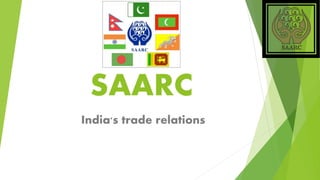
SAARC
India's trade relations
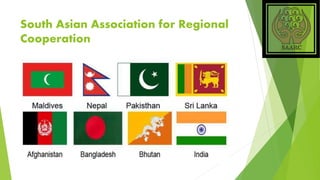
South Asian Association for Regional
Cooperation
INTRODUCTION
 The South Asian Association for Regional Cooperation (SAARC) is an economic
and geopolitical organization of eight countries that are primarily located in
South Asia.
 The SAARC’s Headquarter is in Kathmandu, Nepal.
 The SAARC policies aim to promote welfare economics, collective self-reliance
among the countries of South Asia, and to accelerate socio-cultural
development in the region.
 The 11 stated areas of cooperation are agriculture; education, culture and
sports; health, population and child welfare, the environment and meteorology
; rural development; tourism; transport; science and technology;
communications.
OBJECTIVES OF SAARC
 To promote the welfare of the people.
 To accelerate economic growth, social progress and cultural development.
 To Contribute to mutual trust, understand and appreciation of one
another's problem.
 To promote active collaboration and mutual assistance.
 To strengthen cooperation with other developing countries.
 To cooperate with international and regional organisations with similar
aims and purpose.
 The 18th SAARC summit is not yet happened it is going to
be held in Nov 2014 in Kathmandu.
The SAARC Secretariat is supported by following Regional Centres
established in Member States to promote regional cooperation. These
Centres are managed by Governing Boards comprising representatives
from all the Member States, SAARC Secretary-General and the Ministry of
Foreign/External Affairs of the Host Government. The Director of the
Centre acts as Member Secretary to the Governing Board which reports to
the Programming Committee.
 SAARC Agricultural Centre (SAC), Dhaka
 SAARC Meteorological Research Centre (SMRC), Dhaka
 SAARC Tuberculosis Centre (STC), Kathmandu
 SAARC Documentation Centre (SDC), New Delhi
 SAARC Human Resources Development Centre (SHRDC), Islamabad
 SAARC Coastal Zone Management Centre (SCZMC), Maldives
 SAARC Information Centre (SIC), Nepal
 SAARC Energy Centre (SEC), Pakistan
 SAARC Disaster Management Centre (SDMC), India
 SAARC Forestry Centre (SFC), Bhutan
 SAARC Cultural Centre (SCC), Sri Lanka
Regional Centers
Observer & Potential Future
 Observers
 States with observer status
include Australia, China,
the European Union, Iran, Japan,
Mauritius, Myanmar, South
Korea and the United States.
 On 2 August 2006 the foreign
ministers of the SAARC countries
agreed in principle to grant
observer status to three applicants;
the US and South Korea (both
made requests in April 2006), as well
as the European Union (requested
in July 2006). On 4 March
2008, Iran requested observer status,
followed shortly by Mauritius.
 Potential future members
 Myanmar has expressed interest in
upgrading its status from an
observer to a full member of
SAARC. Russia has applied for
observer status membership of
SAARC.
 Turkey applied for observer status
membership of SAARC in 2012.South
Africa has participated in meetings.
Organisational structure
for SAARC
 The SAARC comprises following layers of organizational structure:
1.Council
 At the top, there is the Council represented by the heads of the
government of the member countries. The council the apex policy making
body. It meets once in 2 years time.
2. Council of Minister
 It is to assist the council. It is represented by the foreign minister of the
member countries.
 Its functions include:
 Formulation of policies
 Review of functioning
 Deciding new areas of cooperation
 Decide about general issues of common of interest of the SAARC member.
Organisational structure
for SAARC
3. Standing Committee
 It is comprised by the foreign secretariat of the member government. Its major
functions are:
 To monitor and co-ordinate the programs
 To determine inter-sectored priorities.
 To mobilize cooperation within and outside the region
 To deal with the modalities of financing.
4. Programming Committee:
 It consist of the senior official of the member governments.
 Its functions include:
 Scrutinizing the budget of the secretarial.
 Finalizing the annual schedule.
 External activities assigned by the standing committee.
 Analyses the respects of the technical committee.
Organisational structure
for SAARC
5. Technical Committee:
 It consist of the represented of the member nations.
 Its function are:
 To formulate project and programmer
 To monitor and execute the projects
 To submit reports.
 The Technical Committee convers the areas such as: Agriculture,
Communication, Environment, Rural Development, Health and Population,
Science and Technology, Tourism and Transport.
Organisational structure
for SAARC
6. Secretarial:
 The SAARC secretarial is located in Nepal.
 Its function include:
 Coordination, execution and monitoring of SAARC activities
 Servicing the SAARC meetings
 Work as communication link between the SAARC and other international
forum.
 The secretariats is headed by the secretary-General appointed by the
Council of Ministers. These are 8 Director (One from each member nation)
and the general service staff.
SAARC Preferential trade arrangement
(SAPTA)
 In December 1991, the Sixth Summit held in Colombo approved the
establishment of an Inter-Governmental Group (IGG) to formulate an
agreement to establish a SAARC Preferential Trading Arrangement
(SAPTA) by 1997. Given the consensus within SAARC, the Agreement on
SAPTA was signed on 11 April 1993 and entered into force on 7 December
1995 well in advance of the date stipulated by the Colombo Summit. The
Agreement reflected the desire of the Member States to promote and
sustain mutual trade and economic cooperation within the SAARC region
through the exchange of concessions.
The basic principles underlying SAPTA
are:
 Overall reciprocity and mutuality of advantages so as to benefit equitably all
Contracting States, taking into account their respective level of economic and
industrial development, the pattern of their external trade, and trade and tariff
policies and systems;
 Negotiation of tariff reform step by step, improved and extended in successive
stages through periodic reviews;
 Recognition of the special needs of the Least Developed Contracting States and
agreement on concrete preferential measures in their favour;
 Inclusion of all products, manufactures and commodities in their raw, semi-
processed and processed forms.
 Four rounds of trade negotiations have been concluded under SAPTA covering
over 5000 commodities. Each Round contributed to an incremental trend in the
product coverage and the deepening of tariff concessions over previous
Rounds.
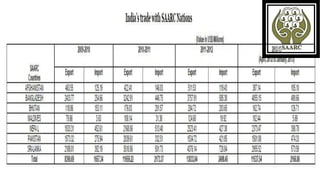
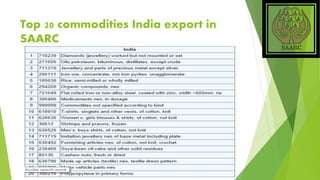
Top 20 commodities India export in
SAARC
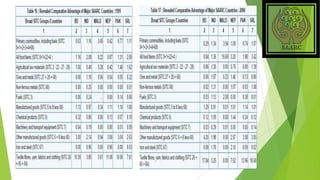
Is SAPTA helpful for trading in SAARC?
Is SAPTA ineffective ?
 With comparing other trade block regions SAARC is least successful region.
 Even after implementing so many policy under SAPTA trading is not that
easy within region.
 Major reason for this failure is political conflicts between India &
Pakistan.(only 600 commodities exchanged)
 Sea Boarder issues of India- Pakistan & India – Maldives.
 Dominance of India In SAARC as being physically connected to all member
countries (except Afghanistan ) .
 In addition the member countries do not have significant potentialities for
trade. (similar natural recourses , least develop countries , low service
trade , etc)
SAARC FDI
& INDIA
Intra-Regional FDI
 Bangladeshi and Maldivian ventures in India are in trade and distribution
sectors.
 The Sri Lankan firms are in a wide range of activities, with textile and
garments dominating the product mix. During the past decade a number
of clothing producers in Sri Lanka, including the two largest producers in
the country, MAS Holdings and Brandix , have set up production bases in
India.
 India was by far the largest regional investor in Bangladesh accounting
for 14% of total number of firms, 4.5% of total cumulative planned
investment and 17.8% of total employment.
Intra-Regional FDI
 The industry profile of Indian investment in Sri Lanka is highly diversified,
encompassing steel, cement, rubber products, tourism, computer software,
IT-training and other professional services, and hotels and tourist resorts.
 According to the data on cumulative foreign investment in Nepal as at 2011,
intra-South Asian invests account for 26% of total foreign-invested firm, 41%
of employment in these firms and 48% total cumulative investment. India is
by far the largest source country, followed by Bangladesh, Pakistan and
Sri Lanka, and Bhutan in that order.
 In Bhutan India is believed to be the largest investor, with investment
predominantly in hydropower.
 In Maldives, Indian firms seem to have a significant involvement in tourist
resorts and hotels, and tourism-related services
Future Investments in SAARC Countries
by INDIA
 India can also make significant investments in the automobile and
automobile components sector in Sri Lanka and Pakistan and hydropower
in Nepal. (hydro-electric power potential of Nepal is about 45,610 MW, but
a mere 1.37% of this is currently exploited.)
 With India’s considerable advances in software development, its
companies can be encouraged to invest in information technology (IT)-
related industries in Bangladesh, Nepal, and Sri Lanka.
Country and Regional Policy
Recommendations
1. Reduction of tariffs and NTBs;
2. Improvement of trade facilitation with the simplification and
transparency of trade regulations and procedures;
3. Curtailment of long negative lists and the removal of important trading
items in those lists;
4. Improvement and expansion of transportation and telecommunications;
energy generation, transmission, and distribution; and other
infrastructure to support industry and commerce; and
5. Removal of restraints and sector caps on investments among SAARC
countries and simplification of investment regulations.
SAARC Current Affairs
 India’s investment in SAARC countries :
 Ceat tiers opening manufacturing plant in Sri-Lanka
 Colgate-Palmolive Indian Ltd, has made a joint venture in Nepal to capture
North India market.
 72 Indian companies has made joint venture in Nepal
 Shinepukur ceramics a joint venture between Abheesht Exports of New
Delhi and Beximo of Bangladesh.
 The National Research Development Corporation of India has transferred
technologies developed in national laboratories for high draught kiln,
spice-oleoresin, anti-fungal tablets, and bleaching powder to Nepal and
for buff colour green pepper to Sri Lanka.
Limitation
 Low level of Intra-SAARC Trade
 Absence of treaties for avoiding double taxation
 Indian Income Tax Provisions
 Lack of Credibility in Regional Capabilities
 Underdeveloped Infrastructure, Skilled Manpower, and Entrepreneurship
 India – Pakistan relation.
Conclusion

SAARC

  • 1.
  • 2.
    South Asian Associationfor Regional Cooperation
  • 3.
    INTRODUCTION  The SouthAsian Association for Regional Cooperation (SAARC) is an economic and geopolitical organization of eight countries that are primarily located in South Asia.  The SAARC’s Headquarter is in Kathmandu, Nepal.  The SAARC policies aim to promote welfare economics, collective self-reliance among the countries of South Asia, and to accelerate socio-cultural development in the region.  The 11 stated areas of cooperation are agriculture; education, culture and sports; health, population and child welfare, the environment and meteorology ; rural development; tourism; transport; science and technology; communications.
  • 4.
    OBJECTIVES OF SAARC To promote the welfare of the people.  To accelerate economic growth, social progress and cultural development.  To Contribute to mutual trust, understand and appreciation of one another's problem.  To promote active collaboration and mutual assistance.  To strengthen cooperation with other developing countries.  To cooperate with international and regional organisations with similar aims and purpose.
  • 5.
     The 18thSAARC summit is not yet happened it is going to be held in Nov 2014 in Kathmandu.
  • 6.
    The SAARC Secretariatis supported by following Regional Centres established in Member States to promote regional cooperation. These Centres are managed by Governing Boards comprising representatives from all the Member States, SAARC Secretary-General and the Ministry of Foreign/External Affairs of the Host Government. The Director of the Centre acts as Member Secretary to the Governing Board which reports to the Programming Committee.  SAARC Agricultural Centre (SAC), Dhaka  SAARC Meteorological Research Centre (SMRC), Dhaka  SAARC Tuberculosis Centre (STC), Kathmandu  SAARC Documentation Centre (SDC), New Delhi  SAARC Human Resources Development Centre (SHRDC), Islamabad  SAARC Coastal Zone Management Centre (SCZMC), Maldives  SAARC Information Centre (SIC), Nepal  SAARC Energy Centre (SEC), Pakistan  SAARC Disaster Management Centre (SDMC), India  SAARC Forestry Centre (SFC), Bhutan  SAARC Cultural Centre (SCC), Sri Lanka Regional Centers
  • 7.
    Observer & PotentialFuture  Observers  States with observer status include Australia, China, the European Union, Iran, Japan, Mauritius, Myanmar, South Korea and the United States.  On 2 August 2006 the foreign ministers of the SAARC countries agreed in principle to grant observer status to three applicants; the US and South Korea (both made requests in April 2006), as well as the European Union (requested in July 2006). On 4 March 2008, Iran requested observer status, followed shortly by Mauritius.  Potential future members  Myanmar has expressed interest in upgrading its status from an observer to a full member of SAARC. Russia has applied for observer status membership of SAARC.  Turkey applied for observer status membership of SAARC in 2012.South Africa has participated in meetings.
  • 8.
    Organisational structure for SAARC The SAARC comprises following layers of organizational structure: 1.Council  At the top, there is the Council represented by the heads of the government of the member countries. The council the apex policy making body. It meets once in 2 years time. 2. Council of Minister  It is to assist the council. It is represented by the foreign minister of the member countries.  Its functions include:  Formulation of policies  Review of functioning  Deciding new areas of cooperation  Decide about general issues of common of interest of the SAARC member.
  • 9.
    Organisational structure for SAARC 3.Standing Committee  It is comprised by the foreign secretariat of the member government. Its major functions are:  To monitor and co-ordinate the programs  To determine inter-sectored priorities.  To mobilize cooperation within and outside the region  To deal with the modalities of financing. 4. Programming Committee:  It consist of the senior official of the member governments.  Its functions include:  Scrutinizing the budget of the secretarial.  Finalizing the annual schedule.  External activities assigned by the standing committee.  Analyses the respects of the technical committee.
  • 10.
    Organisational structure for SAARC 5.Technical Committee:  It consist of the represented of the member nations.  Its function are:  To formulate project and programmer  To monitor and execute the projects  To submit reports.  The Technical Committee convers the areas such as: Agriculture, Communication, Environment, Rural Development, Health and Population, Science and Technology, Tourism and Transport.
  • 11.
    Organisational structure for SAARC 6.Secretarial:  The SAARC secretarial is located in Nepal.  Its function include:  Coordination, execution and monitoring of SAARC activities  Servicing the SAARC meetings  Work as communication link between the SAARC and other international forum.  The secretariats is headed by the secretary-General appointed by the Council of Ministers. These are 8 Director (One from each member nation) and the general service staff.
  • 12.
    SAARC Preferential tradearrangement (SAPTA)  In December 1991, the Sixth Summit held in Colombo approved the establishment of an Inter-Governmental Group (IGG) to formulate an agreement to establish a SAARC Preferential Trading Arrangement (SAPTA) by 1997. Given the consensus within SAARC, the Agreement on SAPTA was signed on 11 April 1993 and entered into force on 7 December 1995 well in advance of the date stipulated by the Colombo Summit. The Agreement reflected the desire of the Member States to promote and sustain mutual trade and economic cooperation within the SAARC region through the exchange of concessions.
  • 13.
    The basic principlesunderlying SAPTA are:  Overall reciprocity and mutuality of advantages so as to benefit equitably all Contracting States, taking into account their respective level of economic and industrial development, the pattern of their external trade, and trade and tariff policies and systems;  Negotiation of tariff reform step by step, improved and extended in successive stages through periodic reviews;  Recognition of the special needs of the Least Developed Contracting States and agreement on concrete preferential measures in their favour;  Inclusion of all products, manufactures and commodities in their raw, semi- processed and processed forms.  Four rounds of trade negotiations have been concluded under SAPTA covering over 5000 commodities. Each Round contributed to an incremental trend in the product coverage and the deepening of tariff concessions over previous Rounds.
  • 15.
    Top 20 commoditiesIndia export in SAARC
  • 16.
    Is SAPTA helpfulfor trading in SAARC?
  • 18.
    Is SAPTA helpfulfor trading in SAARC?
  • 19.
    Is SAPTA ineffective?  With comparing other trade block regions SAARC is least successful region.  Even after implementing so many policy under SAPTA trading is not that easy within region.  Major reason for this failure is political conflicts between India & Pakistan.(only 600 commodities exchanged)  Sea Boarder issues of India- Pakistan & India – Maldives.  Dominance of India In SAARC as being physically connected to all member countries (except Afghanistan ) .  In addition the member countries do not have significant potentialities for trade. (similar natural recourses , least develop countries , low service trade , etc)
  • 20.
  • 21.
    Intra-Regional FDI  Bangladeshiand Maldivian ventures in India are in trade and distribution sectors.  The Sri Lankan firms are in a wide range of activities, with textile and garments dominating the product mix. During the past decade a number of clothing producers in Sri Lanka, including the two largest producers in the country, MAS Holdings and Brandix , have set up production bases in India.  India was by far the largest regional investor in Bangladesh accounting for 14% of total number of firms, 4.5% of total cumulative planned investment and 17.8% of total employment.
  • 22.
    Intra-Regional FDI  Theindustry profile of Indian investment in Sri Lanka is highly diversified, encompassing steel, cement, rubber products, tourism, computer software, IT-training and other professional services, and hotels and tourist resorts.  According to the data on cumulative foreign investment in Nepal as at 2011, intra-South Asian invests account for 26% of total foreign-invested firm, 41% of employment in these firms and 48% total cumulative investment. India is by far the largest source country, followed by Bangladesh, Pakistan and Sri Lanka, and Bhutan in that order.  In Bhutan India is believed to be the largest investor, with investment predominantly in hydropower.  In Maldives, Indian firms seem to have a significant involvement in tourist resorts and hotels, and tourism-related services
  • 23.
    Future Investments inSAARC Countries by INDIA  India can also make significant investments in the automobile and automobile components sector in Sri Lanka and Pakistan and hydropower in Nepal. (hydro-electric power potential of Nepal is about 45,610 MW, but a mere 1.37% of this is currently exploited.)  With India’s considerable advances in software development, its companies can be encouraged to invest in information technology (IT)- related industries in Bangladesh, Nepal, and Sri Lanka.
  • 24.
    Country and RegionalPolicy Recommendations 1. Reduction of tariffs and NTBs; 2. Improvement of trade facilitation with the simplification and transparency of trade regulations and procedures; 3. Curtailment of long negative lists and the removal of important trading items in those lists; 4. Improvement and expansion of transportation and telecommunications; energy generation, transmission, and distribution; and other infrastructure to support industry and commerce; and 5. Removal of restraints and sector caps on investments among SAARC countries and simplification of investment regulations.
  • 25.
    SAARC Current Affairs India’s investment in SAARC countries :  Ceat tiers opening manufacturing plant in Sri-Lanka  Colgate-Palmolive Indian Ltd, has made a joint venture in Nepal to capture North India market.  72 Indian companies has made joint venture in Nepal  Shinepukur ceramics a joint venture between Abheesht Exports of New Delhi and Beximo of Bangladesh.  The National Research Development Corporation of India has transferred technologies developed in national laboratories for high draught kiln, spice-oleoresin, anti-fungal tablets, and bleaching powder to Nepal and for buff colour green pepper to Sri Lanka.
  • 26.
    Limitation  Low levelof Intra-SAARC Trade  Absence of treaties for avoiding double taxation  Indian Income Tax Provisions  Lack of Credibility in Regional Capabilities  Underdeveloped Infrastructure, Skilled Manpower, and Entrepreneurship  India – Pakistan relation.
  • 27.

Editor's Notes

  • #2 Ketan jogi
  • #7 gunjan
  • #9 Gunjan Reference:http://www.preservearticles.com/2012020222426/brief-notes-on-the-organization-structure-of-saarc.html
  • #13 pratham
  • #15 http://pib.nic.in/newsite/PrintRelease.aspx?relid=93409 11 march 2013 Jan 1 2008 tarrif reduced by 20%
  • #21 tejal
  • #26 ketan Ministry of external affairs – sushma swaraj SAARC Secretary General - Arjun B. Thapa
  • #27 Islamabad granted Most Favored Nation(MFN) to India. Reducing non-tariff barriers on trade with Pakistan.