LOOK ACT EAST POLICY
PRIYANKA TC (117), PULASTYA (118), RAKESH (119), RAHUL (120), RAMISHA(121)
SEC B,GROUP 6
INTRODUCTION
• THE LOOK-EAST POLICY WAS OFFICIALLY LAUNCHED IN 1992.
• IT WAS INTRODUCED BY FORMER PM P V NARASIMHA RAO IN 1990S.
• TECHNICALLY, IT COVERS ALL COUNTRIES OF ASIA-PACIFIC REGION,
BUT IN PRACTICAL TERMS, IT HAS BEEN CONFINED TO ONLY SOUTH-EAST
ASIA OR THE MEMBER NATIONS OF ASEAN. THE 10 MEMBER ASEAN
CONSISTS OF INDONESIA, MALAYSIA, SINGAPORE, THAILAND,
PHILIPPINES (FIVE ORIGINAL MEMBERS), BRUNEI, VIETNAM, LAOS,
CAMBODIA AND MYANMAR. IN COMPARISON TO SOUTH- EAST ASIA,
ASIA PACIFIC IS LARGER REGION.
OBJECTIVE
 The objective of the look east policy is to forge social, economic and
cultural relations with the countries of East Asia.
1. First, to renew political contacts and understanding with ASEAN member
states.
2. Second, to achieve enhanced economic interactions including
investment and trade, science and technology, tourism, etc. with South-
East Asian countries
3. Third to strengthen defence and strategic links with these countries to
achieve better understanding. Subsequent govt led by BJP and
Congress parties have acknowledged the importance of South East Asia
The Look-East policy was officially launched in 1992. It was expected to:
 Contribute significantly to India’s efforts globalisation and integration
with the world economy;
 Fill the void caused by the collapse of the Soviet Union, its major
trading partner; and
 Help the country in overcoming its isolation from a world-wide
phenomenon of joining regionalism.
EXPECTATIONS
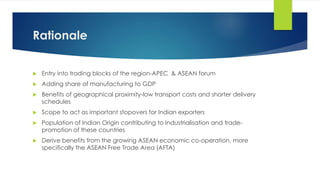
Rationale
 Entry into trading blocks of the region-APEC & ASEAN forum
 Adding share of manufacturing to GDP
 Benefits of geographical proximity-low transport costs and shorter delivery
schedules
 Scope to act as important stopovers for Indian exporters
 Population of Indian Origin contributing to Industrialisation and trade-
promotion of these countries
 Derive benefits from the growing ASEAN economic co-operation, more
specifically the ASEAN Free Trade Area (AFTA)
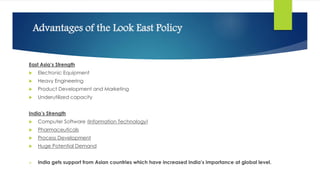
Advantages of the Look East Policy
East Asia’s Strength
 Electronic Equipment
 Heavy Engineering
 Product Development and Marketing
 Underutilized capacity
India’s Strength
 Computer Software (Information Technology)
 Pharmaceuticals
 Process Development
 Huge Potential Demand
 India gets support from Asian countries which have increased India’s importance at global level.
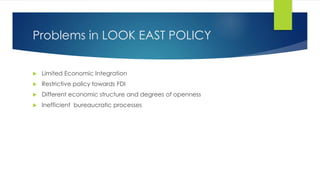
Problems in LOOK EAST POLICY
 Limited Economic Integration
 Restrictive policy towards FDI
 Different economic structure and degrees of openness
 Inefficient bureaucratic processes
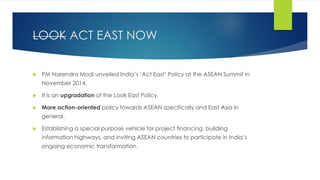
LOOK ACT EAST NOW
 PM Narendra Modi unveiled India’s ‘Act East’ Policy at the ASEAN Summit in
November 2014.
 It is an upgradation of the Look East Policy.
 More action-oriented policy towards ASEAN specifically and East Asia in
general.
 Establishing a special purpose vehicle for project financing, building
information highways, and inviting ASEAN countries to participate in India’s
ongoing economic transformation.
 Establishing a special purpose vehicle for project financing,
building information highways, and inviting ASEAN countries
to participate in India’s ongoing economic transformation.
 India-ASEAN trade has crossed $80 bn as of 2014 and is
expected to scale up to $100 bn by 2015 and double that
volume by 2022.
RUSSIA’s Policy Towards the East
Factors guiding Moscow’s ‘eastern policy’
 Tension with West
 China wants to control south china sea
 Search for new energy partners
Conclusion

Look act east policy

  • 1.
    LOOK ACT EASTPOLICY PRIYANKA TC (117), PULASTYA (118), RAKESH (119), RAHUL (120), RAMISHA(121) SEC B,GROUP 6
  • 2.
    INTRODUCTION • THE LOOK-EASTPOLICY WAS OFFICIALLY LAUNCHED IN 1992. • IT WAS INTRODUCED BY FORMER PM P V NARASIMHA RAO IN 1990S. • TECHNICALLY, IT COVERS ALL COUNTRIES OF ASIA-PACIFIC REGION, BUT IN PRACTICAL TERMS, IT HAS BEEN CONFINED TO ONLY SOUTH-EAST ASIA OR THE MEMBER NATIONS OF ASEAN. THE 10 MEMBER ASEAN CONSISTS OF INDONESIA, MALAYSIA, SINGAPORE, THAILAND, PHILIPPINES (FIVE ORIGINAL MEMBERS), BRUNEI, VIETNAM, LAOS, CAMBODIA AND MYANMAR. IN COMPARISON TO SOUTH- EAST ASIA, ASIA PACIFIC IS LARGER REGION.
  • 3.
    OBJECTIVE  The objectiveof the look east policy is to forge social, economic and cultural relations with the countries of East Asia. 1. First, to renew political contacts and understanding with ASEAN member states. 2. Second, to achieve enhanced economic interactions including investment and trade, science and technology, tourism, etc. with South- East Asian countries 3. Third to strengthen defence and strategic links with these countries to achieve better understanding. Subsequent govt led by BJP and Congress parties have acknowledged the importance of South East Asia
  • 4.
    The Look-East policywas officially launched in 1992. It was expected to:  Contribute significantly to India’s efforts globalisation and integration with the world economy;  Fill the void caused by the collapse of the Soviet Union, its major trading partner; and  Help the country in overcoming its isolation from a world-wide phenomenon of joining regionalism. EXPECTATIONS
  • 5.
    Rationale  Entry intotrading blocks of the region-APEC & ASEAN forum  Adding share of manufacturing to GDP  Benefits of geographical proximity-low transport costs and shorter delivery schedules  Scope to act as important stopovers for Indian exporters  Population of Indian Origin contributing to Industrialisation and trade- promotion of these countries  Derive benefits from the growing ASEAN economic co-operation, more specifically the ASEAN Free Trade Area (AFTA)
  • 6.
    Advantages of theLook East Policy East Asia’s Strength  Electronic Equipment  Heavy Engineering  Product Development and Marketing  Underutilized capacity India’s Strength  Computer Software (Information Technology)  Pharmaceuticals  Process Development  Huge Potential Demand  India gets support from Asian countries which have increased India’s importance at global level.
  • 7.
    Problems in LOOKEAST POLICY  Limited Economic Integration  Restrictive policy towards FDI  Different economic structure and degrees of openness  Inefficient bureaucratic processes
  • 8.
    LOOK ACT EASTNOW  PM Narendra Modi unveiled India’s ‘Act East’ Policy at the ASEAN Summit in November 2014.  It is an upgradation of the Look East Policy.  More action-oriented policy towards ASEAN specifically and East Asia in general.  Establishing a special purpose vehicle for project financing, building information highways, and inviting ASEAN countries to participate in India’s ongoing economic transformation.
  • 9.
     Establishing aspecial purpose vehicle for project financing, building information highways, and inviting ASEAN countries to participate in India’s ongoing economic transformation.  India-ASEAN trade has crossed $80 bn as of 2014 and is expected to scale up to $100 bn by 2015 and double that volume by 2022.
  • 10.
    RUSSIA’s Policy Towardsthe East Factors guiding Moscow’s ‘eastern policy’  Tension with West  China wants to control south china sea  Search for new energy partners
  • 11.