Chinese Perceptions & Policies
in the Indo-Pacific
Friday, July 30, 2021
Manoj Kewalramani
@theChinaDude
Structure of Presentation
● Evolution of the Indo-Pacific Strategy
● China’s Early Perceptions
● The Post-COVID World
3
|
Evolution of the Indo-Pacific
Strategy?
4
|
IPS Strategy
“A geopolitical competition between free and repressive visions of
world order is taking place in the Indo-Pacific region. The region,
which stretches from the west coast of India to the western shores
of the United States, represents the most populous and
economically dynamic part of the world.”
US National Security Strategy, December 2017.
5
|
IPS Strategy
● Termed the Indo-Pacific a “priority theater.”
● Objectives ranged from advancing US interests to preserving “a
rules-based international order” premised on shared interests and
values.
● Key challengers: “revisionist” China, “revitalized” Russia, and North
Korea.
● Pursue a three-pronged approach of “preparedness,” “partnerships,”
and “promotion of a networked region.”
DoD Indo-Pacific Strategy Report, June 2019.
6
|
IPS Strategy
Assessing the Trump era
● Reciprocity, burden-sharing, withdrawal & transactionalism
● Countering China over building congruence
● Indo-US partnership & the Quad
Early directions in the Biden era
● Competitiveness, partnerships & values
● Position of strength
● China policy from an Indo-Pacific and strategic interests prism
● Shifting the balance of power
7
|
IPS Strategy
“The United States relationship with China will be competitive
where it should be, collaborative where it can be, adversarial
where it must be...”
-- US Secretary of State Antony Blinken
8
|
China’s Early Perceptions:
Ambivalence, Assessments &
Adjustments
9
|
“It seems there is never a shortage of headline-grabbing ideas.
They are like the sea foam in the Pacific or Indian Ocean: they may
get some attention, but soon will dissipate...Nowadays, stoking a
new Cold War is out of sync with the times and inciting block
confrontation will find no market.”
Chinese Foreign Minister Wang Yi, March 2018.
China’s Perceptions
10
|
China’s Perceptions
● Conceptual Immaturity
● Targeted at China
● Grand Strategy? Or Pivot + India?
● Multiple Strategies
● Internal assessments
● Tactical adjustments
11
|
“I don’t think anybody would be able to contain China . . . We don’t
have a zero-sum game in the Asia-Pacific. We recognise the interest
of the United States in the Asia-Pacific and we want to cooperate
with the United States.”
Cui Tiankai, China’s Ambassador to the US. Oct. 2017
China’s Perceptions
12
|
“the United States proposed the Indo-Pacific strategy mainly to counter China.
Prior to this, the United States had implemented the Asia-Pacific rebalancing
strategy...I think the US Indo-Pacific strategy is mainly at the military level and lacks
economic cooperation and cultural elements. This is an unfriendly offensive
strategy and few countries welcome it. In the Asia-Pacific region, only a few US
allies such as Japan and Australia have joined the strategy. They also invited India
to join to cover the Indian Ocean region. However, India has a tradition of
non-alignment and ambition to become an important power. I am afraid that it is
unlikely to be willing to become a vassal and lad of the United States. Therefore, I
think the US Indo-Pacific strategy will not succeed.”
Lu Shaye, China’s Ambassador to France, Dec. 2019.
China’s Perceptions
13
|
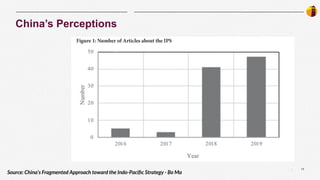
China’s Perceptions
Source: China’s Fragmented Approach toward the Indo-Pacific Strategy - Bo Ma
14
|
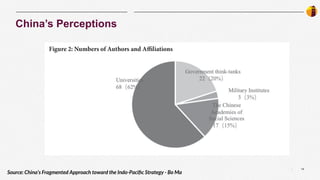
China’s Perceptions
Source: China’s Fragmented Approach toward the Indo-Pacific Strategy - Bo Ma
15
|
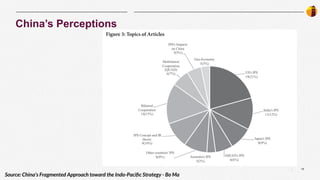
China’s Perceptions
Source: China’s Fragmented Approach toward the Indo-Pacific Strategy - Bo Ma
16
|
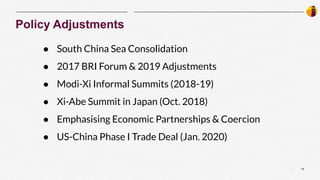
Policy Adjustments
● South China Sea Consolidation
● 2017 BRI Forum & 2019 Adjustments
● Modi-Xi Informal Summits (2018-19)
● Xi-Abe Summit in Japan (Oct. 2018)
● Emphasising Economic Partnerships & Coercion
● US-China Phase I Trade Deal (Jan. 2020)
17
|
The Post-COVID World
18
|
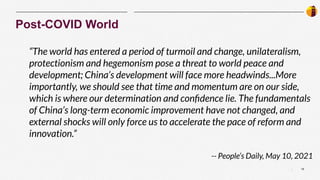
Post-COVID World
“The world has entered a period of turmoil and change, unilateralism,
protectionism and hegemonism pose a threat to world peace and
development; China’s development will face more headwinds...More
importantly, we should see that time and momentum are on our side,
which is where our determination and confidence lie. The fundamentals
of China’s long-term economic improvement have not changed, and
external shocks will only force us to accelerate the pace of reform and
innovation.”
-- People’s Daily, May 10, 2021
19
|
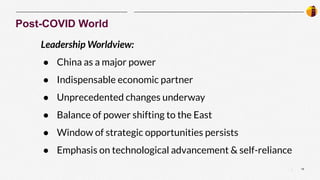
Post-COVID World
Leadership Worldview:
● China as a major power
● Indispensable economic partner
● Unprecedented changes underway
● Balance of power shifting to the East
● Window of strategic opportunities persists
● Emphasis on technological advancement & self-reliance
20
|
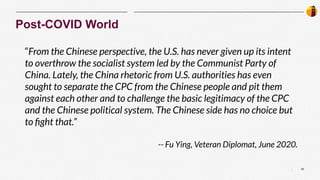
Post-COVID World
“From the Chinese perspective, the U.S. has never given up its intent
to overthrow the socialist system led by the Communist Party of
China. Lately, the China rhetoric from U.S. authorities has even
sought to separate the CPC from the Chinese people and pit them
against each other and to challenge the basic legitimacy of the CPC
and the Chinese political system. The Chinese side has no choice but
to fight that.”
-- Fu Ying, Veteran Diplomat, June 2020.
21
|
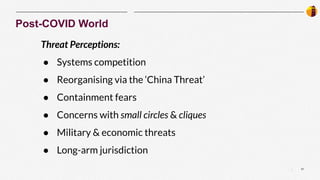
Post-COVID World
Threat Perceptions:
● Systems competition
● Reorganising via the ‘China Threat’
● Containment fears
● Concerns with small circles & cliques
● Military & economic threats
● Long-arm jurisdiction
22
|
Post-COVID World
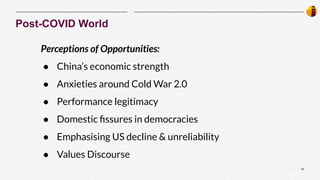
Perceptions of Opportunities:
● China’s economic strength
● Anxieties around Cold War 2.0
● Performance legitimacy
● Domestic fissures in democracies
● Emphasising US decline & unreliability
● Values Discourse
23
|
Post-COVID World
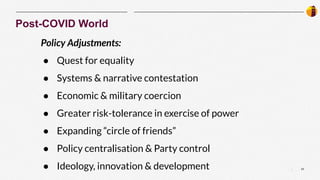
Policy Adjustments:
● Quest for equality
● Systems & narrative contestation
● Economic & military coercion
● Greater risk-tolerance in exercise of power
● Expanding “circle of friends”
● Policy centralisation & Party control
● Ideology, innovation & development
Thank You!

Indo-Pacific: China's Perceptions & Policies

  • 1.
    Chinese Perceptions &Policies in the Indo-Pacific Friday, July 30, 2021 Manoj Kewalramani @theChinaDude
  • 2.
    Structure of Presentation ●Evolution of the Indo-Pacific Strategy ● China’s Early Perceptions ● The Post-COVID World
  • 3.
    3 | Evolution of theIndo-Pacific Strategy?
  • 4.
    4 | IPS Strategy “A geopoliticalcompetition between free and repressive visions of world order is taking place in the Indo-Pacific region. The region, which stretches from the west coast of India to the western shores of the United States, represents the most populous and economically dynamic part of the world.” US National Security Strategy, December 2017.
  • 5.
    5 | IPS Strategy ● Termedthe Indo-Pacific a “priority theater.” ● Objectives ranged from advancing US interests to preserving “a rules-based international order” premised on shared interests and values. ● Key challengers: “revisionist” China, “revitalized” Russia, and North Korea. ● Pursue a three-pronged approach of “preparedness,” “partnerships,” and “promotion of a networked region.” DoD Indo-Pacific Strategy Report, June 2019.
  • 6.
    6 | IPS Strategy Assessing theTrump era ● Reciprocity, burden-sharing, withdrawal & transactionalism ● Countering China over building congruence ● Indo-US partnership & the Quad Early directions in the Biden era ● Competitiveness, partnerships & values ● Position of strength ● China policy from an Indo-Pacific and strategic interests prism ● Shifting the balance of power
  • 7.
    7 | IPS Strategy “The UnitedStates relationship with China will be competitive where it should be, collaborative where it can be, adversarial where it must be...” -- US Secretary of State Antony Blinken
  • 8.
  • 9.
    9 | “It seems thereis never a shortage of headline-grabbing ideas. They are like the sea foam in the Pacific or Indian Ocean: they may get some attention, but soon will dissipate...Nowadays, stoking a new Cold War is out of sync with the times and inciting block confrontation will find no market.” Chinese Foreign Minister Wang Yi, March 2018. China’s Perceptions
  • 10.
    10 | China’s Perceptions ● ConceptualImmaturity ● Targeted at China ● Grand Strategy? Or Pivot + India? ● Multiple Strategies ● Internal assessments ● Tactical adjustments
  • 11.
    11 | “I don’t thinkanybody would be able to contain China . . . We don’t have a zero-sum game in the Asia-Pacific. We recognise the interest of the United States in the Asia-Pacific and we want to cooperate with the United States.” Cui Tiankai, China’s Ambassador to the US. Oct. 2017 China’s Perceptions
  • 12.
    12 | “the United Statesproposed the Indo-Pacific strategy mainly to counter China. Prior to this, the United States had implemented the Asia-Pacific rebalancing strategy...I think the US Indo-Pacific strategy is mainly at the military level and lacks economic cooperation and cultural elements. This is an unfriendly offensive strategy and few countries welcome it. In the Asia-Pacific region, only a few US allies such as Japan and Australia have joined the strategy. They also invited India to join to cover the Indian Ocean region. However, India has a tradition of non-alignment and ambition to become an important power. I am afraid that it is unlikely to be willing to become a vassal and lad of the United States. Therefore, I think the US Indo-Pacific strategy will not succeed.” Lu Shaye, China’s Ambassador to France, Dec. 2019. China’s Perceptions
  • 13.
    13 | China’s Perceptions Source: China’sFragmented Approach toward the Indo-Pacific Strategy - Bo Ma
  • 14.
    14 | China’s Perceptions Source: China’sFragmented Approach toward the Indo-Pacific Strategy - Bo Ma
  • 15.
    15 | China’s Perceptions Source: China’sFragmented Approach toward the Indo-Pacific Strategy - Bo Ma
  • 16.
    16 | Policy Adjustments ● SouthChina Sea Consolidation ● 2017 BRI Forum & 2019 Adjustments ● Modi-Xi Informal Summits (2018-19) ● Xi-Abe Summit in Japan (Oct. 2018) ● Emphasising Economic Partnerships & Coercion ● US-China Phase I Trade Deal (Jan. 2020)
  • 17.
  • 18.
    18 | Post-COVID World “The worldhas entered a period of turmoil and change, unilateralism, protectionism and hegemonism pose a threat to world peace and development; China’s development will face more headwinds...More importantly, we should see that time and momentum are on our side, which is where our determination and confidence lie. The fundamentals of China’s long-term economic improvement have not changed, and external shocks will only force us to accelerate the pace of reform and innovation.” -- People’s Daily, May 10, 2021
  • 19.
    19 | Post-COVID World Leadership Worldview: ●China as a major power ● Indispensable economic partner ● Unprecedented changes underway ● Balance of power shifting to the East ● Window of strategic opportunities persists ● Emphasis on technological advancement & self-reliance
  • 20.
    20 | Post-COVID World “From theChinese perspective, the U.S. has never given up its intent to overthrow the socialist system led by the Communist Party of China. Lately, the China rhetoric from U.S. authorities has even sought to separate the CPC from the Chinese people and pit them against each other and to challenge the basic legitimacy of the CPC and the Chinese political system. The Chinese side has no choice but to fight that.” -- Fu Ying, Veteran Diplomat, June 2020.
  • 21.
    21 | Post-COVID World Threat Perceptions: ●Systems competition ● Reorganising via the ‘China Threat’ ● Containment fears ● Concerns with small circles & cliques ● Military & economic threats ● Long-arm jurisdiction
  • 22.
    22 | Post-COVID World Perceptions ofOpportunities: ● China’s economic strength ● Anxieties around Cold War 2.0 ● Performance legitimacy ● Domestic fissures in democracies ● Emphasising US decline & unreliability ● Values Discourse
  • 23.
    23 | Post-COVID World Policy Adjustments: ●Quest for equality ● Systems & narrative contestation ● Economic & military coercion ● Greater risk-tolerance in exercise of power ● Expanding “circle of friends” ● Policy centralisation & Party control ● Ideology, innovation & development
  • 24.