CHAPTER TWELVE 
Long, Formal Reports 
McGraw-Hill/Irwin © 2005 The McGraw-Hill Companies, Inc. All rights reserved.
GROUP MEMBERS 
Tanim Hasan 
BIT0301 
Md. Arif Ibne Ali 
BIT0308 
Shibbir Hossain 
BIT0317 
Nadia Nahar 
BIT0327 
12-2
Overview 
Organization & content 
of long reports 
Components of long 
reports 
 Structural coherence in 
12-3
Organization and Content 
 Prefatory components 
Title Fly 
Title Page 
Authorization Message 
Transmittal Message, 
Foreword, Preface 
Table of Contents, List of 
Illustrations 
12-4
Letter of 
Transmittal 
MIDWESTERN RESEARCH, INC. 
1732 Midday Avenue 
Chicago, IL 60607 
Telephone: 312.481.2919 
April 13, 2005 
Mr. W. Norman W. Bigbee 
Vice President in Charge of Sales 
Allied Distributors, Inc. 
3131 Speedall Street 
Akron, Ohio 44302 
Dear Mr. Bigbee: 
Here is the report on the four makes of subcompact automobiles you asked me 
to compare last January 3. 
To help you in deciding which of the four makes you should buy as 
replacements for your fleet, I gathered what I believe to be the most complete 
information available. Much of the operating information comes from your 
own records. The remaining data are the findings of both consumer research 
engineers and professional automotive analysts. Only my analyses of these 
data are subjective. 
I sincerely hope, Mr. Bigbee, that my analyses will help you in making the 
correct decision. I truly appreciate this assignment. And should you need any 
assistance in interpreting my analyses, please call on me. 
Sincerely, 
George W. Franklin 
George W. Franklin 
Associate Director 
12-5
Table of Contents 
TABLE OF CONTENTS 
Part Page 
Executive Summary..................................................................................vi 
I. THE FLEET REPLACEMNT PROBLEM......................................1 
A. The Authorization by Vice President Bigbee.............................1 
B. Problem of Selecting Fleet Replacements..................................1 
C. Reports and Records as Sources of Data...................................2 
D. A Preview to the Presentation...................................................2 
II. THE MAJOR FACTOR OF COST.................................................2 
A. Initial Costs Favor Beta.............................................................3 
B. Trade-in Values Show Uniformity............................................4 
C. Operating Costs Are Lowest for Gamma..................................4 
D. Cost Composite Favors Gamma...............................................6 
III. EVALUATION OF SAFETY FEATURES....................................6 
A. Delta Is Best Equipped with Safety Devices.............................7 
B. Acceleration Adds Extra Safety to Delta...................................8 
C. Weight Distribution Is Best in Alpha and Gamma...................9 
D. Gamma Has Best Braking Quality..........................................10 
IV. RIDING COMFORT AND OVERALL CONSTRUCTION........10 
A. Gamma Ranks First in Handling.............................................10 
Part Page 
B. Gamma Gives Best Ride....................................……........11 
C. Gamma Is Judged Most Durable........................................11 
V. RECOMMENDATION OF GAMMA.....................................12 
LIST OF TABLES AND CHARTS 
TABLES 
I. ORIGINAL COST OF FOUR BRANDS 
OF SUBCOMPACT CARS IN 2005.........................................3 
II. COMPARISON OF REPAIRS AND RELATED LOST 
WORKING TIME FOR FOUR MAKES OF CARS FOR 
TWO YEARS....................................................................….....5 
III. COST-PER-MILE ESTIMATE OF OPERATION...................5 
IV. LIST OF STANDARD SAFETY FEATURES..........................7 
V. COMPARATIVE WEIGHT DISTRIBUTIONS, 
BRAKING DISTANCES, AND CORNERING 
ABILITIES.............................................................................….9 
VI. COMPARATIVE COMFORT AND RIDE.........................….11 
CHARTS 
1. Estimated Total Operating Cost.............................................….6 
2. Comparison of Acceleration Times........................................….8 
12-6
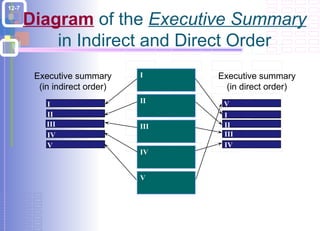
Diagram of the Executive Summary 
in Indirect and Direct Order 
Executive summary 
(in indirect order) 
Executive summary 
(in direct order) 
I 
II 
III 
IV 
V 
I 
II 
III 
IV 
V 
V 
I 
II 
III 
IV 
12-7
Executive Summary 
The recommendation of this study is that Gamma is the best buy for Allied Distributors, 
Inc. 
Authorized by Mr. Norman W. Bigbee, Vice President, on January 3. 2005, this report is 
submitted on April 13, 2005. This study gives Allied Distributors an insight into the 
problem of replacing the approximately 50 two-year-old subcompact cars in its present 
sales fleet. The basis for this recommendation is an analysis of cost, safety, and 
construction factors of four models of subcompact cars (Alpha, Beta, Gamma, and Delta). 
The four cars do not show much difference in ownership cost (initial cost less trade-in 
allowance after two years). On a per-car basis, Beta costs least for a two-year period-- 
$3,216. Compared with costs for the other cars, Beta is $370 under Gamma, $588 under 
Alpha, and $634 under Delta. For the entire sales fleet, these differences become more 
significant. A purchase of 50 Betas would save $18,500 over Gamma, $29,400 over 
Alpha, and $31,700 over Delta. 
Operation costs would favor Gamma. Cost per mile for this car is $0.13970, as compared 
with $0.14558 for Alpha, $0.14785 for Delta, and $0.15184 for Beta. The totals of all 
costs for the 50-car fleet over the two-year period show Gamma to be least costly at 
$385,094. In second place is Alpha, with a cost of $400,208. Third is Delta with 
$406,560, and fourth is Beta with a cost of $417,532. 
On the qualities that pertain to driving safety, Gamma is again superior to the other cars. It 
has the best brakes and is tied with Alpha for the best weight distribution. It is second in 
acceleration and is again tied with Alpha for the number of standard safety devices. Alpha 
is second overall in this category, having the second best brakes of the group. Beta is last 
because of its poor acceleration and poor brakes. 
Construction features and handling abilities place Gamma all by itself. It scores higher 
than any other car in every category. Alpha and Delta are tied for second place. Again 
Beta is last, having poor steering and handling qualities. 
vi 
Executive 
Summary 
12-8
The Report Proper 
 Introduction 
 Report Body 
 Ending of the 
Report 
 Appended 
Parts 
12-9
Introduction 
 Origin of the Report 
 Problem and Purpose 
 Scope 
 Limitations 
 Historical Background 
 Sources and Methods of 
Collecting Information 
 Definitions, Initialisms and 
Acronyms 
12-10
Introduction (contd.) 
 Origin of the report – The facts of authorization 
 Problem and Purpose – 
Problem- what prompted the report 
The problem is commonly stated in infinitive, 
question or declarative form 
The Purpose is the reason for the report 
 Scope – The boundaries of the problem 
 Limitation – Anything that limits the report’s treatment of 
the problem 
 Historical Background – How the problem developed 
12-11
Introduction (contd.) 
 Sources and methods – 
How the information is got 
Sometimes it is necessary to cite 
sources 
More complex research requires 
thorough description 
 Definitions, Initialisms and Acronyms – 
Definitions of unfamiliar words, acronyms or 
12-12
The Report Body 
 The report body presents and 
analyzes the information 
gathered 
 Preparing this part will require 
virtually all the organizing, 
writing and formatting skills 
12-13
The Ending of the Report 
 Ending Summary – 
Informational reports usually end with 
a summary of the major findings 
The ending summary is not as 
complete as the executive summary 
 Conclusions - 
Reports that seek an answer end with 
a conclusion 
Structure of the conclusion varies by 
problem 
 Recommendations – Include recommendations 
when the readers want or expect them 
12-14
Appended Parts 
 Appendix – 
 The appendix contains information that indirectly supports the 
report 
 Information that directly supports the report belongs in the text of 
the report 
 Bibliography – A biography should be included if heavy use of 
published sources is made 
12-15
The Structural Coherence Plan 
 Longer reports need extra structural coherence devices 
 There are a network of explanations, introductions, summaries 
and conclusions 
 The coherence plan begins with the preview, which describes 
the route ahead 
12-16
The first part of the structural coherence plan is 
the introduction preview. Here the readers are told 
how the report will unfold. Specifically, they are 
told what will be covered, in what order it will be 
covered, and the reasons for this order. 
Because the report is long and involved, 
introductions are needed at the beginnings of the 
major sections to remind the readers where they 
are in the plan outlined in the preview. These 
parts introduce the topics to be discussed, point 
the way through the sections, and relate the 
topics of the sections to the overall plan of the 
report. 
12-17 
Diagram of the Structural Coherence 
Plan of a Long, Formal Report (1 of 2)
Diagram of the Structural Coherence 
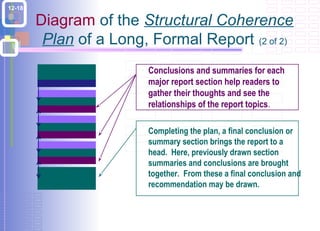
Plan of a Long, Formal Report (2 of 2) 
Conclusions and summaries for each 
major report section help readers to 
gather their thoughts and see the 
relationships of the report topics. 
Completing the plan, a final conclusion or 
summary section brings the report to a 
head. Here, previously drawn section 
summaries and conclusions are brought 
together. From these a final conclusion and 
recommendation may be drawn. 
12-18
ANY INQUIRY?? 
12-19
Its Exercise Time!!! 
12-20
12-21

Long formal report

  • 1.
    CHAPTER TWELVE Long,Formal Reports McGraw-Hill/Irwin © 2005 The McGraw-Hill Companies, Inc. All rights reserved.
  • 2.
    GROUP MEMBERS TanimHasan BIT0301 Md. Arif Ibne Ali BIT0308 Shibbir Hossain BIT0317 Nadia Nahar BIT0327 12-2
  • 3.
    Overview Organization &content of long reports Components of long reports  Structural coherence in 12-3
  • 4.
    Organization and Content  Prefatory components Title Fly Title Page Authorization Message Transmittal Message, Foreword, Preface Table of Contents, List of Illustrations 12-4
  • 5.
    Letter of Transmittal MIDWESTERN RESEARCH, INC. 1732 Midday Avenue Chicago, IL 60607 Telephone: 312.481.2919 April 13, 2005 Mr. W. Norman W. Bigbee Vice President in Charge of Sales Allied Distributors, Inc. 3131 Speedall Street Akron, Ohio 44302 Dear Mr. Bigbee: Here is the report on the four makes of subcompact automobiles you asked me to compare last January 3. To help you in deciding which of the four makes you should buy as replacements for your fleet, I gathered what I believe to be the most complete information available. Much of the operating information comes from your own records. The remaining data are the findings of both consumer research engineers and professional automotive analysts. Only my analyses of these data are subjective. I sincerely hope, Mr. Bigbee, that my analyses will help you in making the correct decision. I truly appreciate this assignment. And should you need any assistance in interpreting my analyses, please call on me. Sincerely, George W. Franklin George W. Franklin Associate Director 12-5
  • 6.
    Table of Contents TABLE OF CONTENTS Part Page Executive Summary..................................................................................vi I. THE FLEET REPLACEMNT PROBLEM......................................1 A. The Authorization by Vice President Bigbee.............................1 B. Problem of Selecting Fleet Replacements..................................1 C. Reports and Records as Sources of Data...................................2 D. A Preview to the Presentation...................................................2 II. THE MAJOR FACTOR OF COST.................................................2 A. Initial Costs Favor Beta.............................................................3 B. Trade-in Values Show Uniformity............................................4 C. Operating Costs Are Lowest for Gamma..................................4 D. Cost Composite Favors Gamma...............................................6 III. EVALUATION OF SAFETY FEATURES....................................6 A. Delta Is Best Equipped with Safety Devices.............................7 B. Acceleration Adds Extra Safety to Delta...................................8 C. Weight Distribution Is Best in Alpha and Gamma...................9 D. Gamma Has Best Braking Quality..........................................10 IV. RIDING COMFORT AND OVERALL CONSTRUCTION........10 A. Gamma Ranks First in Handling.............................................10 Part Page B. Gamma Gives Best Ride....................................……........11 C. Gamma Is Judged Most Durable........................................11 V. RECOMMENDATION OF GAMMA.....................................12 LIST OF TABLES AND CHARTS TABLES I. ORIGINAL COST OF FOUR BRANDS OF SUBCOMPACT CARS IN 2005.........................................3 II. COMPARISON OF REPAIRS AND RELATED LOST WORKING TIME FOR FOUR MAKES OF CARS FOR TWO YEARS....................................................................….....5 III. COST-PER-MILE ESTIMATE OF OPERATION...................5 IV. LIST OF STANDARD SAFETY FEATURES..........................7 V. COMPARATIVE WEIGHT DISTRIBUTIONS, BRAKING DISTANCES, AND CORNERING ABILITIES.............................................................................….9 VI. COMPARATIVE COMFORT AND RIDE.........................….11 CHARTS 1. Estimated Total Operating Cost.............................................….6 2. Comparison of Acceleration Times........................................….8 12-6
  • 7.
    Diagram of theExecutive Summary in Indirect and Direct Order Executive summary (in indirect order) Executive summary (in direct order) I II III IV V I II III IV V V I II III IV 12-7
  • 8.
    Executive Summary Therecommendation of this study is that Gamma is the best buy for Allied Distributors, Inc. Authorized by Mr. Norman W. Bigbee, Vice President, on January 3. 2005, this report is submitted on April 13, 2005. This study gives Allied Distributors an insight into the problem of replacing the approximately 50 two-year-old subcompact cars in its present sales fleet. The basis for this recommendation is an analysis of cost, safety, and construction factors of four models of subcompact cars (Alpha, Beta, Gamma, and Delta). The four cars do not show much difference in ownership cost (initial cost less trade-in allowance after two years). On a per-car basis, Beta costs least for a two-year period-- $3,216. Compared with costs for the other cars, Beta is $370 under Gamma, $588 under Alpha, and $634 under Delta. For the entire sales fleet, these differences become more significant. A purchase of 50 Betas would save $18,500 over Gamma, $29,400 over Alpha, and $31,700 over Delta. Operation costs would favor Gamma. Cost per mile for this car is $0.13970, as compared with $0.14558 for Alpha, $0.14785 for Delta, and $0.15184 for Beta. The totals of all costs for the 50-car fleet over the two-year period show Gamma to be least costly at $385,094. In second place is Alpha, with a cost of $400,208. Third is Delta with $406,560, and fourth is Beta with a cost of $417,532. On the qualities that pertain to driving safety, Gamma is again superior to the other cars. It has the best brakes and is tied with Alpha for the best weight distribution. It is second in acceleration and is again tied with Alpha for the number of standard safety devices. Alpha is second overall in this category, having the second best brakes of the group. Beta is last because of its poor acceleration and poor brakes. Construction features and handling abilities place Gamma all by itself. It scores higher than any other car in every category. Alpha and Delta are tied for second place. Again Beta is last, having poor steering and handling qualities. vi Executive Summary 12-8
  • 9.
    The Report Proper  Introduction  Report Body  Ending of the Report  Appended Parts 12-9
  • 10.
    Introduction  Originof the Report  Problem and Purpose  Scope  Limitations  Historical Background  Sources and Methods of Collecting Information  Definitions, Initialisms and Acronyms 12-10
  • 11.
    Introduction (contd.) Origin of the report – The facts of authorization  Problem and Purpose – Problem- what prompted the report The problem is commonly stated in infinitive, question or declarative form The Purpose is the reason for the report  Scope – The boundaries of the problem  Limitation – Anything that limits the report’s treatment of the problem  Historical Background – How the problem developed 12-11
  • 12.
    Introduction (contd.) Sources and methods – How the information is got Sometimes it is necessary to cite sources More complex research requires thorough description  Definitions, Initialisms and Acronyms – Definitions of unfamiliar words, acronyms or 12-12
  • 13.
    The Report Body  The report body presents and analyzes the information gathered  Preparing this part will require virtually all the organizing, writing and formatting skills 12-13
  • 14.
    The Ending ofthe Report  Ending Summary – Informational reports usually end with a summary of the major findings The ending summary is not as complete as the executive summary  Conclusions - Reports that seek an answer end with a conclusion Structure of the conclusion varies by problem  Recommendations – Include recommendations when the readers want or expect them 12-14
  • 15.
    Appended Parts Appendix –  The appendix contains information that indirectly supports the report  Information that directly supports the report belongs in the text of the report  Bibliography – A biography should be included if heavy use of published sources is made 12-15
  • 16.
    The Structural CoherencePlan  Longer reports need extra structural coherence devices  There are a network of explanations, introductions, summaries and conclusions  The coherence plan begins with the preview, which describes the route ahead 12-16
  • 17.
    The first partof the structural coherence plan is the introduction preview. Here the readers are told how the report will unfold. Specifically, they are told what will be covered, in what order it will be covered, and the reasons for this order. Because the report is long and involved, introductions are needed at the beginnings of the major sections to remind the readers where they are in the plan outlined in the preview. These parts introduce the topics to be discussed, point the way through the sections, and relate the topics of the sections to the overall plan of the report. 12-17 Diagram of the Structural Coherence Plan of a Long, Formal Report (1 of 2)
  • 18.
    Diagram of theStructural Coherence Plan of a Long, Formal Report (2 of 2) Conclusions and summaries for each major report section help readers to gather their thoughts and see the relationships of the report topics. Completing the plan, a final conclusion or summary section brings the report to a head. Here, previously drawn section summaries and conclusions are brought together. From these a final conclusion and recommendation may be drawn. 12-18
  • 19.
  • 20.
  • 21.