















Institute of Information Technology 
JOB TRAINING METHODS AND 
PROCESS: STUDY ON A IT FARM 
Submitted to 
Shaheen Ahmed Chowdhury 
Assistant Professor 
Dept. of Marketing 
University of Dhaka 
Submitted by 
Tanvir Ahmed Khan-BIT0305 
Arif Ibne Ali-BIT0308 
Nadia Nahar-BIT0327 
Ahmad Tahmid-BIT0332 
Date of Submission: 3rd December, 2012
Introduction: 
Sending employees to training opportunities, or bringing opportunities into the company, 
actually infuses a business with new ideas and creative ways of solving old problems. 
Sometimes, just getting employees out of the day-to-day grind of their everyday work schedule 
is enough to jump-start energy and encourage employees to recommit to their jobs and the 
company. But learning new skills and interacting with new and different people has a direct 
impact on the productivity and development of the work environment. 
Training is one of the major activities of the largest organizations including IT/ Software Firm. 
As we are conducting Training procedures running on IT firm, we need to judge the training 
methods that applied in the generic Software or IT firm.
Background of the Study: 
The IT sector is growing at a very fast pace and is expected to earn a revenue of US $87 billion 
by 2008. In 2006, it has earned revenue of about US $ 40 billion with a growth rate of 30%. IT 
sector is expected to generate 2.3 million jobs by 2010, according to NASSCOM (National 
Association of Software and Service Companies) 
With this rapid expansion of IT sector and coming up of major players and new technologies 
like SAP, the need of human resource development has increased. 
According to the recent review by Harvard Business Review, there is a direct link between 
training investment of the companies and the market capitalization. Those companies with higher 
training investment had higher market capitalization. It clearly indicates that the companies 
which have successfully implemented training programs have been able to deliver customer 
goals with effective results. It shows that good training results in enhancement of individual 
performance, which in turn, helps the organization in achieving its business goals. Training is a 
tool that can help in gaining competitive advantage in terms of human resource. 
With the growing investment by IT companies in the development of their employees many 
companies have now started their own learning centers. As an example, Sun has its own training
department. Accenture has Internet based tool by the name of “My Learning” that offers access 
to its vast learning resources to its employees. Companies are investing in both the technical 
training, which has always been an essential part in IT industry, as well as in managerial skills 
development. Companies now kept aside 3-5% of revenue for training programs. As an example, 
some of the major players like Tata Elexi and Accenture are allocating 7% and 3% respectively 
of the company’s overall revenue. 
Importance of Training: 
Training is essential to the achievements of a business. Perhaps its most positive benefit is better 
employees. A company develops the potential of an employee, and part of the way a company 
encourages improvement is through training. Often, good training is just as important as a good 
benefits package for an employee. 
For employers, training allows them to locate a wider range of people with the kind of outlook 
that matches the company mission statement. The right kind of perspective is a hard thing to 
cultivate, whereas workplace specific proficiencies are easier to nature. The other advantage 
employers should remember about training is it offers them an improved retention rate. 
Employees are more loyal to companies that value their growth and want to cultivate it, and 
thusly provide a better performance and decrease the rollover rate at any company, no matter 
how small or large. If an employee thinks a company values him or her, that sentiment will go 
into whatever the employee is designing, selling, manufacturing, etc. 
Every single part of the management at a company must completely sustain the training. 
Otherwise, there is no point in wasting even a shoddy effort at training. Cheap training will 
result in cheap work: quality employees require quality training programs, which means 
spending a bit more money. Excellent training programs emphasize a correlation between 
personal development and official evaluations, allowing an employee to discern that career 
growth and success means evolving their expertise with training.
There are numerous benefits from having a training and learning program for your business' 
bottom line. Here are the top tier-items that come to mind - 
 Increase productivity. Ongoing learning & training will ensure your team has the ability to 
get more done and continually improve. 
 Create a safe environment. While not glamorous, safety matters, and will enable you to 
reduce risk and insurance costs. 
 Enable you to hire the person with the right attitude and best fit with your team. Skills 
like programming languages or database management can be taught; it's harder to teach a 
strong work ethic or good attitude. 
 Boost employee engagement, and in turn effectiveness. Investing in training improves 
employee engagement, and engaged employees are more productive. An engaged employee 
is one who has a feeling of personal connection or pride in their work. 
 Innovation & nimbleness. Connecting your employees to opportunities to develop skills 
and abilities on an ongoing basis means that your organization will be prepared to respond to 
changing circumstances. 
 Show them you care. Investing in employee development is connected to increased job 
satisfaction and thus increased employee retention rates.
Training and Development Objectives: 
The principal objective of training and development division is to make sure the availability of a 
skilled and willing workforce to an organization. In addition to that, there are four other 
objectives: Individual, Organizational, Functional, and Societal. 
Individual Objectives – help employees in achieving their personal goals, which in turn, 
enhances the individual contribution to an organization. 
Organizational Objectives – assist the organization with its primary objective by bringing 
individual effectiveness. 
Functional Objectives – maintain the department’s contribution at a level suitable to the 
organization’s needs. 
Societal Objectives – ensure that an organization is ethically and socially responsible to the 
needs and challenges of the society. 
Methodology: 
The three model of training are: 
1. System Model 
2. Instructional System Development Model 
3. Transitional model
System Model: 
The system model consists of five phases and should be repeated on a regular basis to 
make further improvements. The training should achieve the purpose of helping employee 
to perform their work to required standards. The steps involved in System Model of 
training are as follows: 
1. Analyze and identify the training needs i.e. to analyze the department, job, employees 
requirement, who needs training, what do they need to learn, estimating training cost, etc 
The next step is to develop a performance measure on the basis of which actual 
performance would be evaluated. 
2. Design and provide training to meet identified needs. This step requires developing 
objectives of training, identifying 
3. Develop - This phase requires listing the activities in the training program that will 
assist the participants to learn, selecting delivery method, examining the training material, 
validating information to be imparted to make sure it accomplishes all the goals & 
objectives. 
4. Implementing is the hardest part of the system because one wrong step can lead to the 
failure of whole training program. 
5. Evaluating each phase so as to make sure it has achieved its aim in terms of subsequent 
work performance. Making necessary amendments to any of the previous stage in order to 
remedy or improve failure practices.
Instructional System Development Model: 
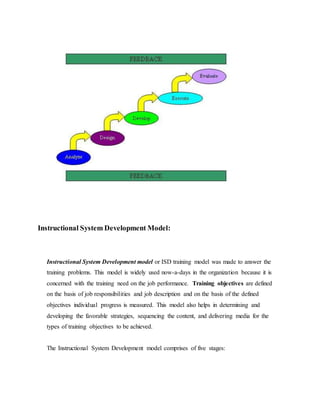
Instructional System Development model or ISD training model was made to answer the 
training problems. This model is widely used now-a-days in the organization because it is 
concerned with the training need on the job performance. Training objectives are defined 
on the basis of job responsibilities and job description and on the basis of the defined 
objectives individual progress is measured. This model also helps in determining and 
developing the favorable strategies, sequencing the content, and delivering media for the 
types of training objectives to be achieved. 
The Instructional System Development model comprises of five stages:
1. Analysis – This phase consist of training need assessment, job analysis, and target 
audience analysis. 
2. Planning – This phase consist of setting goal of the learning outcome, instructional 
objectives that measures behavior of a participant after the training, types of training 
material, media selection, methods of evaluating the trainee, trainer and the training 
program, strategies to impart knowledge i.e. selection of content, sequencing of content, 
etc. 
3. Development – This phase translates design decisions into training material. It consists of 
developing course material for the trainer including handouts, workbooks, visual aids, 
demonstration props, etc, course material for the trainee including handouts of summary.
4. Execution – This phase focuses on logistical arrangements, such as arranging speakers, 
equipments, benches, podium, food facilities, cooling, lighting, parking, and other training 
accessories. 
5. Evaluation – The purpose of this phase is to make sure that the training program has 
achieved its aim in terms of subsequent work performance. This phase consists of identifying 
strengths and weaknesses and making necessary amendments to any of the previous stage in 
order to remedy or improve failure practices. 
The ISD model is a continuous process that lasts throughout the training program. It also 
highlights that feedback is an important phase throughout the entire training program. In this 
model, the output of one phase is an input to the next phase. 
Transitional model: 
Transitional model focuses on the organization as a whole. The outer loop describes the 
vision, mission and values of the organization on the basis of which training model i.e. inner 
loop is executed. 
1. Vision – focuses on the milestones that the organization would like to achieve after the 
defined point of time. A vision statement tells that where the organization sees itself few 
years down the line. A vision may include setting a role mode, or bringing some internal 
transformation, or may be promising to meet some other deadlines. 
2. Mission – explain the reason of organizational existence. It identifies the position in the 
community. The reason of developing a mission statement is to motivate, inspire, and inform 
the employees regarding the organization. The mission statement tells about the identity that
how the organization would like to be viewed by the customers, employees, and all other 
stakeholders. 
3. Values – is the translation of vision and mission into communicable ideals. It reflects the 
deeply held values of the organization and is independent of current industry environment. 
For example, values may include social responsibility, excellent customer service, etc. 
The mission, vision, and values precede the objective in the inner loop. This model considers the 
organization as a whole. The objective is formulated keeping these three things in mind and then 
the training model is further implemented.
Domain of Training in IT: 
The specific areas where training is given in IT/Software Development sector are: 
 Computer Manufacturing 
 EDP/ E- Commerce 
 Designing 
 Maintenance Service 
 Operating jobs, Computer operators, Data Entry 
 System Developing /Programming /Software Engineering 
 Networking 
 Application Programming 
 Research and Development in Peripheral Integration 
 Product Quality Control and Reliability Testing 
 Enterprise Resource Planning (ERP) 
 Database Warehousing and Management 
Training Courses in Software Development Industry 
 B. Tech 
 BCA 
 BSc. (H) Computer Science 
 M. Tech 
 MCA 
 MSc. (H) Computer Science 
 M.E. in Computer Technology & Applications 
 Post Graduate Diploma in Computer Application (P.G.D.C.A)
Preferred Training Methods: 
 Computer Based Training 
 Internet Based Learning 
 Lectures 
 Labs 
 On-the-job (OTJ) Training 
 Distant Learning 
 E-Books 
 Mentoring 
 Coaching 
 Job Rotation 
Concern in Information Technology Training: 
One of the major concerns for training companies is to create professionals who are better able 
to go in for a technology in a specific domain area. Other than that, there are various issues that 
are affecting the IT training sector such as, lack of conviction regarding training, unplanned 
training approach, uncertain quality focus, and lengthy decision-making process. 
With the coming up of various new technologies, it has become a challenge for the training 
institutes to offer effective, updated, latest, planned training to candidates in a shortest-possible 
time. To increase the market share, most of the training institutes are now strategizing to launch 
new product and are marketing aggressively. 
As an example, New Horizons is establishing partnership with its customers and delivering
quality training. The company regularly conducts surveys of training needs in Indian job market. 
On the other side, NIIT has invested in product development to create product segmentation and 
is customizing them to address IT/ITES education area. 
Aptech is venturing into colleges, research firms, and universities. Another opportunity that has 
been identified by Aptech is the field of developing content and the company is offering these 
services to third-party clients for customization. 
Essentials in IT Industry: 
To survive in long term there are some definite essential things such as- 
 Good infrastructure 
 Trained trainers 
 Quality of content 
 Certification of training course 
 Effective Training evaluation 
 Post training support
Emerging Scenario in IT Industry: 
With the rapid expansion in IT sector, now there is enough scope of IT training courses and 
institutes. IT sector is soon going to face a huge shortfall of skilled employees, if the growth in 
the software industry goes by as expected. According to recent report of NASSCOM (The 
National Association of Software and Services Companies) on software industry, the IT 
services sector will see a shortfall of 2,35,000 people by 2008. IT spending in the global 
business world is expected to grow by 6 to 7 % in the next 3 years, which will be enough to give 
boost to the IT training sector. 
This huge IT spending is largely because of uptake in IT recruitment. 
According to a recent IDC report, India alone spends $216 million, i.e. 21% of the total spending 
of IT training in the region, and is expected to be one of the largest contributors in the coming 
years. This is largely because India alone accounts for 60 % of the total Asia-Pacific demand for 
IT professionals.
Currently, the IT training market is valued at Rs 100 crore, and is expected to reach Rs 500 crore 
over the next 3 years. 
The major factor that is responsible for growth in IT sector is the e-governance initiatives 
introduced by central government and various other state governments. 
Now there is a notable shift from long-term course to short-term training certifications. Due to 
this, the focus is now on hiring professionals with expertise in particular domains. The demand 
has largely for JAVA and .NET professionals. And on the NETWORKING end, network storage 
and Linux demand is taking a toll.
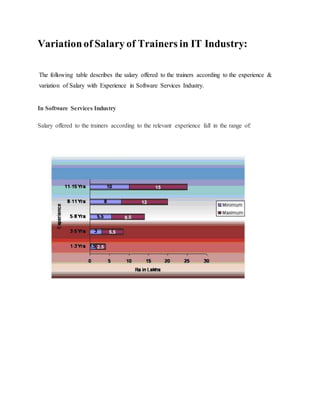
Variation of Salary of Trainers in IT Industry: 
The following table describes the salary offered to the trainers according to the experience & 
variation of Salary with Experience in Software Services Industry. 
In Software Services Industry 
Salary offered to the trainers according to the relevant experience fall in the range of:
Variation of Salary with Experience in BPO/KPO/ITES Sector 
Salary offered to the trainers according to the relevant experience fall in the range of:
Surveys on Training: 
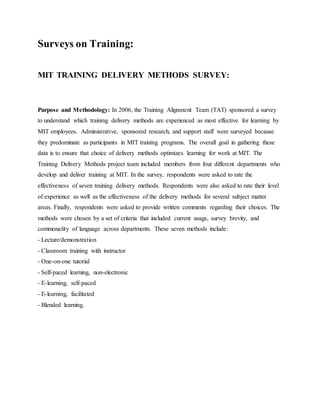
MIT TRAINING DELIVERY METHODS SURVEY: 
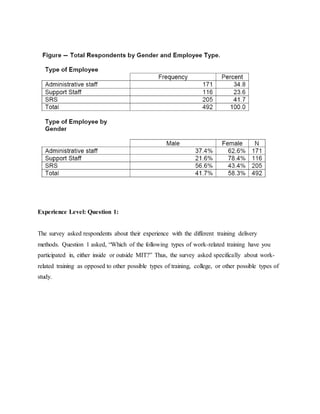
Purpose and Methodology: In 2006, the Training Alignment Team (TAT) sponsored a survey 
to understand which training delivery methods are experienced as most effective for learning by 
MIT employees. Administrative, sponsored research, and support staff were surveyed because 
they predominate as participants in MIT training programs. The overall goal in gathering these 
data is to ensure that choice of delivery methods optimizes learning for work at MIT. The 
Training Delivery Methods project team included members from four different departments who 
develop and deliver training at MIT. In the survey, respondents were asked to rate the 
effectiveness of seven training delivery methods. Respondents were also asked to rate their level 
of experience as well as the effectiveness of the delivery methods for several subject matter 
areas. Finally, respondents were asked to provide written comments regarding their choices. The 
methods were chosen by a set of criteria that included current usage, survey brevity, and 
commonality of language across departments. These seven methods include: 
- Lecture/demonstration 
- Classroom training with instructor 
- One-on-one tutorial 
- Self-paced learning, non-electronic 
- E-learning, self-paced 
- E-learning, facilitated 
- Blended learning.
Survey Question: 
The survey questions were divided into four main areas. 
1 - Experience level. Question one asked which types of training method respondents had 
experienced. They were asked to check all that apply. 
2 – Effectiveness by subject matter. Questions 2-5 asked which method was most effective for 
learning the following different types of subject matter: 
• Question 2.Computing skills or a software application. 
• Question 3.Financial or accounting skills. 
• Question 4.Interpersonal communication or leadership skills. 
• Question 5.A procedural or policy change. 
It is understood that many kinds of subject matter could be chosen. The intention in choosing 
these subject areas was four-fold: 
• To vary the type of subject matter. 
• To reflect current types of training subject matter (though not exhaustively). 
• To keep the list short to ensure greater survey participation. 
• To vary the type of learning. 
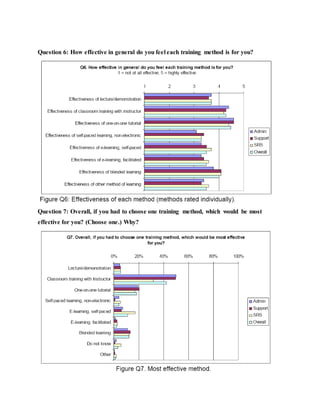
3 – Effectiveness by method. Question 6 asked how effective each of the methods was 
experienced on a scale of 1– 5. For this question, 1 is "Not at all effective" and 5 is "Highly 
effective.” Also for this question, respondents were asked to rate each of the six methods for 
effectiveness on this scale, not to choose one over another. 
4 – Most/least effective and why. Questions 7 and 8 asked which method was most effective 
and which was least effective and why. Question 7 asked which one method, and only one 
method, respondents found most effective. Question 8 asked the same question for least 
effective. For both questions 7 and 8, respondents were also asked to answer “why” in written 
responses. Finally, respondents were given the opportunity to add additional written comments 
(Question 9).
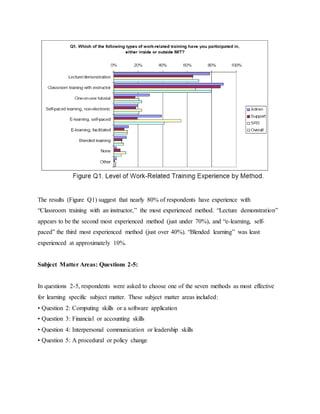
Experience Level: Question 1: 
The survey asked respondents about their experience with the different training delivery 
methods. Question 1 asked, “Which of the following types of work-related training have you 
participated in, either inside or outside MIT?” Thus, the survey asked specifically about work-related 
training as opposed to other possible types of training, college, or other possible types of 
study.
The results (Figure Q1) suggest that nearly 80% of respondents have experience with 
“Classroom training with an instructor,” the most experienced method. “Lecture demonstration” 
appears to be the second most experienced method (just under 70%), and “e-learning, self-paced” 
the third most experienced method (just over 40%). “Blended learning” was least 
experienced at approximately 10%. 
Subject Matter Areas: Questions 2-5: 
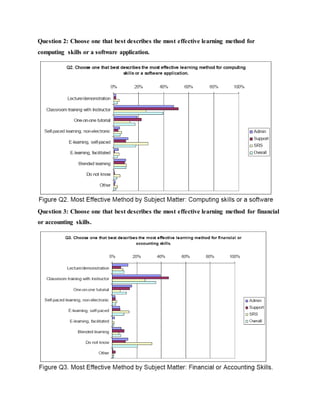
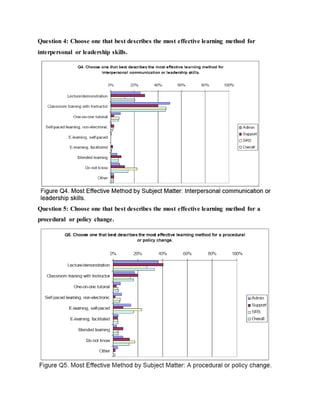
In questions 2-5, respondents were asked to choose one of the seven methods as most effective 
for learning specific subject matter. These subject matter areas included: 
• Question 2: Computing skills or a software application 
• Question 3: Financial or accounting skills 
• Question 4: Interpersonal communication or leadership skills 
• Question 5: A procedural or policy change
Question 2: Choose one that best describes the most effective learning method for 
computing skills or a software application. 
Question 3: Choose one that best describes the most effective learning method for financial 
or accounting skills.
Question 4: Choose one that best describes the most effective learning method for 
interpersonal or leadership skills. 
Question 5: Choose one that best describes the most effective learning method for a 
procedural or policy change.
Question 6: How effective in general do you feel each training method is for you? 
Question 7: Overall, if you had to choose one training method, which would be most 
effective for you? (Choose one.) Why?
Question 7a: Which method is most effective. Why? 
- Asking Questions. Almost a third (31%) of all respondents noted that having the opportunity 
to ask questions, feeling comfortable asking questions and having someone available to answer 
questions is what they value in their training. Specifically, these comments were in reference to 
“classroom training with an instructor,” “blended learning,” and “one-on-one” methods. 
- Learning with others. Next highest (over 14%) were comments associated with the synergy of 
being with others in the classroom. These comments suggest there is a benefit from hearing other 
participants’ perspectives, opinions, and experiences. These respondents noted that working with 
others adds to the overall learning experience. This was especially noted in the “classroom 
training with an instructor” and “blended learning” methods. 
- Interaction with a human instructor. Closely related to being able to ask questions, was 
having a “human instructor,” in their words, who is available to answer questions. Nearly 12% 
indicated this was a significant factor for effective learning. 
- Pace. Other written comments (12%) suggest the importance of pace geared to individual 
needs. Being able to go at one’s own pace, as well as not being slowed down or pressured to 
keep up was seen as positive in “blended learning,” “e-learning, selfpaced,” and “one-on-one” 
methods. 
- Learning by Doing. Approximately 10% wrote that “learning by doing” or “hands-on” 
practices were important when learning new skills, especially technical skills. This was 
associated primarily with “classroom with instructor” and “one-on-one” methods.
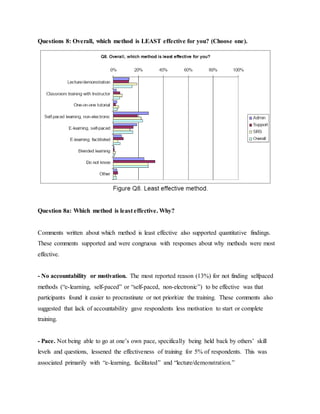
Questions 8: Overall, which method is LEAST effective for you? (Choose one). 
Question 8a: Which method is least effective. Why? 
Comments written about which method is least effective also supported quantitative findings. 
These comments supported and were congruous with responses about why methods were most 
effective. 
- No accountability or motivation. The most reported reason (13%) for not finding selfpaced 
methods (“e-learning, self-paced” or “self-paced, non-electronic”) to be effective was that 
participants found it easier to procrastinate or not prioritize the training. These comments also 
suggested that lack of accountability gave respondents less motivation to start or complete 
training. 
- Pace. Not being able to go at one’s own pace, specifically being held back by others’ skill 
levels and questions, lessened the effectiveness of training for 5% of respondents. This was 
associated primarily with “e-learning, facilitated” and “lecture/demonstration.”
- Not having questions answered. 7% of respondents wrote comments suggesting that not 
having questions answered or difficulty asking questions made “e-learning, selfpaced” and 
“lecture/demonstration” least effective methods of training. 
Overall, written comments were supportive of other findings. Comments written about methods 
seen as most effective and those seen as least effective confirmed and explained quantitative 
findings. 
Question 9: Please share any additional thoughts you have about training methods 
Written responses to Question 9 asking respondents to share additional thoughts varied, but 
supported other findings. Some respondents commented further on the positive aspects of 
instructor- led training, while others suggested that the most effective method depends on the 
subject at hand. 
Other comments suggested the timing of the training or the facilities of training also mattered. As 
one respondent wrote, “I prefer NOT to have classes held over lunch time since that is supposed 
to be a time for employees to take a break rather than continue to work.” Another wrote, “Make 
sure the place is not hot and crowded.” 
Still others made general comments about the value or quality of training at MIT. As one 
respondent wrote in reference to classroom experiences at MIT, “They have all been excellent. 
Better than any other place I have worked.” Another respondent wrote, that “MIT in general has 
done a good job with the training courses I have taken.” 
Still another wrote that, “Training is great!!! Thanks for providing the opportunities.” And, 
as one other respondent wrote, “Thanks for asking our opinions!”
Conclusion: 
Overall, this finding suggests that all seven methods surveyed can be utilized successfully for IT 
employees learning. Along with this, in according with adult training theory, it appears important 
to provide optimal time for training participants to interact with each other, to talk and interact 
with live instructors, to be able to listen to and ask questions not only of a live instructor, but of 
their fellow participants as well. Finally these data suggests that live class room training with an 
instructor and other participants is seen as most effective for learning by most IT employees 
surveyed. 
References: 
1. Training and Development in IT/Software Development Industry: 
http://traininganddevelopment.naukrihub.com/training-scenario/it/ 
2. MIT Training and Development: http://web.mit.edu/training/trainers/ 
3. Oxford Journal: 
i. The effects of general and firm-specific training on wages and performance: evidence 
from banking : 
http://oep.oxfordjournals.org/content/64/1/151.full?maxtoshow=&hits=10&RESULTFO 
RMAT=&fulltext=Training&searchid=1&FIRSTINDEX=0&resourcetype=HWCIT 
ii. Quick Job Entry or Long-Term Human Capital Development? The Dynamic Effects of 
Alternative Training Schemes: 
http://restud.oxfordjournals.org/content/early/2012/06/25/restud.rds022.full?maxtoshow= 
&hits=10&RESULTFORMAT=&fulltext=Training&searchid=1&FIRSTINDEX=0&res 
ourcetype=HWCIT

Job Training Methods and Process

  • 1.
    Institute of InformationTechnology JOB TRAINING METHODS AND PROCESS: STUDY ON A IT FARM Submitted to Shaheen Ahmed Chowdhury Assistant Professor Dept. of Marketing University of Dhaka Submitted by Tanvir Ahmed Khan-BIT0305 Arif Ibne Ali-BIT0308 Nadia Nahar-BIT0327 Ahmad Tahmid-BIT0332 Date of Submission: 3rd December, 2012
  • 2.
    Introduction: Sending employeesto training opportunities, or bringing opportunities into the company, actually infuses a business with new ideas and creative ways of solving old problems. Sometimes, just getting employees out of the day-to-day grind of their everyday work schedule is enough to jump-start energy and encourage employees to recommit to their jobs and the company. But learning new skills and interacting with new and different people has a direct impact on the productivity and development of the work environment. Training is one of the major activities of the largest organizations including IT/ Software Firm. As we are conducting Training procedures running on IT firm, we need to judge the training methods that applied in the generic Software or IT firm.
  • 3.
    Background of theStudy: The IT sector is growing at a very fast pace and is expected to earn a revenue of US $87 billion by 2008. In 2006, it has earned revenue of about US $ 40 billion with a growth rate of 30%. IT sector is expected to generate 2.3 million jobs by 2010, according to NASSCOM (National Association of Software and Service Companies) With this rapid expansion of IT sector and coming up of major players and new technologies like SAP, the need of human resource development has increased. According to the recent review by Harvard Business Review, there is a direct link between training investment of the companies and the market capitalization. Those companies with higher training investment had higher market capitalization. It clearly indicates that the companies which have successfully implemented training programs have been able to deliver customer goals with effective results. It shows that good training results in enhancement of individual performance, which in turn, helps the organization in achieving its business goals. Training is a tool that can help in gaining competitive advantage in terms of human resource. With the growing investment by IT companies in the development of their employees many companies have now started their own learning centers. As an example, Sun has its own training
  • 4.
    department. Accenture hasInternet based tool by the name of “My Learning” that offers access to its vast learning resources to its employees. Companies are investing in both the technical training, which has always been an essential part in IT industry, as well as in managerial skills development. Companies now kept aside 3-5% of revenue for training programs. As an example, some of the major players like Tata Elexi and Accenture are allocating 7% and 3% respectively of the company’s overall revenue. Importance of Training: Training is essential to the achievements of a business. Perhaps its most positive benefit is better employees. A company develops the potential of an employee, and part of the way a company encourages improvement is through training. Often, good training is just as important as a good benefits package for an employee. For employers, training allows them to locate a wider range of people with the kind of outlook that matches the company mission statement. The right kind of perspective is a hard thing to cultivate, whereas workplace specific proficiencies are easier to nature. The other advantage employers should remember about training is it offers them an improved retention rate. Employees are more loyal to companies that value their growth and want to cultivate it, and thusly provide a better performance and decrease the rollover rate at any company, no matter how small or large. If an employee thinks a company values him or her, that sentiment will go into whatever the employee is designing, selling, manufacturing, etc. Every single part of the management at a company must completely sustain the training. Otherwise, there is no point in wasting even a shoddy effort at training. Cheap training will result in cheap work: quality employees require quality training programs, which means spending a bit more money. Excellent training programs emphasize a correlation between personal development and official evaluations, allowing an employee to discern that career growth and success means evolving their expertise with training.
  • 5.
    There are numerousbenefits from having a training and learning program for your business' bottom line. Here are the top tier-items that come to mind -  Increase productivity. Ongoing learning & training will ensure your team has the ability to get more done and continually improve.  Create a safe environment. While not glamorous, safety matters, and will enable you to reduce risk and insurance costs.  Enable you to hire the person with the right attitude and best fit with your team. Skills like programming languages or database management can be taught; it's harder to teach a strong work ethic or good attitude.  Boost employee engagement, and in turn effectiveness. Investing in training improves employee engagement, and engaged employees are more productive. An engaged employee is one who has a feeling of personal connection or pride in their work.  Innovation & nimbleness. Connecting your employees to opportunities to develop skills and abilities on an ongoing basis means that your organization will be prepared to respond to changing circumstances.  Show them you care. Investing in employee development is connected to increased job satisfaction and thus increased employee retention rates.
  • 6.
    Training and DevelopmentObjectives: The principal objective of training and development division is to make sure the availability of a skilled and willing workforce to an organization. In addition to that, there are four other objectives: Individual, Organizational, Functional, and Societal. Individual Objectives – help employees in achieving their personal goals, which in turn, enhances the individual contribution to an organization. Organizational Objectives – assist the organization with its primary objective by bringing individual effectiveness. Functional Objectives – maintain the department’s contribution at a level suitable to the organization’s needs. Societal Objectives – ensure that an organization is ethically and socially responsible to the needs and challenges of the society. Methodology: The three model of training are: 1. System Model 2. Instructional System Development Model 3. Transitional model
  • 7.
    System Model: Thesystem model consists of five phases and should be repeated on a regular basis to make further improvements. The training should achieve the purpose of helping employee to perform their work to required standards. The steps involved in System Model of training are as follows: 1. Analyze and identify the training needs i.e. to analyze the department, job, employees requirement, who needs training, what do they need to learn, estimating training cost, etc The next step is to develop a performance measure on the basis of which actual performance would be evaluated. 2. Design and provide training to meet identified needs. This step requires developing objectives of training, identifying 3. Develop - This phase requires listing the activities in the training program that will assist the participants to learn, selecting delivery method, examining the training material, validating information to be imparted to make sure it accomplishes all the goals & objectives. 4. Implementing is the hardest part of the system because one wrong step can lead to the failure of whole training program. 5. Evaluating each phase so as to make sure it has achieved its aim in terms of subsequent work performance. Making necessary amendments to any of the previous stage in order to remedy or improve failure practices.
  • 8.
    Instructional System DevelopmentModel: Instructional System Development model or ISD training model was made to answer the training problems. This model is widely used now-a-days in the organization because it is concerned with the training need on the job performance. Training objectives are defined on the basis of job responsibilities and job description and on the basis of the defined objectives individual progress is measured. This model also helps in determining and developing the favorable strategies, sequencing the content, and delivering media for the types of training objectives to be achieved. The Instructional System Development model comprises of five stages:
  • 9.
    1. Analysis –This phase consist of training need assessment, job analysis, and target audience analysis. 2. Planning – This phase consist of setting goal of the learning outcome, instructional objectives that measures behavior of a participant after the training, types of training material, media selection, methods of evaluating the trainee, trainer and the training program, strategies to impart knowledge i.e. selection of content, sequencing of content, etc. 3. Development – This phase translates design decisions into training material. It consists of developing course material for the trainer including handouts, workbooks, visual aids, demonstration props, etc, course material for the trainee including handouts of summary.
  • 10.
    4. Execution –This phase focuses on logistical arrangements, such as arranging speakers, equipments, benches, podium, food facilities, cooling, lighting, parking, and other training accessories. 5. Evaluation – The purpose of this phase is to make sure that the training program has achieved its aim in terms of subsequent work performance. This phase consists of identifying strengths and weaknesses and making necessary amendments to any of the previous stage in order to remedy or improve failure practices. The ISD model is a continuous process that lasts throughout the training program. It also highlights that feedback is an important phase throughout the entire training program. In this model, the output of one phase is an input to the next phase. Transitional model: Transitional model focuses on the organization as a whole. The outer loop describes the vision, mission and values of the organization on the basis of which training model i.e. inner loop is executed. 1. Vision – focuses on the milestones that the organization would like to achieve after the defined point of time. A vision statement tells that where the organization sees itself few years down the line. A vision may include setting a role mode, or bringing some internal transformation, or may be promising to meet some other deadlines. 2. Mission – explain the reason of organizational existence. It identifies the position in the community. The reason of developing a mission statement is to motivate, inspire, and inform the employees regarding the organization. The mission statement tells about the identity that
  • 11.
    how the organizationwould like to be viewed by the customers, employees, and all other stakeholders. 3. Values – is the translation of vision and mission into communicable ideals. It reflects the deeply held values of the organization and is independent of current industry environment. For example, values may include social responsibility, excellent customer service, etc. The mission, vision, and values precede the objective in the inner loop. This model considers the organization as a whole. The objective is formulated keeping these three things in mind and then the training model is further implemented.
  • 12.
    Domain of Trainingin IT: The specific areas where training is given in IT/Software Development sector are:  Computer Manufacturing  EDP/ E- Commerce  Designing  Maintenance Service  Operating jobs, Computer operators, Data Entry  System Developing /Programming /Software Engineering  Networking  Application Programming  Research and Development in Peripheral Integration  Product Quality Control and Reliability Testing  Enterprise Resource Planning (ERP)  Database Warehousing and Management Training Courses in Software Development Industry  B. Tech  BCA  BSc. (H) Computer Science  M. Tech  MCA  MSc. (H) Computer Science  M.E. in Computer Technology & Applications  Post Graduate Diploma in Computer Application (P.G.D.C.A)
  • 13.
    Preferred Training Methods:  Computer Based Training  Internet Based Learning  Lectures  Labs  On-the-job (OTJ) Training  Distant Learning  E-Books  Mentoring  Coaching  Job Rotation Concern in Information Technology Training: One of the major concerns for training companies is to create professionals who are better able to go in for a technology in a specific domain area. Other than that, there are various issues that are affecting the IT training sector such as, lack of conviction regarding training, unplanned training approach, uncertain quality focus, and lengthy decision-making process. With the coming up of various new technologies, it has become a challenge for the training institutes to offer effective, updated, latest, planned training to candidates in a shortest-possible time. To increase the market share, most of the training institutes are now strategizing to launch new product and are marketing aggressively. As an example, New Horizons is establishing partnership with its customers and delivering
  • 14.
    quality training. Thecompany regularly conducts surveys of training needs in Indian job market. On the other side, NIIT has invested in product development to create product segmentation and is customizing them to address IT/ITES education area. Aptech is venturing into colleges, research firms, and universities. Another opportunity that has been identified by Aptech is the field of developing content and the company is offering these services to third-party clients for customization. Essentials in IT Industry: To survive in long term there are some definite essential things such as-  Good infrastructure  Trained trainers  Quality of content  Certification of training course  Effective Training evaluation  Post training support
  • 15.
    Emerging Scenario inIT Industry: With the rapid expansion in IT sector, now there is enough scope of IT training courses and institutes. IT sector is soon going to face a huge shortfall of skilled employees, if the growth in the software industry goes by as expected. According to recent report of NASSCOM (The National Association of Software and Services Companies) on software industry, the IT services sector will see a shortfall of 2,35,000 people by 2008. IT spending in the global business world is expected to grow by 6 to 7 % in the next 3 years, which will be enough to give boost to the IT training sector. This huge IT spending is largely because of uptake in IT recruitment. According to a recent IDC report, India alone spends $216 million, i.e. 21% of the total spending of IT training in the region, and is expected to be one of the largest contributors in the coming years. This is largely because India alone accounts for 60 % of the total Asia-Pacific demand for IT professionals.
  • 16.
    Currently, the ITtraining market is valued at Rs 100 crore, and is expected to reach Rs 500 crore over the next 3 years. The major factor that is responsible for growth in IT sector is the e-governance initiatives introduced by central government and various other state governments. Now there is a notable shift from long-term course to short-term training certifications. Due to this, the focus is now on hiring professionals with expertise in particular domains. The demand has largely for JAVA and .NET professionals. And on the NETWORKING end, network storage and Linux demand is taking a toll.
  • 17.
    Variation of Salaryof Trainers in IT Industry: The following table describes the salary offered to the trainers according to the experience & variation of Salary with Experience in Software Services Industry. In Software Services Industry Salary offered to the trainers according to the relevant experience fall in the range of:
  • 18.
    Variation of Salarywith Experience in BPO/KPO/ITES Sector Salary offered to the trainers according to the relevant experience fall in the range of:
  • 19.
    Surveys on Training: MIT TRAINING DELIVERY METHODS SURVEY: Purpose and Methodology: In 2006, the Training Alignment Team (TAT) sponsored a survey to understand which training delivery methods are experienced as most effective for learning by MIT employees. Administrative, sponsored research, and support staff were surveyed because they predominate as participants in MIT training programs. The overall goal in gathering these data is to ensure that choice of delivery methods optimizes learning for work at MIT. The Training Delivery Methods project team included members from four different departments who develop and deliver training at MIT. In the survey, respondents were asked to rate the effectiveness of seven training delivery methods. Respondents were also asked to rate their level of experience as well as the effectiveness of the delivery methods for several subject matter areas. Finally, respondents were asked to provide written comments regarding their choices. The methods were chosen by a set of criteria that included current usage, survey brevity, and commonality of language across departments. These seven methods include: - Lecture/demonstration - Classroom training with instructor - One-on-one tutorial - Self-paced learning, non-electronic - E-learning, self-paced - E-learning, facilitated - Blended learning.
  • 20.
    Survey Question: Thesurvey questions were divided into four main areas. 1 - Experience level. Question one asked which types of training method respondents had experienced. They were asked to check all that apply. 2 – Effectiveness by subject matter. Questions 2-5 asked which method was most effective for learning the following different types of subject matter: • Question 2.Computing skills or a software application. • Question 3.Financial or accounting skills. • Question 4.Interpersonal communication or leadership skills. • Question 5.A procedural or policy change. It is understood that many kinds of subject matter could be chosen. The intention in choosing these subject areas was four-fold: • To vary the type of subject matter. • To reflect current types of training subject matter (though not exhaustively). • To keep the list short to ensure greater survey participation. • To vary the type of learning. 3 – Effectiveness by method. Question 6 asked how effective each of the methods was experienced on a scale of 1– 5. For this question, 1 is "Not at all effective" and 5 is "Highly effective.” Also for this question, respondents were asked to rate each of the six methods for effectiveness on this scale, not to choose one over another. 4 – Most/least effective and why. Questions 7 and 8 asked which method was most effective and which was least effective and why. Question 7 asked which one method, and only one method, respondents found most effective. Question 8 asked the same question for least effective. For both questions 7 and 8, respondents were also asked to answer “why” in written responses. Finally, respondents were given the opportunity to add additional written comments (Question 9).
  • 21.
    Experience Level: Question1: The survey asked respondents about their experience with the different training delivery methods. Question 1 asked, “Which of the following types of work-related training have you participated in, either inside or outside MIT?” Thus, the survey asked specifically about work-related training as opposed to other possible types of training, college, or other possible types of study.
  • 22.
    The results (FigureQ1) suggest that nearly 80% of respondents have experience with “Classroom training with an instructor,” the most experienced method. “Lecture demonstration” appears to be the second most experienced method (just under 70%), and “e-learning, self-paced” the third most experienced method (just over 40%). “Blended learning” was least experienced at approximately 10%. Subject Matter Areas: Questions 2-5: In questions 2-5, respondents were asked to choose one of the seven methods as most effective for learning specific subject matter. These subject matter areas included: • Question 2: Computing skills or a software application • Question 3: Financial or accounting skills • Question 4: Interpersonal communication or leadership skills • Question 5: A procedural or policy change
  • 23.
    Question 2: Chooseone that best describes the most effective learning method for computing skills or a software application. Question 3: Choose one that best describes the most effective learning method for financial or accounting skills.
  • 24.
    Question 4: Chooseone that best describes the most effective learning method for interpersonal or leadership skills. Question 5: Choose one that best describes the most effective learning method for a procedural or policy change.
  • 25.
    Question 6: Howeffective in general do you feel each training method is for you? Question 7: Overall, if you had to choose one training method, which would be most effective for you? (Choose one.) Why?
  • 26.
    Question 7a: Whichmethod is most effective. Why? - Asking Questions. Almost a third (31%) of all respondents noted that having the opportunity to ask questions, feeling comfortable asking questions and having someone available to answer questions is what they value in their training. Specifically, these comments were in reference to “classroom training with an instructor,” “blended learning,” and “one-on-one” methods. - Learning with others. Next highest (over 14%) were comments associated with the synergy of being with others in the classroom. These comments suggest there is a benefit from hearing other participants’ perspectives, opinions, and experiences. These respondents noted that working with others adds to the overall learning experience. This was especially noted in the “classroom training with an instructor” and “blended learning” methods. - Interaction with a human instructor. Closely related to being able to ask questions, was having a “human instructor,” in their words, who is available to answer questions. Nearly 12% indicated this was a significant factor for effective learning. - Pace. Other written comments (12%) suggest the importance of pace geared to individual needs. Being able to go at one’s own pace, as well as not being slowed down or pressured to keep up was seen as positive in “blended learning,” “e-learning, selfpaced,” and “one-on-one” methods. - Learning by Doing. Approximately 10% wrote that “learning by doing” or “hands-on” practices were important when learning new skills, especially technical skills. This was associated primarily with “classroom with instructor” and “one-on-one” methods.
  • 27.
    Questions 8: Overall,which method is LEAST effective for you? (Choose one). Question 8a: Which method is least effective. Why? Comments written about which method is least effective also supported quantitative findings. These comments supported and were congruous with responses about why methods were most effective. - No accountability or motivation. The most reported reason (13%) for not finding selfpaced methods (“e-learning, self-paced” or “self-paced, non-electronic”) to be effective was that participants found it easier to procrastinate or not prioritize the training. These comments also suggested that lack of accountability gave respondents less motivation to start or complete training. - Pace. Not being able to go at one’s own pace, specifically being held back by others’ skill levels and questions, lessened the effectiveness of training for 5% of respondents. This was associated primarily with “e-learning, facilitated” and “lecture/demonstration.”
  • 28.
    - Not havingquestions answered. 7% of respondents wrote comments suggesting that not having questions answered or difficulty asking questions made “e-learning, selfpaced” and “lecture/demonstration” least effective methods of training. Overall, written comments were supportive of other findings. Comments written about methods seen as most effective and those seen as least effective confirmed and explained quantitative findings. Question 9: Please share any additional thoughts you have about training methods Written responses to Question 9 asking respondents to share additional thoughts varied, but supported other findings. Some respondents commented further on the positive aspects of instructor- led training, while others suggested that the most effective method depends on the subject at hand. Other comments suggested the timing of the training or the facilities of training also mattered. As one respondent wrote, “I prefer NOT to have classes held over lunch time since that is supposed to be a time for employees to take a break rather than continue to work.” Another wrote, “Make sure the place is not hot and crowded.” Still others made general comments about the value or quality of training at MIT. As one respondent wrote in reference to classroom experiences at MIT, “They have all been excellent. Better than any other place I have worked.” Another respondent wrote, that “MIT in general has done a good job with the training courses I have taken.” Still another wrote that, “Training is great!!! Thanks for providing the opportunities.” And, as one other respondent wrote, “Thanks for asking our opinions!”
  • 29.
    Conclusion: Overall, thisfinding suggests that all seven methods surveyed can be utilized successfully for IT employees learning. Along with this, in according with adult training theory, it appears important to provide optimal time for training participants to interact with each other, to talk and interact with live instructors, to be able to listen to and ask questions not only of a live instructor, but of their fellow participants as well. Finally these data suggests that live class room training with an instructor and other participants is seen as most effective for learning by most IT employees surveyed. References: 1. Training and Development in IT/Software Development Industry: http://traininganddevelopment.naukrihub.com/training-scenario/it/ 2. MIT Training and Development: http://web.mit.edu/training/trainers/ 3. Oxford Journal: i. The effects of general and firm-specific training on wages and performance: evidence from banking : http://oep.oxfordjournals.org/content/64/1/151.full?maxtoshow=&hits=10&RESULTFO RMAT=&fulltext=Training&searchid=1&FIRSTINDEX=0&resourcetype=HWCIT ii. Quick Job Entry or Long-Term Human Capital Development? The Dynamic Effects of Alternative Training Schemes: http://restud.oxfordjournals.org/content/early/2012/06/25/restud.rds022.full?maxtoshow= &hits=10&RESULTFORMAT=&fulltext=Training&searchid=1&FIRSTINDEX=0&res ourcetype=HWCIT