The Short Reports
and
The Long Reports
Effective Business Communication
by
Herta A. Murphy
Herbert W. Hilderbrandt
Jane P. Thomas
The short reports must quickly capture the
attention of the reader, immediately transmit the
information needed, and often recommend a course
of action to the reader. And it must do all this
concisely and clearly.
Different kinds of short reports are:
• Proposal
• Progress Report
• Periodic Reports
• Memo
• Letter Report
Proposal
The reports state your understanding of what you
have been asked to do, presents precisely how
you are going to do it, and address each of the
items noted in the planning of a report.
Progress Report
If you are coordinator for employee
communications and are involved in a nine-
months study to determine what employees want
to read, it would be reasonable that your
supervisor would want to keep informed, from
time to time, of what is taking place concerning
the study. The progress report can accomplish
one or more following objectives:
• Emphasize status
• Note problems
• Indicate schedule
• Note costs
Periodic Reports
The periodic report is a routine statement
concerning the activities of a manager’s job.
Because the periodic report is routine, the
format and topics covered generally will differ
from report to report.
Memo Report
These are the reports usually written within the
organizations.
Letter Report
Letter is a bit more formal than the
memorandum.
The Long Reports
It is a formally written document that concerns a
situation worthy of the considerable time and
effort that must go into it. Whereas the short
report summarizes activities, events, and
situations, the long report is more detailed. It
generally presents the results of an investigation
and offers conclusions and/or recommendations.
The long report will be studied carefully by
those involved in the decision-making process.
The long report will play an important role in
formulating a decision-to eliminate a product,
purchase a plant, acquire a company, or change
the employees hospitalization program.
Report Strategies
It is important for the writer to develop the most
appropriate strategy in order to gain acceptance
for the ideas presented. Following may be the
strategies:
•The Persuasive Strategy
After careful research, the coordinator of
Internal
Employees Communications determines that
the department should be expanded. A long
report needs to be prepared for the President.
The coordinator feels that the department can
attain the objectives only if it is expanded.
There is a need to expand the department that
conclusion is reached before writing the report.
But now the report must be prepared in such a
way as to persuade the decision makers that
expansion is reasonable and acceptable.
The use of Primary and secondary sources, the
logic and how the ideas are supported become
very important. This repot is difficult document
to write because it must be clearly persuasive.
• The Information Strategy
The purpose of the information report is to
present data. How the data are collected (primary
& secondary sources) is as important as how the
data are organized and presented. The originality
of the writer in logically presenting and
organizing the information is vital.
It becomes important to supplement the words
with tables, charts, and other visual aids. The
tables will permit the decision-makers to
compare the quantitative information, while
charts & graphs will reflect trends in production
or sales.
• The Comparative Strategy
When an organization wants to consider various
solutions to a problem, it is possible to organize
the report to present the alternatives and
compare them.
For example the choices facing a growing small-
part manufacturing company could be presented
using the comparative strategy:
 expand the Detroit plant
 expand the South California plant by adding
third plant
 expand the South California plant by
addition to current physical facility
 do not expand
 maintain status quo.
• The Analytical Strategy
The primary purpose of some long reports is to
analyze a situation. Such reports often follow a
four-point presentation:
 identifying the various problems (or supposed
problem areas)
 examine each in depth
 present conclusion which are justified
 offer recommendations which are
substantiated
• Combined Strategies
It must be recognized that it is possible for a long
report to encompass one or more of the strategies.
For instance, a report on the expansion of the
Internal Communications Department could:
 start with a strong information strategy that
would present history and need
 compare alternative solutions to the
problem
 analyze each of the alternative
 present a recommendation in a persuasive
manners
Parts of the Long Report
There are three basic parts to the long report and each
can have several divisions: the preliminaries, the
body, and the supplements
For the purpose of showing you a long report, sample
parts of one will be presented here. You should
realize that some companies will want to rearrange
the order. But if you know the purpose of each of the
parts, you will be able to adjust to the standards of
any organization’s format.
• The Preliminaries
The first few pages of any report are devoted to
preliminary matters. Some of these are
formalities which depend on company policy.
Others are meant to prepare readers for the
report that follow:
 Title Page
 Authorization
 Letter of transmittal
 Table of Contents
 Table of Tables
 Synopsis
 Cover & Binding
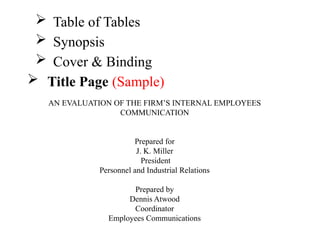
 Title Page (Sample)
AN EVALUATION OF THE FIRM’S INTERNAL EMPLOYEES
COMMUNICATION
Prepared for
J. K. Miller
President
Personnel and Industrial Relations
Prepared by
Dennis Atwood
Coordinator
Employees Communications
 Authorization
If you received a letter authorizing you to conduct
the study, that letter often becomes part of your final
report. The authorization letter specifies what is to
be done and establishes your authority to conduct the
research. Such a letter is included in most
government and other official reports, although it is
found less commonly in the business reports.
Letter of Transmittal
The purpose is to transmit the report to the reader(s).
It is similar to cover letter.
The letter can accomplish one or more of the
following tasks;
 establishes your authority to conduct the
research and write the report
 state the purpose of the project in a brief manner
 cite any major limitations of the report such as
interviewing fewer people because of vacation
schedule
 summarizes the basic findings
 acknowledges those who assisted in the
preparation of the report
 Table of Contents
The table of contents presents the major divisions
of the report and indicate their respective page
(report pagination is important)
 Table of Tables
If your table contains numerous tables and figures,
a separate listing of tables is necessary.
 Synopsis
This document is crispy written one-page
statement that gives an overview of the report and
stresses the result. Think of the major findings and
consider the busy executive who
will have only a few moments to concentrate on
your report. What are the most important items
from the report that must be communicated? The
synopsis should provide excellent overview to
the person who will read only this one page. To
further aid the busy reader, it is wise to include
clear topics, headings in the synopsis.
 Cover & Binding
Organizations often specify how they prefer to
have the report covered & bound. Numerous
styles & degrees of excellence are available.
Although inordinate expensive covers are not
recommended, it should be remembered that
some people judge a book by its cover. The date
placed on the cover presents ,at the least, the
report’s short title, the individual or the
department for whom the report is written and
the date.
A variety of techniques are available for
bindings the report. There are simple staple
binding, ring binding, spiral binding and plastic
binding methods etc available in the market.
Sometimes loose-leaf techniques are preferred.
• The Body
The body of the report presents the major
substantive materials. The organization of the
body follows the outline you have prepared
previously. The items contained in the body can
be categorized into three major divisions:
• introduction
• discussion, &
• conclusions & recommendations
• Introduction
Introduction is very similar to the research
proposal. The basic difference is that the proposal
is written in the future tense and the introduction
is written in the past tense. Generally the topics
covered in the introduction include:
 a statement of the problem
 a specific statement of purpose
 definition of terms
 research procedure and
 the scope & limitations of the research
It is important to establish clearly the case for
doing the research in the writing of the
introduction.
•Discussion
The discussion section of the report, actually the
heart of the report, takes up the majority of the
total length. All of the basic rules of
communications and writing are applied in
presenting the discussion. The format & the
generous use of headings are important. The
insertion of visual to supplement ideas also can
aid to the presentation.
Briefly review English usage before writing the
report. Some of the common items you probably
will encounter in writing the long report: direct
quotes, ellipses, capitalization, the use of
numbers, and others
Pagination is basic to the report and its
organization. Footnotes generally, if necessary,
appear at the bottom of the page. The business
report will also contain a bibliography that cites
all the sources used in the report. The simple
citation method calls for assigning each item in
the bibliography a number.
In the text, when it is necessary, for example to
refer to article by R. Wayne Pace, who is
assigned number 17, one just inserts (3). The
notation means the idea came from the work by
Pace, page (3).
Figures, Tables, Charts, obviously can be
important in the report.
•Conclusions and(or) Recommendations
The large report will have a conclusion. If the
writer’s assignment was to solve a problem, the
report also will have a recommendation.
Often the writer will want to include both
conclusions and recommendations.
The conclusion summarizes the major points of
the total report. If the report is one that calls for a
recommendation, the writer may prepare a
conclusion section and a separate
recommendation section. Recommendations
should be very clear, and precise. Broad multi-
directional recommendations help no one. If
recommendations for different areas are provided,
each section should be introduced with a heading.
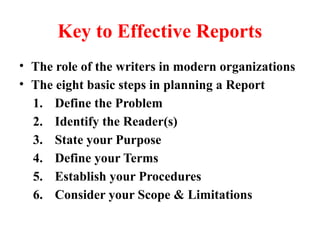
Key to Effective Reports
• The role of the writers in modern organizations
• The eight basic steps in planning a Report
1. Define the Problem
2. Identify the Reader(s)
3. State your Purpose
4. Define your Terms
5. Establish your Procedures
6. Consider your Scope & Limitations
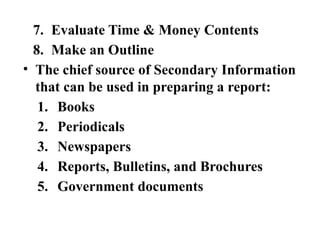
7. Evaluate Time & Money Contents
8. Make an Outline
• The chief source of Secondary Information
that can be used in preparing a report:
1. Books
2. Periodicals
3. Newspapers
4. Reports, Bulletins, and Brochures
5. Government documents
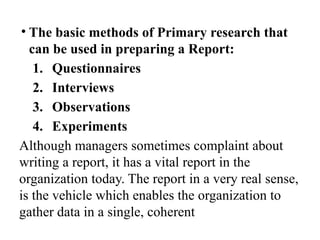
• The basic methods of Primary research that
can be used in preparing a Report:
1. Questionnaires
2. Interviews
3. Observations
4. Experiments
Although managers sometimes complaint about
writing a report, it has a vital report in the
organization today. The report in a very real sense,
is the vehicle which enables the organization to
gather data in a single, coherent
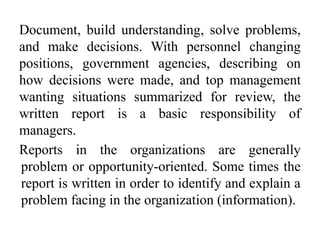
Document, build understanding, solve problems,
and make decisions. With personnel changing
positions, government agencies, describing on
how decisions were made, and top management
wanting situations summarized for review, the
written report is a basic responsibility of
managers.
Reports in the organizations are generally
problem or opportunity-oriented. Some times the
report is written in order to identify and explain a
problem facing in the organization (information).
At other times, it is prepared to present possible
solutions to problems (recommendations) or the
report may be used to analyze a situation or
describe how a unit or organization is attempting
to overcome previous or present problems
(analysis).
In business and other type of organizations the
report also is an action-oriented document. The
report puts a fence around a problem, presents an
analysis of a situation, offers justified conclusions
and finally makes carefully substantiated
recommendations.
It is through the report writing process that the
managers can present a rationale, build a case,
and reach a decision. All the steps in the process
–identifying the problem, purpose, and audience,
collecting and analyzing the data and
assembling.
The reports itself are carried through for one
purpose. The purpose is for the reader(s) to make
an effective decision.
Preparing to Write
Designing an effective plan is very important.
Make sure to follow eight basic steps.
1. Define the Problem
The first task of the report writer is to identify
the problem and state it accurately, objectively,
and clearly. This step often can be toughest in
the entire process. Your boss says “problem is
ineffective personnel.”That may be his
conclusion after he has reviewed the situation.
However the problem may be poor supervision,
inefficient equipment, labor troubles, or a dozen
other factors which contribute to the boss’s view of
ineffective personnel.
In many situations the problem can be stated in a
paragraph or two. Sometimes it may be necessary
to provide more information in stating the problem.
2. Identifying the Reader
Before attempting you must know who is going to
be the primary reader of the report and is there a
potential of wider circulation of the report.
If you are to prepare a report for someone very
familiar with the situation, many items can be left
out of the report or mentioned in a superficial
manner. On the other hand, if you are writing the
report for an individual who is unfamiliar with the
situation, you will need to go into much additional
details and you probably will need to provide
historical background. The reader also will influence
your research method, your writing style, your word
choice, the complexity or simplicity of your graphic
aids, how forcefully you state recommendations, and
to some degree what material you emphasize and
de-emphasize. In short knowing you reader(s) is a
key to effective communication.
3. State a Specific Purpose
Whereas the statement of the problem may be
somewhat general, the statement of the purpose is
very specific. The purpose statement is exact,
precise, and narrow. Some purpose statements could
be:
 to determine why the Karachi Lab has increased
its efficiency;
 to investigate if the amount of employee pilferage
varies significantly among our six retail outlets;
 to analyze the morals of selected quality
Auto—Parts Laborers;
 to determine how to improve signal strength;
In longer reports, it is possible to have a multiple
—purpose statements. But again, each statement
should be stated individually in the simpler and
clear manner.
4. Define the Terms
It is your responsibility to gain agreement on
what is really being investigated. What do you
mean with terms such as absenteeism, FIFO, or
Employee pilferage? You may mean one thing
and the reader may interpret another. Therefore
to eliminate problems, on the front end, before
you start your investigation and research, you
must make sure that all concerned are at the
same wavelength.
In defining terms, you use working definitions
that may not be identical with dictionary or
common usage definitions. You are defining the
terms in the context of the particular
investigation.
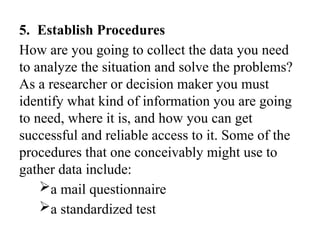
5. Establish Procedures
How are you going to collect the data you need
to analyze the situation and solve the problems?
As a researcher or decision maker you must
identify what kind of information you are going
to need, where it is, and how you can get
successful and reliable access to it. Some of the
procedures that one conceivably might use to
gather data include:
a mail questionnaire
a standardized test
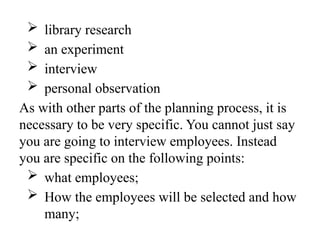
 library research
 an experiment
 interview
 personal observation
As with other parts of the planning process, it is
necessary to be very specific. You cannot just say
you are going to interview employees. Instead
you are specific on the following points:
 what employees;
 How the employees will be selected and how
many;
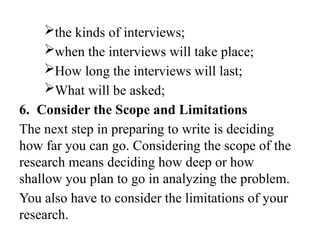
the kinds of interviews;
when the interviews will take place;
How long the interviews will last;
What will be asked;
6. Consider the Scope and Limitations
The next step in preparing to write is deciding
how far you can go. Considering the scope of the
research means deciding how deep or how
shallow you plan to go in analyzing the problem.
You also have to consider the limitations of your
research.
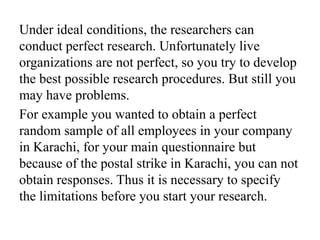
Under ideal conditions, the researchers can
conduct perfect research. Unfortunately live
organizations are not perfect, so you try to develop
the best possible research procedures. But still you
may have problems.
For example you wanted to obtain a perfect
random sample of all employees in your company
in Karachi, for your main questionnaire but
because of the postal strike in Karachi, you can not
obtain responses. Thus it is necessary to specify
the limitations before you start your research.
7. Evaluate Time & Money
Organizations are concerned with how long it will
take to obtain the answer they want and how much it
will cost. Often you are given an exact date for
presenting your report. It is important to consider the
problem, purpose, and procedure to see if it is
possible to accomplish the desired work within the
limits of time.
You also have to consider the cost of your research.
Obviously most organizations are not going to
authorize Rs. 190,000 research expenditure to solve
a Rs. 900 problem.
8. Outline
Before jumping into the report—writing and
decision making process, the final activity of the
planning stage is to prepare an initial outline. The
report outline, which indicates how the report
will be organized and what will be examined, aid
both you and another viewing your plan. It
clearly presents the building scheme.
There is nothing absolute about an outline, and it
will change many times before you complete the
project.
But it is much better to consult the road-map
before leaving on a journey than after going
down some road and discovering that you are
heading in the wrong direction or you have
reached at a dead end.
These eight steps to report writing are vital to
follow before you plan to write a report.
Gathering Information
• Secondary Sources
Secondary sources are those information sources
based on the experiences, experiments, and
writing of others. These may be:
Books
Magazines, and Periodicals
Newspapers
Reports, Bulletins, and Brochures
Government Documents
• Primary Sources
Primary source is the first-hand material. It is not
obtained in the library and is not determined by
someone else’s study; primary sources are
obtained and determined directly by you.
Questionnaires
Whom To questions
Random samples
Stratified samples
What kind of questionnaire
Designing your own questionnaire
Random Sample
The random sample assumes that every
individual in the universe has an equal chance of
being selected. Thus if you require a sample of
fifty from a population, or universe, of say 500
dentists, a plan must be devised to reach the
sample size in such a way that each dentist has
an equal opportunity of being selected .
Selected Sample
Realizing that you have 10 % of your employees
in management, 70 % in hourly positions, and
20 % in clerical jobs, you select a sample of 100
employees. You send ten questionnaire to managers,
seventy to hourly employee and twenty to those in
clerical positions. This is usually referred to as a
proportional stratified sample.
Designing your own Questionnaire
oSequence questions carefully;
o Ask simple questions for early
response;
o Address only one topic in each question;
oDo not ask a leading question;
oAvoid skip and jump questions
 Interviews
Face-to-face interviews
Telephone interviews
Observations
Experiments
Letter of Transmittal
It is also known as the Cover Letter and is
addressed to the person by whom the report was
previously requested and to whom it is being
submitted. It may often refer to conclusions and
recommendations and may also repeat Statement
of Purpose, Scope and Limitations.
It is a normal business letter and occupies one
page. It acts as an introduction to the report and
includes the Subject or Title of the report,
authorization for the report, and
acknowledgements.

The Short Reports & The Long Reports.pptx

  • 1.
    The Short Reports and TheLong Reports Effective Business Communication by Herta A. Murphy Herbert W. Hilderbrandt Jane P. Thomas
  • 2.
    The short reportsmust quickly capture the attention of the reader, immediately transmit the information needed, and often recommend a course of action to the reader. And it must do all this concisely and clearly. Different kinds of short reports are: • Proposal • Progress Report • Periodic Reports • Memo • Letter Report
  • 3.
    Proposal The reports stateyour understanding of what you have been asked to do, presents precisely how you are going to do it, and address each of the items noted in the planning of a report. Progress Report If you are coordinator for employee communications and are involved in a nine- months study to determine what employees want to read, it would be reasonable that your supervisor would want to keep informed, from
  • 4.
    time to time,of what is taking place concerning the study. The progress report can accomplish one or more following objectives: • Emphasize status • Note problems • Indicate schedule • Note costs Periodic Reports The periodic report is a routine statement concerning the activities of a manager’s job.
  • 5.
    Because the periodicreport is routine, the format and topics covered generally will differ from report to report. Memo Report These are the reports usually written within the organizations. Letter Report Letter is a bit more formal than the memorandum.
  • 6.
    The Long Reports Itis a formally written document that concerns a situation worthy of the considerable time and effort that must go into it. Whereas the short report summarizes activities, events, and situations, the long report is more detailed. It generally presents the results of an investigation and offers conclusions and/or recommendations. The long report will be studied carefully by those involved in the decision-making process. The long report will play an important role in
  • 7.
    formulating a decision-toeliminate a product, purchase a plant, acquire a company, or change the employees hospitalization program. Report Strategies It is important for the writer to develop the most appropriate strategy in order to gain acceptance for the ideas presented. Following may be the strategies: •The Persuasive Strategy After careful research, the coordinator of Internal
  • 8.
    Employees Communications determinesthat the department should be expanded. A long report needs to be prepared for the President. The coordinator feels that the department can attain the objectives only if it is expanded. There is a need to expand the department that conclusion is reached before writing the report. But now the report must be prepared in such a way as to persuade the decision makers that expansion is reasonable and acceptable.
  • 9.
    The use ofPrimary and secondary sources, the logic and how the ideas are supported become very important. This repot is difficult document to write because it must be clearly persuasive. • The Information Strategy The purpose of the information report is to present data. How the data are collected (primary & secondary sources) is as important as how the data are organized and presented. The originality of the writer in logically presenting and organizing the information is vital.
  • 10.
    It becomes importantto supplement the words with tables, charts, and other visual aids. The tables will permit the decision-makers to compare the quantitative information, while charts & graphs will reflect trends in production or sales. • The Comparative Strategy When an organization wants to consider various solutions to a problem, it is possible to organize the report to present the alternatives and compare them.
  • 11.
    For example thechoices facing a growing small- part manufacturing company could be presented using the comparative strategy:  expand the Detroit plant  expand the South California plant by adding third plant  expand the South California plant by addition to current physical facility  do not expand  maintain status quo.
  • 12.
    • The AnalyticalStrategy The primary purpose of some long reports is to analyze a situation. Such reports often follow a four-point presentation:  identifying the various problems (or supposed problem areas)  examine each in depth  present conclusion which are justified  offer recommendations which are substantiated
  • 13.
    • Combined Strategies Itmust be recognized that it is possible for a long report to encompass one or more of the strategies. For instance, a report on the expansion of the Internal Communications Department could:  start with a strong information strategy that would present history and need  compare alternative solutions to the problem  analyze each of the alternative
  • 14.
     present arecommendation in a persuasive manners Parts of the Long Report There are three basic parts to the long report and each can have several divisions: the preliminaries, the body, and the supplements For the purpose of showing you a long report, sample parts of one will be presented here. You should realize that some companies will want to rearrange the order. But if you know the purpose of each of the parts, you will be able to adjust to the standards of any organization’s format.
  • 15.
    • The Preliminaries Thefirst few pages of any report are devoted to preliminary matters. Some of these are formalities which depend on company policy. Others are meant to prepare readers for the report that follow:  Title Page  Authorization  Letter of transmittal  Table of Contents
  • 16.
     Table ofTables  Synopsis  Cover & Binding  Title Page (Sample) AN EVALUATION OF THE FIRM’S INTERNAL EMPLOYEES COMMUNICATION Prepared for J. K. Miller President Personnel and Industrial Relations Prepared by Dennis Atwood Coordinator Employees Communications
  • 17.
     Authorization If youreceived a letter authorizing you to conduct the study, that letter often becomes part of your final report. The authorization letter specifies what is to be done and establishes your authority to conduct the research. Such a letter is included in most government and other official reports, although it is found less commonly in the business reports. Letter of Transmittal The purpose is to transmit the report to the reader(s). It is similar to cover letter.
  • 18.
    The letter canaccomplish one or more of the following tasks;  establishes your authority to conduct the research and write the report  state the purpose of the project in a brief manner  cite any major limitations of the report such as interviewing fewer people because of vacation schedule  summarizes the basic findings  acknowledges those who assisted in the preparation of the report
  • 19.
     Table ofContents The table of contents presents the major divisions of the report and indicate their respective page (report pagination is important)  Table of Tables If your table contains numerous tables and figures, a separate listing of tables is necessary.  Synopsis This document is crispy written one-page statement that gives an overview of the report and stresses the result. Think of the major findings and consider the busy executive who
  • 20.
    will have onlya few moments to concentrate on your report. What are the most important items from the report that must be communicated? The synopsis should provide excellent overview to the person who will read only this one page. To further aid the busy reader, it is wise to include clear topics, headings in the synopsis.  Cover & Binding Organizations often specify how they prefer to have the report covered & bound. Numerous styles & degrees of excellence are available.
  • 21.
    Although inordinate expensivecovers are not recommended, it should be remembered that some people judge a book by its cover. The date placed on the cover presents ,at the least, the report’s short title, the individual or the department for whom the report is written and the date. A variety of techniques are available for bindings the report. There are simple staple binding, ring binding, spiral binding and plastic binding methods etc available in the market. Sometimes loose-leaf techniques are preferred.
  • 22.
    • The Body Thebody of the report presents the major substantive materials. The organization of the body follows the outline you have prepared previously. The items contained in the body can be categorized into three major divisions: • introduction • discussion, & • conclusions & recommendations
  • 23.
    • Introduction Introduction isvery similar to the research proposal. The basic difference is that the proposal is written in the future tense and the introduction is written in the past tense. Generally the topics covered in the introduction include:  a statement of the problem  a specific statement of purpose  definition of terms  research procedure and  the scope & limitations of the research
  • 24.
    It is importantto establish clearly the case for doing the research in the writing of the introduction. •Discussion The discussion section of the report, actually the heart of the report, takes up the majority of the total length. All of the basic rules of communications and writing are applied in presenting the discussion. The format & the generous use of headings are important. The insertion of visual to supplement ideas also can aid to the presentation.
  • 25.
    Briefly review Englishusage before writing the report. Some of the common items you probably will encounter in writing the long report: direct quotes, ellipses, capitalization, the use of numbers, and others Pagination is basic to the report and its organization. Footnotes generally, if necessary, appear at the bottom of the page. The business report will also contain a bibliography that cites all the sources used in the report. The simple citation method calls for assigning each item in the bibliography a number.
  • 26.
    In the text,when it is necessary, for example to refer to article by R. Wayne Pace, who is assigned number 17, one just inserts (3). The notation means the idea came from the work by Pace, page (3). Figures, Tables, Charts, obviously can be important in the report. •Conclusions and(or) Recommendations The large report will have a conclusion. If the writer’s assignment was to solve a problem, the report also will have a recommendation.
  • 27.
    Often the writerwill want to include both conclusions and recommendations. The conclusion summarizes the major points of the total report. If the report is one that calls for a recommendation, the writer may prepare a conclusion section and a separate recommendation section. Recommendations should be very clear, and precise. Broad multi- directional recommendations help no one. If recommendations for different areas are provided, each section should be introduced with a heading.
  • 28.
    Key to EffectiveReports • The role of the writers in modern organizations • The eight basic steps in planning a Report 1. Define the Problem 2. Identify the Reader(s) 3. State your Purpose 4. Define your Terms 5. Establish your Procedures 6. Consider your Scope & Limitations
  • 29.
    7. Evaluate Time& Money Contents 8. Make an Outline • The chief source of Secondary Information that can be used in preparing a report: 1. Books 2. Periodicals 3. Newspapers 4. Reports, Bulletins, and Brochures 5. Government documents
  • 30.
    • The basicmethods of Primary research that can be used in preparing a Report: 1. Questionnaires 2. Interviews 3. Observations 4. Experiments Although managers sometimes complaint about writing a report, it has a vital report in the organization today. The report in a very real sense, is the vehicle which enables the organization to gather data in a single, coherent
  • 31.
    Document, build understanding,solve problems, and make decisions. With personnel changing positions, government agencies, describing on how decisions were made, and top management wanting situations summarized for review, the written report is a basic responsibility of managers. Reports in the organizations are generally problem or opportunity-oriented. Some times the report is written in order to identify and explain a problem facing in the organization (information).
  • 32.
    At other times,it is prepared to present possible solutions to problems (recommendations) or the report may be used to analyze a situation or describe how a unit or organization is attempting to overcome previous or present problems (analysis). In business and other type of organizations the report also is an action-oriented document. The report puts a fence around a problem, presents an analysis of a situation, offers justified conclusions and finally makes carefully substantiated recommendations.
  • 33.
    It is throughthe report writing process that the managers can present a rationale, build a case, and reach a decision. All the steps in the process –identifying the problem, purpose, and audience, collecting and analyzing the data and assembling. The reports itself are carried through for one purpose. The purpose is for the reader(s) to make an effective decision.
  • 34.
    Preparing to Write Designingan effective plan is very important. Make sure to follow eight basic steps. 1. Define the Problem The first task of the report writer is to identify the problem and state it accurately, objectively, and clearly. This step often can be toughest in the entire process. Your boss says “problem is ineffective personnel.”That may be his conclusion after he has reviewed the situation. However the problem may be poor supervision,
  • 35.
    inefficient equipment, labortroubles, or a dozen other factors which contribute to the boss’s view of ineffective personnel. In many situations the problem can be stated in a paragraph or two. Sometimes it may be necessary to provide more information in stating the problem. 2. Identifying the Reader Before attempting you must know who is going to be the primary reader of the report and is there a potential of wider circulation of the report.
  • 36.
    If you areto prepare a report for someone very familiar with the situation, many items can be left out of the report or mentioned in a superficial manner. On the other hand, if you are writing the report for an individual who is unfamiliar with the situation, you will need to go into much additional details and you probably will need to provide historical background. The reader also will influence your research method, your writing style, your word choice, the complexity or simplicity of your graphic aids, how forcefully you state recommendations, and to some degree what material you emphasize and
  • 37.
    de-emphasize. In shortknowing you reader(s) is a key to effective communication. 3. State a Specific Purpose Whereas the statement of the problem may be somewhat general, the statement of the purpose is very specific. The purpose statement is exact, precise, and narrow. Some purpose statements could be:  to determine why the Karachi Lab has increased its efficiency;  to investigate if the amount of employee pilferage varies significantly among our six retail outlets;
  • 38.
     to analyzethe morals of selected quality Auto—Parts Laborers;  to determine how to improve signal strength; In longer reports, it is possible to have a multiple —purpose statements. But again, each statement should be stated individually in the simpler and clear manner. 4. Define the Terms It is your responsibility to gain agreement on what is really being investigated. What do you mean with terms such as absenteeism, FIFO, or
  • 39.
    Employee pilferage? Youmay mean one thing and the reader may interpret another. Therefore to eliminate problems, on the front end, before you start your investigation and research, you must make sure that all concerned are at the same wavelength. In defining terms, you use working definitions that may not be identical with dictionary or common usage definitions. You are defining the terms in the context of the particular investigation.
  • 40.
    5. Establish Procedures Howare you going to collect the data you need to analyze the situation and solve the problems? As a researcher or decision maker you must identify what kind of information you are going to need, where it is, and how you can get successful and reliable access to it. Some of the procedures that one conceivably might use to gather data include: a mail questionnaire a standardized test
  • 41.
     library research an experiment  interview  personal observation As with other parts of the planning process, it is necessary to be very specific. You cannot just say you are going to interview employees. Instead you are specific on the following points:  what employees;  How the employees will be selected and how many;
  • 42.
    the kinds ofinterviews; when the interviews will take place; How long the interviews will last; What will be asked; 6. Consider the Scope and Limitations The next step in preparing to write is deciding how far you can go. Considering the scope of the research means deciding how deep or how shallow you plan to go in analyzing the problem. You also have to consider the limitations of your research.
  • 43.
    Under ideal conditions,the researchers can conduct perfect research. Unfortunately live organizations are not perfect, so you try to develop the best possible research procedures. But still you may have problems. For example you wanted to obtain a perfect random sample of all employees in your company in Karachi, for your main questionnaire but because of the postal strike in Karachi, you can not obtain responses. Thus it is necessary to specify the limitations before you start your research.
  • 44.
    7. Evaluate Time& Money Organizations are concerned with how long it will take to obtain the answer they want and how much it will cost. Often you are given an exact date for presenting your report. It is important to consider the problem, purpose, and procedure to see if it is possible to accomplish the desired work within the limits of time. You also have to consider the cost of your research. Obviously most organizations are not going to authorize Rs. 190,000 research expenditure to solve a Rs. 900 problem.
  • 45.
    8. Outline Before jumpinginto the report—writing and decision making process, the final activity of the planning stage is to prepare an initial outline. The report outline, which indicates how the report will be organized and what will be examined, aid both you and another viewing your plan. It clearly presents the building scheme. There is nothing absolute about an outline, and it will change many times before you complete the project.
  • 46.
    But it ismuch better to consult the road-map before leaving on a journey than after going down some road and discovering that you are heading in the wrong direction or you have reached at a dead end. These eight steps to report writing are vital to follow before you plan to write a report.
  • 47.
    Gathering Information • SecondarySources Secondary sources are those information sources based on the experiences, experiments, and writing of others. These may be: Books Magazines, and Periodicals Newspapers Reports, Bulletins, and Brochures Government Documents
  • 48.
    • Primary Sources Primarysource is the first-hand material. It is not obtained in the library and is not determined by someone else’s study; primary sources are obtained and determined directly by you. Questionnaires Whom To questions Random samples Stratified samples What kind of questionnaire Designing your own questionnaire
  • 49.
    Random Sample The randomsample assumes that every individual in the universe has an equal chance of being selected. Thus if you require a sample of fifty from a population, or universe, of say 500 dentists, a plan must be devised to reach the sample size in such a way that each dentist has an equal opportunity of being selected . Selected Sample Realizing that you have 10 % of your employees in management, 70 % in hourly positions, and
  • 50.
    20 % inclerical jobs, you select a sample of 100 employees. You send ten questionnaire to managers, seventy to hourly employee and twenty to those in clerical positions. This is usually referred to as a proportional stratified sample. Designing your own Questionnaire oSequence questions carefully; o Ask simple questions for early response; o Address only one topic in each question; oDo not ask a leading question;
  • 51.
    oAvoid skip andjump questions  Interviews Face-to-face interviews Telephone interviews Observations Experiments
  • 52.
    Letter of Transmittal Itis also known as the Cover Letter and is addressed to the person by whom the report was previously requested and to whom it is being submitted. It may often refer to conclusions and recommendations and may also repeat Statement of Purpose, Scope and Limitations. It is a normal business letter and occupies one page. It acts as an introduction to the report and includes the Subject or Title of the report, authorization for the report, and acknowledgements.