Lecturer-: Ven. K. Wimaladhamma
Presented by
Ven. B. Dhammarama
SIBA-BABL 14-13
4th Semester
Sri Lanka International Buddhist Academy
Content
 Introduction
 Origin of Philosophy
 Definition of Philosophy
 Goals of Philosophy
 Scope of Philosophy
 Branches of Philosophy
 Importance of Philosophy
 Conclusion
 References
Introduction
Philosophy is the systematic study of the foundation of
human knowledge with an emphasis on the conditions of its
validity and finding answers to ultimate questions.
Though the term philosophy is of Western origin and implies
a kind of investigation typical of western culture, it has its
equivalents in the various other cultures of the world,
notably India, China and the Middle East.
In this presentation I’ll give a brief introduction on what
philosophy is? And what do we have to study in the name of
philosophy? So on……
Origin of Philosophy
Socrates, a Greek philosopher used the
term philosophie as an equivalent to the
search for wisdom. Also, the term
wisdom is used as a general term for
describing the intellectual probing of
any idea.
The term “philosophy” is taken from the
Greek word „phylos‟ meaning “to love” or
“to befriend” and „sophie‟ meaning
“wisdom”. Thus philosophy means “love
of wisdom”.
Definition of Philosophy
Philia
Sofia
Love
Wisdom
 The study of the nature and meaning of the universe and of human life
-Oxford Advanced Learner’s Dictionary
 Truth of reason (Analytical propositions)
-Immanuel Kant
 Philosophy is a systematic and comprehensive study of truth about life, about
the universe, and everything including events, relationship and experience.
 Philosophy is a process of analysis, criticism, interpretation and speculation.
Goals of Philosophy
 Wisdom is the main goal of
philosophy.
 Discovering the nature of
truth and the nature of
knowledge.
 It searches for what is basic
value and importance in life.
 Examining the relationship
between individuals and the
society as well as humanity
and nature.
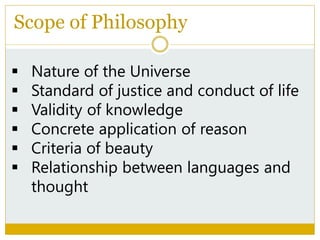
Scope of Philosophy
 Nature of the Universe
 Standard of justice and conduct of life
 Validity of knowledge
 Concrete application of reason
 Criteria of beauty
 Relationship between languages and
thought
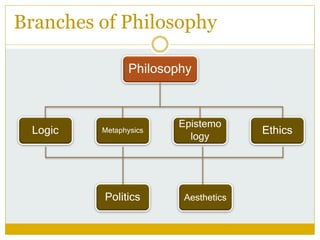
Branches of Philosophy
Philosophy
Epistemo
logy
EthicsLogic Metaphysics
Politics Aesthetics
Importance of Philosophy
1. People can clarify what they are believing.
2. We can be stimulated to think of ultimate question.
3. Philosophy promises us better understanding of ourselves.
4. The study of philosophy enables us to think carefully and
clearly about important issues.
5. Studying philosophy sharpens our analytical abilities,
enabling to identify and evaluate the strengths and
weaknesses in any position.
6. It hones your ability to construct and articulate cogent
arguments of your own.
Conclusion
I hope that, now you may understand that what philosophy is?
and what are the thing that we have to study in the name of
philosophy. Every nation, culture, religion, community has its
own set of philosophical beliefs.
Philosophy is the systematic study of ideas and issues, a
reasoned pursuit of fundamental truths, a quest for a
comprehensive understanding of the world, a study of
principles of conduct and much more.
Philosophy has one major goal is the development of the total
intellect of a person and the realization of the human potential.
References
Primary Sources
• Descartes & Rene (1998), Discourse on Method and Meditation on First
Philosophy, Fourth Edition, Hacket Publishing Company.
• Brian Carr & Indira Mahalingam (2013), Companion Encyclopedia of
Asian Philosophy, Thistlerose Publication.
Secondary Sources
• Grayling A.C. (1998), Philosophy 1: A Guide through the Subject, Oxford
University Press.
• Durant, Will & Ariel Durant (1991), The Story of Philosophy: The Lives and
Opinions of the World’s Greatest Philosophers, Indiana University Press.
Dictionary
Oxford Advanced Learner’s Dictionary.
Introduction to philosophy

Introduction to philosophy

  • 1.
    Lecturer-: Ven. K.Wimaladhamma Presented by Ven. B. Dhammarama SIBA-BABL 14-13 4th Semester Sri Lanka International Buddhist Academy
  • 2.
    Content  Introduction  Originof Philosophy  Definition of Philosophy  Goals of Philosophy  Scope of Philosophy  Branches of Philosophy  Importance of Philosophy  Conclusion  References
  • 3.
    Introduction Philosophy is thesystematic study of the foundation of human knowledge with an emphasis on the conditions of its validity and finding answers to ultimate questions. Though the term philosophy is of Western origin and implies a kind of investigation typical of western culture, it has its equivalents in the various other cultures of the world, notably India, China and the Middle East. In this presentation I’ll give a brief introduction on what philosophy is? And what do we have to study in the name of philosophy? So on……
  • 4.
    Origin of Philosophy Socrates,a Greek philosopher used the term philosophie as an equivalent to the search for wisdom. Also, the term wisdom is used as a general term for describing the intellectual probing of any idea. The term “philosophy” is taken from the Greek word „phylos‟ meaning “to love” or “to befriend” and „sophie‟ meaning “wisdom”. Thus philosophy means “love of wisdom”.
  • 5.
    Definition of Philosophy Philia Sofia Love Wisdom The study of the nature and meaning of the universe and of human life -Oxford Advanced Learner’s Dictionary  Truth of reason (Analytical propositions) -Immanuel Kant  Philosophy is a systematic and comprehensive study of truth about life, about the universe, and everything including events, relationship and experience.  Philosophy is a process of analysis, criticism, interpretation and speculation.
  • 6.
    Goals of Philosophy Wisdom is the main goal of philosophy.  Discovering the nature of truth and the nature of knowledge.  It searches for what is basic value and importance in life.  Examining the relationship between individuals and the society as well as humanity and nature.
  • 7.
    Scope of Philosophy Nature of the Universe  Standard of justice and conduct of life  Validity of knowledge  Concrete application of reason  Criteria of beauty  Relationship between languages and thought
  • 8.
  • 9.
    Importance of Philosophy 1.People can clarify what they are believing. 2. We can be stimulated to think of ultimate question. 3. Philosophy promises us better understanding of ourselves. 4. The study of philosophy enables us to think carefully and clearly about important issues. 5. Studying philosophy sharpens our analytical abilities, enabling to identify and evaluate the strengths and weaknesses in any position. 6. It hones your ability to construct and articulate cogent arguments of your own.
  • 10.
    Conclusion I hope that,now you may understand that what philosophy is? and what are the thing that we have to study in the name of philosophy. Every nation, culture, religion, community has its own set of philosophical beliefs. Philosophy is the systematic study of ideas and issues, a reasoned pursuit of fundamental truths, a quest for a comprehensive understanding of the world, a study of principles of conduct and much more. Philosophy has one major goal is the development of the total intellect of a person and the realization of the human potential.
  • 11.
    References Primary Sources • Descartes& Rene (1998), Discourse on Method and Meditation on First Philosophy, Fourth Edition, Hacket Publishing Company. • Brian Carr & Indira Mahalingam (2013), Companion Encyclopedia of Asian Philosophy, Thistlerose Publication. Secondary Sources • Grayling A.C. (1998), Philosophy 1: A Guide through the Subject, Oxford University Press. • Durant, Will & Ariel Durant (1991), The Story of Philosophy: The Lives and Opinions of the World’s Greatest Philosophers, Indiana University Press. Dictionary Oxford Advanced Learner’s Dictionary.