Lock Out / Tag Out - (LOTO)
TRAINING
BY
PARABAKARAN BALASUBRAMANIAM
2
Professional Summary: With over 15 years of comprehensive experience in
Environmental Safety and Health (HSE), Parabakaran Balasubramaniam is a
seasoned professional with specialized expertise in delivering impactful training
programs. He holds a Master's Degree in Environmental Safety and Health from
the University Malaysia Pahang and has dedicated 5 years specifically to the
field of HSE training and consultancy.
Key Skills and Competencies:
Extensive knowledge in environmental safety regulations and compliance
standards.
Proven track record in designing and delivering engaging and effective HSE
training modules.
Strong understanding of risk assessment methodologies and hazard control
strategies.
Skilled in conducting safety audits and implementing corrective measures.
Excellent communication and interpersonal skills for effective training delivery
PRE TRAINING ASSESMENT
Objectives of LOTO training
After this training session you will be able:
 Better understand requirements Lockout/TAGout (LOTO) standard
 Better understand hazards of unexpected energization or start-up of the
equipment, while maintenance and service
 How safely organize equipment service and maintenance by following with
LOTO requirements or apply alternative means of control
Foreword
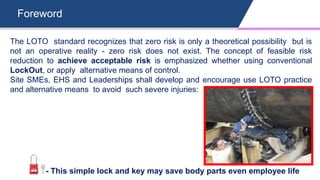
The LOTO standard recognizes that zero risk is only a theoretical possibility but is
not an operative reality - zero risk does not exist. The concept of feasible risk
reduction to achieve acceptable risk is emphasized whether using conventional
LockOut, or apply alternative means of control.
Site SMEs, EHS and Leaderships shall develop and encourage use LOTO practice
and alternative means to avoid such severe injuries:
- This simple lock and key may save body parts even employee life
Foreword
BUSINESS CONFIDENTIAL |
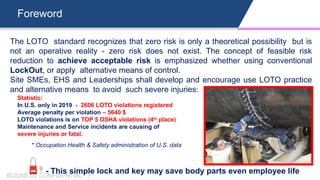
The LOTO standard recognizes that zero risk is only a theoretical possibility but is
not an operative reality - zero risk does not exist. The concept of feasible risk
reduction to achieve acceptable risk is emphasized whether using conventional
LockOut, or apply alternative means of control.
Site SMEs, EHS and Leaderships shall develop and encourage use LOTO practice
and alternative means to avoid such severe injuries:
- This simple lock and key may save body parts even employee life
Statistic:
In U.S. only in 2019 - 2606 LOTO violations registered
Average penalty per violation – 5640 $
LOTO violations is on TOP 5 OSHA violations (4th
place)
Maintenance and Service incidents are causing of
severe injuries or fatal.
* Occupation Health & Safety administration of U.S. data
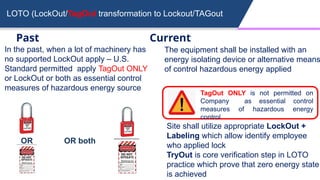
LOTO (LockOut/TagOut transformation to Lockout/TAGout
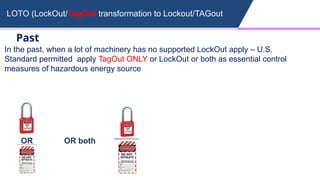
In the past, when a lot of machinery has no supported LockOut apply – U.S.
Standard permitted apply TagOut ONLY or LockOut or both as essential control
measures of hazardous energy source
Past
OR OR both
LOTO (LockOut/TagOut transformation to Lockout/TAGout
In the past, when a lot of machinery has
no supported LockOut apply – U.S.
Standard permitted apply TagOut ONLY
or LockOut or both as essential control
measures of hazardous energy source
Past Current
Site shall utilize appropriate LockOut +
Labeling which allow identify employee
who applied lock
TryOut is core verification step in LOTO
practice which prove that zero energy state
is achieved
The equipment shall be installed with an
energy isolating device or alternative means
of control hazardous energy applied
TagOut ONLY is not permitted on
Company as essential control
measures of hazardous energy
control
OR OR both
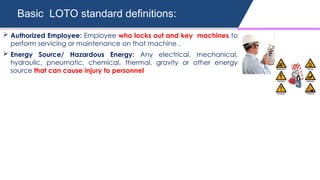
Basic LOTO standard definitions:
 Authorized Employee: Employee who locks out and key machines to
perform servicing or maintenance on that machine .
 Energy Source/ Hazardous Energy: Any electrical, mechanical,
hydraulic, pneumatic, chemical, thermal, gravity or other energy
source that can cause injury to personnel
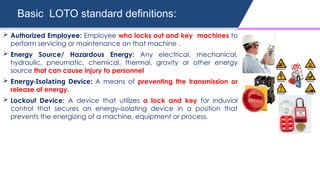
Basic LOTO standard definitions:
 Authorized Employee: Employee who locks out and key machines to
perform servicing or maintenance on that machine .
 Energy Source/ Hazardous Energy: Any electrical, mechanical,
hydraulic, pneumatic, chemical, thermal, gravity or other energy
source that can cause injury to personnel
 Energy-Isolating Device: A means of preventing the transmission or
release of energy.
 Lockout Device: A device that utilizes a lock and key for induvial
control that secures an energy-isolating device in a position that
prevents the energizing of a machine, equipment or process.
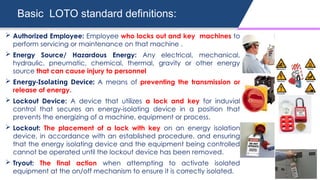
Basic LOTO standard definitions:
 Authorized Employee: Employee who locks out and key machines to
perform servicing or maintenance on that machine .
 Energy Source/ Hazardous Energy: Any electrical, mechanical,
hydraulic, pneumatic, chemical, thermal, gravity or other energy
source that can cause injury to personnel
 Energy-Isolating Device: A means of preventing the transmission or
release of energy.
 Lockout Device: A device that utilizes a lock and key for induvial
control that secures an energy-isolating device in a position that
prevents the energizing of a machine, equipment or process.
 Lockout: The placement of a lock with key on an energy isolation
device, in accordance with an established procedure, and ensuring
that the energy isolating device and the equipment being controlled
cannot be operated until the lockout device has been removed.
 Tryout: The final action when attempting to activate isolated
equipment at the on/off mechanism to ensure it is correctly isolated.
Exclusions from LOTO standard
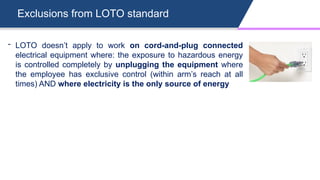
- LOTO doesn’t apply to work on cord-and-plug connected
electrical equipment where: the exposure to hazardous energy
is controlled completely by unplugging the equipment where
the employee has exclusive control (within arm’s reach at all
times) AND where electricity is the only source of energy
Exclusions from LOTO standard
- LOTO doesn’t apply to work on cord-and-plug connected
electrical equipment where: the exposure to hazardous energy
is controlled completely by unplugging the equipment where
the employee has exclusive control (within arm’s reach at all
times) AND where electricity is the only source of energy
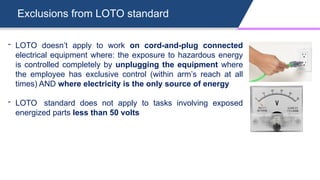
- LOTO standard does not apply to tasks involving exposed
energized parts less than 50 volts
Exclusions from LOTO standard
- LOTO doesn’t apply to work on cord-and-plug connected
electrical equipment where: the exposure to hazardous energy
is controlled completely by unplugging the equipment where
the employee has exclusive control (within arm’s reach at all
times) AND where electricity is the only source of energy
- LOTO standard does not apply to tasks involving exposed
energized parts less than 50 volts
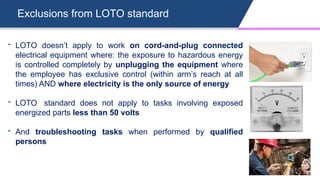
- And troubleshooting tasks when performed by qualified
persons
Section 3.1 and 3.1.3: Requirements for site
local procedure
15
Remember Your Site procedure Shall cover the below items:
• Corporate EHS standard
- Cover all sections of the corporate standard that apply to your site
• Local regulations (country, regional, state, province, etc.)
• Divisional requirements
• Consensus standard
• Site and Customer Requirements
Note:
 If local regulations are more stringent follow corporate standard plus
additional local regulations
 If local regulations are less stringent follow corporate standard
Section 3.1 and 3.1.3: Requirements for
site local procedure (Part 1)
 Process for creating, validating, approving, updating machine/system specific
LOTO instructions
 Process to maintain inventory of all LOTO Subject Matter Experts (SMEs) and
their responsible area
 Process for notification of affected employees
 Process for properly shutting down equipment and/or machinery
 Process for isolating all primary energy sources
 Process for releasing all secondary (stored) sources of energy
 Process for verifying the lockout (Tryout)
Section 3.1 and 3.1.3: Requirements for
site local procedure (Part 2)
 Process for handling lockout during shift change
 Process for bring equipment back normal operation
 Process for group LOTO
 Process for lockout device destroying & removal
 Process for minor service exceptions to LOTO and alternative means of control
 Process for taking equipment out of service for long term
 Requirements for Energy Isolation (LOTO) devices
 Identifying employee(s) who applied lock(s)
 Contractor personnel LOTO requirements
The machine inventory shall
- Determine which machines or pieces of equipment
apply LOTO practice
- Identify equipment that are only maintained by
contractors
- Will be reviewed on an annual basis
- Cover all production floor as well warehouse,
laboratory, offices, utilities supply system, etc.
Authorized employees training shall include:
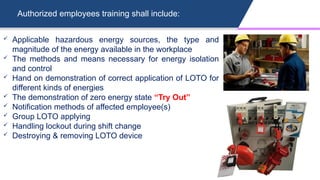
 Applicable hazardous energy sources, the type and
magnitude of the energy available in the workplace
 The methods and means necessary for energy isolation
and control
 Hand on demonstration of correct application of LOTO for
different kinds of energies
 The demonstration of zero energy state “Try Out”
 Notification methods of affected employee(s)
 Group LOTO applying
 Handling lockout during shift change
 Destroying & removing LOTO device
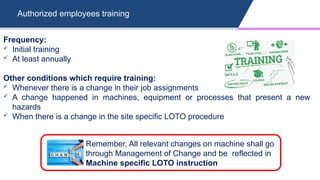
Authorized employees training
Frequency:
 Initial training
 At least annually
Other conditions which require training:
 Whenever there is a change in their job assignments
 A change happened in machines, equipment or processes that present a new
hazards
 When there is a change in the site specific LOTO procedure
Remember, All relevant changes on machine shall go
through Management of Change and be reflected in
Machine specific LOTO instruction
LOTO SMEs & other employees training
BUSINESS CONFIDENTIAL |
Each LOTO SMEs shall:
 Be trained equal with Authorized employee training
 Fully understand requirements of LOTO standards and the purpose of LOTO.
 Document their understanding and demonstrate their competency with the design,
construction, operation and/or maintenance of the specific machine/system and the
associated hazards. This shall be documented through education, training and/or
experience.
All affected employees shall:
 Be instructed in the purpose and
use of this standard
 At least annual retraining
All other employees:
 who work in an area where this standard may be used, shall be instructed on the
general requirements of LOTO, and the fact that it is prohibited to attempt to restart
or reenergize machines or equipment that are locked out
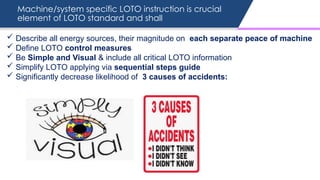
Machine/system specific LOTO instruction is crucial
element of LOTO standard and shall
 Describe all energy sources, their magnitude on each separate peace of machine
 Define LOTO control measures
 Be Simple and Visual & include all critical LOTO information
 Simplify LOTO applying via sequential steps guide
 Significantly decrease likelihood of 3 causes of accidents:
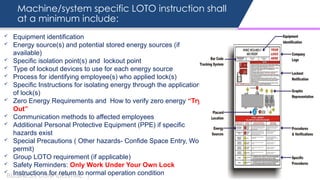
Machine/system specific LOTO instruction shall
at a minimum include:
BUSINESS CONFIDENTIAL |
 Equipment identification
 Energy source(s) and potential stored energy sources (if
available)
 Specific isolation point(s) and lockout point
 Type of lockout devices to use for each energy source
 Process for identifying employee(s) who applied lock(s)
 Specific Instructions for isolating energy through the application
of lock(s)
 Zero Energy Requirements and How to verify zero energy “Try-
Out”
 Communication methods to affected employees
 Additional Personal Protective Equipment (PPE) if specific
hazards exist
 Special Precautions ( Other hazards- Confide Space Entry, Work
permit)
 Group LOTO requirement (if applicable)
 Safety Reminders: Only Work Under Your Own Lock
 Instructions for return to normal operation condition
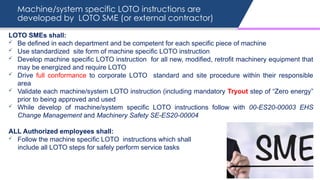
Machine/system specific LOTO instructions are
developed by LOTO SME (or external contractor)
LOTO SMEs shall:
 Be defined in each department and be competent for each specific piece of machine
 Use standardized site form of machine specific LOTO instruction
 Develop machine specific LOTO instruction for all new, modified, retrofit machinery equipment that
may be energized and require LOTO
 Drive full conformance to corporate LOTO standard and site procedure within their responsible
area
 Validate each machine/system LOTO instruction (including mandatory Tryout step of “Zero energy”
prior to being approved and used
 While develop of machine/system specific LOTO instructions follow with 00-ES20-00003 EHS
Change Management and Machinery Safety SE-ES20-00004
ALL Authorized employees shall:
 Follow the machine specific LOTO instructions which shall
include all LOTO steps for safely perform service tasks
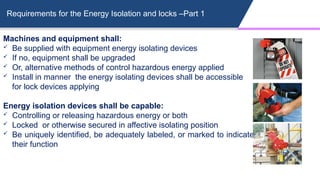
Requirements for the Energy Isolation and locks –Part 1
Machines and equipment shall:
 Be supplied with equipment energy isolating devices
 If no, equipment shall be upgraded
 Or, alternative methods of control hazardous energy applied
 Install in manner the energy isolating devices shall be accessible
for lock devices applying
Energy isolation devices shall be capable:
 Controlling or releasing hazardous energy or both
 Locked or otherwise secured in affective isolating position
 Be uniquely identified, be adequately labeled, or marked to indicate
their function
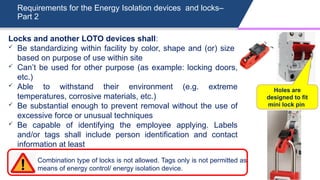
Requirements for the Energy Isolation devices and locks–
Part 2
Locks and another LOTO devices shall:
 Be standardizing within facility by color, shape and (or) size
based on purpose of use within site
 Can’t be used for other purpose (as example: locking doors,
etc.)
 Able to withstand their environment (e.g. extreme
temperatures, corrosive materials, etc.)
 Be substantial enough to prevent removal without the use of
excessive force or unusual techniques
 Be capable of identifying the employee applying. Labels
and/or tags shall include person identification and contact
information at least
Holes are
designed to fit
mini lock pin
Combination type of locks is not allowed. Tags only is not permitted as
means of energy control/ energy isolation device.
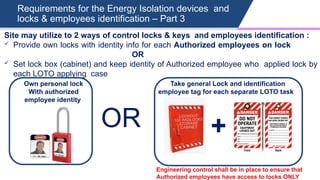
Requirements for the Energy Isolation devices and
locks & employees identification – Part 3
Site may utilize to 2 ways of control locks & keys and employees identification :
 Provide own locks with identity info for each Authorized employees on lock
OOOOOOOOOOOOOOOOOOOOR
 Set lock box (cabinet) and keep identity of Authorized employee who applied lock by
each LOTO applying case
OR +
Own personal lock
With authorized
employee identity
Take general Lock and identification
employee tag for each separate LOTO task
Engineering control shall be in place to ensure that
Authorized employees have access to locks ONLY
Requirements for the Energy Isolation devices and
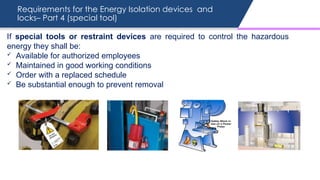
locks– Part 4 (special tool)
If special tools or restraint devices are required to control the hazardous
energy they shall be:
 Available for authorized employees
 Maintained in good working conditions
 Order with a replaced schedule
 Be substantial enough to prevent removal
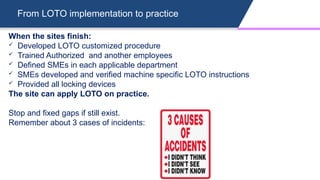
From LOTO implementation to practice
When the sites finish:
 Developed LOTO customized procedure
 Trained Authorized and another employees
 Defined SMEs in each applicable department
 SMEs developed and verified machine specific LOTO instructions
 Provided all locking devices
The site can apply LOTO on practice.
Stop and fixed gaps if still exist.
Remember about 3 cases of incidents:
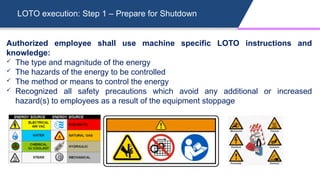
LOTO execution: Step 1 – Prepare for Shutdown
Authorized employee shall use machine specific LOTO instructions and
knowledge:
 The type and magnitude of the energy
 The hazards of the energy to be controlled
 The method or means to control the energy
 Recognized all safety precautions which avoid any additional or increased
hazard(s) to employees as a result of the equipment stoppage
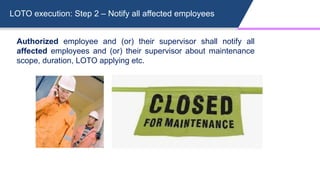
LOTO execution: Step 2 – Notify all affected employees
Authorized employee and (or) their supervisor shall notify all
affected employees and (or) their supervisor about maintenance
scope, duration, LOTO applying etc.
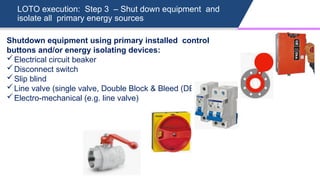
LOTO execution: Step 3 – Shut down equipment and
isolate all primary energy sources
Shutdown equipment using primary installed control
buttons and/or energy isolating devices:
Electrical circuit beaker
Disconnect switch
Slip blind
Line valve (single valve, Double Block & Bleed (DBB) valve)
Electro-mechanical (e.g. line valve)
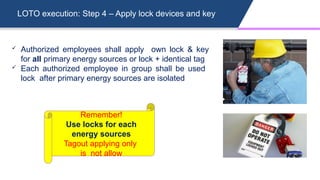
LOTO execution: Step 4 – Apply lock devices and key
 Authorized employees shall apply own lock & key
for all primary energy sources or lock + identical tag
 Each authorized employee in group shall be used
lock after primary energy sources are isolated
Remember!
Use locks for each
energy sources
Tagout applying only
is not allow
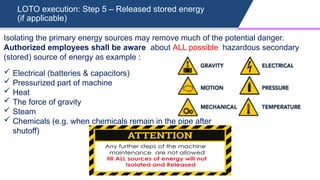
LOTO execution: Step 5 – Released stored energy
(if applicable)
 Electrical (batteries & capacitors)
 Pressurized part of machine
 Heat
 The force of gravity
 Steam
 Chemicals (e.g. when chemicals remain in the pipe after
shutoff)
Isolating the primary energy sources may remove much of the potential danger.
Authorized employees shall be aware about ALL possible hazardous secondary
(stored) source of energy as example :
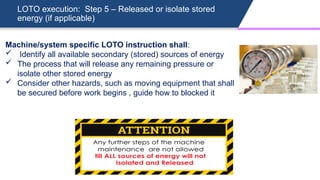
LOTO execution: Step 5 – Released or isolate stored
energy (if applicable)
Machine/system specific LOTO instruction shall:
 Identify all available secondary (stored) sources of energy
 The process that will release any remaining pressure or
isolate other stored energy
 Consider other hazards, such as moving equipment that shall
be secured before work begins , guide how to blocked it
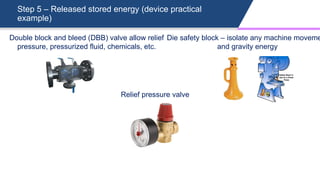
Step 5 – Released stored energy (device practical
example)
Double block and bleed (DBB) valve allow relief
pressure, pressurized fluid, chemicals, etc.
Die safety block – isolate any machine moveme
and gravity energy
Relief pressure valve
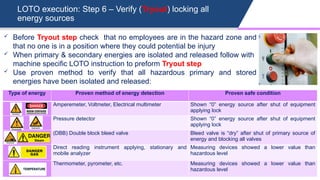
LOTO execution: Step 6 – Verify (Tryout) locking all
energy sources
 Before Tryout step check that no employees are in the hazard zone and
that no one is in a position where they could potential be injury
 When primary & secondary energies are isolated and released follow with
machine specific LOTO instruction to preform Tryout step
 Use proven method to verify that all hazardous primary and stored
energies have been isolated and released:
Type of energy Proven method of energy detection Proven safe condition
Amperemeter, Voltmeter, Electrical multimeter Shown “0” energy source after shut of equipment
applying lock
Pressure detector Shown “0” energy source after shut of equipment
applying lock
(DBB) Double block bleed valve Bleed valve is “dry” after shut of primary source of
energy and blocking all valves
Direct reading instrument applying, stationary and
mobile analyzer
Measuring devices showed a lower value than
hazardous level
Thermometer, pyrometer, etc. Measuring devices showed a lower value than
hazardous level
LOTO execution: Step 6 – Verify (Tryout) locking all
energy sources
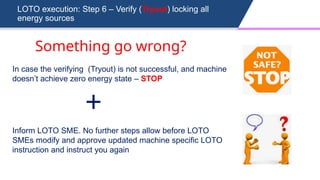
Something go wrong?
In case the verifying (Tryout) is not successful, and machine
doesn’t achieve zero energy state – STOP
+
Inform LOTO SME. No further steps allow before LOTO
SMEs modify and approve updated machine specific LOTO
instruction and instruct you again
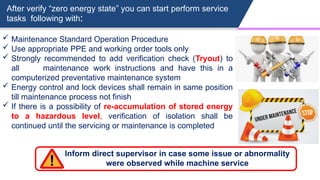
After verify “zero energy state” you can start perform service
tasks following with:
 Maintenance Standard Operation Procedure
 Use appropriate PPE and working order tools only
 Strongly recommended to add verification check (Tryout) to
all maintenance work instructions and have this in a
computerized preventative maintenance system
 Energy control and lock devices shall remain in same position
till maintenance process not finish
 If there is a possibility of re-accumulation of stored energy
to a hazardous level, verification of isolation shall be
continued until the servicing or maintenance is completed
Inform direct supervisor in case some issue or abnormality
were observed while machine service
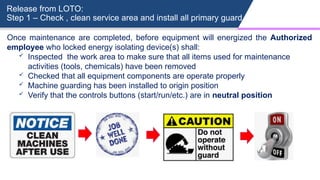
Release from LOTO:
Step 1 – Check , clean service area and install all primary guard
Once maintenance are completed, before equipment will energized the Authorized
employee who locked energy isolating device(s) shall:
 Inspected the work area to make sure that all items used for maintenance
activities (tools, chemicals) have been removed
 Checked that all equipment components are operate properly
 Machine guarding has been installed to origin position
 Verify that the controls buttons (start/run/etc.) are in neutral position
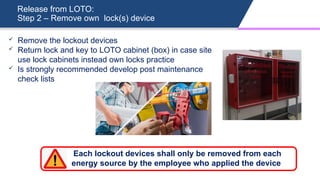
Release from LOTO:
Step 2 – Remove own lock(s) device
 Remove the lockout devices
 Return lock and key to LOTO cabinet (box) in case site
use lock cabinets instead own locks practice
 Is strongly recommended develop post maintenance
check lists
Each lockout devices shall only be removed from each
energy source by the employee who applied the device
Release from LOTO:
Step 3 – Notify all affected employees
After servicing is completed, and machine is ready for use for
normal operation:
 Notify the affected employees
 And/or their supervisor
 Reenergize the machine (if needed)
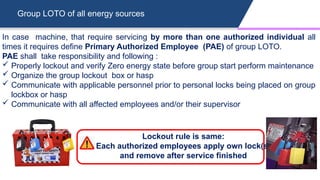
Group LOTO of all energy sources
In case machine, that require servicing by more than one authorized individual all
times it requires define Primary Authorized Employee (PAE) of group LOTO.
PAE shall take responsibility and following :
 Properly lockout and verify Zero energy state before group start perform maintenance
 Organize the group lockout box or hasp
 Communicate with applicable personnel prior to personal locks being placed on group
lockbox or hasp
 Communicate with all affected employees and/or their supervisor
Lockout rule is same:
Each authorized employees apply own lock(s)
and remove after service finished
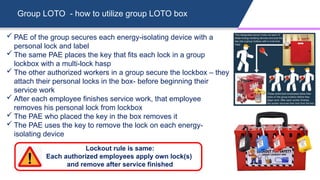
Group LOTO - how to utilize group LOTO box
Lockout rule is same:
Each authorized employees apply own lock(s)
and remove after service finished
 PAE of the group secures each energy-isolating device with a
personal lock and label
 The same PAE places the key that fits each lock in a group
lockbox with a multi-lock hasp
 The other authorized workers in a group secure the lockbox – they
attach their personal locks in the box- before beginning their
service work
 After each employee finishes service work, that employee
removes his personal lock from lockbox
 The PAE who placed the key in the box removes it
 The PAE uses the key to remove the lock on each energy-
isolating device
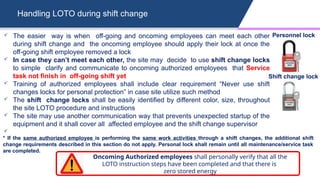
Handling LOTO during shift change
 The easier way is when off-going and oncoming employees can meet each other
during shift change and the oncoming employee should apply their lock at once the
off-going shift employee removed a lock
 In case they can’t meet each other, the site may decide to use shift change locks
to simple clarify and communicate to oncoming authorized employees that Service
task not finish in off-going shift yet
 Training of authorized employees shall include clear requirement “Never use shift
changes locks for personal protection” in case site utilize such method
 The shift change locks shall be easily identified by different color, size, throughout
the site LOTO procedure and instructions
 The site may use another communication way that prevents unexpected startup of the
equipment and it shall cover all affected employee and the shift change supervisor

* If the same authorized employee is performing the same work activities through a shift changes, the additional shift
change requirements described in this section do not apply. Personal lock shall remain until all maintenance/service task
are completed.
Oncoming Authorized employees shall personally verify that all the
LOTO instruction steps have been completed and that there is
zero stored energy
Personnel lock
Shift change lock
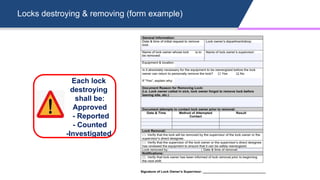
Locks destroying & removing
Lockout device shall be removed ONLY by the employee who applied the lock.
Exceptional cases are: 1) when authorized employee lost key 2) when the
authorized employee who applied the locks is not available to remove that device
In both exceptional cases lockout device destroying is not allowed without
preapproved site-specific form and signed by authorized leadership
The form shall include at least the following:
 Information about employee assigned lock(s) – lock owner
 Date & time, place of machine where lock shall be destroyed
 Documented reason of lock removal & destroying
 All done verification efforts that lock owner is not at the facility
 Verification steps that lock removal are safe &
all impacted employees are informed
 All done communication efforts to lock owner
 Informing method of lock(s) owner that his/her lock(s) has been removed
 Written signed of by lock(s) owner direct manager (supervisor) site leadership
Each lock
destroying
shall be:
Approved
- Reported
- Counted
-Investigated
Locks destroying & removing (form example)
Each lock
destroying
shall be:
Approved
- Reported
- Counted
-Investigated
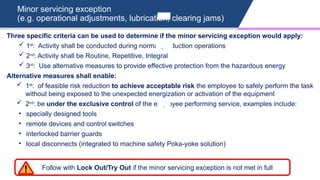
Minor servicing exception
(e.g. operational adjustments, lubrication, clearing jams)
Three specific criteria can be used to determine if the minor servicing exception would apply:
 1st
: Activity shall be conducted during normal production operations
 2nd
: Activity shall be Routine, Repetitive, Integral
 3rd
: Use alternative measures to provide effective protection from the hazardous energy
Alternative measures shall enable:
 1st
: of feasible risk reduction to achieve acceptable risk the employee to safely perform the task
without being exposed to the unexpected energization or activation of the equipment
 2nd
: be under the exclusive control of the employee performing service, examples include:
• specially designed tools
• remote devices and control switches
• interlocked barrier guards
• local disconnects (integrated to machine safety Poka-yoke solution)
Follow with Lock Out/Try Out if the minor servicing exception is not met in full
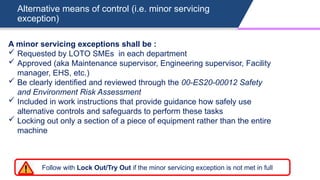
Alternative means of control (i.e. minor servicing
exception)
A minor servicing exceptions shall be :
 Requested by LOTO SMEs in each department
 Approved (aka Maintenance supervisor, Engineering supervisor, Facility
manager, EHS, etc.)
 Be clearly identified and reviewed through the 00-ES20-00012 Safety
and Environment Risk Assessment
 Included in work instructions that provide guidance how safely use
alternative controls and safeguards to perform these tasks
 Locking out only a section of a piece of equipment rather than the entire
machine
Follow with Lock Out/Try Out if the minor servicing exception is not met in full
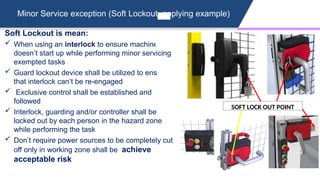
Minor Service exception (Soft Lockout applying example)
Soft Lockout is mean:
 When using an interlock to ensure machinery
doesn’t start up while performing minor servicing
exempted tasks
 Guard lockout device shall be utilized to ensure
that interlock can’t be re-engaged
 Exclusive control shall be established and
followed
 Interlock, guarding and/or controller shall be
locked out by each person in the hazard zone
while performing the task
 Don’t require power sources to be completely cut
off only in working zone shall be achieve
acceptable risk
SOFT LOCK OUT POINT
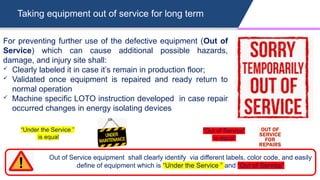
Taking equipment out of service for long term
For preventing further use of the defective equipment (Out of
Service) which can cause additional possible hazards,
damage, and injury site shall:
 Clearly labeled it in case it’s remain in production floor;
 Validated once equipment is repaired and ready return to
normal operation
 Machine specific LOTO instruction developed in case repair
occurred changes in energy isolating devices
Out of Service equipment shall clearly identify via different labels, color code, and easily
define of equipment which is “Under the Service ” and “Out of Service”
“Under the Service ”
is equal
“Out of Service”
is equal
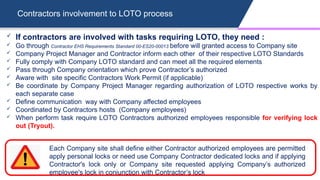
Contractors involvement to LOTO process
Each Company site shall define either Contractor authorized employees are permitted
apply personal locks or need use Company Contractor dedicated locks and if applying
Contractor's lock only or Company site requested applying Company’s authorized
employee's lock in conjunction with Contractor’s lock
 If contractors are involved with tasks requiring LOTO, they need :
 Go through Contractor EHS Requirements Standard 00-ES20-00013 before will granted access to Company site
 Company Project Manager and Contractor inform each other of their respective LOTO Standards
 Fully comply with Company LOTO standard and can meet all the required elements
 Pass through Company orientation which prove Contractor’s authorized
 Aware with site specific Contractors Work Permit (if applicable)
 Be coordinate by Company Project Manager regarding authorization of LOTO respective works by
each separate case
 Define communication way with Company affected employees
 Coordinated by Contractors hosts (Company employees)
 When perform task require LOTO Contractors authorized employees responsible for verifying lock
out (Tryout).
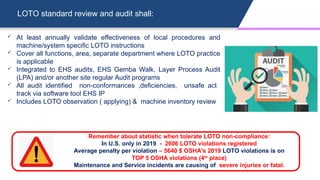
LOTO standard review and audit shall:
 At least annually validate effectiveness of local procedures and
machine/system specific LOTO instructions
 Cover all functions, area, separate department where LOTO practice
is applicable
 Integrated to EHS audits, EHS Gemba Walk, Layer Process Audit
(LPA) and/or another site regular Audit programs
 All audit identified non-conformances ,deficiencies, unsafe act
track via software tool EHS IP
 Includes LOTO observation ( applying) & machine inventory review
Remember about statistic when tolerate LOTO non-compliance:
In U.S. only in 2019 - 2606 LOTO violations registered
Average penalty per violation – 5640 $ OSHA's 2019 LOTO violations is on
TOP 5 OSHA violations (4th
place)
Maintenance and Service incidents are causing of severe injuries or fatal.
POST TRAINING ASSESMENT
011-11091391
THANK YOU FOR
YOUR ATTENDANCE
– QUESTIONS?

LOTO_Training awareness for - 1DAY.pptx

  • 1.
    Lock Out /Tag Out - (LOTO) TRAINING BY PARABAKARAN BALASUBRAMANIAM
  • 2.
    2 Professional Summary: Withover 15 years of comprehensive experience in Environmental Safety and Health (HSE), Parabakaran Balasubramaniam is a seasoned professional with specialized expertise in delivering impactful training programs. He holds a Master's Degree in Environmental Safety and Health from the University Malaysia Pahang and has dedicated 5 years specifically to the field of HSE training and consultancy. Key Skills and Competencies: Extensive knowledge in environmental safety regulations and compliance standards. Proven track record in designing and delivering engaging and effective HSE training modules. Strong understanding of risk assessment methodologies and hazard control strategies. Skilled in conducting safety audits and implementing corrective measures. Excellent communication and interpersonal skills for effective training delivery
  • 3.
  • 4.
    Objectives of LOTOtraining After this training session you will be able:  Better understand requirements Lockout/TAGout (LOTO) standard  Better understand hazards of unexpected energization or start-up of the equipment, while maintenance and service  How safely organize equipment service and maintenance by following with LOTO requirements or apply alternative means of control
  • 5.
    Foreword The LOTO standardrecognizes that zero risk is only a theoretical possibility but is not an operative reality - zero risk does not exist. The concept of feasible risk reduction to achieve acceptable risk is emphasized whether using conventional LockOut, or apply alternative means of control. Site SMEs, EHS and Leaderships shall develop and encourage use LOTO practice and alternative means to avoid such severe injuries: - This simple lock and key may save body parts even employee life
  • 6.
    Foreword BUSINESS CONFIDENTIAL | TheLOTO standard recognizes that zero risk is only a theoretical possibility but is not an operative reality - zero risk does not exist. The concept of feasible risk reduction to achieve acceptable risk is emphasized whether using conventional LockOut, or apply alternative means of control. Site SMEs, EHS and Leaderships shall develop and encourage use LOTO practice and alternative means to avoid such severe injuries: - This simple lock and key may save body parts even employee life Statistic: In U.S. only in 2019 - 2606 LOTO violations registered Average penalty per violation – 5640 $ LOTO violations is on TOP 5 OSHA violations (4th place) Maintenance and Service incidents are causing of severe injuries or fatal. * Occupation Health & Safety administration of U.S. data
  • 7.
    LOTO (LockOut/TagOut transformationto Lockout/TAGout In the past, when a lot of machinery has no supported LockOut apply – U.S. Standard permitted apply TagOut ONLY or LockOut or both as essential control measures of hazardous energy source Past OR OR both
  • 8.
    LOTO (LockOut/TagOut transformationto Lockout/TAGout In the past, when a lot of machinery has no supported LockOut apply – U.S. Standard permitted apply TagOut ONLY or LockOut or both as essential control measures of hazardous energy source Past Current Site shall utilize appropriate LockOut + Labeling which allow identify employee who applied lock TryOut is core verification step in LOTO practice which prove that zero energy state is achieved The equipment shall be installed with an energy isolating device or alternative means of control hazardous energy applied TagOut ONLY is not permitted on Company as essential control measures of hazardous energy control OR OR both
  • 9.
    Basic LOTO standarddefinitions:  Authorized Employee: Employee who locks out and key machines to perform servicing or maintenance on that machine .  Energy Source/ Hazardous Energy: Any electrical, mechanical, hydraulic, pneumatic, chemical, thermal, gravity or other energy source that can cause injury to personnel
  • 10.
    Basic LOTO standarddefinitions:  Authorized Employee: Employee who locks out and key machines to perform servicing or maintenance on that machine .  Energy Source/ Hazardous Energy: Any electrical, mechanical, hydraulic, pneumatic, chemical, thermal, gravity or other energy source that can cause injury to personnel  Energy-Isolating Device: A means of preventing the transmission or release of energy.  Lockout Device: A device that utilizes a lock and key for induvial control that secures an energy-isolating device in a position that prevents the energizing of a machine, equipment or process.
  • 11.
    Basic LOTO standarddefinitions:  Authorized Employee: Employee who locks out and key machines to perform servicing or maintenance on that machine .  Energy Source/ Hazardous Energy: Any electrical, mechanical, hydraulic, pneumatic, chemical, thermal, gravity or other energy source that can cause injury to personnel  Energy-Isolating Device: A means of preventing the transmission or release of energy.  Lockout Device: A device that utilizes a lock and key for induvial control that secures an energy-isolating device in a position that prevents the energizing of a machine, equipment or process.  Lockout: The placement of a lock with key on an energy isolation device, in accordance with an established procedure, and ensuring that the energy isolating device and the equipment being controlled cannot be operated until the lockout device has been removed.  Tryout: The final action when attempting to activate isolated equipment at the on/off mechanism to ensure it is correctly isolated.
  • 12.
    Exclusions from LOTOstandard - LOTO doesn’t apply to work on cord-and-plug connected electrical equipment where: the exposure to hazardous energy is controlled completely by unplugging the equipment where the employee has exclusive control (within arm’s reach at all times) AND where electricity is the only source of energy
  • 13.
    Exclusions from LOTOstandard - LOTO doesn’t apply to work on cord-and-plug connected electrical equipment where: the exposure to hazardous energy is controlled completely by unplugging the equipment where the employee has exclusive control (within arm’s reach at all times) AND where electricity is the only source of energy - LOTO standard does not apply to tasks involving exposed energized parts less than 50 volts
  • 14.
    Exclusions from LOTOstandard - LOTO doesn’t apply to work on cord-and-plug connected electrical equipment where: the exposure to hazardous energy is controlled completely by unplugging the equipment where the employee has exclusive control (within arm’s reach at all times) AND where electricity is the only source of energy - LOTO standard does not apply to tasks involving exposed energized parts less than 50 volts - And troubleshooting tasks when performed by qualified persons
  • 15.
    Section 3.1 and3.1.3: Requirements for site local procedure 15 Remember Your Site procedure Shall cover the below items: • Corporate EHS standard - Cover all sections of the corporate standard that apply to your site • Local regulations (country, regional, state, province, etc.) • Divisional requirements • Consensus standard • Site and Customer Requirements Note:  If local regulations are more stringent follow corporate standard plus additional local regulations  If local regulations are less stringent follow corporate standard
  • 16.
    Section 3.1 and3.1.3: Requirements for site local procedure (Part 1)  Process for creating, validating, approving, updating machine/system specific LOTO instructions  Process to maintain inventory of all LOTO Subject Matter Experts (SMEs) and their responsible area  Process for notification of affected employees  Process for properly shutting down equipment and/or machinery  Process for isolating all primary energy sources  Process for releasing all secondary (stored) sources of energy  Process for verifying the lockout (Tryout)
  • 17.
    Section 3.1 and3.1.3: Requirements for site local procedure (Part 2)  Process for handling lockout during shift change  Process for bring equipment back normal operation  Process for group LOTO  Process for lockout device destroying & removal  Process for minor service exceptions to LOTO and alternative means of control  Process for taking equipment out of service for long term  Requirements for Energy Isolation (LOTO) devices  Identifying employee(s) who applied lock(s)  Contractor personnel LOTO requirements
  • 18.
    The machine inventoryshall - Determine which machines or pieces of equipment apply LOTO practice - Identify equipment that are only maintained by contractors - Will be reviewed on an annual basis - Cover all production floor as well warehouse, laboratory, offices, utilities supply system, etc.
  • 19.
    Authorized employees trainingshall include:  Applicable hazardous energy sources, the type and magnitude of the energy available in the workplace  The methods and means necessary for energy isolation and control  Hand on demonstration of correct application of LOTO for different kinds of energies  The demonstration of zero energy state “Try Out”  Notification methods of affected employee(s)  Group LOTO applying  Handling lockout during shift change  Destroying & removing LOTO device
  • 20.
    Authorized employees training Frequency: Initial training  At least annually Other conditions which require training:  Whenever there is a change in their job assignments  A change happened in machines, equipment or processes that present a new hazards  When there is a change in the site specific LOTO procedure Remember, All relevant changes on machine shall go through Management of Change and be reflected in Machine specific LOTO instruction
  • 21.
    LOTO SMEs &other employees training BUSINESS CONFIDENTIAL | Each LOTO SMEs shall:  Be trained equal with Authorized employee training  Fully understand requirements of LOTO standards and the purpose of LOTO.  Document their understanding and demonstrate their competency with the design, construction, operation and/or maintenance of the specific machine/system and the associated hazards. This shall be documented through education, training and/or experience. All affected employees shall:  Be instructed in the purpose and use of this standard  At least annual retraining All other employees:  who work in an area where this standard may be used, shall be instructed on the general requirements of LOTO, and the fact that it is prohibited to attempt to restart or reenergize machines or equipment that are locked out
  • 22.
    Machine/system specific LOTOinstruction is crucial element of LOTO standard and shall  Describe all energy sources, their magnitude on each separate peace of machine  Define LOTO control measures  Be Simple and Visual & include all critical LOTO information  Simplify LOTO applying via sequential steps guide  Significantly decrease likelihood of 3 causes of accidents:
  • 23.
    Machine/system specific LOTOinstruction shall at a minimum include: BUSINESS CONFIDENTIAL |  Equipment identification  Energy source(s) and potential stored energy sources (if available)  Specific isolation point(s) and lockout point  Type of lockout devices to use for each energy source  Process for identifying employee(s) who applied lock(s)  Specific Instructions for isolating energy through the application of lock(s)  Zero Energy Requirements and How to verify zero energy “Try- Out”  Communication methods to affected employees  Additional Personal Protective Equipment (PPE) if specific hazards exist  Special Precautions ( Other hazards- Confide Space Entry, Work permit)  Group LOTO requirement (if applicable)  Safety Reminders: Only Work Under Your Own Lock  Instructions for return to normal operation condition
  • 24.
    Machine/system specific LOTOinstructions are developed by LOTO SME (or external contractor) LOTO SMEs shall:  Be defined in each department and be competent for each specific piece of machine  Use standardized site form of machine specific LOTO instruction  Develop machine specific LOTO instruction for all new, modified, retrofit machinery equipment that may be energized and require LOTO  Drive full conformance to corporate LOTO standard and site procedure within their responsible area  Validate each machine/system LOTO instruction (including mandatory Tryout step of “Zero energy” prior to being approved and used  While develop of machine/system specific LOTO instructions follow with 00-ES20-00003 EHS Change Management and Machinery Safety SE-ES20-00004 ALL Authorized employees shall:  Follow the machine specific LOTO instructions which shall include all LOTO steps for safely perform service tasks
  • 25.
    Requirements for theEnergy Isolation and locks –Part 1 Machines and equipment shall:  Be supplied with equipment energy isolating devices  If no, equipment shall be upgraded  Or, alternative methods of control hazardous energy applied  Install in manner the energy isolating devices shall be accessible for lock devices applying Energy isolation devices shall be capable:  Controlling or releasing hazardous energy or both  Locked or otherwise secured in affective isolating position  Be uniquely identified, be adequately labeled, or marked to indicate their function
  • 26.
    Requirements for theEnergy Isolation devices and locks– Part 2 Locks and another LOTO devices shall:  Be standardizing within facility by color, shape and (or) size based on purpose of use within site  Can’t be used for other purpose (as example: locking doors, etc.)  Able to withstand their environment (e.g. extreme temperatures, corrosive materials, etc.)  Be substantial enough to prevent removal without the use of excessive force or unusual techniques  Be capable of identifying the employee applying. Labels and/or tags shall include person identification and contact information at least Holes are designed to fit mini lock pin Combination type of locks is not allowed. Tags only is not permitted as means of energy control/ energy isolation device.
  • 27.
    Requirements for theEnergy Isolation devices and locks & employees identification – Part 3 Site may utilize to 2 ways of control locks & keys and employees identification :  Provide own locks with identity info for each Authorized employees on lock OOOOOOOOOOOOOOOOOOOOR  Set lock box (cabinet) and keep identity of Authorized employee who applied lock by each LOTO applying case OR + Own personal lock With authorized employee identity Take general Lock and identification employee tag for each separate LOTO task Engineering control shall be in place to ensure that Authorized employees have access to locks ONLY
  • 28.
    Requirements for theEnergy Isolation devices and locks– Part 4 (special tool) If special tools or restraint devices are required to control the hazardous energy they shall be:  Available for authorized employees  Maintained in good working conditions  Order with a replaced schedule  Be substantial enough to prevent removal
  • 29.
    From LOTO implementationto practice When the sites finish:  Developed LOTO customized procedure  Trained Authorized and another employees  Defined SMEs in each applicable department  SMEs developed and verified machine specific LOTO instructions  Provided all locking devices The site can apply LOTO on practice. Stop and fixed gaps if still exist. Remember about 3 cases of incidents:
  • 30.
    LOTO execution: Step1 – Prepare for Shutdown Authorized employee shall use machine specific LOTO instructions and knowledge:  The type and magnitude of the energy  The hazards of the energy to be controlled  The method or means to control the energy  Recognized all safety precautions which avoid any additional or increased hazard(s) to employees as a result of the equipment stoppage
  • 31.
    LOTO execution: Step2 – Notify all affected employees Authorized employee and (or) their supervisor shall notify all affected employees and (or) their supervisor about maintenance scope, duration, LOTO applying etc.
  • 32.
    LOTO execution: Step3 – Shut down equipment and isolate all primary energy sources Shutdown equipment using primary installed control buttons and/or energy isolating devices: Electrical circuit beaker Disconnect switch Slip blind Line valve (single valve, Double Block & Bleed (DBB) valve) Electro-mechanical (e.g. line valve)
  • 33.
    LOTO execution: Step4 – Apply lock devices and key  Authorized employees shall apply own lock & key for all primary energy sources or lock + identical tag  Each authorized employee in group shall be used lock after primary energy sources are isolated Remember! Use locks for each energy sources Tagout applying only is not allow
  • 34.
    LOTO execution: Step5 – Released stored energy (if applicable)  Electrical (batteries & capacitors)  Pressurized part of machine  Heat  The force of gravity  Steam  Chemicals (e.g. when chemicals remain in the pipe after shutoff) Isolating the primary energy sources may remove much of the potential danger. Authorized employees shall be aware about ALL possible hazardous secondary (stored) source of energy as example :
  • 35.
    LOTO execution: Step5 – Released or isolate stored energy (if applicable) Machine/system specific LOTO instruction shall:  Identify all available secondary (stored) sources of energy  The process that will release any remaining pressure or isolate other stored energy  Consider other hazards, such as moving equipment that shall be secured before work begins , guide how to blocked it
  • 36.
    Step 5 –Released stored energy (device practical example) Double block and bleed (DBB) valve allow relief pressure, pressurized fluid, chemicals, etc. Die safety block – isolate any machine moveme and gravity energy Relief pressure valve
  • 37.
    LOTO execution: Step6 – Verify (Tryout) locking all energy sources  Before Tryout step check that no employees are in the hazard zone and that no one is in a position where they could potential be injury  When primary & secondary energies are isolated and released follow with machine specific LOTO instruction to preform Tryout step  Use proven method to verify that all hazardous primary and stored energies have been isolated and released: Type of energy Proven method of energy detection Proven safe condition Amperemeter, Voltmeter, Electrical multimeter Shown “0” energy source after shut of equipment applying lock Pressure detector Shown “0” energy source after shut of equipment applying lock (DBB) Double block bleed valve Bleed valve is “dry” after shut of primary source of energy and blocking all valves Direct reading instrument applying, stationary and mobile analyzer Measuring devices showed a lower value than hazardous level Thermometer, pyrometer, etc. Measuring devices showed a lower value than hazardous level
  • 38.
    LOTO execution: Step6 – Verify (Tryout) locking all energy sources Something go wrong? In case the verifying (Tryout) is not successful, and machine doesn’t achieve zero energy state – STOP + Inform LOTO SME. No further steps allow before LOTO SMEs modify and approve updated machine specific LOTO instruction and instruct you again
  • 39.
    After verify “zeroenergy state” you can start perform service tasks following with:  Maintenance Standard Operation Procedure  Use appropriate PPE and working order tools only  Strongly recommended to add verification check (Tryout) to all maintenance work instructions and have this in a computerized preventative maintenance system  Energy control and lock devices shall remain in same position till maintenance process not finish  If there is a possibility of re-accumulation of stored energy to a hazardous level, verification of isolation shall be continued until the servicing or maintenance is completed Inform direct supervisor in case some issue or abnormality were observed while machine service
  • 40.
    Release from LOTO: Step1 – Check , clean service area and install all primary guard Once maintenance are completed, before equipment will energized the Authorized employee who locked energy isolating device(s) shall:  Inspected the work area to make sure that all items used for maintenance activities (tools, chemicals) have been removed  Checked that all equipment components are operate properly  Machine guarding has been installed to origin position  Verify that the controls buttons (start/run/etc.) are in neutral position
  • 41.
    Release from LOTO: Step2 – Remove own lock(s) device  Remove the lockout devices  Return lock and key to LOTO cabinet (box) in case site use lock cabinets instead own locks practice  Is strongly recommended develop post maintenance check lists Each lockout devices shall only be removed from each energy source by the employee who applied the device
  • 42.
    Release from LOTO: Step3 – Notify all affected employees After servicing is completed, and machine is ready for use for normal operation:  Notify the affected employees  And/or their supervisor  Reenergize the machine (if needed)
  • 43.
    Group LOTO ofall energy sources In case machine, that require servicing by more than one authorized individual all times it requires define Primary Authorized Employee (PAE) of group LOTO. PAE shall take responsibility and following :  Properly lockout and verify Zero energy state before group start perform maintenance  Organize the group lockout box or hasp  Communicate with applicable personnel prior to personal locks being placed on group lockbox or hasp  Communicate with all affected employees and/or their supervisor Lockout rule is same: Each authorized employees apply own lock(s) and remove after service finished
  • 44.
    Group LOTO -how to utilize group LOTO box Lockout rule is same: Each authorized employees apply own lock(s) and remove after service finished  PAE of the group secures each energy-isolating device with a personal lock and label  The same PAE places the key that fits each lock in a group lockbox with a multi-lock hasp  The other authorized workers in a group secure the lockbox – they attach their personal locks in the box- before beginning their service work  After each employee finishes service work, that employee removes his personal lock from lockbox  The PAE who placed the key in the box removes it  The PAE uses the key to remove the lock on each energy- isolating device
  • 45.
    Handling LOTO duringshift change  The easier way is when off-going and oncoming employees can meet each other during shift change and the oncoming employee should apply their lock at once the off-going shift employee removed a lock  In case they can’t meet each other, the site may decide to use shift change locks to simple clarify and communicate to oncoming authorized employees that Service task not finish in off-going shift yet  Training of authorized employees shall include clear requirement “Never use shift changes locks for personal protection” in case site utilize such method  The shift change locks shall be easily identified by different color, size, throughout the site LOTO procedure and instructions  The site may use another communication way that prevents unexpected startup of the equipment and it shall cover all affected employee and the shift change supervisor  * If the same authorized employee is performing the same work activities through a shift changes, the additional shift change requirements described in this section do not apply. Personal lock shall remain until all maintenance/service task are completed. Oncoming Authorized employees shall personally verify that all the LOTO instruction steps have been completed and that there is zero stored energy Personnel lock Shift change lock
  • 46.
    Locks destroying &removing Lockout device shall be removed ONLY by the employee who applied the lock. Exceptional cases are: 1) when authorized employee lost key 2) when the authorized employee who applied the locks is not available to remove that device In both exceptional cases lockout device destroying is not allowed without preapproved site-specific form and signed by authorized leadership The form shall include at least the following:  Information about employee assigned lock(s) – lock owner  Date & time, place of machine where lock shall be destroyed  Documented reason of lock removal & destroying  All done verification efforts that lock owner is not at the facility  Verification steps that lock removal are safe & all impacted employees are informed  All done communication efforts to lock owner  Informing method of lock(s) owner that his/her lock(s) has been removed  Written signed of by lock(s) owner direct manager (supervisor) site leadership Each lock destroying shall be: Approved - Reported - Counted -Investigated
  • 47.
    Locks destroying &removing (form example) Each lock destroying shall be: Approved - Reported - Counted -Investigated
  • 48.
    Minor servicing exception (e.g.operational adjustments, lubrication, clearing jams) Three specific criteria can be used to determine if the minor servicing exception would apply:  1st : Activity shall be conducted during normal production operations  2nd : Activity shall be Routine, Repetitive, Integral  3rd : Use alternative measures to provide effective protection from the hazardous energy Alternative measures shall enable:  1st : of feasible risk reduction to achieve acceptable risk the employee to safely perform the task without being exposed to the unexpected energization or activation of the equipment  2nd : be under the exclusive control of the employee performing service, examples include: • specially designed tools • remote devices and control switches • interlocked barrier guards • local disconnects (integrated to machine safety Poka-yoke solution) Follow with Lock Out/Try Out if the minor servicing exception is not met in full
  • 49.
    Alternative means ofcontrol (i.e. minor servicing exception) A minor servicing exceptions shall be :  Requested by LOTO SMEs in each department  Approved (aka Maintenance supervisor, Engineering supervisor, Facility manager, EHS, etc.)  Be clearly identified and reviewed through the 00-ES20-00012 Safety and Environment Risk Assessment  Included in work instructions that provide guidance how safely use alternative controls and safeguards to perform these tasks  Locking out only a section of a piece of equipment rather than the entire machine Follow with Lock Out/Try Out if the minor servicing exception is not met in full
  • 50.
    Minor Service exception(Soft Lockout applying example) Soft Lockout is mean:  When using an interlock to ensure machinery doesn’t start up while performing minor servicing exempted tasks  Guard lockout device shall be utilized to ensure that interlock can’t be re-engaged  Exclusive control shall be established and followed  Interlock, guarding and/or controller shall be locked out by each person in the hazard zone while performing the task  Don’t require power sources to be completely cut off only in working zone shall be achieve acceptable risk SOFT LOCK OUT POINT
  • 51.
    Taking equipment outof service for long term For preventing further use of the defective equipment (Out of Service) which can cause additional possible hazards, damage, and injury site shall:  Clearly labeled it in case it’s remain in production floor;  Validated once equipment is repaired and ready return to normal operation  Machine specific LOTO instruction developed in case repair occurred changes in energy isolating devices Out of Service equipment shall clearly identify via different labels, color code, and easily define of equipment which is “Under the Service ” and “Out of Service” “Under the Service ” is equal “Out of Service” is equal
  • 52.
    Contractors involvement toLOTO process Each Company site shall define either Contractor authorized employees are permitted apply personal locks or need use Company Contractor dedicated locks and if applying Contractor's lock only or Company site requested applying Company’s authorized employee's lock in conjunction with Contractor’s lock  If contractors are involved with tasks requiring LOTO, they need :  Go through Contractor EHS Requirements Standard 00-ES20-00013 before will granted access to Company site  Company Project Manager and Contractor inform each other of their respective LOTO Standards  Fully comply with Company LOTO standard and can meet all the required elements  Pass through Company orientation which prove Contractor’s authorized  Aware with site specific Contractors Work Permit (if applicable)  Be coordinate by Company Project Manager regarding authorization of LOTO respective works by each separate case  Define communication way with Company affected employees  Coordinated by Contractors hosts (Company employees)  When perform task require LOTO Contractors authorized employees responsible for verifying lock out (Tryout).
  • 53.
    LOTO standard reviewand audit shall:  At least annually validate effectiveness of local procedures and machine/system specific LOTO instructions  Cover all functions, area, separate department where LOTO practice is applicable  Integrated to EHS audits, EHS Gemba Walk, Layer Process Audit (LPA) and/or another site regular Audit programs  All audit identified non-conformances ,deficiencies, unsafe act track via software tool EHS IP  Includes LOTO observation ( applying) & machine inventory review Remember about statistic when tolerate LOTO non-compliance: In U.S. only in 2019 - 2606 LOTO violations registered Average penalty per violation – 5640 $ OSHA's 2019 LOTO violations is on TOP 5 OSHA violations (4th place) Maintenance and Service incidents are causing of severe injuries or fatal.
  • 54.
  • 55.
    THANK YOU FOR YOURATTENDANCE – QUESTIONS?