

PLATE
TECTONICS
By:
Daryl F. Cadanilla
 a theory in geology: the
lithosphere of the earth is divided
into a small number
of plates which float on and travel
independently over the mantle
and much of the earth's seismic
activity occurs at the boundaries
of these plates
RECALL
LITHOSPHERE
 Entire lithosphere of the Earth is broken
into numerous segments called lithospheric
plates.
 The slow but constant moving of these
plates is called tectonics, thus moving
lithospheric plates is called plate tectonics.
 One of the consequences of these plate
movements is EARTHQUAKE.
Objective: Locate the epicenter
of an earthquake using
triangulation method
What data are needed?
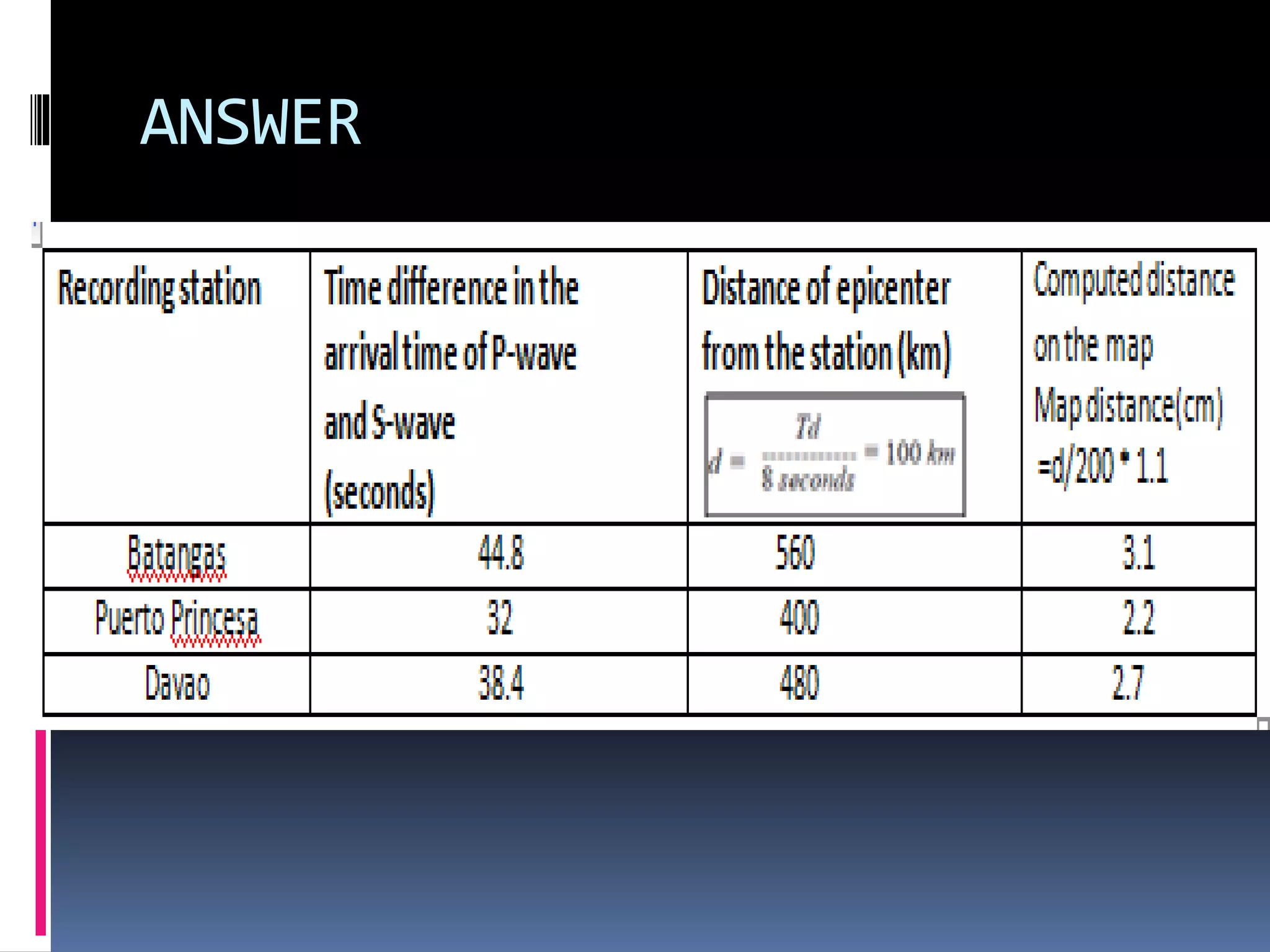
1.At least three(3) recording stations
2.Time difference in the arrival of P-wave and S-
wave in each station
3. Distance of epicenter from each station using
the formula
ACTIVITY SHEET
ANSWER
Q1.Where is the epicenter of this hypothetical earthquake?Use
triangulation method.
- CEBU
Q2.What difficulty will you encounter if you only have data
from two recording stations?
Two recording stations would result to two epicenters.
Q3.What is the distance of the epicenter from the seismic station? -
9000 km.
Q4.What do you think is the importance of determining
the epicenter of an earthquake?
It will help in assessing the damage zone where death and
destruction will be maximum.Thus, helps in planning
post-earthquake rehabilitation and relief measures, in
forewarning of tsunami-related hazard and in assuring
of minimum loss to life and property if it is the deserted
or inhabited region
NEW
LESSON
PLATE BOUNDARIES
Determining location of earthquake epicenters
plays a vital role in laying the foundation of
plate tectonics.
The places on Earth where most of the
earthquakes originated or some of the
mountains and volcanoes were formed
marked the boundaries of each lithospheric
plates
3 TYPESOF PLATE BOUNDARIES
 DIVERGENT PLATE BOUNDARY
 2 lithospheric plates move away from
each other
 CONVERGENT PLATE BOUNDARY
 2 lithospheric plates move toward
each other
 TRANSFROM FAULT
2 lithospheric plates slide past each other
DIVERGENT BOUNDARY
Objectives:
--Explain the processes that
occur along divergent
boundaries.
--Determine the results of
plates that are moving apart
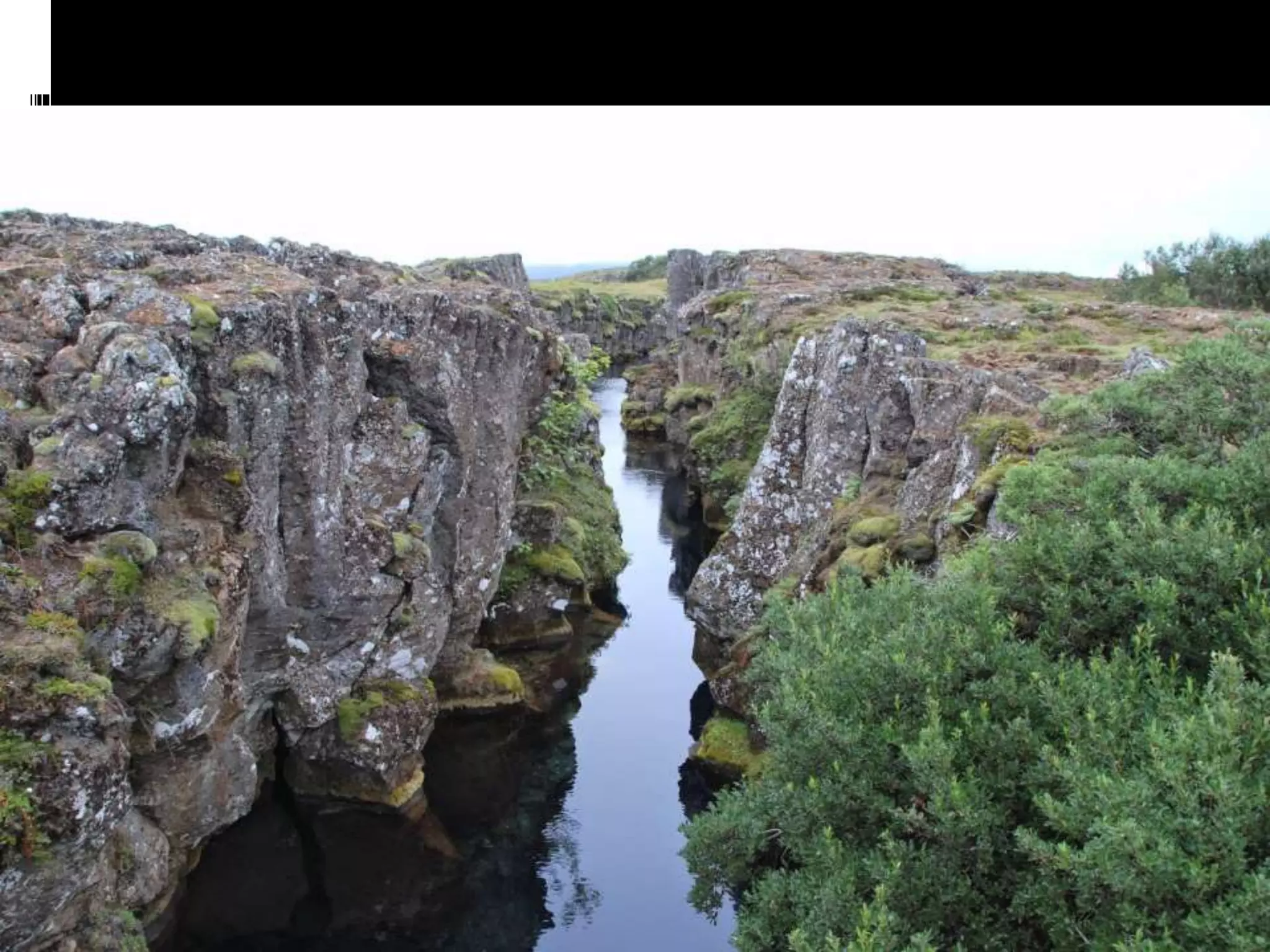
Analyze the
photographs of rift
valleys and oceanic
ridges and answer
the question that
follows.
Questions:
 1. What are common in four
pictures?
 2.Million of years ago, landmasses
in each picture were once connected
.What do you think is happening to
the Earth’s crust in those pictures?
 3. If this event continues for million
of years, what do you think will be
the effect on the crust?
Short video
Types of divergent plate boundary
 1. continental divergence
-As the two plates pull apart, normal faults develop on
both sides of the rift, and the central blocks slide
downwards
Early in the rift-forming process, streams and rivers
will flow into the sinking rift valley to form a long
linear lake.
As the rift grows deeper it might drop below sea level,
allowing ocean waters to flow in.This will produce a
narrow, shallow sea within the rift.
This rift can then grow deeper and wider. If rifting
continues, a new ocean basin could be produced.
Example
 The East Africa RiftValley is a classic example of
this type of plate boundary.The East Africa Rift is
in a very early stage of development.The plate
has not been completely rifted, and the rift valley
is still above sea level but occupied by lakes at
several locations.The Red Sea is an example of a
more completely developed rift.There the plates
have fully separated, and the central rift valley
has dropped below sea level.
GEOLOGICAL EFFECTS
 a rift valley sometimes occupied by long
linear lakes or a shallow arm of the
ocean; numerous normal faults
bounding a central rift valley;
 shallow earthquake activity along the
normal faults.
 Volcanic activity sometimes occurs
within the rift.
2. Oceanic Divergence
 When a divergent boundary occurs beneath
oceanic lithosphere, the rising convection
current below lifts the lithosphere, producing a
mid-ocean ridge.
 Extensional forces stretch the lithosphere and
produce a deep fissure. When the fissure opens,
pressure is reduced on the super-heated mantle
material below.
 It responds by melting, and the new magma
flows into the fissure.The magma then solidifies
and the process repeats itself.
example
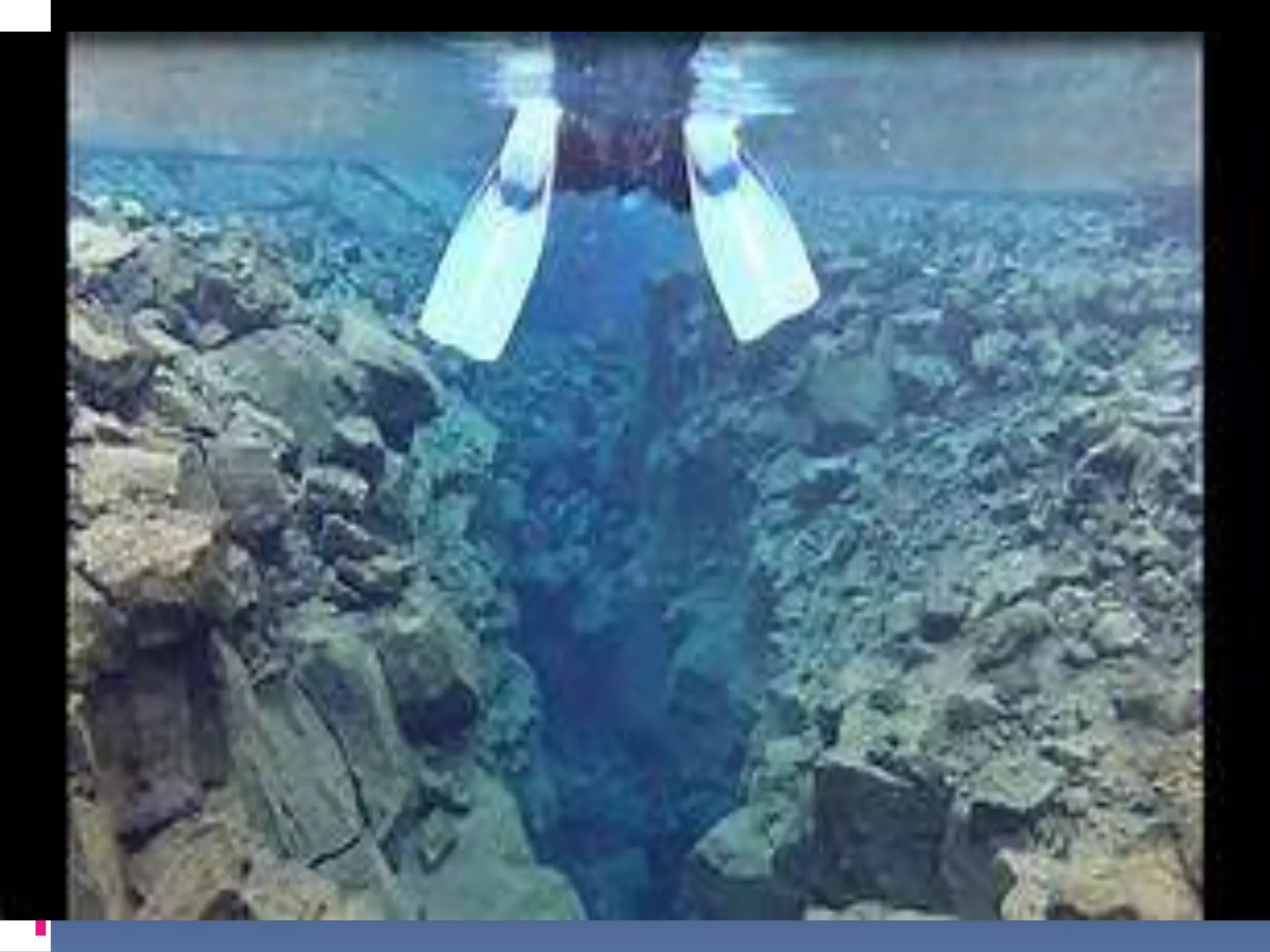
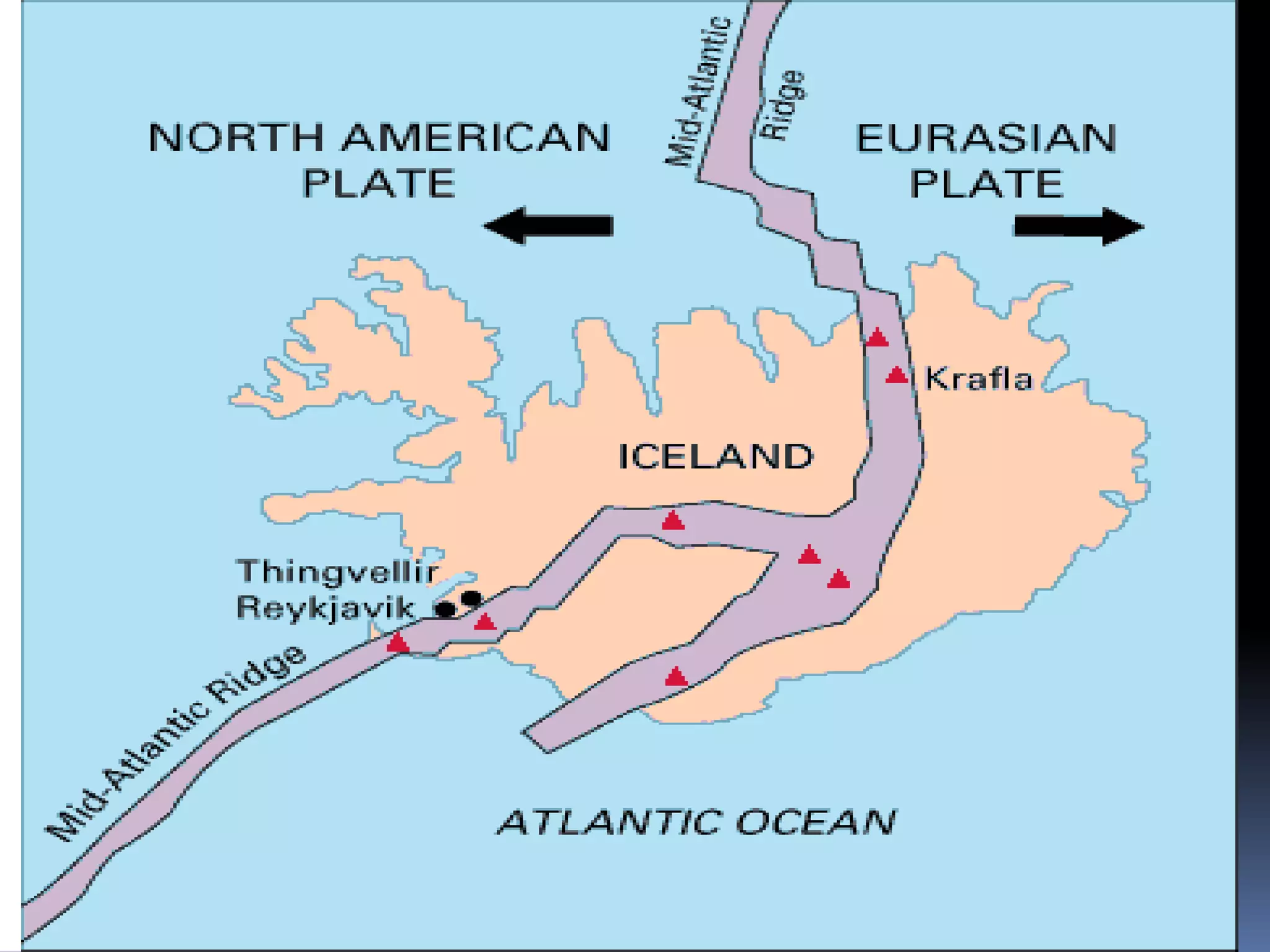
 The Mid-Atlantic Ridge is a classic example of
this type of plate boundary.The Ridge is a
high area compared to the surrounding
seafloor because of the lift from the
convection current below.
GEOLOGICAL EFFECTS
 a submarine mountain range such as the Mid-
Atlantic Ridge;
 volcanic activity in the form of fissure
eruptions;
 shallow earthquake activity;
 creation of new seafloor and a widening
ocean basin.
ASSESSMENT
 Which of the following is NOT an example
of a divergent plate boundary?
a.The boundary between the Nazca Plate and
the South American Plate
b.The boundary between the North American
Plate and the Eurasian Plate
c.The East African Rift
d.The plate boundary that passes over Iceland
Which of the following describes a divergent
boundary?
a. When two plates collide with each other
b. When two plates interact in any way
c.When two plates move apart from each other
d.When two plates slide alongside each other
What feature forms near divergent
boundaries between two pieces of oceanic
crust?
a. Mid-ocean ridge
b. Non-volcanic mountain
c. Continental rift valley
d.Trench
What feature forms near divergent
boundaries between two pieces of
continental crust?
a.continental rift valley
b. non-volcanic mountain
c. mid-ocean ridge
d. canyon
NEW
LESSON
CONVERGENT PLATE BOUNDARY
 occur where the Earth’s tectonic plates collide
or move toward one another.
 As the plates converge, the denser, thinner
tectonic plate subducts or dives beneath the
lighter, thicker, more buoyant tectonic plate.
3 TYPES
 1. Continental convergence
 2. Oceanic Convergence
 3.Continental -Oceanic Convergence
CONTINENTAL-CONTINETAL
 TO BE CONTINUED.. HAHAHA!

LOCATING THE EPICENTER/DIVERGENT BOUNDARY PPT

  • 1.
  • 2.
     a theoryin geology: the lithosphere of the earth is divided into a small number of plates which float on and travel independently over the mantle and much of the earth's seismic activity occurs at the boundaries of these plates
  • 3.
  • 4.
  • 5.
     Entire lithosphereof the Earth is broken into numerous segments called lithospheric plates.  The slow but constant moving of these plates is called tectonics, thus moving lithospheric plates is called plate tectonics.  One of the consequences of these plate movements is EARTHQUAKE.
  • 8.
    Objective: Locate theepicenter of an earthquake using triangulation method What data are needed? 1.At least three(3) recording stations 2.Time difference in the arrival of P-wave and S- wave in each station 3. Distance of epicenter from each station using the formula
  • 9.
  • 11.
  • 12.
    Q1.Where is theepicenter of this hypothetical earthquake?Use triangulation method. - CEBU Q2.What difficulty will you encounter if you only have data from two recording stations? Two recording stations would result to two epicenters. Q3.What is the distance of the epicenter from the seismic station? - 9000 km. Q4.What do you think is the importance of determining the epicenter of an earthquake? It will help in assessing the damage zone where death and destruction will be maximum.Thus, helps in planning post-earthquake rehabilitation and relief measures, in forewarning of tsunami-related hazard and in assuring of minimum loss to life and property if it is the deserted or inhabited region
  • 13.
  • 14.
    PLATE BOUNDARIES Determining locationof earthquake epicenters plays a vital role in laying the foundation of plate tectonics. The places on Earth where most of the earthquakes originated or some of the mountains and volcanoes were formed marked the boundaries of each lithospheric plates
  • 15.
    3 TYPESOF PLATEBOUNDARIES  DIVERGENT PLATE BOUNDARY  2 lithospheric plates move away from each other  CONVERGENT PLATE BOUNDARY  2 lithospheric plates move toward each other  TRANSFROM FAULT 2 lithospheric plates slide past each other
  • 16.
    DIVERGENT BOUNDARY Objectives: --Explain theprocesses that occur along divergent boundaries. --Determine the results of plates that are moving apart
  • 17.
    Analyze the photographs ofrift valleys and oceanic ridges and answer the question that follows.
  • 22.
    Questions:  1. Whatare common in four pictures?  2.Million of years ago, landmasses in each picture were once connected .What do you think is happening to the Earth’s crust in those pictures?  3. If this event continues for million of years, what do you think will be the effect on the crust?
  • 23.
  • 24.
    Types of divergentplate boundary  1. continental divergence -As the two plates pull apart, normal faults develop on both sides of the rift, and the central blocks slide downwards Early in the rift-forming process, streams and rivers will flow into the sinking rift valley to form a long linear lake. As the rift grows deeper it might drop below sea level, allowing ocean waters to flow in.This will produce a narrow, shallow sea within the rift. This rift can then grow deeper and wider. If rifting continues, a new ocean basin could be produced.
  • 27.
    Example  The EastAfrica RiftValley is a classic example of this type of plate boundary.The East Africa Rift is in a very early stage of development.The plate has not been completely rifted, and the rift valley is still above sea level but occupied by lakes at several locations.The Red Sea is an example of a more completely developed rift.There the plates have fully separated, and the central rift valley has dropped below sea level.
  • 28.
    GEOLOGICAL EFFECTS  arift valley sometimes occupied by long linear lakes or a shallow arm of the ocean; numerous normal faults bounding a central rift valley;  shallow earthquake activity along the normal faults.  Volcanic activity sometimes occurs within the rift.
  • 29.
    2. Oceanic Divergence When a divergent boundary occurs beneath oceanic lithosphere, the rising convection current below lifts the lithosphere, producing a mid-ocean ridge.  Extensional forces stretch the lithosphere and produce a deep fissure. When the fissure opens, pressure is reduced on the super-heated mantle material below.  It responds by melting, and the new magma flows into the fissure.The magma then solidifies and the process repeats itself.
  • 32.
    example  The Mid-AtlanticRidge is a classic example of this type of plate boundary.The Ridge is a high area compared to the surrounding seafloor because of the lift from the convection current below.
  • 33.
    GEOLOGICAL EFFECTS  asubmarine mountain range such as the Mid- Atlantic Ridge;  volcanic activity in the form of fissure eruptions;  shallow earthquake activity;  creation of new seafloor and a widening ocean basin.
  • 35.
    ASSESSMENT  Which ofthe following is NOT an example of a divergent plate boundary? a.The boundary between the Nazca Plate and the South American Plate b.The boundary between the North American Plate and the Eurasian Plate c.The East African Rift d.The plate boundary that passes over Iceland
  • 36.
    Which of thefollowing describes a divergent boundary? a. When two plates collide with each other b. When two plates interact in any way c.When two plates move apart from each other d.When two plates slide alongside each other
  • 37.
    What feature formsnear divergent boundaries between two pieces of oceanic crust? a. Mid-ocean ridge b. Non-volcanic mountain c. Continental rift valley d.Trench
  • 38.
    What feature formsnear divergent boundaries between two pieces of continental crust? a.continental rift valley b. non-volcanic mountain c. mid-ocean ridge d. canyon
  • 40.
  • 41.
    CONVERGENT PLATE BOUNDARY occur where the Earth’s tectonic plates collide or move toward one another.  As the plates converge, the denser, thinner tectonic plate subducts or dives beneath the lighter, thicker, more buoyant tectonic plate.
  • 42.
    3 TYPES  1.Continental convergence  2. Oceanic Convergence  3.Continental -Oceanic Convergence
  • 43.