FINANCE IN
DENTAL CARE
PRESENTED BY- DR. JASPREET SINGH TUTEJA
READER
Dept. of Public Health Dentistry
Rama Dental College- Hospital & Research Centre, Kanpur
1
CONTENTS
‱ Introduction
‱ Terminologies
‱ History
‱ Different payment mechanisms
 Private fee - for services
 Post payment plans
 Private third party service plans
 Salary
 Public programs
‱ Dental Insurance Management
‱ Conclusion
‱ References
2
INTRODUCTION
 Health care historically has been provided on a fee for
service basis, in which the patient pays the provider directly
for services.
 Methods of financing however, have progressed far beyond
this traditional system since the mid 1930's and more so
since 1965.
 One of the main reasons for emergence of third party
payment systems is the rising cost of health care.
3
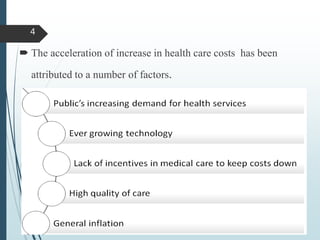
 The acceleration of increase in health care costs has been
attributed to a number of factors.
4
TERMINOLOGIES
‱ Participating dentist: (provider) is a dentist who signs a
contract with the insurance company and agrees to provide
dental services and supplies to eligible participants at a fixed
price.
5
Glossary of insurance terms, NATIONAL ASSOCIATION OF INSURANCE COMMISSIONERS
‱ Direct reimbursement plan: is a dental insurance plan that is
usually entirely funded by the employer and allows the insured
to see any dentist of his/her choice without any network
restrictions.
‱ Premium: is the money amount one is to pay on a regular basis
(usually either every month or every year) so that, the insurance
company could fund your dental plan.
6
‱ Usual, customary, and reasonable fee: (UCR fee) is a fee
associated with each dental procedure which reflects the fee
charged by the majority of dentists for the services in question
in a given area. The "UCR" fee can help you determine
whether your dentist is charging too much.
‱ Third party payment: an organization other than the patient ( first
party) or health care provider (second party) involved in the
financing of personal health services.
7
‱ Prepaid dental plan: a method of financing the cost of dental care
for a defined population, in advance of receipt of services.
‱ Preferred provider organization: (PPO) a formal agreement
between a purchaser of a dental benefit programming and a
defined group of dentists for the delivery of dental services to a
specific patient population, as an adjunct to a traditional plan,
using discount fees for cost savings.
8
HISTORY
‱ Fee for service was the first mode of payment to the dentist
with respect to the services received.
‱ 1945- start of voluntary prepaid comprehensive dental care in
St. Louis, U.S.A.
‱ 1948-Establishment of a National Insurance Scheme including
Comprehensive Dental Service in England
9
Garla BK, Satish G, Divya KT. Dental insurance: A systematic review. Journal of International Society of
Preventive & Community Dentistry. 2014 Dec;4(Suppl 2):S73.
‱ 1948- Bisell. B.Palmer of New York City founded group health
dental insurance as open panel pre-payment system.
‱ 1949- Group Health Association, consumers co-operative in
Washington, established a clinic dental service, which soon
changed from fee for service basis to prepayment.
10
‱ 1954- Washington State Dental Council organized Washington
State Dental Services Corporation to help administer prepayment
dental care plan for children of International Longshoreman’s
Union Pacific Maritime Association. This mechanism was soon
found to be the best form of rendering dental care.
‱ 1966- Medicare brought medical care to the aged people of the
U.S., regardless of their income. This did not include dentistry,
but Medicaid did.
11
‱ 1973- Health Maintenance Organization Act was passed
which provided government support for organizations
providing standardized comprehensive care to the individuals
in enrolled groups.
‱ 1989- Delta Dental Plan and other such agencies were covering
about 107millionbeneficiaries.
12
MECHANISM OF PAYMENT FOR DENTAL
CARE
 Private fee for service
 Post payment plans
 Private third party prepayment plans
‱ Commercial insurance plans
‱ Non profit health service corporations
‱ Prepaid group practice
‱ Capitation plans
 Salary
 Public programs
13
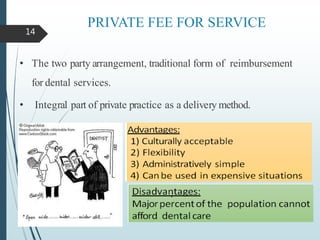
PRIVATE FEE FOR SERVICE
‱ The two party arrangement, traditional form of reimbursement
for dental services.
‱ Integral part of private practice as a delivery method.
14
INDIAN SCENARIO
‱ This payment method most commonly employed in India.
‱ India, though a socialist state and committed to providing
health care for its citizens , has one of the lowest per capita
public expenditures on health.
‱ The government spends just 1.28%of the GDP on health care.
15
NATIONAL HEALTH PROFILE DATA, 2019
‱ This results in poor quality of care in most of government
institutions. This pushes the patients to use the private sector
to meet their health needs.
‱ Estimates show that about 80% of all outpatients and about 40-
60% of all inpatients use the private health care facilities . At
these facilities, the patients pay user fees for each service
received, by themselves.
16
‱ As the cost of dental care continues to rise, the majority of the
people are not able to afford dental treatment, especially when
it is being provided on a fee for service basis. Very few people
can afford to utilize this service regularly.
‱ Most of the people visit dentist only for curative services
occasionally. Preventive measures are not given importance
due to high cost.
17
POST PAYMENT PLANS ORBUDGET
PLANS
 First started in Late 1930’s by local dental societies in Pennsylvania
and Michigan
 Post payment plans are mechanisms for individual purchase of
service.
 Payments made at intervals over a period of time
18
19
Application, approved by the
lending Institution
The dentist is paid the entire fee for
his service
Then patient repays the loan to
the bank in budgeted amounts
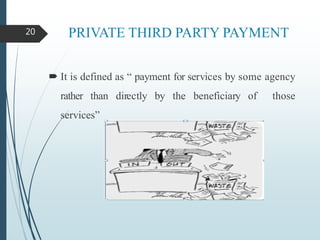
PRIVATE THIRD PARTY PAYMENT
 It is defined as “ payment for services by some agency
rather than directly by the beneficiary of those
services”
20
THIRD PARTY:
 The third party is also known as carrier, insurer, under writer
or administrative agent.
21
ï‚ŽĆŸ
. INSURANCE PRINCIPLES
 To Be Insurable, A Risk Must:
1. Be Precisely definable
2. Be of sufficient magnitude, that if it occurs, constitute a major
loss
3. Be infrequent
4. Be of unwanted nature ex: accident, fire, etc
5.Beyond the control of individual
22
‱ Dental insurance can be made feasible by:
1. Having patient pay a share of the cost
2. Limiting the range of services available
3. Offering services only to group
4. Include waiting period before benefits become payable
5. Use preauthorization and annual expenditure limits
23
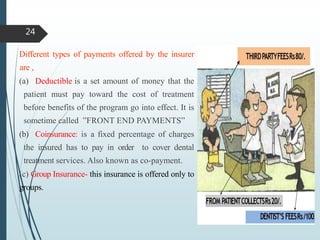
Different types of payments offered by the insurer
are ,
(a) Deductible:is a set amount of money that the
patient must pay toward the cost of treatment
before benefits of the program go into effect. It is
sometime called ”FRONT END PAYMENTS”
(b) Coinsurance: is a fixed percentage of charges
the insured has to pay in order to cover dental
treatment services. Also known as co-payment.
(c) Group Insurance- this insurance is offered only to
groups.
24
Reimbursement of Dentist in Third
Party Plans
 The major forms of third-party reimbursement currently in use
are:
 Usual, customary and reasonable fee
 Table of allowances
 Fee schedules
 Discounted fee (preferred provider organizations)
 Capitation
25
 Usual fee: The fee that an individual dentist most frequently
charges for a given dental service.
 Customary Fee: The fee level determined by the administrator
of a dental benefit plan from actual submitted fees for a specific
dental procedure to establish the maximum benefit payable under
a given plan for that specific procedure.
26
 Reasonable Fee: the fee charged by the dentist for a specific dental
procedure that has been modified by the nature and severity of the
condition being treated and by any medical or dental complications
may differ from the dentists usual fee or the benefit administrators
customary fee.
 Table of allowance: it is defined as a list of covered services with an
assigned amount that represents the total obligation of the plan with
respect to payment for such services, but does not necessarily
represent the dentists full fee for that service.
27
 Fee schedule: it is defined as a list of the charges established or agreed to by a
dentist for specific dental services.
 Discounted fee: these are usually the basis for PPO plans. Participating
dentists have agreed to provide care for fees that are usually lower than those
charged by many dentists in their area.
 Capitation :“A capitation fee is usually a fixed monthly payment paid by a carrier
to a dentist based on the number or patients assigned to the dentist for treatment.
Capitation requires that patients be assigned to specific dentists or dental
practices for care, so that the capitation payment can be paid to the appropriate
dentist or practice.”
28
Commercial insurance companies
 They can be more selective about a group to which it chooses
to offer dental insurance.
 They organize their levels of reimbursement differently.
 They claim no obligation toward the dental health of the
community.
29
Dr. Bhavna Singh , Govind Kumar Saxena. Scope of Dental Insurance In India . IOSR Journal of Dental and Medical Sciences ,Volume
17, Issue 10 Ver. 7 (October. 2018), PP 59-63
30
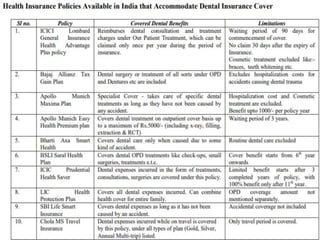
‱ Stand alone dental insurance plan: This type of plan covers the
expenses related to general dental problems, such as periodontitis
and extraction of permanent teeth due to ailments such as caries.
This type of plan is generally provided by the popular dental care
product companies in association with one of the insurance
companies.
 Dental insurance cover as part of general health insurance plan:
This type of dental insurance is provided by the general
insurance companies as part of their own general health
insurance schemes, such as health advantage policy or student
medical policy. Through this scheme, one can claim dental
expenses along with the other kinds of reimbursements, such
as the cost of medicines or hospitalization.
31
PEPSODENT DENTAL INSURANCE
32
 Hindustan Lever Limited (HLL) on 9th Oct 2002 launched,
‘Pepsodent Dental Insurance’, in partnership with New India
Assurance, which was the first of its kind dental insurance
scheme in India.
 Every purchase of a Pepsodent toothpaste enable the customer to
get 1,000/- free dental insurance.
 Customers had to send the proposal form along with 3 wrappers
of the toothpaste and medical certificates and bills to avail the
benefit.
33
 This plan was time bound and did not cover dental
rehabilitation.
Under this initiative, Pepsodent offered consumers
insurance cover against expenses for the extraction of a
permanent tooth due to severe caries and periodontitis,
including cost of medication.
 Claims for cosmetic dentistry or loss of a tooth due to
accidents were not covered.
The insurance cover would be valid for one year
This scheme has been discontinued as of today.
34
OCARE
 OCARE, an Insurance Provider As A Service (IPASS)
platform has recently launched India‟s first “Dental Insurance
Plan‟
 It is a group insurance product, offering insurance upto
25,000/- a year with 1699/- annual premium and 100% tax
benefit on the premium amount paid.
 Procedures like extraction, complete / partial denture, RCT,
crown, bridge etc are covered including pre-existing dental
conditions.
35
 Some of the major exclusions under the policy are:
1. Tooth/Teeth fillings and Restorations
2. Dental Implants
3. Aesthetic and Cosmetic Procedures
4. Teeth Whitening
5. Tooth Jewellery
 On allotment of a provider, for every adult enrolee (above 18years) will
be entitled to one cleaning, and one consultations free of charge for a
year and a child(below 18years) will be entitled to one cleaning, one
consultation and one topical fluoride application free of charge.
36
 It covers 2 dental check-ups per year plus a loyalty card
redeemable on dental services.
 OCARE plan was initially launched in Maharashtra at village
level, through respective gram panchayats, with a view to
make dental treatment accessible and affordable to all.
 Presently it is offered only to corporate, schools, colleges,
institutes etc and later intended to include dental insurance
cover to individuals.
37
38
NON PROFITABLE HEALTH SERVICE
CORPORATION
Dental Service Corporation
 Legally constituted Non–profitable organization incorporated
on a state by state basis, that negotiates and administers
contracts for dental care.
 Started as National association of dental service plans
(NADSP) JUNE 1966
 Name changed to DELTA DENTAL PLANS ASSOCIATION,
APRIL 1969
39
Delta plans encourage all dentists to participate. Dentist
participating in the plan have to agree to the following
conditions
- Pre-filing of their usual and customary fees.
- Acceptance of payment for their services at an agreed-on
percentile.
- Fee audits by auditors from delta plan.
- Post treatment inspection
- Withholding of small amount of each fee to go into the delta
capital reserve fund.
40
 Preauthorization: Also called predetermination, precertification,
pre-treatment review, or prior authorization. The dentist is required
to submit the treatment plan to the insurer for review before the
treatment begins.
 Procedure Codes -Dental procedure codes also were developed in
the early days of dental prepayment. With the advent of third-party
involvement, an unambiguous method had to be developed to
define which procedures would be covered and which would not, as
well as to facilitate the accurate reporting of which services were
provided.
41
BLUE CROSS/BLUE SHIELD
‱ Blue Cross/Blue Shield Association (BCBSA) is a federation of
38 separate health insurance organizations and companies in the
United States.
‱ Blue Cross(1929) and Blue Shield(1939) developed separately
and later on merged (1982).
‱ Adopted many of the cost control features pioneered by
delta plans.
‱ Dental coverage was usually limited to services provided in the
hospital.
42
NON PROFIT HEALTH SERVICE
CORPORATION IN INDIA
‱ KARUNA TRUST-It was initiated in September 2002 by a
partnership between Karuna Trust, the Govt. of Karnataka, the
Govt. of India, the United Nations Development Programe
(UNDP), the National Insurance Corporation (NIC) and the
Centre for Population Dynamics (CFPD).
 The premium varies according to the socio-economic status.
43
 NAANDI FOUNDATION
 Naandi Foundation is an autonomous, not-for-profit trust
dedicated to changing lives of the underserved populations in
India through public-private Partnerships.
 Since 2002 and under the banner of Child Rights, it works in
partnership with the state government of Andhra Pradesh.
 Young Children in the age group of 6 to 14 years enlisted in
public schools
44
‱ The insurance plan provides “whole care” coverage without
any limitation or service cap while operating at all levels:
primary, secondary and tertiary level.
‱ Surgical interventions extend to corrective, cosmetic and
dental surgery.
45
‱ TRINITYCARE FOUNDATION
‱ Non-Profit Organization based in Bangalore since 2007
‱ Dedicated to School Health Programs, Facial Deformity
Programs and Oral Cancer Programs.
‱ Working with the community organizations, educational
institutions and involving Government, Industry and the Medical
profession.
46
HEALTH MAINTENANCE
ORGANIZATIONS (HMO)
47
Definition:
"A legal entity which provides a prescribed range of health services
to each individual who has enrolled in the organization in return
for a prepaid, fixed and uniform payment.
It Provides comprehensive health maintenance and treatment
services which includes Primary care, Emergency care, Hospital
care, Rehabilitation.
An Enrolled Group:
‱ Members of the HMO are those people who voluntarily join the
HMO through a contract arrangement in which the enrolled
agrees to pay the fixed monthly or other periodic payment to the
HMO.
‱ Enrollees agree to use the HMO as their principal source of health
care if they become ill or need care.
48
Dental Personnel in HMO
49
‱ Staff model –Dentists, dental hygienists, and dental assistants
are salaried employees of the HMO.
‱ Group models – HMO contracts directly with a group practice,
partnership or corporations for the provision of dental services.
‱ Independent Practice Association (IPA)– the IPA is an
association of independent dentist that develops its own
management and fiscal structures for the treatment of patients
enrolled in an HMO.
‱ Primary Care Capitated Network Or Direct Contract Model –
network is similar to IPA except that the HMO contracts directly
with the individual provider for provision of services.
50
‱ PreferredProvider Organizations (PPOs)
‱ PPOs, along with HMOs, are one of the main managed care
arrangement system.
‱ It involves contract between insurer and a number of practitioners
who agree to provide specific services for fees that are lower than
average for that area.
CAPITATION PLANS
51
‱ The basis of capitation is that the contracting provider,
whether an HMO or individual dentist receives an established,
negotiated sum on a monthly or yearly basis for each eligible
patient.
‱ The money is paid regardless of whether the patients utilize care
or not.
‱ In return, patient is entitled to receive a prescribed set of services
over a specified period
SALARY
52
Dentists in some group practices, those in the armed forces
and those employed by public agencies are salaried.
8
9
Advantages:
‱ It allows a dentist to be largely free of the business
concerns of running a practice, thereby allowing the dentist
to concentrate on clinical matters.
‱ Fringe benefits are also often attractive.
Disadvantages:
‱ There could be lack of financial incentive that some
dentists need to be highly productive.
53
Public Financing of Dental Care
54
Medicare
 This programme removed all financial barriers for hospital and
physician services for persons age 65 and over, regardless of
their financial means.
 The dental segment of medicare is limited to those services
which require hospitalization for treatment, usually surgical
treatment of fractures and oral cancer.
55
Medicaid
The original intent of Medicaid was to provide funds to meet the
health care needs of all indigent and medically indigent persons.
It is a joint federal state program .
56
Employees State Insurance Scheme (ESIS)
57
Managed by Employees State Insurance Corporation (ESIC) –
a wholly Govt owned enterprises
Presently, there are 9 medical colleges and 2 dental colleges
established by the ESI Scheme.
The Dental colleges run by the ESI Corporation are located
in New Delhi and Gulbarga, Karnataka
Central government health scheme
(CGHS)
58
‱ Previously known as – “Contributory Health Service
Scheme”
‱ Introduced in 1954 in New Delhi to provide comprehensive
medical care to central government employees and their
families
‱ 320 Separate dispensaries for the employees
www.cghs.gov.in
 Ex-servicemen Contributory Health Scheme (ECHS) was launched with
effect from 01 April 2003.
 The Scheme aims to provide allopathic Medicare to Ex-servicemen
pensioner and their dependents through a network of ECHS Polyclinics,
Service medical facilities and civil empanelled/Govt hospitals spread
across the country.
59
http://www.desw.gov.in/ex-servicemen-contributory-health-scheme/about-
echs
National health insurance
60
‱ The National Health Insurance Scheme was launched in 2007 by the
government.
‱ It aims to protect unorganized sector workers below the poverty line
from major health expenses associated with hospitalization.
‱ The scheme is sponsored by the central and state governments. The
state governments contract with insurance companies to manage
financial risk and run the schemes (each state government goes
through its own procurement process to select an insurance company).
‱ The benefits package is limited to hospitalization and surgical
services.
Ayushman Bharat Health Insurance Scheme
 Launched on 23rd September 2018.
 Since its launch, the scheme has been renamed as PM Jan Arogya
Yojana (PMJAY).
 It offers insurance cover of Rs 5 lakh per family.
 The scheme is aimed at providing insurance cover to economically
backward people in rural and urban areas who will be identified on the
basis of data from the Socio-Economic Caste Census (SECC) 2011.
61
DENTAL INSURANCE MANAGEMENT PLAN
62
Although the patient is responsible for ascertaining the benefits
of his or her policy, the office should be able to clarify what the
benefits are available to the patient, so that there is no
misunderstanding as to the patient’s responsibility.
Mashioff LS. Management of dental insurance in the dental
office. Dental clinics of North America. 1987 Apr;31(2):179-92.
‱ Because major dental carriers have many different types of plans,
one of the essential ingredients for a management system to work
smoothly and effectively is the “Insurance Bible”.
‱ At first contact with the patient (which is often by
telephone), the patient should be requested to:
1) Bring several insurance forms into the office and
2) Bring in their insurance policy, which gives a description of
servicebenefits.
63
‱ The parts of the plan that explain the benefits, deductibles, and the
expiration date of the policy should be highlighted.
‱ In this way the staff can determine while the patient is there, the
dentist’s fee, what services the insurance company covers, the
amount they will pay, and whether the patient is responsible for the
differential.
‱ Highlight the expiration date so that there will be no confusion as
to when the policy expires.
64
SUPERBILL FORM
 A Superbill is used by healthcare providers as a primary source of data
for creating claims. These claims will eventually be submitted to payers
for reimbursement.
 Essentially, a Superbill is an itemized list of all services provided to a
client.
‱ Reduces work load and increases efficiency
‱ It has prewritten codes for all procedures routinely used
‱ Special slots for tooth number and dentist fee
‱ Once these sections are filled superbill is stapled with patient’s
insurance form and send to company
65
Marking of patient chart
66
‱ Receptionist places white piece of tape or colour codes on
the side of patient’s chart to denote that he has insurance.
CONCLUSION
 The financing of dental care is well developed and well practiced in developed
countries like U.S.
 However, In India, fee for service is still the most prevalent form of availing
dental services. Although free dental services are provided by the government
at some of the health centers, it is scarce and inefficient.
 Dental insurance is in its infancy and with the very high premiums, dental
service is still very far from the reaches of the indigent.
67
REFERENCES
 Peter S. Essentials of Public Health Dentistry . 6th ed. Arya (Medi) Publishing House Pvt . Ltd; 2017.
 Burt BA, Eklund. Dentistry , Dental practice and the Community. 6th edition . Elsevier Health sciences;2005.
 Garla BK, Satish G, Divya KT. Dental insurance: A systematic review. Journal of International Society of
Preventive & Community Dentistry. 2014 Dec;4(Suppl 2):S73.
 Sebastian S. Dental Insurance In India: An Overview.Int J Dent Health Sci 2014;1(6):788-795.
 Goodman-Bacon A. The long-run effects of childhood insurance coverage: Medicaid implementation, adult
health, and labor market outcomes. National Bureau of Economic Research; 2016 Dec 1.
 Brevoort K, Grodzicki D, Hackmann MB. Medicaid and financial health. National Bureau of Economic
Research; 2017 Nov 2.
 Goodman-Bacon A. Public insurance and mortality: evidence from Medicaid implementation. Journal of Political
Economy. 2018 Feb 1;126(1):216-62
68
 Mashioff LS. Management of dental insurance in the dental office. Dental clinics
of North America. 1987 Apr;31(2):179-92.
 Singh A. Current Situation of Health care Coverage in India.News Across
Asia.2016
 http://www.desw.gov.in/ex-servicemen-contributory-health-scheme/about-echs
 https://pmjay.gov.in/organogram
 Huffman KF, Upchurch G. The health of older Americans: A primer on Medicare
and a local perspective. Journal of the American Geriatrics Society. 2018
Jan;66(1):25-32.
 Alker J. Choosing Premium Assistance: What Does State Experience Tell Us?. Henry
J. Kaiser Family Foundation; 2008.
 https://www.medicare.gov/coverage/dental-services
 https://www.medicaid.gov/medicaid/benefits/downloads/ohi-baselines-progress-
goals.pdf
 http://assets.milliman.com/ektron/medicaid-adult-dental-reimbursement.pdf
70
THANK YOU
71

FINANCE IN DENTAL CARE.pptx

  • 1.
    FINANCE IN DENTAL CARE PRESENTEDBY- DR. JASPREET SINGH TUTEJA READER Dept. of Public Health Dentistry Rama Dental College- Hospital & Research Centre, Kanpur 1
  • 2.
    CONTENTS ‱ Introduction ‱ Terminologies ‱History ‱ Different payment mechanisms  Private fee - for services  Post payment plans  Private third party service plans  Salary  Public programs ‱ Dental Insurance Management ‱ Conclusion ‱ References 2
  • 3.
    INTRODUCTION  Health carehistorically has been provided on a fee for service basis, in which the patient pays the provider directly for services.  Methods of financing however, have progressed far beyond this traditional system since the mid 1930's and more so since 1965.  One of the main reasons for emergence of third party payment systems is the rising cost of health care. 3
  • 4.
     The accelerationof increase in health care costs has been attributed to a number of factors. 4
  • 5.
    TERMINOLOGIES ‱ Participating dentist:(provider) is a dentist who signs a contract with the insurance company and agrees to provide dental services and supplies to eligible participants at a fixed price. 5 Glossary of insurance terms, NATIONAL ASSOCIATION OF INSURANCE COMMISSIONERS
  • 6.
    ‱ Direct reimbursementplan: is a dental insurance plan that is usually entirely funded by the employer and allows the insured to see any dentist of his/her choice without any network restrictions. ‱ Premium: is the money amount one is to pay on a regular basis (usually either every month or every year) so that, the insurance company could fund your dental plan. 6
  • 7.
    ‱ Usual, customary,and reasonable fee: (UCR fee) is a fee associated with each dental procedure which reflects the fee charged by the majority of dentists for the services in question in a given area. The "UCR" fee can help you determine whether your dentist is charging too much. ‱ Third party payment: an organization other than the patient ( first party) or health care provider (second party) involved in the financing of personal health services. 7
  • 8.
    ‱ Prepaid dentalplan: a method of financing the cost of dental care for a defined population, in advance of receipt of services. ‱ Preferred provider organization: (PPO) a formal agreement between a purchaser of a dental benefit programming and a defined group of dentists for the delivery of dental services to a specific patient population, as an adjunct to a traditional plan, using discount fees for cost savings. 8
  • 9.
    HISTORY ‱ Fee forservice was the first mode of payment to the dentist with respect to the services received. ‱ 1945- start of voluntary prepaid comprehensive dental care in St. Louis, U.S.A. ‱ 1948-Establishment of a National Insurance Scheme including Comprehensive Dental Service in England 9 Garla BK, Satish G, Divya KT. Dental insurance: A systematic review. Journal of International Society of Preventive & Community Dentistry. 2014 Dec;4(Suppl 2):S73.
  • 10.
    ‱ 1948- Bisell.B.Palmer of New York City founded group health dental insurance as open panel pre-payment system. ‱ 1949- Group Health Association, consumers co-operative in Washington, established a clinic dental service, which soon changed from fee for service basis to prepayment. 10
  • 11.
    ‱ 1954- WashingtonState Dental Council organized Washington State Dental Services Corporation to help administer prepayment dental care plan for children of International Longshoreman’s Union Pacific Maritime Association. This mechanism was soon found to be the best form of rendering dental care. ‱ 1966- Medicare brought medical care to the aged people of the U.S., regardless of their income. This did not include dentistry, but Medicaid did. 11
  • 12.
    ‱ 1973- HealthMaintenance Organization Act was passed which provided government support for organizations providing standardized comprehensive care to the individuals in enrolled groups. ‱ 1989- Delta Dental Plan and other such agencies were covering about 107millionbeneficiaries. 12
  • 13.
    MECHANISM OF PAYMENTFOR DENTAL CARE  Private fee for service  Post payment plans  Private third party prepayment plans ‱ Commercial insurance plans ‱ Non profit health service corporations ‱ Prepaid group practice ‱ Capitation plans  Salary  Public programs 13
  • 14.
    PRIVATE FEE FORSERVICE ‱ The two party arrangement, traditional form of reimbursement for dental services. ‱ Integral part of private practice as a delivery method. 14
  • 15.
    INDIAN SCENARIO ‱ Thispayment method most commonly employed in India. ‱ India, though a socialist state and committed to providing health care for its citizens , has one of the lowest per capita public expenditures on health. ‱ The government spends just 1.28%of the GDP on health care. 15 NATIONAL HEALTH PROFILE DATA, 2019
  • 16.
    ‱ This resultsin poor quality of care in most of government institutions. This pushes the patients to use the private sector to meet their health needs. ‱ Estimates show that about 80% of all outpatients and about 40- 60% of all inpatients use the private health care facilities . At these facilities, the patients pay user fees for each service received, by themselves. 16
  • 17.
    ‱ As thecost of dental care continues to rise, the majority of the people are not able to afford dental treatment, especially when it is being provided on a fee for service basis. Very few people can afford to utilize this service regularly. ‱ Most of the people visit dentist only for curative services occasionally. Preventive measures are not given importance due to high cost. 17
  • 18.
    POST PAYMENT PLANSORBUDGET PLANS  First started in Late 1930’s by local dental societies in Pennsylvania and Michigan  Post payment plans are mechanisms for individual purchase of service.  Payments made at intervals over a period of time 18
  • 19.
    19 Application, approved bythe lending Institution The dentist is paid the entire fee for his service Then patient repays the loan to the bank in budgeted amounts
  • 20.
    PRIVATE THIRD PARTYPAYMENT  It is defined as “ payment for services by some agency rather than directly by the beneficiary of those services” 20
  • 21.
    THIRD PARTY:  Thethird party is also known as carrier, insurer, under writer or administrative agent. 21
  • 22.
    ï‚ŽĆŸ . INSURANCE PRINCIPLES To Be Insurable, A Risk Must: 1. Be Precisely definable 2. Be of sufficient magnitude, that if it occurs, constitute a major loss 3. Be infrequent 4. Be of unwanted nature ex: accident, fire, etc 5.Beyond the control of individual 22
  • 23.
    ‱ Dental insurancecan be made feasible by: 1. Having patient pay a share of the cost 2. Limiting the range of services available 3. Offering services only to group 4. Include waiting period before benefits become payable 5. Use preauthorization and annual expenditure limits 23
  • 24.
    Different types ofpayments offered by the insurer are , (a) Deductible:is a set amount of money that the patient must pay toward the cost of treatment before benefits of the program go into effect. It is sometime called ”FRONT END PAYMENTS” (b) Coinsurance: is a fixed percentage of charges the insured has to pay in order to cover dental treatment services. Also known as co-payment. (c) Group Insurance- this insurance is offered only to groups. 24
  • 25.
    Reimbursement of Dentistin Third Party Plans  The major forms of third-party reimbursement currently in use are:  Usual, customary and reasonable fee  Table of allowances  Fee schedules  Discounted fee (preferred provider organizations)  Capitation 25
  • 26.
     Usual fee:The fee that an individual dentist most frequently charges for a given dental service.  Customary Fee: The fee level determined by the administrator of a dental benefit plan from actual submitted fees for a specific dental procedure to establish the maximum benefit payable under a given plan for that specific procedure. 26
  • 27.
     Reasonable Fee:the fee charged by the dentist for a specific dental procedure that has been modified by the nature and severity of the condition being treated and by any medical or dental complications may differ from the dentists usual fee or the benefit administrators customary fee.  Table of allowance: it is defined as a list of covered services with an assigned amount that represents the total obligation of the plan with respect to payment for such services, but does not necessarily represent the dentists full fee for that service. 27
  • 28.
     Fee schedule:it is defined as a list of the charges established or agreed to by a dentist for specific dental services.  Discounted fee: these are usually the basis for PPO plans. Participating dentists have agreed to provide care for fees that are usually lower than those charged by many dentists in their area.  Capitation :“A capitation fee is usually a fixed monthly payment paid by a carrier to a dentist based on the number or patients assigned to the dentist for treatment. Capitation requires that patients be assigned to specific dentists or dental practices for care, so that the capitation payment can be paid to the appropriate dentist or practice.” 28
  • 29.
    Commercial insurance companies They can be more selective about a group to which it chooses to offer dental insurance.  They organize their levels of reimbursement differently.  They claim no obligation toward the dental health of the community. 29 Dr. Bhavna Singh , Govind Kumar Saxena. Scope of Dental Insurance In India . IOSR Journal of Dental and Medical Sciences ,Volume 17, Issue 10 Ver. 7 (October. 2018), PP 59-63
  • 30.
    30 ‱ Stand alonedental insurance plan: This type of plan covers the expenses related to general dental problems, such as periodontitis and extraction of permanent teeth due to ailments such as caries. This type of plan is generally provided by the popular dental care product companies in association with one of the insurance companies.
  • 31.
     Dental insurancecover as part of general health insurance plan: This type of dental insurance is provided by the general insurance companies as part of their own general health insurance schemes, such as health advantage policy or student medical policy. Through this scheme, one can claim dental expenses along with the other kinds of reimbursements, such as the cost of medicines or hospitalization. 31
  • 32.
  • 33.
     Hindustan LeverLimited (HLL) on 9th Oct 2002 launched, ‘Pepsodent Dental Insurance’, in partnership with New India Assurance, which was the first of its kind dental insurance scheme in India.  Every purchase of a Pepsodent toothpaste enable the customer to get 1,000/- free dental insurance.  Customers had to send the proposal form along with 3 wrappers of the toothpaste and medical certificates and bills to avail the benefit. 33
  • 34.
     This planwas time bound and did not cover dental rehabilitation. Under this initiative, Pepsodent offered consumers insurance cover against expenses for the extraction of a permanent tooth due to severe caries and periodontitis, including cost of medication.  Claims for cosmetic dentistry or loss of a tooth due to accidents were not covered. The insurance cover would be valid for one year This scheme has been discontinued as of today. 34
  • 35.
    OCARE  OCARE, anInsurance Provider As A Service (IPASS) platform has recently launched India‟s first “Dental Insurance Plan‟  It is a group insurance product, offering insurance upto 25,000/- a year with 1699/- annual premium and 100% tax benefit on the premium amount paid.  Procedures like extraction, complete / partial denture, RCT, crown, bridge etc are covered including pre-existing dental conditions. 35
  • 36.
     Some ofthe major exclusions under the policy are: 1. Tooth/Teeth fillings and Restorations 2. Dental Implants 3. Aesthetic and Cosmetic Procedures 4. Teeth Whitening 5. Tooth Jewellery  On allotment of a provider, for every adult enrolee (above 18years) will be entitled to one cleaning, and one consultations free of charge for a year and a child(below 18years) will be entitled to one cleaning, one consultation and one topical fluoride application free of charge. 36
  • 37.
     It covers2 dental check-ups per year plus a loyalty card redeemable on dental services.  OCARE plan was initially launched in Maharashtra at village level, through respective gram panchayats, with a view to make dental treatment accessible and affordable to all.  Presently it is offered only to corporate, schools, colleges, institutes etc and later intended to include dental insurance cover to individuals. 37
  • 38.
  • 39.
    NON PROFITABLE HEALTHSERVICE CORPORATION Dental Service Corporation  Legally constituted Non–profitable organization incorporated on a state by state basis, that negotiates and administers contracts for dental care.  Started as National association of dental service plans (NADSP) JUNE 1966  Name changed to DELTA DENTAL PLANS ASSOCIATION, APRIL 1969 39
  • 40.
    Delta plans encourageall dentists to participate. Dentist participating in the plan have to agree to the following conditions - Pre-filing of their usual and customary fees. - Acceptance of payment for their services at an agreed-on percentile. - Fee audits by auditors from delta plan. - Post treatment inspection - Withholding of small amount of each fee to go into the delta capital reserve fund. 40
  • 41.
     Preauthorization: Alsocalled predetermination, precertification, pre-treatment review, or prior authorization. The dentist is required to submit the treatment plan to the insurer for review before the treatment begins.  Procedure Codes -Dental procedure codes also were developed in the early days of dental prepayment. With the advent of third-party involvement, an unambiguous method had to be developed to define which procedures would be covered and which would not, as well as to facilitate the accurate reporting of which services were provided. 41
  • 42.
    BLUE CROSS/BLUE SHIELD ‱Blue Cross/Blue Shield Association (BCBSA) is a federation of 38 separate health insurance organizations and companies in the United States. ‱ Blue Cross(1929) and Blue Shield(1939) developed separately and later on merged (1982). ‱ Adopted many of the cost control features pioneered by delta plans. ‱ Dental coverage was usually limited to services provided in the hospital. 42
  • 43.
    NON PROFIT HEALTHSERVICE CORPORATION IN INDIA ‱ KARUNA TRUST-It was initiated in September 2002 by a partnership between Karuna Trust, the Govt. of Karnataka, the Govt. of India, the United Nations Development Programe (UNDP), the National Insurance Corporation (NIC) and the Centre for Population Dynamics (CFPD).  The premium varies according to the socio-economic status. 43
  • 44.
     NAANDI FOUNDATION Naandi Foundation is an autonomous, not-for-profit trust dedicated to changing lives of the underserved populations in India through public-private Partnerships.  Since 2002 and under the banner of Child Rights, it works in partnership with the state government of Andhra Pradesh.  Young Children in the age group of 6 to 14 years enlisted in public schools 44
  • 45.
    ‱ The insuranceplan provides “whole care” coverage without any limitation or service cap while operating at all levels: primary, secondary and tertiary level. ‱ Surgical interventions extend to corrective, cosmetic and dental surgery. 45
  • 46.
    ‱ TRINITYCARE FOUNDATION ‱Non-Profit Organization based in Bangalore since 2007 ‱ Dedicated to School Health Programs, Facial Deformity Programs and Oral Cancer Programs. ‱ Working with the community organizations, educational institutions and involving Government, Industry and the Medical profession. 46
  • 47.
    HEALTH MAINTENANCE ORGANIZATIONS (HMO) 47 Definition: "Alegal entity which provides a prescribed range of health services to each individual who has enrolled in the organization in return for a prepaid, fixed and uniform payment. It Provides comprehensive health maintenance and treatment services which includes Primary care, Emergency care, Hospital care, Rehabilitation.
  • 48.
    An Enrolled Group: ‱Members of the HMO are those people who voluntarily join the HMO through a contract arrangement in which the enrolled agrees to pay the fixed monthly or other periodic payment to the HMO. ‱ Enrollees agree to use the HMO as their principal source of health care if they become ill or need care. 48
  • 49.
    Dental Personnel inHMO 49 ‱ Staff model –Dentists, dental hygienists, and dental assistants are salaried employees of the HMO. ‱ Group models – HMO contracts directly with a group practice, partnership or corporations for the provision of dental services. ‱ Independent Practice Association (IPA)– the IPA is an association of independent dentist that develops its own management and fiscal structures for the treatment of patients enrolled in an HMO. ‱ Primary Care Capitated Network Or Direct Contract Model – network is similar to IPA except that the HMO contracts directly with the individual provider for provision of services.
  • 50.
    50 ‱ PreferredProvider Organizations(PPOs) ‱ PPOs, along with HMOs, are one of the main managed care arrangement system. ‱ It involves contract between insurer and a number of practitioners who agree to provide specific services for fees that are lower than average for that area.
  • 51.
    CAPITATION PLANS 51 ‱ Thebasis of capitation is that the contracting provider, whether an HMO or individual dentist receives an established, negotiated sum on a monthly or yearly basis for each eligible patient. ‱ The money is paid regardless of whether the patients utilize care or not. ‱ In return, patient is entitled to receive a prescribed set of services over a specified period
  • 52.
    SALARY 52 Dentists in somegroup practices, those in the armed forces and those employed by public agencies are salaried. 8 9
  • 53.
    Advantages: ‱ It allowsa dentist to be largely free of the business concerns of running a practice, thereby allowing the dentist to concentrate on clinical matters. ‱ Fringe benefits are also often attractive. Disadvantages: ‱ There could be lack of financial incentive that some dentists need to be highly productive. 53
  • 54.
    Public Financing ofDental Care 54
  • 55.
    Medicare  This programmeremoved all financial barriers for hospital and physician services for persons age 65 and over, regardless of their financial means.  The dental segment of medicare is limited to those services which require hospitalization for treatment, usually surgical treatment of fractures and oral cancer. 55
  • 56.
    Medicaid The original intentof Medicaid was to provide funds to meet the health care needs of all indigent and medically indigent persons. It is a joint federal state program . 56
  • 57.
    Employees State InsuranceScheme (ESIS) 57 Managed by Employees State Insurance Corporation (ESIC) – a wholly Govt owned enterprises Presently, there are 9 medical colleges and 2 dental colleges established by the ESI Scheme. The Dental colleges run by the ESI Corporation are located in New Delhi and Gulbarga, Karnataka
  • 58.
    Central government healthscheme (CGHS) 58 ‱ Previously known as – “Contributory Health Service Scheme” ‱ Introduced in 1954 in New Delhi to provide comprehensive medical care to central government employees and their families ‱ 320 Separate dispensaries for the employees www.cghs.gov.in
  • 59.
     Ex-servicemen ContributoryHealth Scheme (ECHS) was launched with effect from 01 April 2003.  The Scheme aims to provide allopathic Medicare to Ex-servicemen pensioner and their dependents through a network of ECHS Polyclinics, Service medical facilities and civil empanelled/Govt hospitals spread across the country. 59 http://www.desw.gov.in/ex-servicemen-contributory-health-scheme/about- echs
  • 60.
    National health insurance 60 ‱The National Health Insurance Scheme was launched in 2007 by the government. ‱ It aims to protect unorganized sector workers below the poverty line from major health expenses associated with hospitalization. ‱ The scheme is sponsored by the central and state governments. The state governments contract with insurance companies to manage financial risk and run the schemes (each state government goes through its own procurement process to select an insurance company). ‱ The benefits package is limited to hospitalization and surgical services.
  • 61.
    Ayushman Bharat HealthInsurance Scheme  Launched on 23rd September 2018.  Since its launch, the scheme has been renamed as PM Jan Arogya Yojana (PMJAY).  It offers insurance cover of Rs 5 lakh per family.  The scheme is aimed at providing insurance cover to economically backward people in rural and urban areas who will be identified on the basis of data from the Socio-Economic Caste Census (SECC) 2011. 61
  • 62.
    DENTAL INSURANCE MANAGEMENTPLAN 62 Although the patient is responsible for ascertaining the benefits of his or her policy, the office should be able to clarify what the benefits are available to the patient, so that there is no misunderstanding as to the patient’s responsibility. Mashioff LS. Management of dental insurance in the dental office. Dental clinics of North America. 1987 Apr;31(2):179-92.
  • 63.
    ‱ Because majordental carriers have many different types of plans, one of the essential ingredients for a management system to work smoothly and effectively is the “Insurance Bible”. ‱ At first contact with the patient (which is often by telephone), the patient should be requested to: 1) Bring several insurance forms into the office and 2) Bring in their insurance policy, which gives a description of servicebenefits. 63
  • 64.
    ‱ The partsof the plan that explain the benefits, deductibles, and the expiration date of the policy should be highlighted. ‱ In this way the staff can determine while the patient is there, the dentist’s fee, what services the insurance company covers, the amount they will pay, and whether the patient is responsible for the differential. ‱ Highlight the expiration date so that there will be no confusion as to when the policy expires. 64
  • 65.
    SUPERBILL FORM  ASuperbill is used by healthcare providers as a primary source of data for creating claims. These claims will eventually be submitted to payers for reimbursement.  Essentially, a Superbill is an itemized list of all services provided to a client. ‱ Reduces work load and increases efficiency ‱ It has prewritten codes for all procedures routinely used ‱ Special slots for tooth number and dentist fee ‱ Once these sections are filled superbill is stapled with patient’s insurance form and send to company 65
  • 66.
    Marking of patientchart 66 ‱ Receptionist places white piece of tape or colour codes on the side of patient’s chart to denote that he has insurance.
  • 67.
    CONCLUSION  The financingof dental care is well developed and well practiced in developed countries like U.S.  However, In India, fee for service is still the most prevalent form of availing dental services. Although free dental services are provided by the government at some of the health centers, it is scarce and inefficient.  Dental insurance is in its infancy and with the very high premiums, dental service is still very far from the reaches of the indigent. 67
  • 68.
    REFERENCES  Peter S.Essentials of Public Health Dentistry . 6th ed. Arya (Medi) Publishing House Pvt . Ltd; 2017.  Burt BA, Eklund. Dentistry , Dental practice and the Community. 6th edition . Elsevier Health sciences;2005.  Garla BK, Satish G, Divya KT. Dental insurance: A systematic review. Journal of International Society of Preventive & Community Dentistry. 2014 Dec;4(Suppl 2):S73.  Sebastian S. Dental Insurance In India: An Overview.Int J Dent Health Sci 2014;1(6):788-795.  Goodman-Bacon A. The long-run effects of childhood insurance coverage: Medicaid implementation, adult health, and labor market outcomes. National Bureau of Economic Research; 2016 Dec 1.  Brevoort K, Grodzicki D, Hackmann MB. Medicaid and financial health. National Bureau of Economic Research; 2017 Nov 2.  Goodman-Bacon A. Public insurance and mortality: evidence from Medicaid implementation. Journal of Political Economy. 2018 Feb 1;126(1):216-62 68
  • 69.
     Mashioff LS.Management of dental insurance in the dental office. Dental clinics of North America. 1987 Apr;31(2):179-92.  Singh A. Current Situation of Health care Coverage in India.News Across Asia.2016  http://www.desw.gov.in/ex-servicemen-contributory-health-scheme/about-echs  https://pmjay.gov.in/organogram  Huffman KF, Upchurch G. The health of older Americans: A primer on Medicare and a local perspective. Journal of the American Geriatrics Society. 2018 Jan;66(1):25-32.
  • 70.
     Alker J.Choosing Premium Assistance: What Does State Experience Tell Us?. Henry J. Kaiser Family Foundation; 2008.  https://www.medicare.gov/coverage/dental-services  https://www.medicaid.gov/medicaid/benefits/downloads/ohi-baselines-progress- goals.pdf  http://assets.milliman.com/ektron/medicaid-adult-dental-reimbursement.pdf 70
  • 71.