Mahal Kita pero Walang
Forever kaya
BREAK MUNA TAYO!
Curriculum
Contextualization
Objectives:
• Gain functional and operational understanding of
curriculum contextualization;
Objectives:
• Illustrate ways on how the curriculum and/or subject
could be localized/indigenized; and
Objectives:
• Express appreciation of the need to adapt to the learners’
diversity through contextualization.
DEPARTMENT OF EDUCATION
Let us think
1. What do you know about Curriculum
Contextualization?
2. What is Localization?
3. What is indigenization?
DEPARTMENT OF EDUCATION
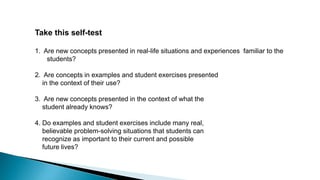
Take This Self-Test
1. Are new concepts presented in real-life situations and
experiences familiar to the students?
2. Are concepts in examples and student exercises presented
in the context of their use ?
3. Are new concepts presented in the context of what the
students already know?
4. Do examples and student exercises include many real,
believable problem-solving situations that students can
recognize as important to their current and possible future
lives ?
DEPARTMENT OF EDUCATION
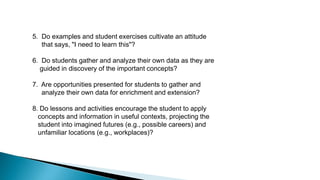
Take This Self-Test
5. Do examples and student exercises cultivate an attitude that
says “I need to learn this”?
6. Do students gather and analyze their own data as they are
guided in discovery of important concepts ?
7. Are opportunities presented for students to gather and
analyze their own data for enrichment and extension ?
8. Do lessons and activities encourage students to apply
concepts and information in useful contexts, projecting the
student into imagined futures (e.g. possible careers) and
unfamiliar locations (e.g. workplaces) ?
Kategorya 1: Kilala
NAMIN ito!
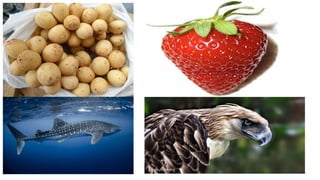
Kategorya 2:
Meron KAMI Nito!
Kategorya 3: Sa
AMIN sya
nanggaling!
Kategorya 4:
Amin to!
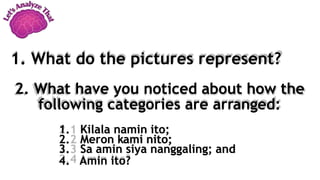
2. What have you noticed about how the
following categories are arranged:
1. Kilala namin ito;
2. Meron kami nito;
3. Sa amin siya nanggaling; and
4. Amin ito?
1. What do the pictures represent?
The K to 12 curriculum framework highlights the
fundamental importance of context in shaping the
curriculum, and consequently, the teaching-
learning process
Enhanced Basic Education Act of 2013 (RA 10533), Sec. 5
The DepEd shall adhere to the following standards and principles in
developing the enhanced basic education curriculum:
(d)
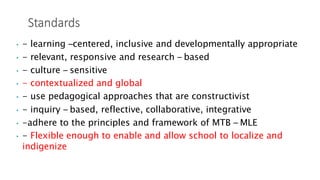
• - learning –centered, inclusive and developmentally appropriate
• - relevant, responsive and research – based
• - culture – sensitive
• - contextualized and global
• - use pedagogical approaches that are constructivist
• - inquiry – based, reflective, collaborative, integrative
• -adhere to the principles and framework of MTB – MLE
• - Flexible enough to enable and allow school to localize and
indigenize
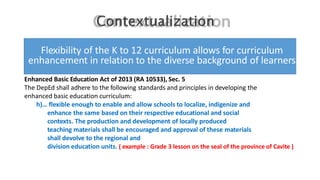
Flexibility of the K to 12 curriculum allows for curriculum
enhancement in relation to the diverse background of learners
Enhanced Basic Education Act of 2013 (RA 10533), Sec. 5
The DepEd shall adhere to the following standards and principles in developing the
enhanced basic education curriculum:
h)… flexible enough to enable and allow schools to localize, indigenize and
enhance the same based on their respective educational and social
contexts. The production and development of locally produced
teaching materials shall be encouraged and approval of these materials
shall devolve to the regional and
division education units. ( example : Grade 3 lesson on the seal of the province of Cavite )
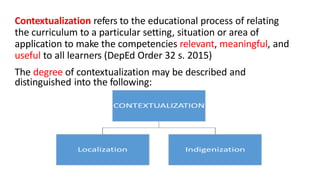
Contextualization refers to the educational process of relating
the curriculum to a particular setting, situation or area of
application to make the competencies relevant, meaningful, and
useful to all learners (DepEd Order 32 s. 2015)
The degree of contextualization may be described and
distinguished into the following:
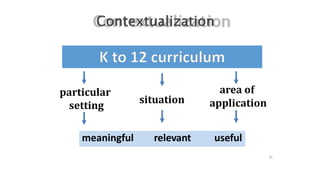
25
particular
setting
situation
area of
application
meaningful relevant useful
Use relevant (makabuluhan) lesson that
can excite our students to find meaning
inside the classroom and eventually
ignite them to engage in contemporary
issues outside.
A lesson is meaningful if it provides
learners with facts and empirical data
and explain how these relate with each
other
.
But if the learner does not find any
relevance in learning for learning’s sake,
then the learning is not a meaningful one.
•Useful – applicable in everyday
situation , practicable
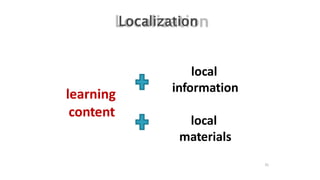
Localization– the process of relating
learning content specified in the
curriculum to local information and
materials from the learner’s community.
31
learning
content
local
information
local
materials
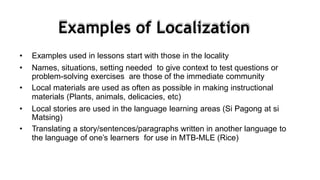
• Examples used in lessons start with those in the locality
• Names, situations, setting needed to give context to test questions or
problem-solving exercises are those of the immediate community
• Local materials are used as often as possible in making instructional
materials (Plants, animals, delicacies, etc)
• Local stories are used in the language learning areas (Si Pagong at si
Matsing)
• Translating a story/sentences/paragraphs written in another language to
the language of one’s learners for use in MTB-MLE (Rice)
Examples of Localization
Indigenization refers to the process of enhancing
curriculum competencies, education resources, and
teaching-learning processes in relation to the bio-
geographical, historical, and socio-cultural context of the
learners’ community. Indigenization may also involve the
enhancement of the curriculum framework, curriculum
design, and learning standards of subject areas, guided by
the standards and principles adhered to by the national
curriculum. (indigenous means deeply rooted to a place)
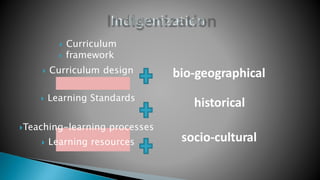
bio-geographical
historical
socio-cultural
 Curriculum
 framework
 Curriculum design
 Learning Standards
Teaching-learning processes
 Learning resources
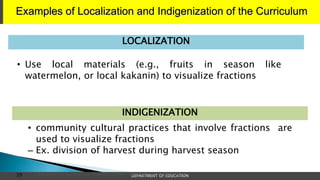
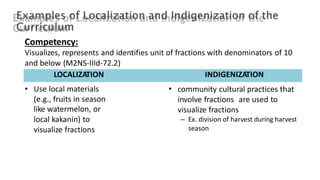
Competency:
Visualizes, represents and identifies unit of fractions with denominators of 10
and below (M2NS-IIId-72.2)
• Use local materials •
(e.g., fruits in season
like watermelon, or
local kakanin) to
visualize fractions
LOCALIZATION INDIGENIZATION
community cultural practices that
involve fractions are used to
visualize fractions
– Ex. division of harvest during harvest
season
Examples of Localization and Indigenization of the Curriculum in
Mathematics
DEPARTMENT OF EDUCATION
38 | School Heads’ Development Program: FOUNDATIONAL COURSE | MODULE 1
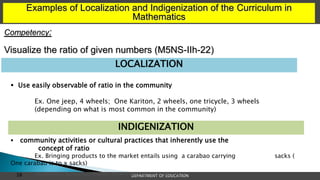
LOCALIZATION
INDIGENIZATION
Competency:
Visualize the ratio of given numbers (M5NS-IIh-22)
 Use easily observable of ratio in the community
Ex. One jeep, 4 wheels; One Kariton, 2 wheels, one tricycle, 3 wheels
(depending on what is most common in the community)
 community activities or cultural practices that inherently use the
concept of ratio
Ex. Bringing products to the market entails using a carabao carrying sacks (
One carabao is to x sacks)
Examples of Localization and Indigenization of the Curriculum
DEPARTMENT OF EDUCATION
39 | School Heads’ Development Program: FOUNDATIONAL COURSE | MODULE 1
• Use local materials (e.g., fruits in season like
watermelon, or local kakanin) to visualize fractions
LOCALIZATION
• community cultural practices that involve fractions are
used to visualize fractions
– Ex. division of harvest during harvest season
INDIGENIZATION
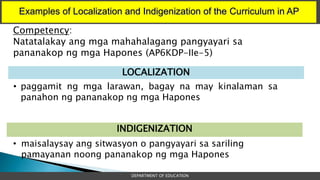
Examples of Localization and Indigenization of the Curriculum in AP
DEPARTMENT OF EDUCATION
Competency:
Natatalakay ang mga mahahalagang pangyayari sa
pananakop ng mga Hapones (AP6KDP-IIe-5)
• paggamit ng mga larawan, bagay na may kinalaman sa
panahon ng pananakop ng mga Hapones
LOCALIZATION
• maisalaysay ang sitwasyon o pangyayari sa sariling
pamayanan noong pananakop ng mga Hapones
INDIGENIZATION
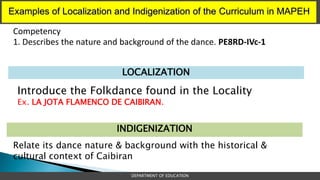
Examples of Localization and Indigenization of the Curriculum in MAPEH
DEPARTMENT OF EDUCATION
Competency
1. Describes the nature and background of the dance. PE8RD-IVc-1
LOCALIZATION
Relate its dance nature & background with the historical &
cultural context of Caibiran
INDIGENIZATION
Introduce the Folkdance found in the Locality
Ex. LA JOTA FLAMENCO DE CAIBIRAN.
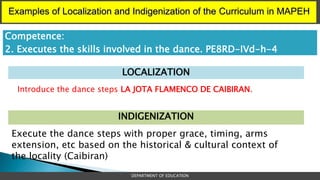
Examples of Localization and Indigenization of the Curriculum in MAPEH
DEPARTMENT OF EDUCATION
LOCALIZATION
INDIGENIZATION
Introduce the dance steps LA JOTA FLAMENCO DE CAIBIRAN.
Competence:
2. Executes the skills involved in the dance. PE8RD-IVd-h-4
Execute the dance steps with proper grace, timing, arms
extension, etc based on the historical & cultural context of
the locality (Caibiran)
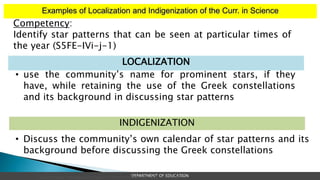
Examples of Localization and Indigenization of the Curr. in Science
DEPARTMENT OF EDUCATION
| School Heads’ Development Program: FOUNDATIONAL COURSE | MODULE 1
Competency:
Identify star patterns that can be seen at particular times of
the year (S5FE-IVi-j-1)
• use the community’s name for prominent stars, if they
have, while retaining the use of the Greek constellations
and its background in discussing star patterns
LOCALIZATION
• Discuss the community’s own calendar of star patterns and its
background before discussing the Greek constellations
INDIGENIZATION
Major Curriculum thrust of K to 12: CONTEXTUALIZATION
DEPARTMENT OF EDUCATION
Localization and indigenization are degrees or
levels of doing contextualization
When we localize, we do not necessarily
indigenize
When we indigenize, we localize
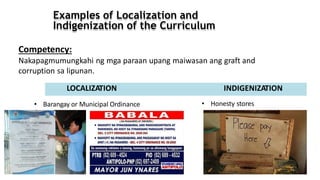
Competency:
Nakapagmumungkahi ng mga paraan upang maiwasan ang graft and
corruption sa lipunan.
• Barangay or Municipal Ordinance
LOCALIZATION INDIGENIZATION
• Honesty stores
Examples of Localization and
Indigenization of the Curriculum
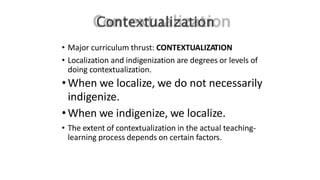
• Major curriculum thrust: CONTEXTUALIZATION
• Localization and indigenization are degrees or levels of
doing contextualization.
•When we localize, we do not necessarily
indigenize.
•When we indigenize, we localize.
• The extent of contextualization in the actual teaching-
learning process depends on certain factors.
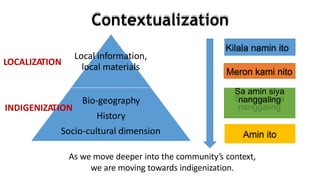
Local information,
local materials
Bio-geography
History
Socio-cultural dimension
LOCALIZATION
INDIGENIZATION
Contextualization
Kilala namin ito
Meron kami nito
Sa amin siya
nanggaling
Amin ito
As we move deeper into the community’s context,
we are moving towards indigenization.
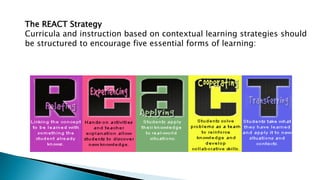
The REACT Strategy
Curricula and instruction based on contextual learning strategies should
be structured to encourage five essential forms of learning:
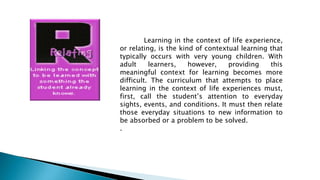
EXPERIENCING
Learning in the context of life experience,
or relating, is the kind of contextual learning that
typically occurs with very young children. With
adult learners, however, providing this
meaningful context for learning becomes more
difficult. The curriculum that attempts to place
learning in the context of life experiences must,
first, call the student’s attention to everyday
sights, events, and conditions. It must then relate
those everyday situations to new information to
be absorbed or a problem to be solved.
.
• Filipino - saranggola – relate - nakagawa ba sila ng saranggola
kasama ng tatay ?
• Economics – kakapusan – realate - ano yung mga kakapusan na
nararanasan sa bahay, sa mga pinagkukunang yaman sa Cordillera
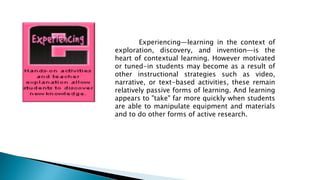
Experiencing—learning in the context of
exploration, discovery, and invention—is the
heart of contextual learning. However motivated
or tuned-in students may become as a result of
other instructional strategies such as video,
narrative, or text-based activities, these remain
relatively passive forms of learning. And learning
appears to "take" far more quickly when students
are able to manipulate equipment and materials
and to do other forms of active research.
• Science – fermentation – make strawberry wine, tapuey
Economics – pamilihan at sambahayanan - students goes to the Baguio
public market and SM and compare the prices of agricultural products
etc.
Applying concepts and information
in a useful context often projects students
into an imagined future (a possible career)
or into an unfamiliar location (a
workplace). This happens most commonly
through text, video, labs, and activities,
and these contextual learning experiences
are often followed up with firsthand
experiences such as plant tours,
mentoring arrangements, and
internships.
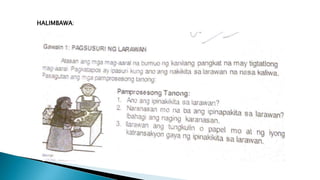
HALIMBAWA:
Cooperating—learning in the context of
sharing, responding, and communicating with other
learners—is a primary instructional strategy in
contextual teaching. The experience of cooperating
not only helps the majority of students learn the
material, it also is consistent with the real-world
focus of contextual teaching.
HALIMBAWA:
Learning in the context of existing
knowledge, or transferring, uses and
builds upon what the student has
already learned. Such an approach is
similar to relating, Students develop
confidence in their problem-solving
abilities if we make a point of building
new learning experiences on what they
already know.
HALIMBAWA:
• Localization and contextualization
can be done in all subject areas
• Localization maximizes materials
that are locally available
• To contextualize, teachers use authentic materials,
activities, interests, issues, and needs from
learners’ lives
• Should create rooms for students to pose problems
and issues and develop strategies together for
addressing them
Contextualization
•Learner – centered
•Outcomes – based
•Knowledge producers
•Multiple exits
In contextualizing our lesson
We do not just give information to our learners.
We do not just kindle appreciation on our culture.
It is a true learning
When we inspire our learners to embrace their (Filipino,
Igorot) identity. ( REACT)
It is high time that we reclaim our indigenous culture.
A closer look on our culture is a must.
We need to retrieve the positive
elements of our history and culture.
Be Culturally Responsive
• Becoming culturally responsive is an on going process that
evolves as we learn about our selves, our world and other
cultures.
• To become culturally responsive first look at your own
culture – especially if it is part of our country’s dominant
culture .
• Have an open – mind to what you don’t understand and be
ready to learn new ways of looking and doing things.
Are You Teaching
Contextually?
Take this self-test
1. Are new concepts presented in real-life situations and experiences familiar to the
students?
2. Are concepts in examples and student exercises presented
in the context of their use?
3. Are new concepts presented in the context of what the
student already knows?
4. Do examples and student exercises include many real,
believable problem-solving situations that students can
recognize as important to their current and possible
future lives?
5. Do examples and student exercises cultivate an attitude
that says, "I need to learn this"?
6. Do students gather and analyze their own data as they are
guided in discovery of the important concepts?
7. Are opportunities presented for students to gather and
analyze their own data for enrichment and extension?
8. Do lessons and activities encourage the student to apply
concepts and information in useful contexts, projecting the
student into imagined futures (e.g., possible careers) and
unfamiliar locations (e.g., workplaces)?
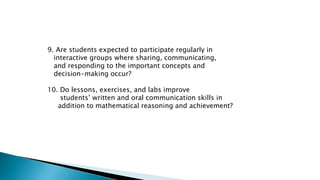
9. Are students expected to participate regularly in
interactive groups where sharing, communicating,
and responding to the important concepts and
decision-making occur?
10. Do lessons, exercises, and labs improve
students’ written and oral communication skills in
addition to mathematical reasoning and achievement?
Application
•Create your own Hugot pa more!
quotation that tells or manifest the
importance of localization and
contextualization in FILIPINO
The best curricula is contextualized by those
implementing it.
It is now up to us to ensure that this enhanced
curriculum truly transforms our schools and
communities.
With the best of our attitudes let us do what we can
for the Filipino learner
.
Usec. Dina Ocampo

Session on contextualization for Filipino teachers - Copy.pptx

  • 1.
    Mahal Kita peroWalang Forever kaya BREAK MUNA TAYO! Curriculum Contextualization
  • 2.
    Objectives: • Gain functionaland operational understanding of curriculum contextualization;
  • 3.
    Objectives: • Illustrate wayson how the curriculum and/or subject could be localized/indigenized; and
  • 4.
    Objectives: • Express appreciationof the need to adapt to the learners’ diversity through contextualization.
  • 5.
    DEPARTMENT OF EDUCATION Letus think 1. What do you know about Curriculum Contextualization? 2. What is Localization? 3. What is indigenization?
  • 6.
    DEPARTMENT OF EDUCATION TakeThis Self-Test 1. Are new concepts presented in real-life situations and experiences familiar to the students? 2. Are concepts in examples and student exercises presented in the context of their use ? 3. Are new concepts presented in the context of what the students already know? 4. Do examples and student exercises include many real, believable problem-solving situations that students can recognize as important to their current and possible future lives ?
  • 7.
    DEPARTMENT OF EDUCATION TakeThis Self-Test 5. Do examples and student exercises cultivate an attitude that says “I need to learn this”? 6. Do students gather and analyze their own data as they are guided in discovery of important concepts ? 7. Are opportunities presented for students to gather and analyze their own data for enrichment and extension ? 8. Do lessons and activities encourage students to apply concepts and information in useful contexts, projecting the student into imagined futures (e.g. possible careers) and unfamiliar locations (e.g. workplaces) ?
  • 9.
  • 11.
  • 13.
    Kategorya 3: Sa AMINsya nanggaling!
  • 15.
  • 23.
    2. What haveyou noticed about how the following categories are arranged: 1. Kilala namin ito; 2. Meron kami nito; 3. Sa amin siya nanggaling; and 4. Amin ito? 1. What do the pictures represent?
  • 24.
    The K to12 curriculum framework highlights the fundamental importance of context in shaping the curriculum, and consequently, the teaching- learning process Enhanced Basic Education Act of 2013 (RA 10533), Sec. 5 The DepEd shall adhere to the following standards and principles in developing the enhanced basic education curriculum: (d)
  • 25.
    • - learning–centered, inclusive and developmentally appropriate • - relevant, responsive and research – based • - culture – sensitive • - contextualized and global • - use pedagogical approaches that are constructivist • - inquiry – based, reflective, collaborative, integrative • -adhere to the principles and framework of MTB – MLE • - Flexible enough to enable and allow school to localize and indigenize
  • 26.
    Flexibility of theK to 12 curriculum allows for curriculum enhancement in relation to the diverse background of learners Enhanced Basic Education Act of 2013 (RA 10533), Sec. 5 The DepEd shall adhere to the following standards and principles in developing the enhanced basic education curriculum: h)… flexible enough to enable and allow schools to localize, indigenize and enhance the same based on their respective educational and social contexts. The production and development of locally produced teaching materials shall be encouraged and approval of these materials shall devolve to the regional and division education units. ( example : Grade 3 lesson on the seal of the province of Cavite )
  • 27.
    Contextualization refers tothe educational process of relating the curriculum to a particular setting, situation or area of application to make the competencies relevant, meaningful, and useful to all learners (DepEd Order 32 s. 2015) The degree of contextualization may be described and distinguished into the following:
  • 28.
  • 29.
    Use relevant (makabuluhan)lesson that can excite our students to find meaning inside the classroom and eventually ignite them to engage in contemporary issues outside.
  • 30.
    A lesson ismeaningful if it provides learners with facts and empirical data and explain how these relate with each other . But if the learner does not find any relevance in learning for learning’s sake, then the learning is not a meaningful one.
  • 31.
    •Useful – applicablein everyday situation , practicable
  • 32.
    Localization– the processof relating learning content specified in the curriculum to local information and materials from the learner’s community.
  • 33.
  • 34.
    • Examples usedin lessons start with those in the locality • Names, situations, setting needed to give context to test questions or problem-solving exercises are those of the immediate community • Local materials are used as often as possible in making instructional materials (Plants, animals, delicacies, etc) • Local stories are used in the language learning areas (Si Pagong at si Matsing) • Translating a story/sentences/paragraphs written in another language to the language of one’s learners for use in MTB-MLE (Rice) Examples of Localization
  • 35.
    Indigenization refers tothe process of enhancing curriculum competencies, education resources, and teaching-learning processes in relation to the bio- geographical, historical, and socio-cultural context of the learners’ community. Indigenization may also involve the enhancement of the curriculum framework, curriculum design, and learning standards of subject areas, guided by the standards and principles adhered to by the national curriculum. (indigenous means deeply rooted to a place)
  • 36.
    bio-geographical historical socio-cultural  Curriculum  framework Curriculum design  Learning Standards Teaching-learning processes  Learning resources
  • 37.
    Competency: Visualizes, represents andidentifies unit of fractions with denominators of 10 and below (M2NS-IIId-72.2) • Use local materials • (e.g., fruits in season like watermelon, or local kakanin) to visualize fractions LOCALIZATION INDIGENIZATION community cultural practices that involve fractions are used to visualize fractions – Ex. division of harvest during harvest season
  • 38.
    Examples of Localizationand Indigenization of the Curriculum in Mathematics DEPARTMENT OF EDUCATION 38 | School Heads’ Development Program: FOUNDATIONAL COURSE | MODULE 1 LOCALIZATION INDIGENIZATION Competency: Visualize the ratio of given numbers (M5NS-IIh-22)  Use easily observable of ratio in the community Ex. One jeep, 4 wheels; One Kariton, 2 wheels, one tricycle, 3 wheels (depending on what is most common in the community)  community activities or cultural practices that inherently use the concept of ratio Ex. Bringing products to the market entails using a carabao carrying sacks ( One carabao is to x sacks)
  • 39.
    Examples of Localizationand Indigenization of the Curriculum DEPARTMENT OF EDUCATION 39 | School Heads’ Development Program: FOUNDATIONAL COURSE | MODULE 1 • Use local materials (e.g., fruits in season like watermelon, or local kakanin) to visualize fractions LOCALIZATION • community cultural practices that involve fractions are used to visualize fractions – Ex. division of harvest during harvest season INDIGENIZATION
  • 40.
    Examples of Localizationand Indigenization of the Curriculum in AP DEPARTMENT OF EDUCATION Competency: Natatalakay ang mga mahahalagang pangyayari sa pananakop ng mga Hapones (AP6KDP-IIe-5) • paggamit ng mga larawan, bagay na may kinalaman sa panahon ng pananakop ng mga Hapones LOCALIZATION • maisalaysay ang sitwasyon o pangyayari sa sariling pamayanan noong pananakop ng mga Hapones INDIGENIZATION
  • 41.
    Examples of Localizationand Indigenization of the Curriculum in MAPEH DEPARTMENT OF EDUCATION Competency 1. Describes the nature and background of the dance. PE8RD-IVc-1 LOCALIZATION Relate its dance nature & background with the historical & cultural context of Caibiran INDIGENIZATION Introduce the Folkdance found in the Locality Ex. LA JOTA FLAMENCO DE CAIBIRAN.
  • 42.
    Examples of Localizationand Indigenization of the Curriculum in MAPEH DEPARTMENT OF EDUCATION LOCALIZATION INDIGENIZATION Introduce the dance steps LA JOTA FLAMENCO DE CAIBIRAN. Competence: 2. Executes the skills involved in the dance. PE8RD-IVd-h-4 Execute the dance steps with proper grace, timing, arms extension, etc based on the historical & cultural context of the locality (Caibiran)
  • 43.
    Examples of Localizationand Indigenization of the Curr. in Science DEPARTMENT OF EDUCATION | School Heads’ Development Program: FOUNDATIONAL COURSE | MODULE 1 Competency: Identify star patterns that can be seen at particular times of the year (S5FE-IVi-j-1) • use the community’s name for prominent stars, if they have, while retaining the use of the Greek constellations and its background in discussing star patterns LOCALIZATION • Discuss the community’s own calendar of star patterns and its background before discussing the Greek constellations INDIGENIZATION
  • 44.
    Major Curriculum thrustof K to 12: CONTEXTUALIZATION DEPARTMENT OF EDUCATION Localization and indigenization are degrees or levels of doing contextualization When we localize, we do not necessarily indigenize When we indigenize, we localize
  • 45.
    Competency: Nakapagmumungkahi ng mgaparaan upang maiwasan ang graft and corruption sa lipunan. • Barangay or Municipal Ordinance LOCALIZATION INDIGENIZATION • Honesty stores Examples of Localization and Indigenization of the Curriculum
  • 46.
    • Major curriculumthrust: CONTEXTUALIZATION • Localization and indigenization are degrees or levels of doing contextualization. •When we localize, we do not necessarily indigenize. •When we indigenize, we localize. • The extent of contextualization in the actual teaching- learning process depends on certain factors.
  • 47.
    Local information, local materials Bio-geography History Socio-culturaldimension LOCALIZATION INDIGENIZATION Contextualization Kilala namin ito Meron kami nito Sa amin siya nanggaling Amin ito As we move deeper into the community’s context, we are moving towards indigenization.
  • 48.
    The REACT Strategy Curriculaand instruction based on contextual learning strategies should be structured to encourage five essential forms of learning: EXPERIENCING
  • 49.
    Learning in thecontext of life experience, or relating, is the kind of contextual learning that typically occurs with very young children. With adult learners, however, providing this meaningful context for learning becomes more difficult. The curriculum that attempts to place learning in the context of life experiences must, first, call the student’s attention to everyday sights, events, and conditions. It must then relate those everyday situations to new information to be absorbed or a problem to be solved. .
  • 50.
    • Filipino -saranggola – relate - nakagawa ba sila ng saranggola kasama ng tatay ? • Economics – kakapusan – realate - ano yung mga kakapusan na nararanasan sa bahay, sa mga pinagkukunang yaman sa Cordillera
  • 51.
    Experiencing—learning in thecontext of exploration, discovery, and invention—is the heart of contextual learning. However motivated or tuned-in students may become as a result of other instructional strategies such as video, narrative, or text-based activities, these remain relatively passive forms of learning. And learning appears to "take" far more quickly when students are able to manipulate equipment and materials and to do other forms of active research.
  • 52.
    • Science –fermentation – make strawberry wine, tapuey Economics – pamilihan at sambahayanan - students goes to the Baguio public market and SM and compare the prices of agricultural products etc.
  • 53.
    Applying concepts andinformation in a useful context often projects students into an imagined future (a possible career) or into an unfamiliar location (a workplace). This happens most commonly through text, video, labs, and activities, and these contextual learning experiences are often followed up with firsthand experiences such as plant tours, mentoring arrangements, and internships.
  • 54.
  • 55.
    Cooperating—learning in thecontext of sharing, responding, and communicating with other learners—is a primary instructional strategy in contextual teaching. The experience of cooperating not only helps the majority of students learn the material, it also is consistent with the real-world focus of contextual teaching.
  • 56.
  • 57.
    Learning in thecontext of existing knowledge, or transferring, uses and builds upon what the student has already learned. Such an approach is similar to relating, Students develop confidence in their problem-solving abilities if we make a point of building new learning experiences on what they already know.
  • 58.
  • 59.
    • Localization andcontextualization can be done in all subject areas • Localization maximizes materials that are locally available
  • 60.
    • To contextualize,teachers use authentic materials, activities, interests, issues, and needs from learners’ lives • Should create rooms for students to pose problems and issues and develop strategies together for addressing them
  • 61.
    Contextualization •Learner – centered •Outcomes– based •Knowledge producers •Multiple exits
  • 62.
    In contextualizing ourlesson We do not just give information to our learners. We do not just kindle appreciation on our culture. It is a true learning When we inspire our learners to embrace their (Filipino, Igorot) identity. ( REACT) It is high time that we reclaim our indigenous culture.
  • 63.
    A closer lookon our culture is a must. We need to retrieve the positive elements of our history and culture.
  • 64.
    Be Culturally Responsive •Becoming culturally responsive is an on going process that evolves as we learn about our selves, our world and other cultures. • To become culturally responsive first look at your own culture – especially if it is part of our country’s dominant culture . • Have an open – mind to what you don’t understand and be ready to learn new ways of looking and doing things.
  • 65.
  • 66.
    Take this self-test 1.Are new concepts presented in real-life situations and experiences familiar to the students? 2. Are concepts in examples and student exercises presented in the context of their use? 3. Are new concepts presented in the context of what the student already knows? 4. Do examples and student exercises include many real, believable problem-solving situations that students can recognize as important to their current and possible future lives?
  • 67.
    5. Do examplesand student exercises cultivate an attitude that says, "I need to learn this"? 6. Do students gather and analyze their own data as they are guided in discovery of the important concepts? 7. Are opportunities presented for students to gather and analyze their own data for enrichment and extension? 8. Do lessons and activities encourage the student to apply concepts and information in useful contexts, projecting the student into imagined futures (e.g., possible careers) and unfamiliar locations (e.g., workplaces)?
  • 68.
    9. Are studentsexpected to participate regularly in interactive groups where sharing, communicating, and responding to the important concepts and decision-making occur? 10. Do lessons, exercises, and labs improve students’ written and oral communication skills in addition to mathematical reasoning and achievement?
  • 69.
    Application •Create your ownHugot pa more! quotation that tells or manifest the importance of localization and contextualization in FILIPINO
  • 70.
    The best curriculais contextualized by those implementing it. It is now up to us to ensure that this enhanced curriculum truly transforms our schools and communities. With the best of our attitudes let us do what we can for the Filipino learner . Usec. Dina Ocampo