Mahal Kita pero Walang
Forever kaya
BREAK MUNA TAYO!
Curriculum
Contextualization
Objectives:
• Gain functional and operational understanding of
curriculum contextualization
• Illustrate ways on how the curriculum and/or subject
could be localized/indigenized; and
• Express appreciation of the need to adapt to the learners’
diversity through contextualization.
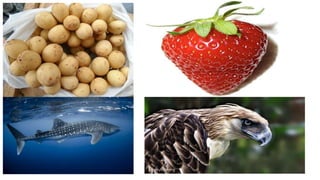
Kategorya 1:
Kilala NAMIN ito!
Kategorya 2:
Meron KAMI Nito!
Kategorya 3:
Sa AMIN sya
nanggaling!
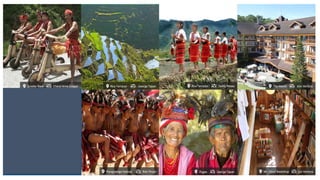
Kategorya 4:
Amin to!
2. What have you noticed about how the
following categories are arranged:
2.1 Kilala namin ito;
2.2 Meron kami nito;
2.3 Sa amin siya nanggaling; and
2.4 Amin ito?
1. What do the pictures represent?
The K to 12 curriculum framework highlights the
fundamental importance of context in shaping the
curriculum, and consequently, the teaching-learning
process
DEPARTMENT OF EDUCATION
Contextualization
Enhanced Basic Education Act of 2013 (RA 10533), Sec. 5
The DepEd shall adhere to the following standards and principles in
developing the enhanced basic education curriculum:
(d)
Standards
• - learning –centered, inclusive and developmentally appropriate
• - relevant, responsive and research – based
• - culture – sensitive
• - contextualized and global
• - use pedagogical approaches that are constructivist
• - inquiry – based, reflective, collaborative, integrative
• -adhere to the principles and framework of MTB – MLE
• - Flexible enough to enable and allow school to localize and indigenize
Flexibility of the K to 12 curriculum allows for curriculum
enhancement in relation to the diverse background of
learners
DEPARTMENT OF EDUCATION
Enhanced Basic Education Act of 2013 (RA 10533), Sec. 5
The DepEd shall adhere to the following standards and principles in
developing the enhanced basic education curriculum:
h)… flexible enough to enable and allow schools to
localize, indigenize and enhance the same based on
their respective educational and social contexts. The
production and development of locally produced
teaching materials shall be encouraged and approval of
these materials shall devolve to the regional and
division education units. ( example : Grade 3 lesson on the seal of
the province of Cavite )
Contextualization
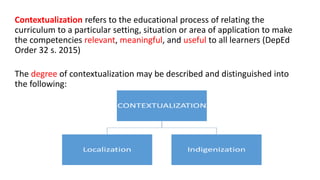
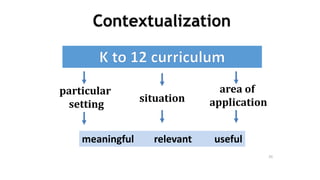
Contextualization refers to the educational process of relating the
curriculum to a particular setting, situation or area of application to make
the competencies relevant, meaningful, and useful to all learners (DepEd
Order 32 s. 2015)
The degree of contextualization may be described and distinguished into
the following:
DEPARTMENT OF EDUCATION
25
particular
setting
situation
area of
application
meaningful relevant useful
Contextualization
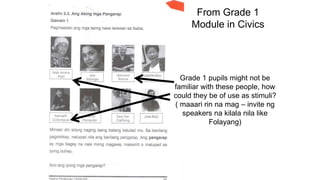
From Grade 1
Module in Civics
Grade 1 pupils might not be
familiar with these people, how
could they be of use as stimuli?
( maaari rin na mag – invite ng
speakers na kilala nila like
Folayang)
Use relevant (makabuluhan) lesson that
can excite our students to find meaning
inside the classroom and eventually
ignite them to engage in contemporary
issues outside.
A lesson is meaningful if it provides
learners with facts and empirical data
and explain how these relate with each
other.
But if the learner does not find any
relevance in learning for learning’s sake,
then the learning is not a meaningful one.
•Useful – applicable in everyday
situation , practicable
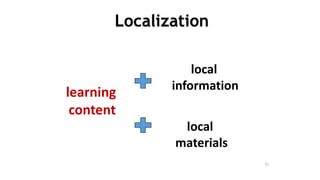
Localization– the process of relating
learning content specified in the
curriculum to local information and
materials from the learner’s community.
31
learning
content
local
information
local
materials
DEPARTMENT OF EDUCATION
Localization
DEPARTMENT OF EDUCATION
• Examples used in lessons start with those in the locality
• Names, situations, setting needed to give context to test questions or
problem-solving exercises are those of the immediate community
• Local materials are used as often as possible in making instructional
materials (Plants, animals, delicacies, etc)
• Local stories are used in the language learning areas (Si Pagong at si
Matsing)
• Translating a story/sentences/paragraphs written in another language to
the language of one’s learners for use in MTB-MLE (Rice)
3
2
Examples of Localization
DEPARTMENT OF EDUCATIONDEPARTMENT OF EDUCATION
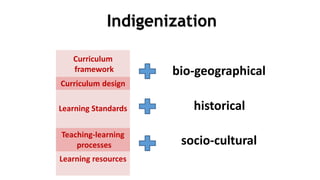
Indigenization refers to the process of enhancing
curriculum competencies, education resources, and
teaching-learning processes in relation to the bio-
geographical, historical, and socio-cultural context of the
learners’ community. Indigenization may also involve the
enhancement of the curriculum framework, curriculum
design, and learning standards of subject areas, guided by
the standards and principles adhered to by the national
curriculum. (indigenous means deeply rooted to a place)
bio-geographical
Learning resources
Teaching-learning
processes socio-cultural
historical
Curriculum
framework
Curriculum design
Learning Standards
DEPARTMENT OF EDUCATION
Indigenization
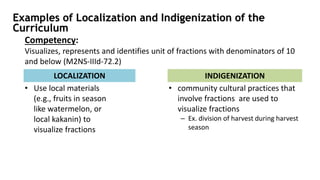
Competency:
Visualizes, represents and identifies unit of fractions with denominators of 10
and below (M2NS-IIId-72.2)
• Use local materials
(e.g., fruits in season
like watermelon, or
local kakanin) to
visualize fractions
LOCALIZATION
• community cultural practices that
involve fractions are used to
visualize fractions
– Ex. division of harvest during harvest
season
INDIGENIZATION
Examples of Localization and Indigenization of the
Curriculum
SAMPLE LOCALIZATION AND
INDIGINIZATION OF PRODUCTS
AND PERFORMANCE IN ARALING
PANLIPUNAN
(Performance Standards – QA)
GRADE 10 - AP
(Performance Standards – QA)
Source: Department of Education – Division of Antipolo City
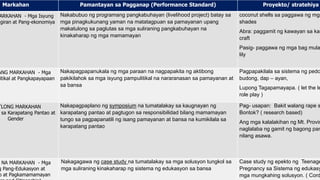
Markahan Pamantayan sa Pagganap (Performance Standard) Proyekto/ stratehiya
ARKAHAN - Mga Isyung
igiran at Pang-ekonomiya
Nakabubuo ng programang pangkabuhayan (livelihood project) batay sa
mga pinagkukunang yaman na matatagpuan sa pamayanan upang
makatulong sa paglutas sa mga suliraning pangkabuhayan na
kinakaharap ng mga mamamayan
coconut shells sa paggawa ng mga
shades
Abra: paggamit ng kawayan sa kan
craft
Pasig- paggawa ng mga bag mula
lily
ANG MARKAHAN - Mga
itikal at Pangkapayapaan
Nakapagpapanukala ng mga paraan na nagpapakita ng aktibong
pakikilahok sa mga isyung pampulitikal na nararanasan sa pamayanan at
sa bansa
Pagpapakilala sa sistema ng pedc
budong, dap – ayan,
Lupong Tagapamayapa. ( let the le
role play )
TLONG MARKAHAN
sa Karapatang Pantao at
Gender
Nakapagpaplano ng symposium na tumatalakay sa kaugnayan ng
karapatang pantao at pagtugon sa responsibilidad bilang mamamayan
tungo sa pagpapanatili ng isang pamayanan at bansa na kumikilala sa
karapatang pantao
Pag- usapan: Bakit walang rape s
Bontok? ( research based)
Ang mga kalalakihan ng Mt. Provin
naglalaba ng gamit ng bagong pan
nilang asawa.
NA MARKAHAN - Mga
g Pang-Edukasyon at
o at Pagkamamamayan
Nakagagawa ng case study na tumatalakay sa mga solusyon tungkol sa
mga suliraning kinakaharap ng sistema ng edukasyon sa bansa
Case study ng epekto ng Teenage
Pregnancy sa Sistema ng edukasy
mga mungkahing solusyon. ( Cord
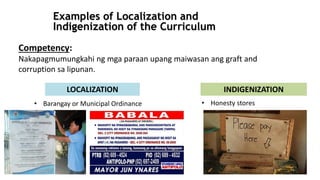
Competency:
Nakapagmumungkahi ng mga paraan upang maiwasan ang graft and
corruption sa lipunan.
• Barangay or Municipal Ordinance
LOCALIZATION
• Honesty stores
INDIGENIZATION
Examples of Localization and
Indigenization of the Curriculum
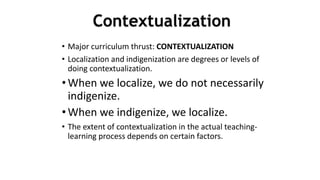
• Major curriculum thrust: CONTEXTUALIZATION
• Localization and indigenization are degrees or levels of
doing contextualization.
• When we localize, we do not necessarily
indigenize.
• When we indigenize, we localize.
• The extent of contextualization in the actual teaching-
learning process depends on certain factors.
4
0
Contextualization
4
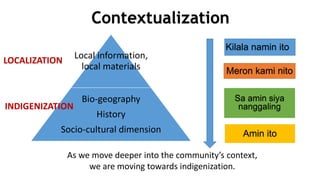
Local information,
local materials
Bio-geography
History
Socio-cultural dimension
LOCALIZATION
INDIGENIZATION
Contextualization
Kilala namin ito
Meron kami nito
Sa amin siya
nanggaling
Amin ito
As we move deeper into the community’s context,
we are moving towards indigenization.
• Filipino - saranggola – relate - nakagawa ba sila ng saranggola
kasama ng tatay ?
• Economics – kakapusan – realate - ano yung mga kakapusan na
nararanasan sa bahay, sa mga pinagkukunang yaman sa Cordillera
• Science – fermentation – make strawberry wine, tapuey
Economics – pamilihan at sambahayanan - students goes to the Baguio
public market and SM and compare the prices of agricultural products
etc.
Contextualization
•Learner – centered
•Outcomes – based
•.knowledge producers
•Multiple exits
In contextualizing our lesson
We do not just give information to our learners.
We do not just kindle appreciation on our culture.
It is a true learning
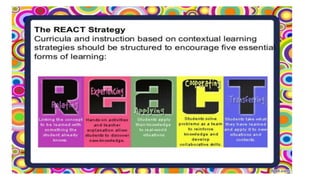
When we inspire our learners to embrace their (Filipino,
Igorot) identity. ( REACT)
It is high time that we reclaim our indigenous culture.
A closer look on our culture is a must.
We need to retrieve the positive
elements of our history and culture.
Be Culturally Responsive
• Becoming culturally responsive is an on going process that
evolves as we learn about our selves, our world and other

cultures.
• To become culturally responsive first look at your own
culture – especially if it is part of our country’s dominant
culture .
• Have an open – mind to what you don’t understand and be
ready to learn new ways of looking and doing things.
The best curricula is contextualized by those
implementing it.
It is now up to us to ensure that this enhanced
curriculum truly transforms our schools and
communities.
With the best of our attitudes let us do what we can
for the Filipino learner.
Usec. Dina Ocampo

Contextualize Lesson Plan

  • 1.
    Mahal Kita peroWalang Forever kaya BREAK MUNA TAYO! Curriculum Contextualization
  • 2.
    Objectives: • Gain functionaland operational understanding of curriculum contextualization • Illustrate ways on how the curriculum and/or subject could be localized/indigenized; and • Express appreciation of the need to adapt to the learners’ diversity through contextualization.
  • 6.
  • 8.
  • 10.
    Kategorya 3: Sa AMINsya nanggaling!
  • 12.
  • 20.
    2. What haveyou noticed about how the following categories are arranged: 2.1 Kilala namin ito; 2.2 Meron kami nito; 2.3 Sa amin siya nanggaling; and 2.4 Amin ito? 1. What do the pictures represent?
  • 21.
    The K to12 curriculum framework highlights the fundamental importance of context in shaping the curriculum, and consequently, the teaching-learning process DEPARTMENT OF EDUCATION Contextualization Enhanced Basic Education Act of 2013 (RA 10533), Sec. 5 The DepEd shall adhere to the following standards and principles in developing the enhanced basic education curriculum: (d)
  • 22.
    Standards • - learning–centered, inclusive and developmentally appropriate • - relevant, responsive and research – based • - culture – sensitive • - contextualized and global • - use pedagogical approaches that are constructivist • - inquiry – based, reflective, collaborative, integrative • -adhere to the principles and framework of MTB – MLE • - Flexible enough to enable and allow school to localize and indigenize
  • 23.
    Flexibility of theK to 12 curriculum allows for curriculum enhancement in relation to the diverse background of learners DEPARTMENT OF EDUCATION Enhanced Basic Education Act of 2013 (RA 10533), Sec. 5 The DepEd shall adhere to the following standards and principles in developing the enhanced basic education curriculum: h)… flexible enough to enable and allow schools to localize, indigenize and enhance the same based on their respective educational and social contexts. The production and development of locally produced teaching materials shall be encouraged and approval of these materials shall devolve to the regional and division education units. ( example : Grade 3 lesson on the seal of the province of Cavite ) Contextualization
  • 24.
    Contextualization refers tothe educational process of relating the curriculum to a particular setting, situation or area of application to make the competencies relevant, meaningful, and useful to all learners (DepEd Order 32 s. 2015) The degree of contextualization may be described and distinguished into the following: DEPARTMENT OF EDUCATION
  • 25.
  • 26.
    From Grade 1 Modulein Civics Grade 1 pupils might not be familiar with these people, how could they be of use as stimuli? ( maaari rin na mag – invite ng speakers na kilala nila like Folayang)
  • 27.
    Use relevant (makabuluhan)lesson that can excite our students to find meaning inside the classroom and eventually ignite them to engage in contemporary issues outside.
  • 28.
    A lesson ismeaningful if it provides learners with facts and empirical data and explain how these relate with each other. But if the learner does not find any relevance in learning for learning’s sake, then the learning is not a meaningful one.
  • 29.
    •Useful – applicablein everyday situation , practicable
  • 30.
    Localization– the processof relating learning content specified in the curriculum to local information and materials from the learner’s community.
  • 31.
  • 32.
    DEPARTMENT OF EDUCATION •Examples used in lessons start with those in the locality • Names, situations, setting needed to give context to test questions or problem-solving exercises are those of the immediate community • Local materials are used as often as possible in making instructional materials (Plants, animals, delicacies, etc) • Local stories are used in the language learning areas (Si Pagong at si Matsing) • Translating a story/sentences/paragraphs written in another language to the language of one’s learners for use in MTB-MLE (Rice) 3 2 Examples of Localization
  • 33.
    DEPARTMENT OF EDUCATIONDEPARTMENTOF EDUCATION Indigenization refers to the process of enhancing curriculum competencies, education resources, and teaching-learning processes in relation to the bio- geographical, historical, and socio-cultural context of the learners’ community. Indigenization may also involve the enhancement of the curriculum framework, curriculum design, and learning standards of subject areas, guided by the standards and principles adhered to by the national curriculum. (indigenous means deeply rooted to a place)
  • 34.
  • 35.
    Competency: Visualizes, represents andidentifies unit of fractions with denominators of 10 and below (M2NS-IIId-72.2) • Use local materials (e.g., fruits in season like watermelon, or local kakanin) to visualize fractions LOCALIZATION • community cultural practices that involve fractions are used to visualize fractions – Ex. division of harvest during harvest season INDIGENIZATION Examples of Localization and Indigenization of the Curriculum
  • 36.
    SAMPLE LOCALIZATION AND INDIGINIZATIONOF PRODUCTS AND PERFORMANCE IN ARALING PANLIPUNAN (Performance Standards – QA)
  • 37.
    GRADE 10 -AP (Performance Standards – QA)
  • 38.
    Source: Department ofEducation – Division of Antipolo City Markahan Pamantayan sa Pagganap (Performance Standard) Proyekto/ stratehiya ARKAHAN - Mga Isyung igiran at Pang-ekonomiya Nakabubuo ng programang pangkabuhayan (livelihood project) batay sa mga pinagkukunang yaman na matatagpuan sa pamayanan upang makatulong sa paglutas sa mga suliraning pangkabuhayan na kinakaharap ng mga mamamayan coconut shells sa paggawa ng mga shades Abra: paggamit ng kawayan sa kan craft Pasig- paggawa ng mga bag mula lily ANG MARKAHAN - Mga itikal at Pangkapayapaan Nakapagpapanukala ng mga paraan na nagpapakita ng aktibong pakikilahok sa mga isyung pampulitikal na nararanasan sa pamayanan at sa bansa Pagpapakilala sa sistema ng pedc budong, dap – ayan, Lupong Tagapamayapa. ( let the le role play ) TLONG MARKAHAN sa Karapatang Pantao at Gender Nakapagpaplano ng symposium na tumatalakay sa kaugnayan ng karapatang pantao at pagtugon sa responsibilidad bilang mamamayan tungo sa pagpapanatili ng isang pamayanan at bansa na kumikilala sa karapatang pantao Pag- usapan: Bakit walang rape s Bontok? ( research based) Ang mga kalalakihan ng Mt. Provin naglalaba ng gamit ng bagong pan nilang asawa. NA MARKAHAN - Mga g Pang-Edukasyon at o at Pagkamamamayan Nakagagawa ng case study na tumatalakay sa mga solusyon tungkol sa mga suliraning kinakaharap ng sistema ng edukasyon sa bansa Case study ng epekto ng Teenage Pregnancy sa Sistema ng edukasy mga mungkahing solusyon. ( Cord
  • 39.
    Competency: Nakapagmumungkahi ng mgaparaan upang maiwasan ang graft and corruption sa lipunan. • Barangay or Municipal Ordinance LOCALIZATION • Honesty stores INDIGENIZATION Examples of Localization and Indigenization of the Curriculum
  • 40.
    • Major curriculumthrust: CONTEXTUALIZATION • Localization and indigenization are degrees or levels of doing contextualization. • When we localize, we do not necessarily indigenize. • When we indigenize, we localize. • The extent of contextualization in the actual teaching- learning process depends on certain factors. 4 0 Contextualization
  • 41.
    4 Local information, local materials Bio-geography History Socio-culturaldimension LOCALIZATION INDIGENIZATION Contextualization Kilala namin ito Meron kami nito Sa amin siya nanggaling Amin ito As we move deeper into the community’s context, we are moving towards indigenization.
  • 44.
    • Filipino -saranggola – relate - nakagawa ba sila ng saranggola kasama ng tatay ? • Economics – kakapusan – realate - ano yung mga kakapusan na nararanasan sa bahay, sa mga pinagkukunang yaman sa Cordillera
  • 46.
    • Science –fermentation – make strawberry wine, tapuey Economics – pamilihan at sambahayanan - students goes to the Baguio public market and SM and compare the prices of agricultural products etc.
  • 50.
    Contextualization •Learner – centered •Outcomes– based •.knowledge producers •Multiple exits
  • 51.
    In contextualizing ourlesson We do not just give information to our learners. We do not just kindle appreciation on our culture. It is a true learning When we inspire our learners to embrace their (Filipino, Igorot) identity. ( REACT) It is high time that we reclaim our indigenous culture.
  • 52.
    A closer lookon our culture is a must. We need to retrieve the positive elements of our history and culture.
  • 53.
    Be Culturally Responsive •Becoming culturally responsive is an on going process that evolves as we learn about our selves, our world and other cultures. • To become culturally responsive first look at your own culture – especially if it is part of our country’s dominant culture . • Have an open – mind to what you don’t understand and be ready to learn new ways of looking and doing things.
  • 54.
    The best curriculais contextualized by those implementing it. It is now up to us to ensure that this enhanced curriculum truly transforms our schools and communities. With the best of our attitudes let us do what we can for the Filipino learner. Usec. Dina Ocampo

Editor's Notes

  • #2 All these are catchphrases from the law [discuss each quadrant] BALANCE between the ideal, the meaningful, the logistically feasible Allows for varied ways of delivery ONE STOP SHOP and inclusive Standards- and competence-based Built around the needs of the learner and the community
  • #21 RA 10533 h)
  • #22 RA 10533 h)
  • #24 RA 10533 h)
  • #32 Examples familiar to children Local materials- stories AP as a learning area promotes contextualization Grade 3 AP- regional profiles Examples used in lessons start with those in the locality Names, situations, setting needed to give context to test questions or problem-solving exercises are those of the immediate community Local materials are used as often as possible in making instructional materials Local stories are used in the language learning areas Translating a story written in another language to the language of one’s learners for use in MTB-MLE
  • #35 Even without IP communities, indigenization can be done Examples Design of lessons throughout the year is related with the life of the community Bio-geographical- “Sibuyan island” island ecosystem, Badjao Historical –struggle for self determination (Moro, IP) Socio-cultural – agricultural communities (way of life in an agrarian community), social organization- urban “estero communities” Examples Relating the discussion of national competencies with the community’s life cycle Applying the national competencies in relation to community needs, realities and situations Using indigenous knowledge and competencies as springboard in developing the national competencies Teaching the national competency using the community competency Using community events, indigenous knowledge or celebrations as a theme around which learning areas can be organized to encourage integrative teaching and learning Maximizing the community environment as learning space or venue for learning Involving community members in the teaching-learning process (content, instruction and assessment)
  • #36 For indigenization Some agricultural communities still practice group harvesting (called different names by various cultural groups) to be more efficient. Families send one representative to be part of a group who work on the farm of each family represented in that group. The culturally devised way of compensating labor is by giving a share of the harvest. One practice stipulates that the harvest from half of the field goes to the family who owns the field, and the other half is subdivided by the rest of the group. Other cultural groups designate one-third as the share of the owner of the field, two-thirds to be subdivided by the rest of the group.
  • #41 Given the policy directives discussed, we see that a major curriculum thrust with K to 12 is contextualization with localization and indigenization as degrees of doing contextualization.
  • #42 Given the policy directives discussed, we see that a major curriculum thrust with K to 12 is contextualization with localization and indigenization as degrees of doing contextualization.