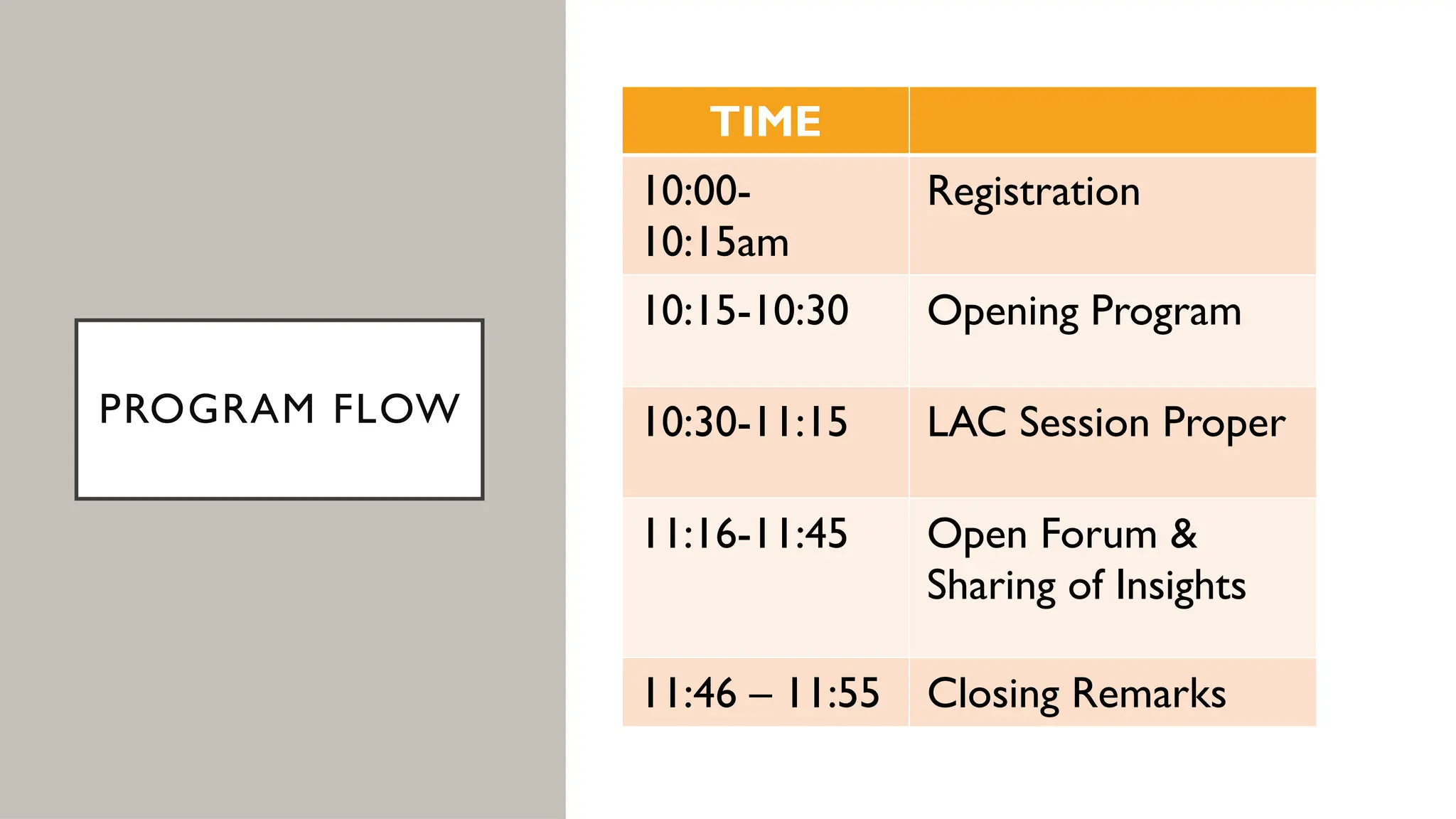
PROGRAM FLOW
TIME
10:00-
10:15am
Registration
10:15-10:30 Opening Program
10:30-11:15 LAC Session Proper
11:16-11:45 Open Forum &
Sharing of Insights
11:46 – 11:55 Closing Remarks
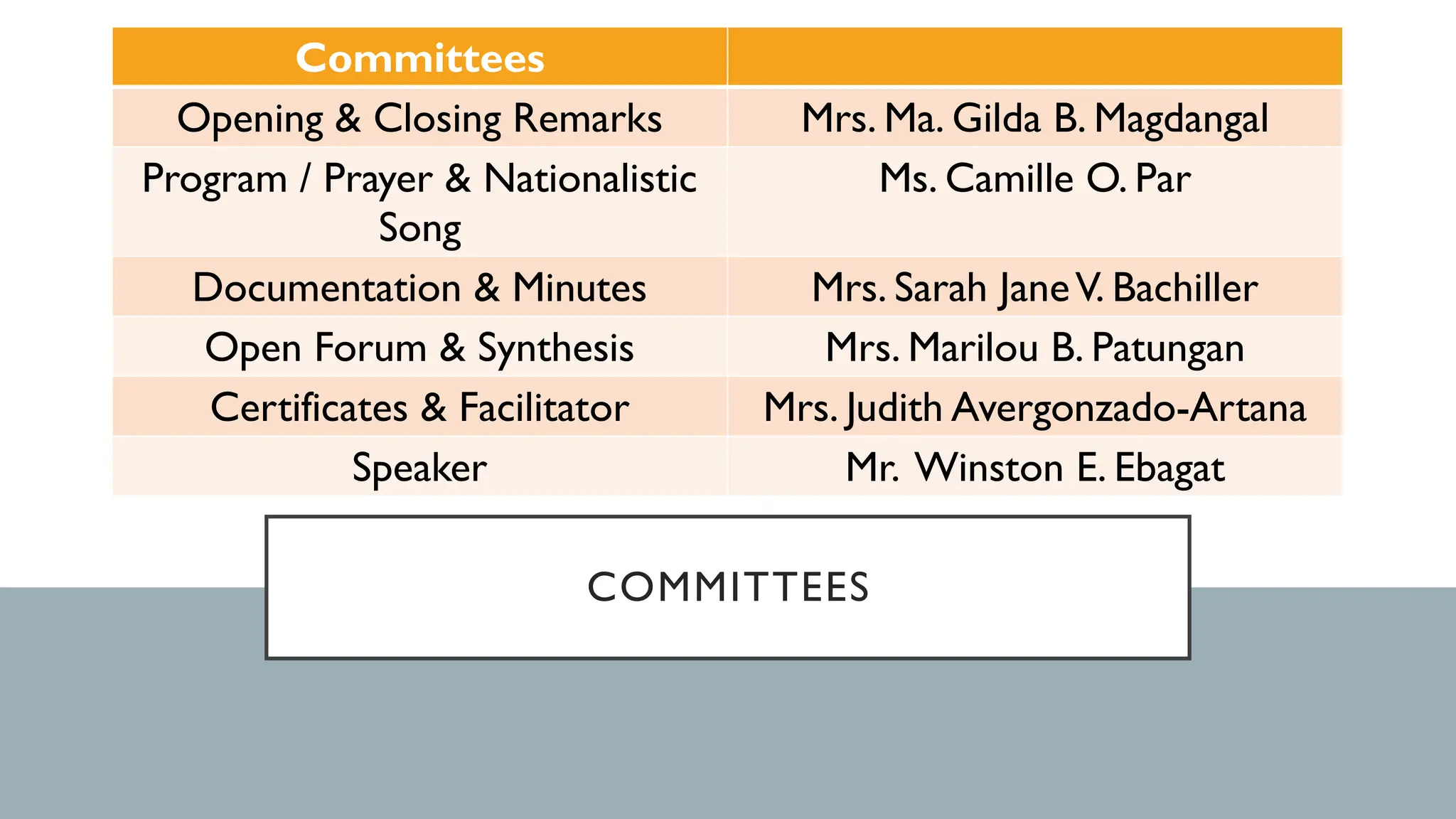
COMMITTEES
Committees
Opening & Closing Remarks Mrs. Ma. Gilda B. Magdangal
Program / Prayer & Nationalistic
Song
Ms. Camille O. Par
Documentation & Minutes Mrs. Sarah JaneV. Bachiller
Open Forum & Synthesis Mrs. Marilou B. Patungan
Certificates & Facilitator Mrs. Judith Avergonzado-Artana
Speaker Mr. Winston E. Ebagat
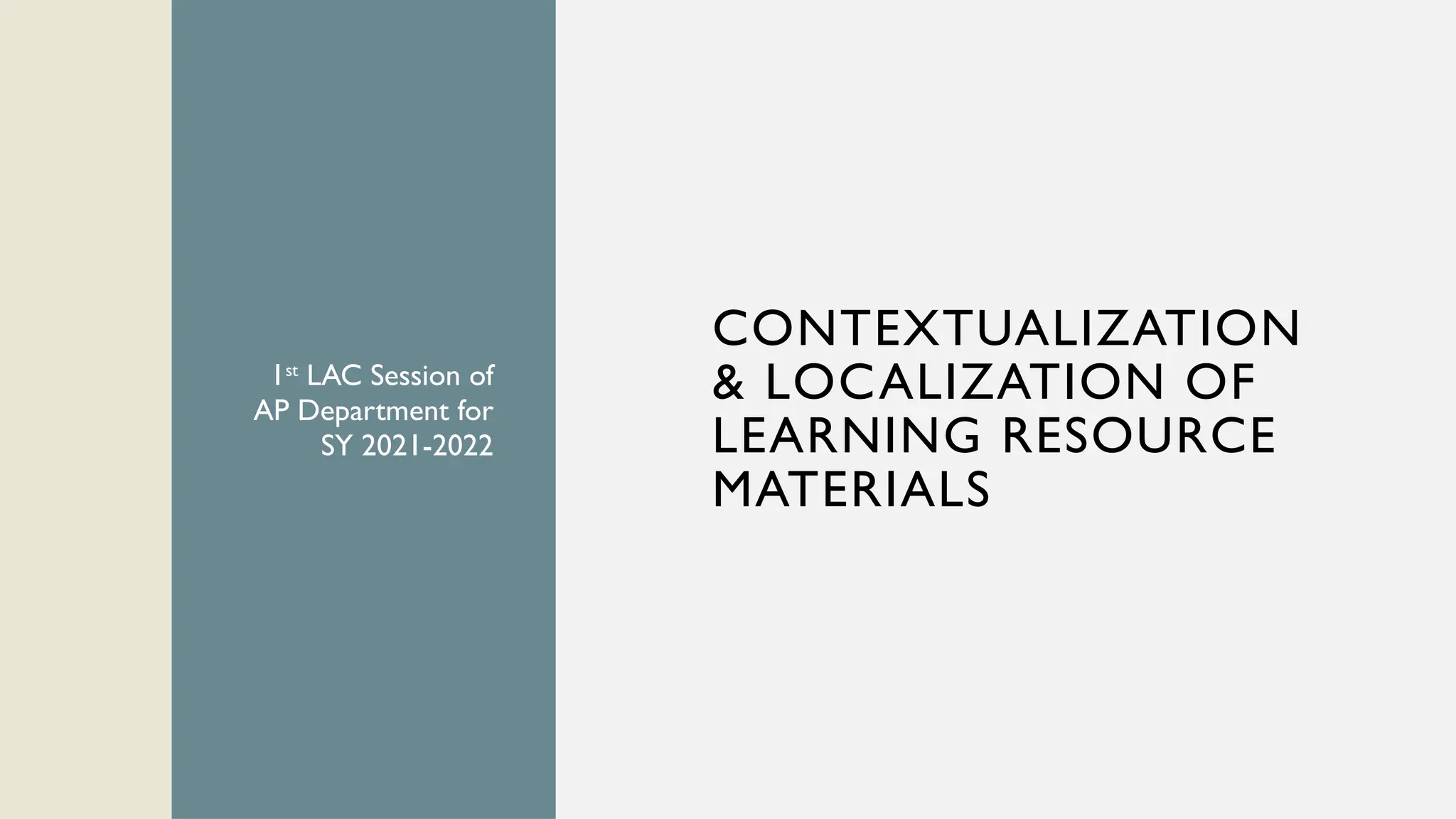
CONTEXTUALIZATION
& LOCALIZATION OF
LEARNING RESOURCE
MATERIALS
1st
LAC Session of
AP Department for
SY 2021-2022
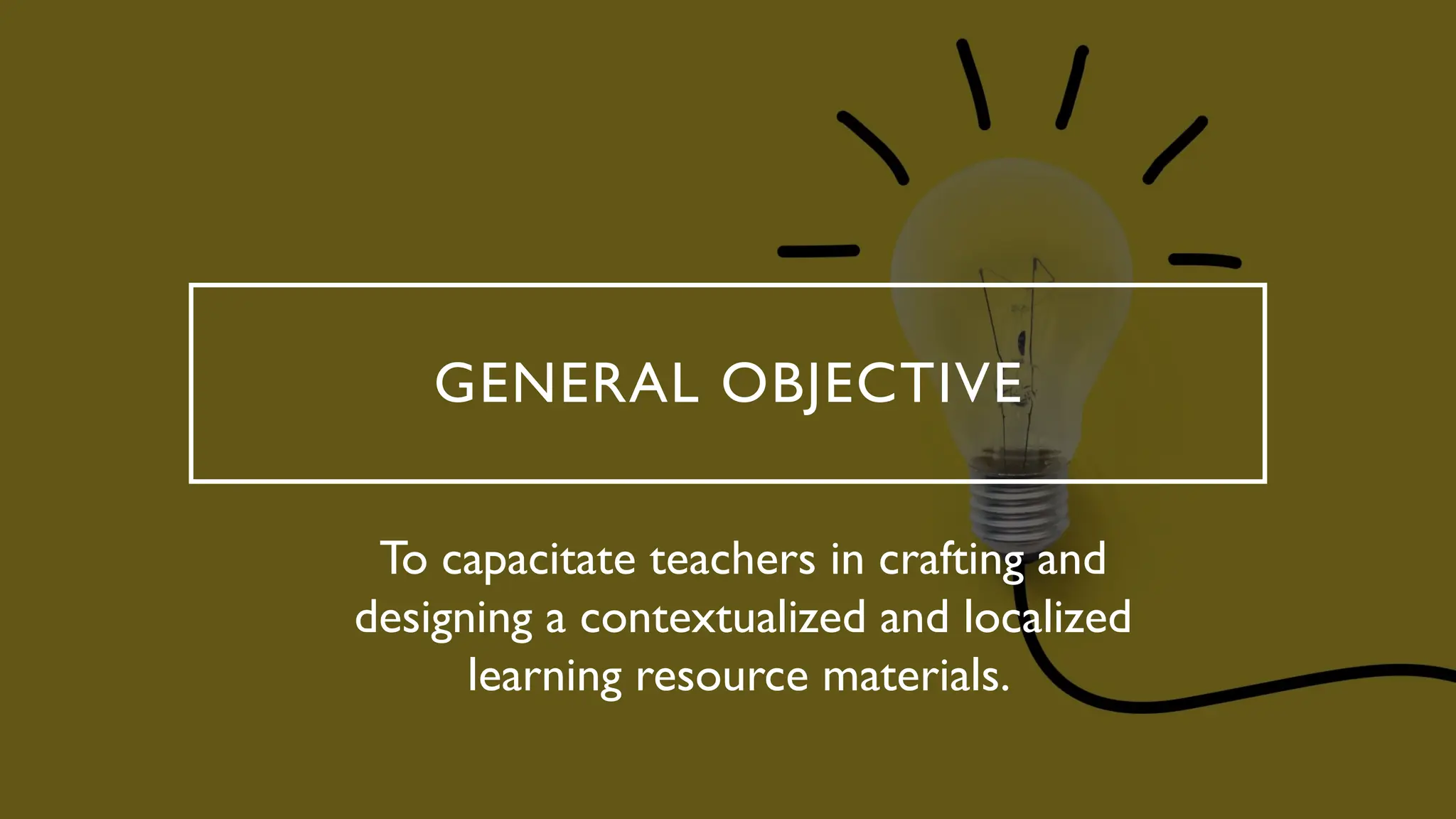
GENERAL OBJECTIVE
To capacitate teachers in crafting and
designing a contextualized and localized
learning resource materials.
SPECIFIC OBJECTIVES
At the end of the LAC session, the teachers are expected to:
• Define the concepts and meanings of contextualization and localization;
• Recognize the significance of contextualizing and localizing learning resource materials responsive
to the needs of the learners;
• Distinguish learning contextualization and material localization;
• Justify the need to create and design contextualized and localized learning resource materials
• Create contextualized and localized learning resource materials.
Priming activity
• Tell whether the following
statements or situations
illustrate Localization or
Contextualization or both
1. Gamit ang mga lokal na produkto ng
inyong komunidad, gumawa ng
advertisement kung paano ito
maitatampok o maipapakilala.
2. Ano ba ang pakiramdam kapag brownout
o kapag nawalan ng suplay ng tubig?
3. Bumuo ng isang mini-business plan
gamit ang natutunan sa TLE para sa
binabalak na negosyo ng grupo.
4. Magsagawa ng “price survey” ng mga
sangkap sa pagluluto ng pinangat.
5. Matapos ninyong matutunan ang
aralin tungkol sa produksyon, ang
bawat pangkat ay inaasahang
magsadula ng “economic activity” sa
inyong lugar.
1. What are your bases in deciding
whether a statement is localized
or contextualized?
2. What is your impression
about localization and
contextualization?
Localization and Contextualization
Article XIV, Section 14 of the 1987
Philippine Constitution which states
that “The State shall foster the
preservation, enrichment, and dynamic
evolution of a Filipino national
culture based on the principle of unity in
diversity in a climate of free artistic and
intellectual expression”
LEGAL BASES
Article XIV, Section 5. (1),which
states that “The State shall take
into account regional and sectoral
needs and conditions and shall
encourage local planning in the
development of educational
policies and programs.”
Localization and Contextualization
RA 10533
Enhanced Basic
Education Act of 2013
LEGAL
BASIS
Sec. 10.2 (d) and (h) – Implementing Rules and

Regulations for RA 10533
“The curriculum shall be CONTEXTUALIZED
and global;”
“The curriculum shall be flexible enough to
enable and allow schools to LOCALIZE,
INDIGENIZE, and enhance [the curriculum]
based on their respective educational and
social contexts.”
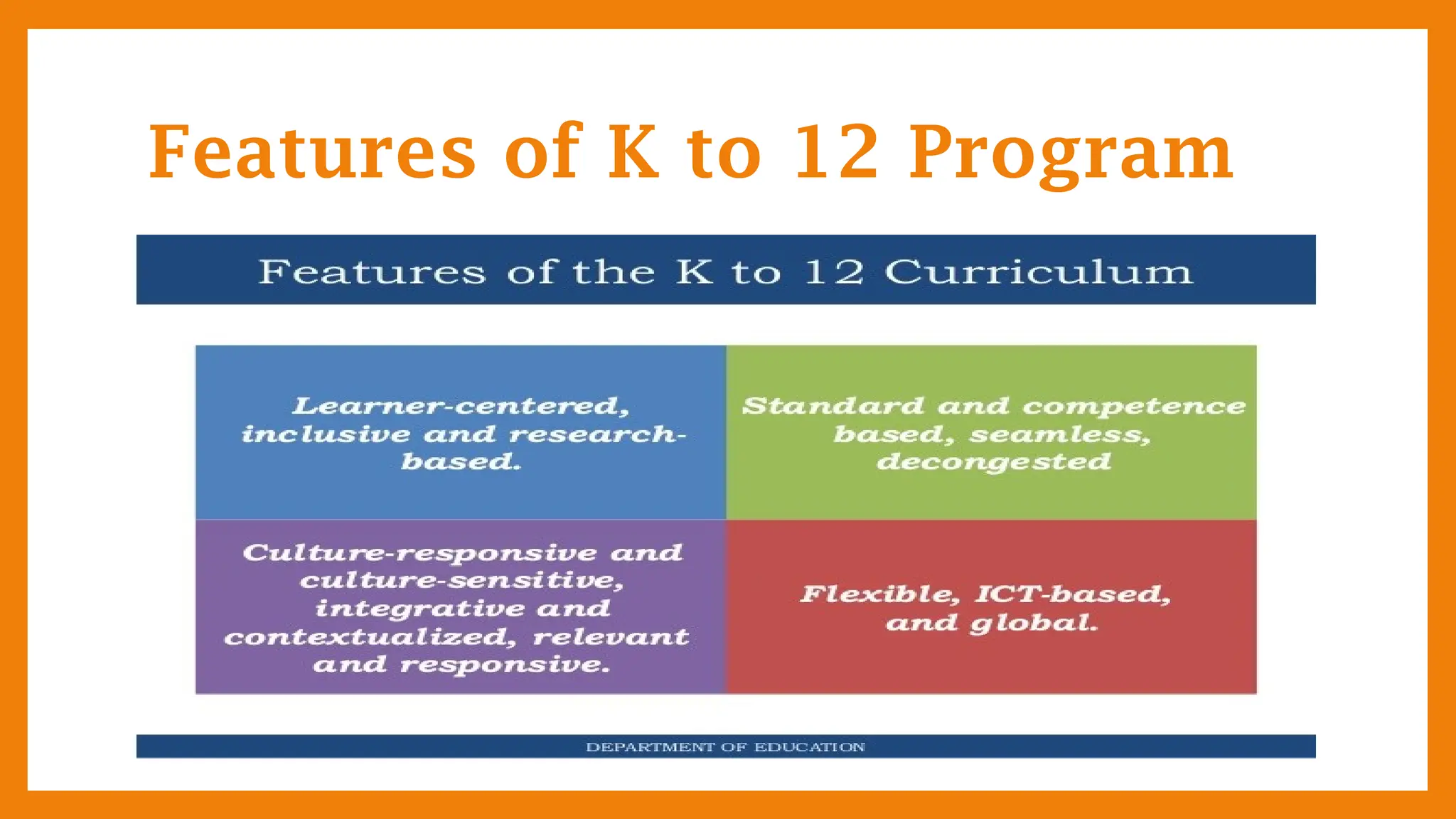
Features of K to 12 Program
Contextualization
refers to the educational process of
relating the curriculum to a particular setting,
situation or area of application to make the
competencies relevant, meaningful and useful
to the learners.
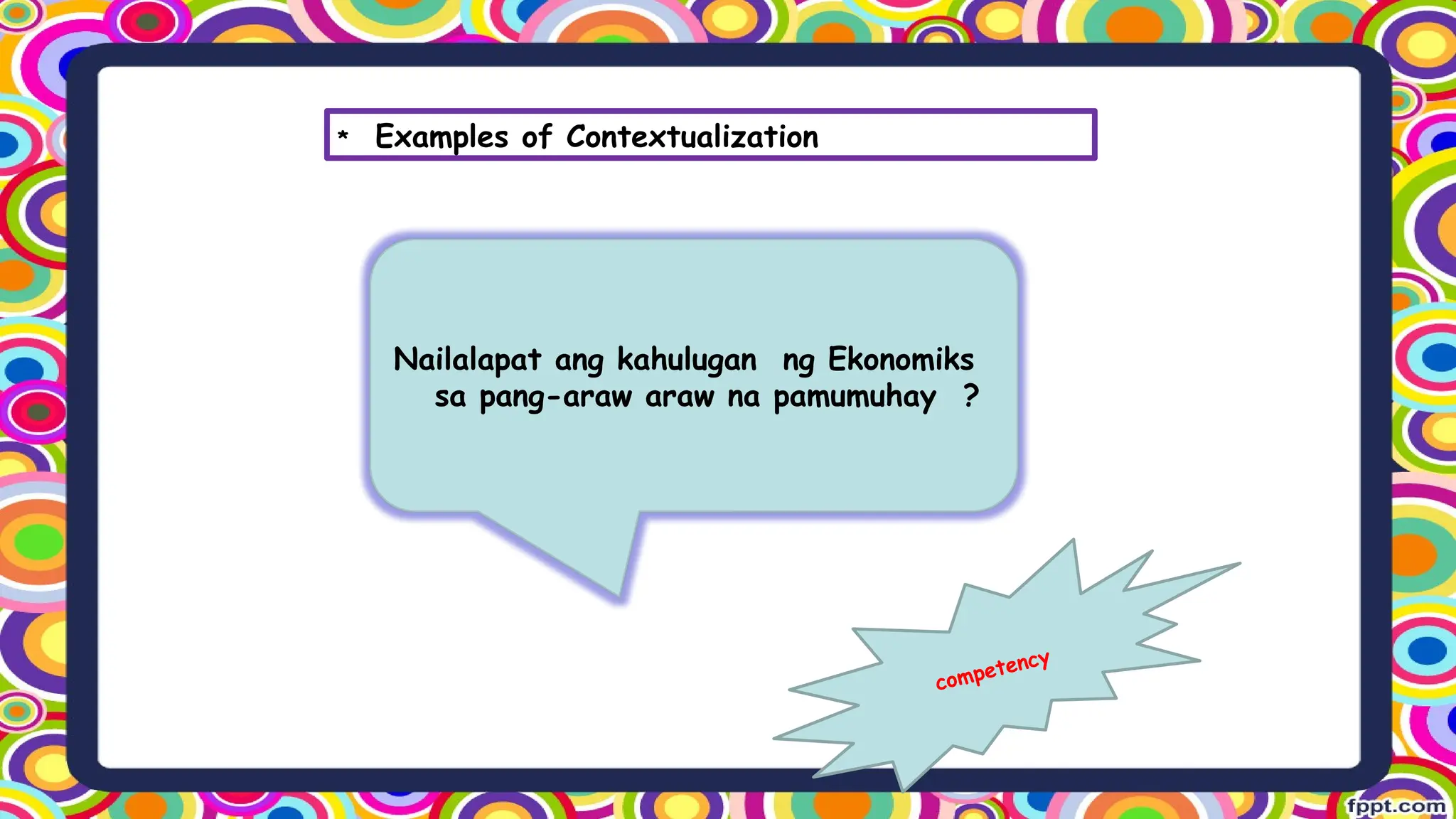
* Examples of Contextualization
Nailalapat ang kahulugan ng Ekonomiks
sa pang-araw araw na pamumuhay ?
competency
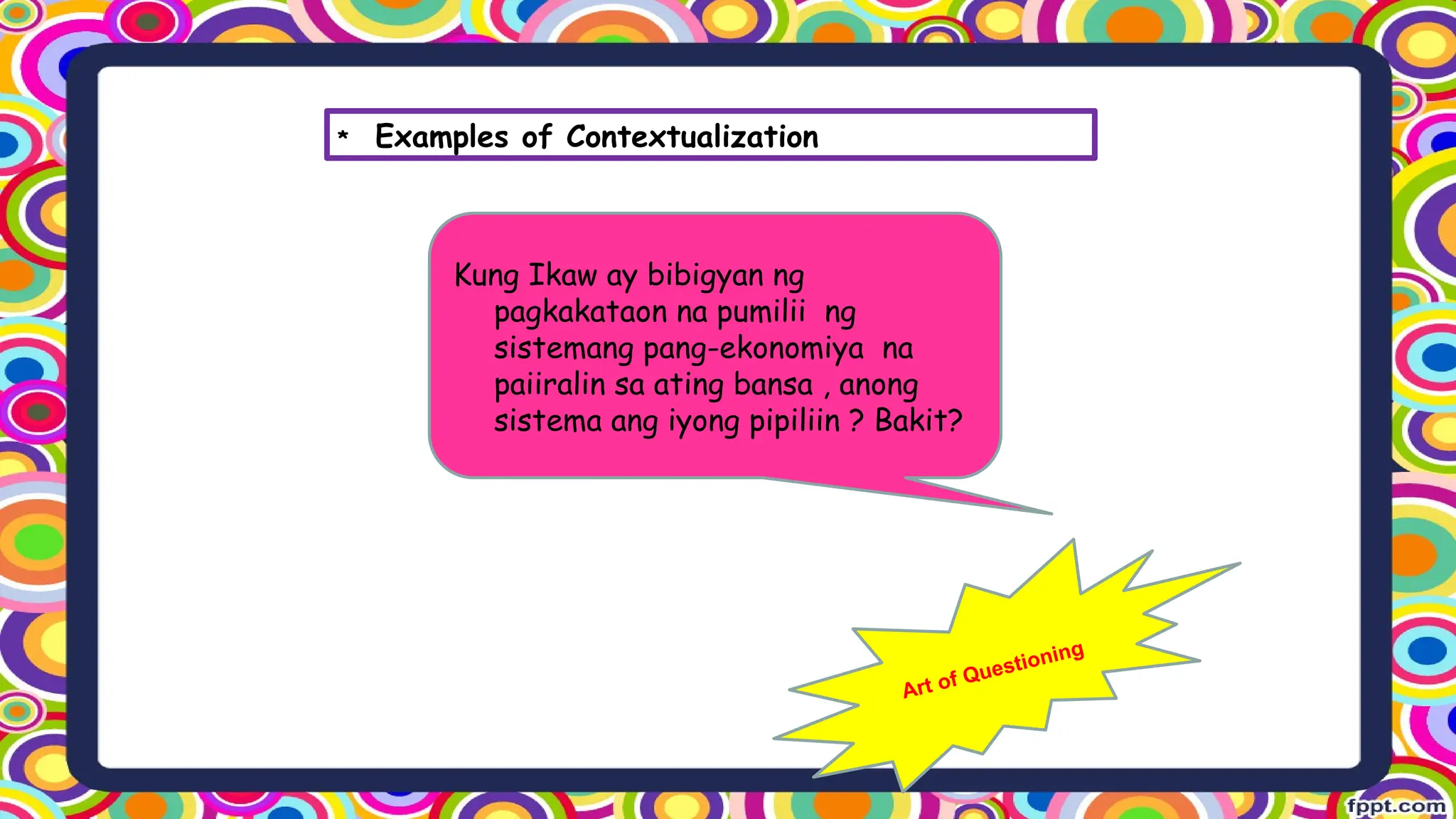
Kung Ikaw ay bibigyan ng
pagkakataon na pumilii ng
sistemang pang-ekonomiya na
paiiralin sa ating bansa , anong
sistema ang iyong pipiliin ? Bakit?
Art of Questioning
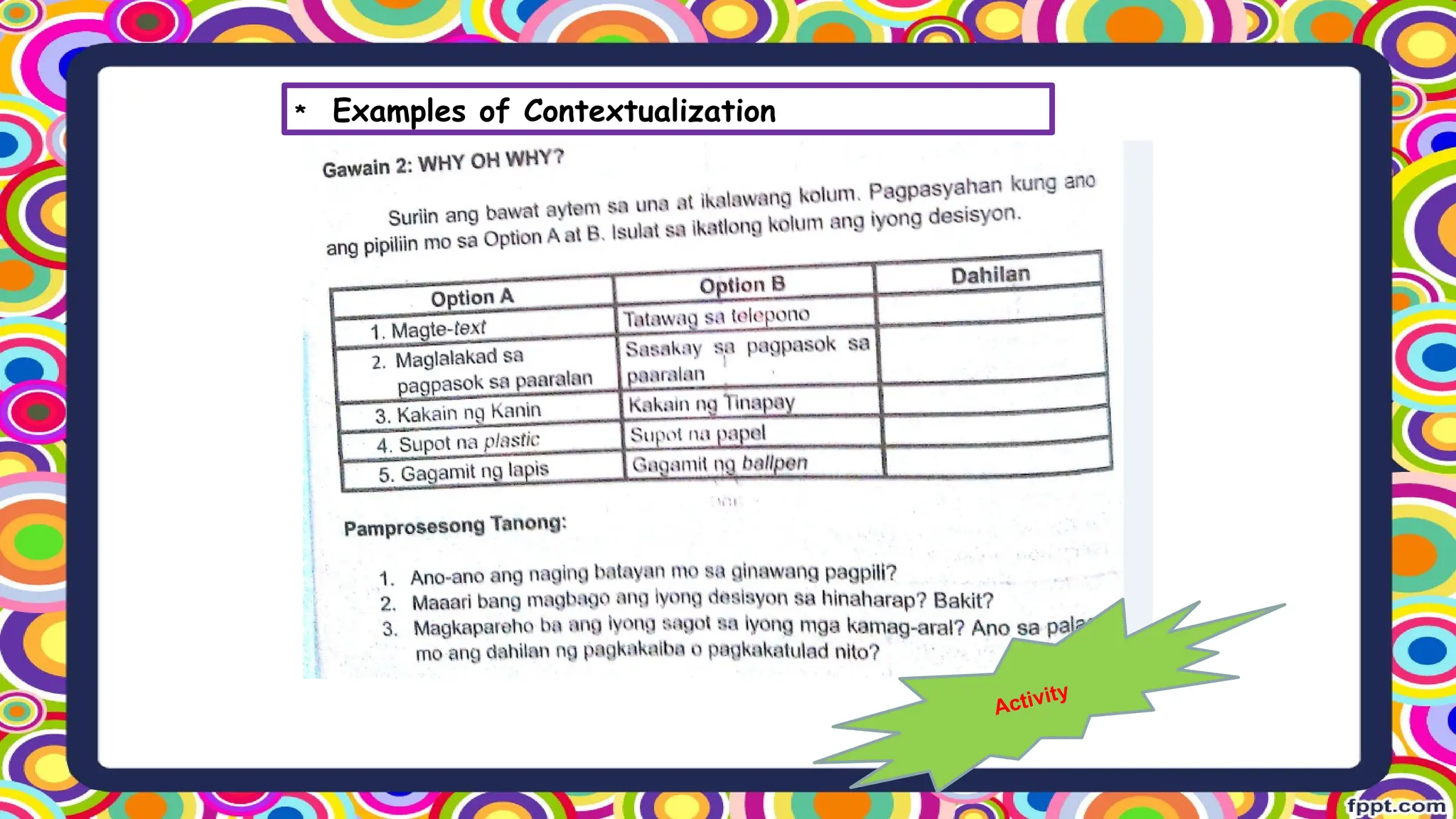
* Examples of Contextualization
Activity
Curriculum
K TO 12
* Example of Contextualization
the process of relating learning content
specified in the curriculum to local information
and materials from the learner’s community
As one of the degrees of contextualization,
localization is defined as:
Localization
Localization of content is about how the course material
is adapted in order to fit local culture, language and
religious beliefs (Andersson, 2008).
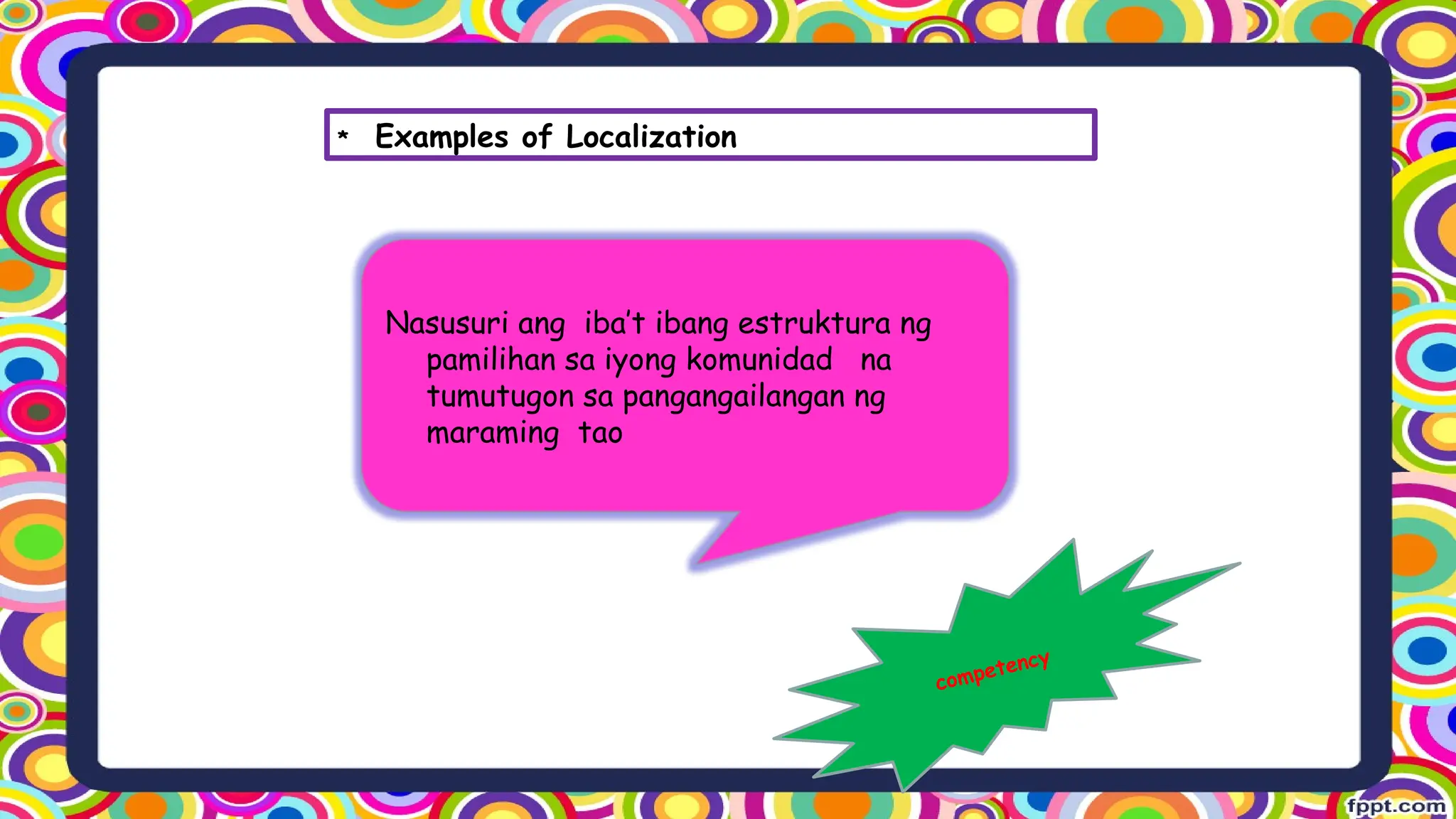
* Examples of Localization
Nasusuri ang iba’t ibang estruktura ng
pamilihan sa iyong komunidad na
tumutugon sa pangangailangan ng
maraming tao
competency
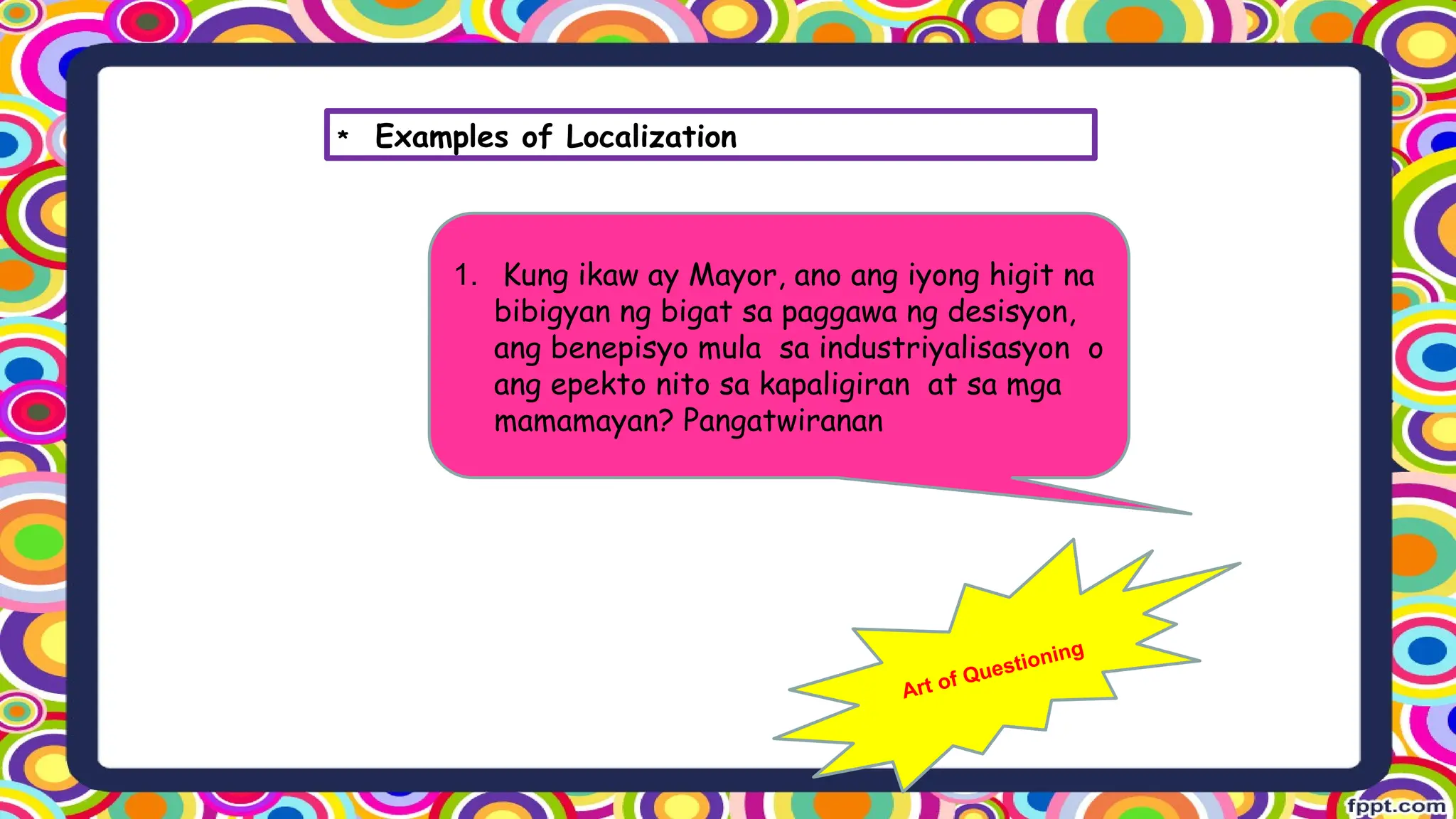
1. Kung ikaw ay Mayor, ano ang iyong higit na
bibigyan ng bigat sa paggawa ng desisyon,
ang benepisyo mula sa industriyalisasyon o
ang epekto nito sa kapaligiran at sa mga
mamamayan? Pangatwiranan
Art of Questioning
* Examples of Localization
Curriculum
Mother Tongue
* Examples of Localization
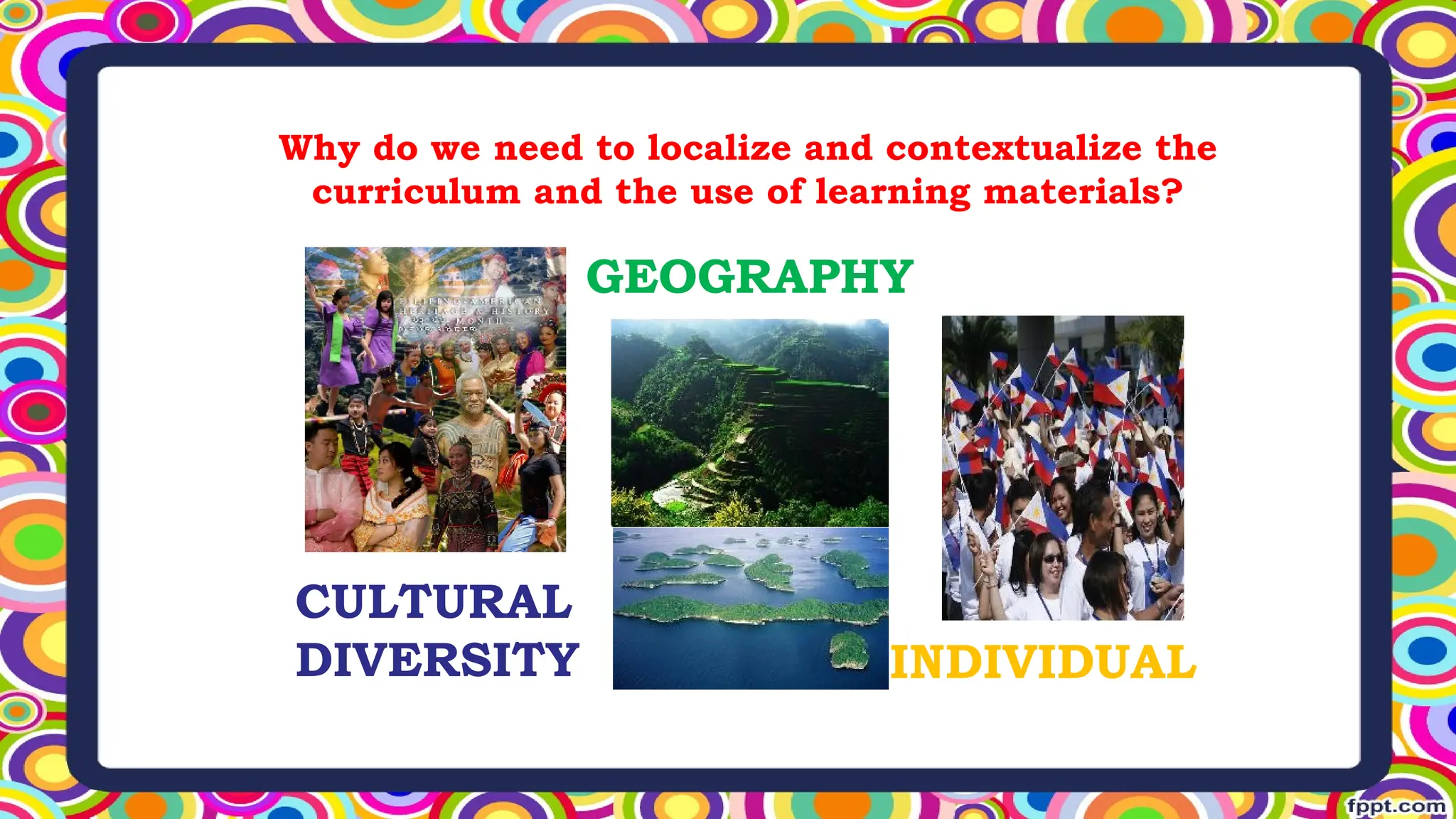
Why do we need to localize and contextualize the
curriculum and the use of learning materials?
CULTURAL
DIVERSITY
GEOGRAPHY
INDIVIDUAL
Localization and Contextualization
The curriculum is alive, it changes depending who
is implementing it, where and when it is
implemented.
In order for you to localize and contextualize the
curriculum, “you have to think of where you are so
that you can make the curriculum relevant to
you.” – Usec. Dina Ocampo
when we localize [the curriculum], we agree to it
This means that different areas in the country will
also use different materials, they will use different
instruments so that they can deliver the standards
of the curriculum.
Localization and
Contextualization
HOW?
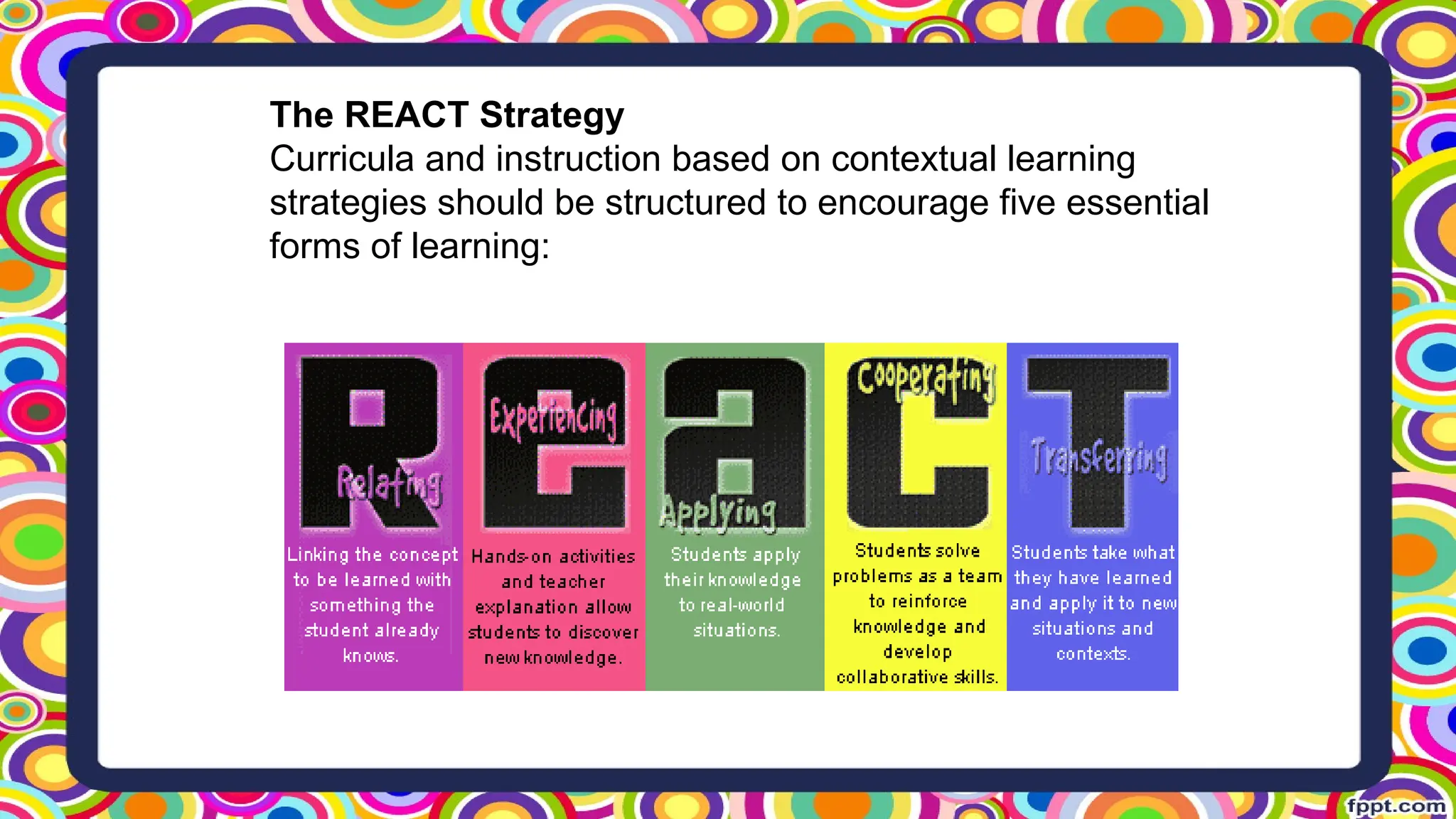
The REACT Strategy
Curricula and instruction based on contextual learning
strategies should be structured to encourage five essential
forms of learning:
EXPERIENCING
Learning in the context of life
experience, or relating, is the kind of
contextual learning that typically occurs
with very young children. With adult
learners, however, providing this
meaningful context for learning becomes
more difficult. The curriculum that
attempts to place learning in the context
of life experiences must, first, call the
student’s attention to everyday sights,
events, and conditions. It must then
relate those everyday situations to new
information to be absorbed or a problem
to be solved.
.
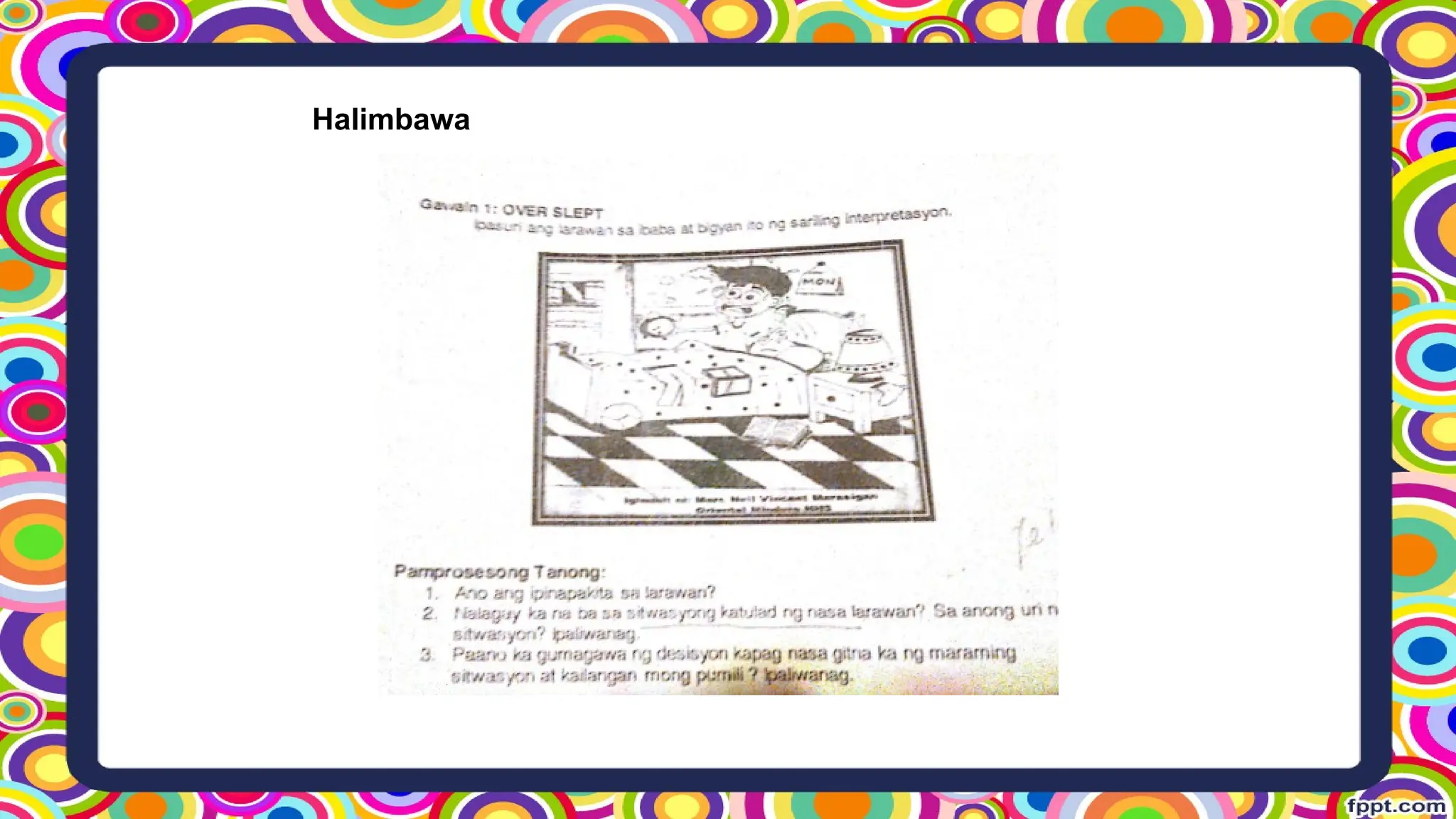
Halimbawa
Experiencing—learning in the
context of exploration, discovery, and
invention—is the heart of contextual
learning. However motivated or tuned-in
students may become as a result of
other instructional strategies such as
video, narrative, or text-based activities,
these remain relatively passive forms of
learning. And learning appears to "take"
far more quickly when students are able
to manipulate equipment and materials
and to do other forms of active
research.
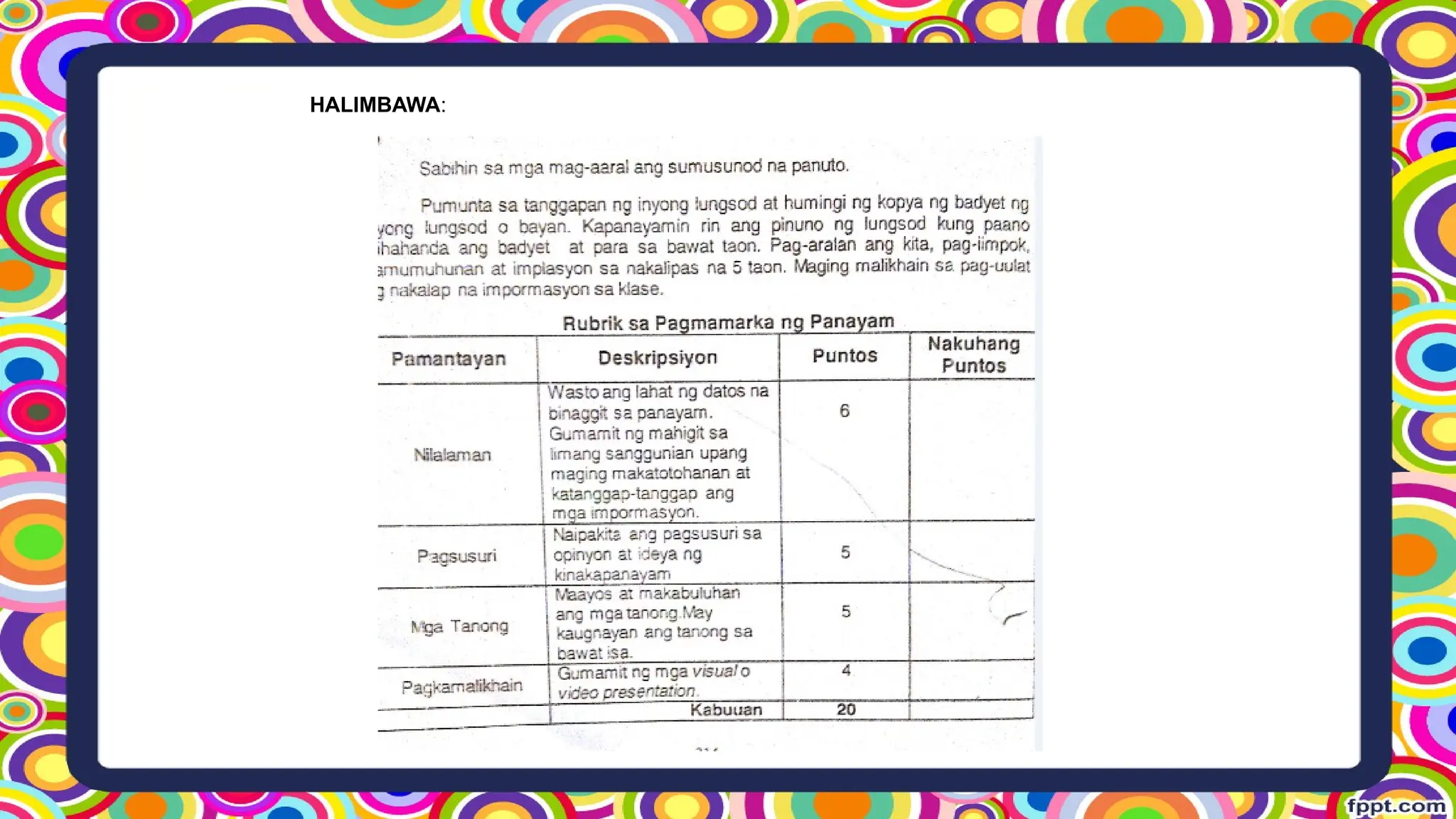
HALIMBAWA:
Applying concepts and
information in a useful context
often projects students into an
imagined future (a possible
career) or into an unfamiliar
location (a workplace). This
happens most commonly through
text, video, labs, and activities,
and these contextual learning
experiences are often followed up
with firsthand experiences such
as plant tours, mentoring
arrangements, and internships.
HALIMBAWA:
Cooperating—learning in the
context of sharing, responding, and
communicating with other learners—is a
primary instructional strategy in contextual
teaching. The experience of cooperating
not only helps the majority of students learn
the material, it also is consistent with the
real-world focus of contextual teaching.
HALIMBAWA:
Learning in the context of
existing knowledge, or
transferring, uses and builds
upon what the student has
already learned. Such an
approach is similar to relating,
Students develop confidence in
their problem-solving abilities if
we make a point of building new
learning experiences on what
they already know.
HALIMBAWA:
• Localization and
contextualization can be
done in all subject areas
• Localization maximizes
materials that are locally
available
• To contextualize, teachers use
authentic materials, activities,
interests, issues, and needs from
learners’ lives
• Should create rooms for students to
pose problems and issues and develop
strategies together for addressing them
WHY DO WE NEED TO
CONTEXTUALIZE/LOCALIZE?
What does the experts say?
WHY DO WE NEED TO
CONTEXTUALIZE/LOCALIZE?
Localizing learning
materials often benefits
the students because it
is anchored to their
needs (Andersson,
2008).
Contextualization of a
course's content and
concepts can improve
student motivation,
learning, and persistence.
“EFFECTS OF CONTEXTUALIZATION”
KRAUSE, WATERS & STUART (2016)
1.) It has been shown that instruction with contextualized content can activate
learners' prior knowledge and promote more effective problem solving;
2.) Contextualization of content in interactive classroom engagement activities that
motivates students with a concept's relevance can improve learning.
3.) Contextualization of content helps students reflect on their learning to bridge
ideas from a familiar concrete context of an abstract concept so they can recognize
their own personal relationship to these concepts.
OTHER FINDINGS
According to Mouraz and Leite (2013), contextualization is a prerequisite in addressing
the content and organization of activities to be undertaken in the classroom. Students'
engagement in their schoolwork increases significantly when they are taught, why they
are learning the concepts and how those concepts can be used in real-world contexts.
According to Ozele, cultural contextualize education motivates students to know
more about their cultural heritage in order to appreciate and understand other
cultural heritage.
SIMPLIFIED LEARNING ACTIVITY
SHEETS (SLAS)
Part II of LAC Session
CVIF-DLP
Learning Activity Sheet
- Ito ay isang kagamitang pampagtuturo na
nakabatay sa K-12 curriculum ng Kagawaran ng
Edukasyon.
- Hinihikayat ang sariling pagkatuto sa mga
mag-aaral at napatunayang epektibo sa
pagpapabuti ng akademikong pagganap ng mga
mag-aaral.
CVIF-DLP
Learning Activity Sheet
Inihanda para sa sariling pagkatuto na naglalaman
ng pangunahing idea na matutunan ng mag-aaral.
Isinusulat muli upang mapahusay ang
pagpapanatili ng kaalaman tungkol sa paksa.
Binuo para sa mga mag-aaral upang basahin
at magawa ang gawain mag-isa.
CVIF-DLP
Learning Activity Sheet
Dapat ay malinaw at nauunawaan ng mag-aaral.
Kailangan masagutan ng mga ng mga mag-aaral
ng walang paunang pagtalakay ng paksa.
LAS
Learning
Activity
Sheet
LAS
- Ito ay pangunahing
kasangkapan sa pagtuturo
at pagkatuto ng mga mag-
aaral
 Isang pahina na naglalaman ng
isang konsepto.
 Hindi nangangailangan ng
panimulang panayam
 Kinokopya ang kabuoan gamit ang
kamay
 May 2-3 tanong sa pagsasanay
 Lingguhang ipinapasa sa bawat
guro.
LAS
Nilalaman ng LAS:
 Dapat nakapaloob ang
pangunahing idea sa pagkatuto.
 Kailangan mayroong 1 o 2 na
pokus sa pagkatuto.
o Simple, malinaw, tiyak,
mapahahalagahan at
makakamit
o Ayon sa pananaw ng mag
mag-aaral
o Nakabatay sa MELCs
 Sanggunian ay dapat mabanggit.
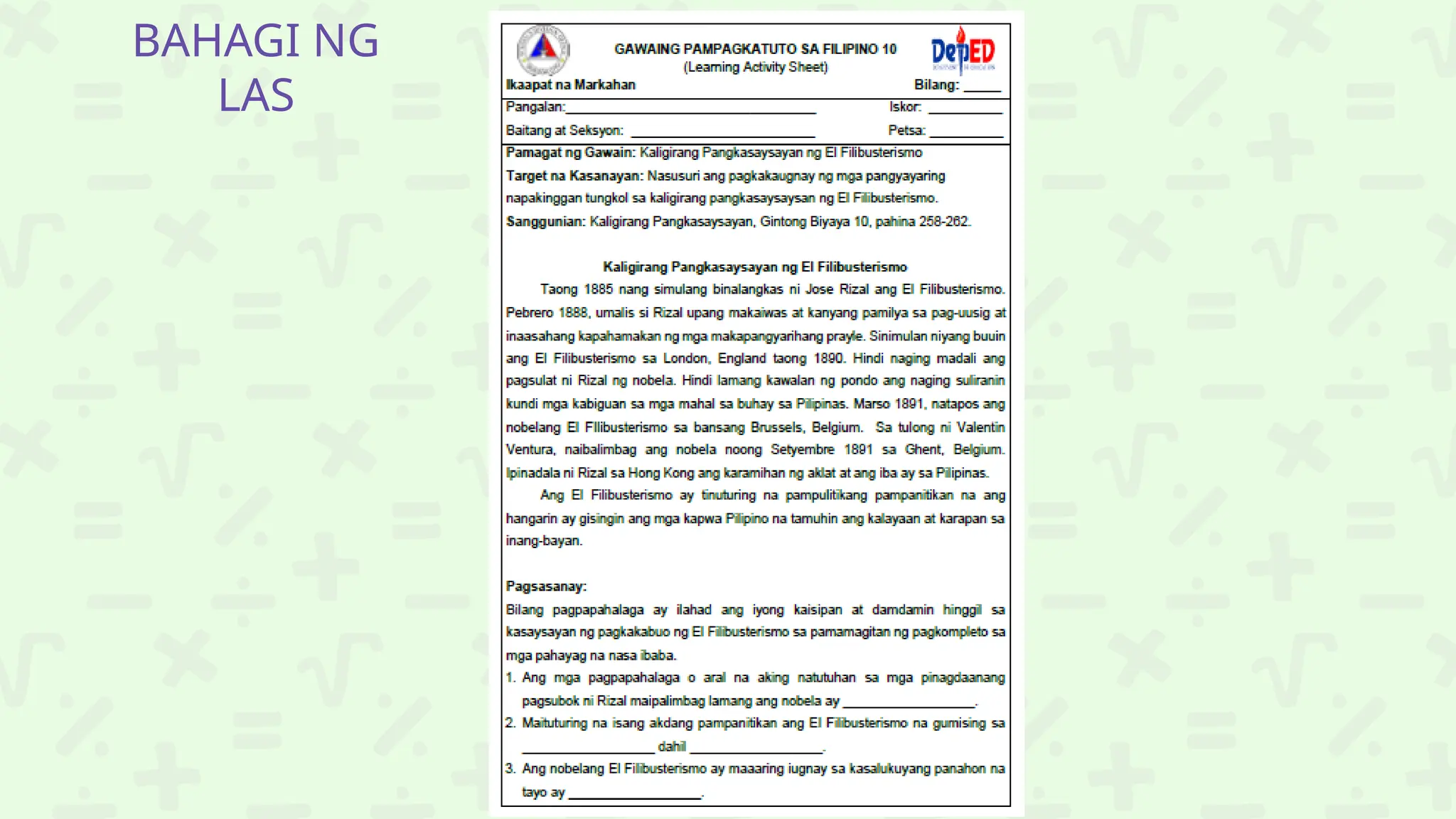
BAHAGI NG
LAS
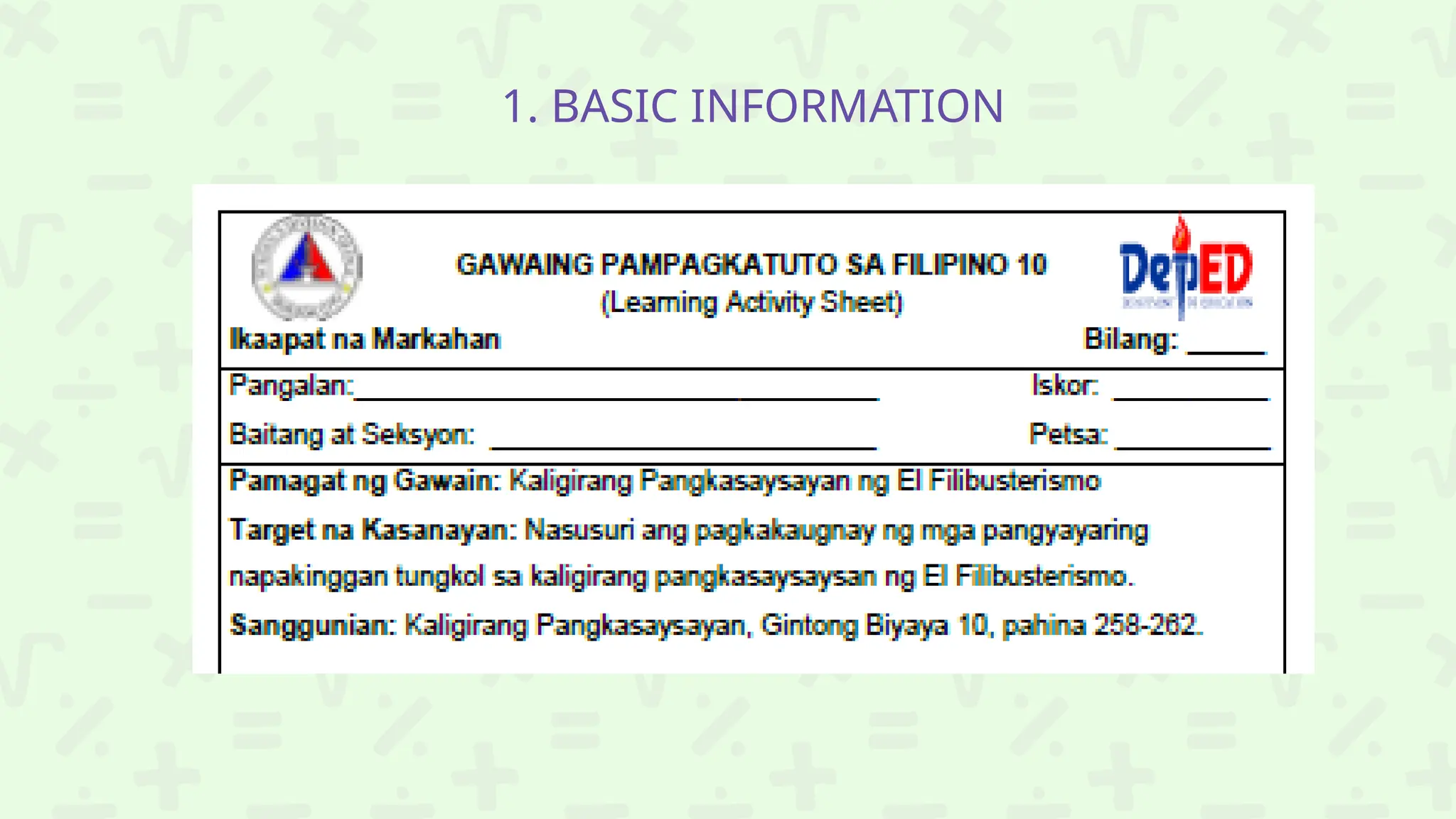
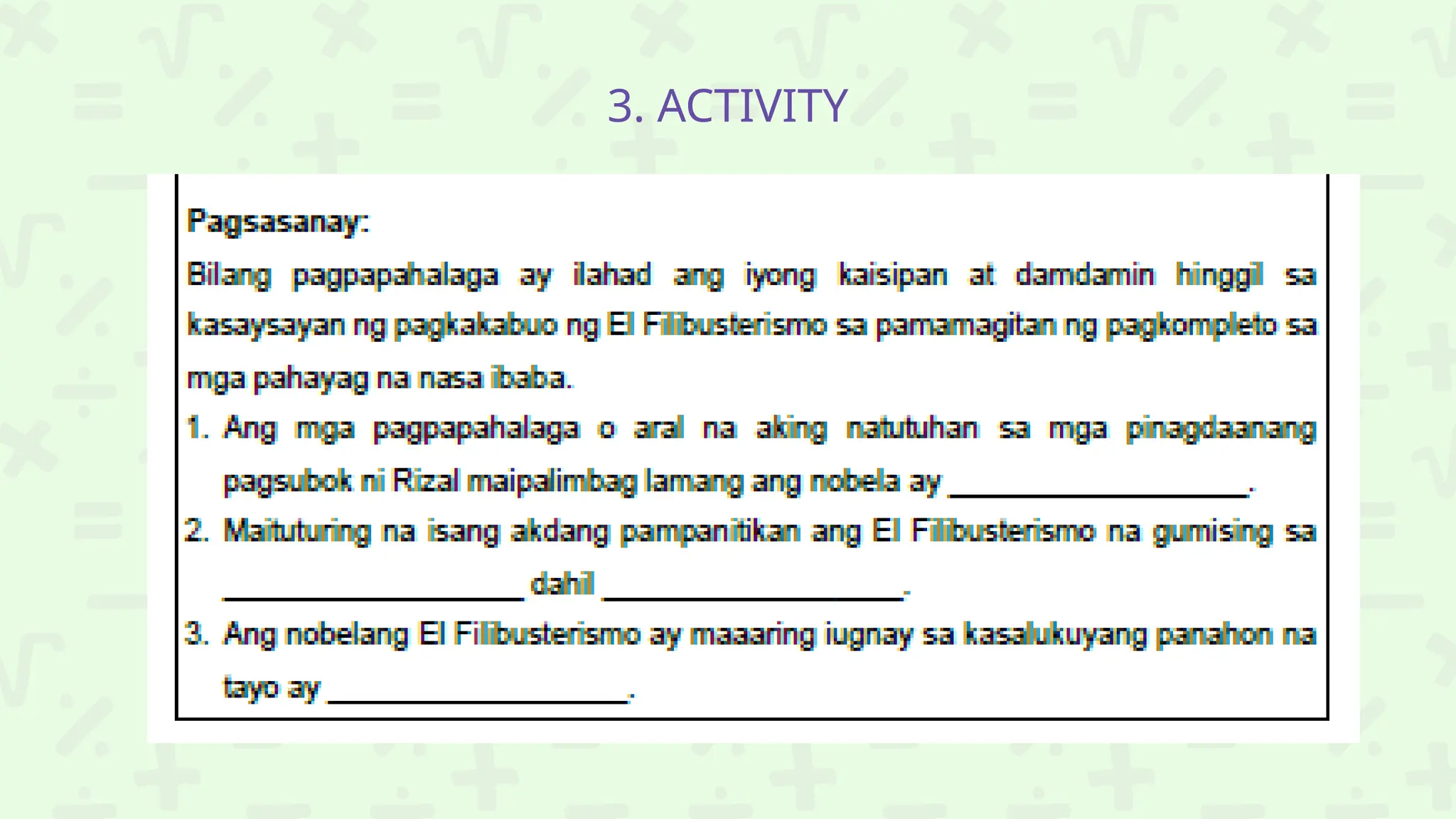
1. BASIC INFORMATION
2. CONCEPT NOTES / DIGEST
3. ACTIVITY
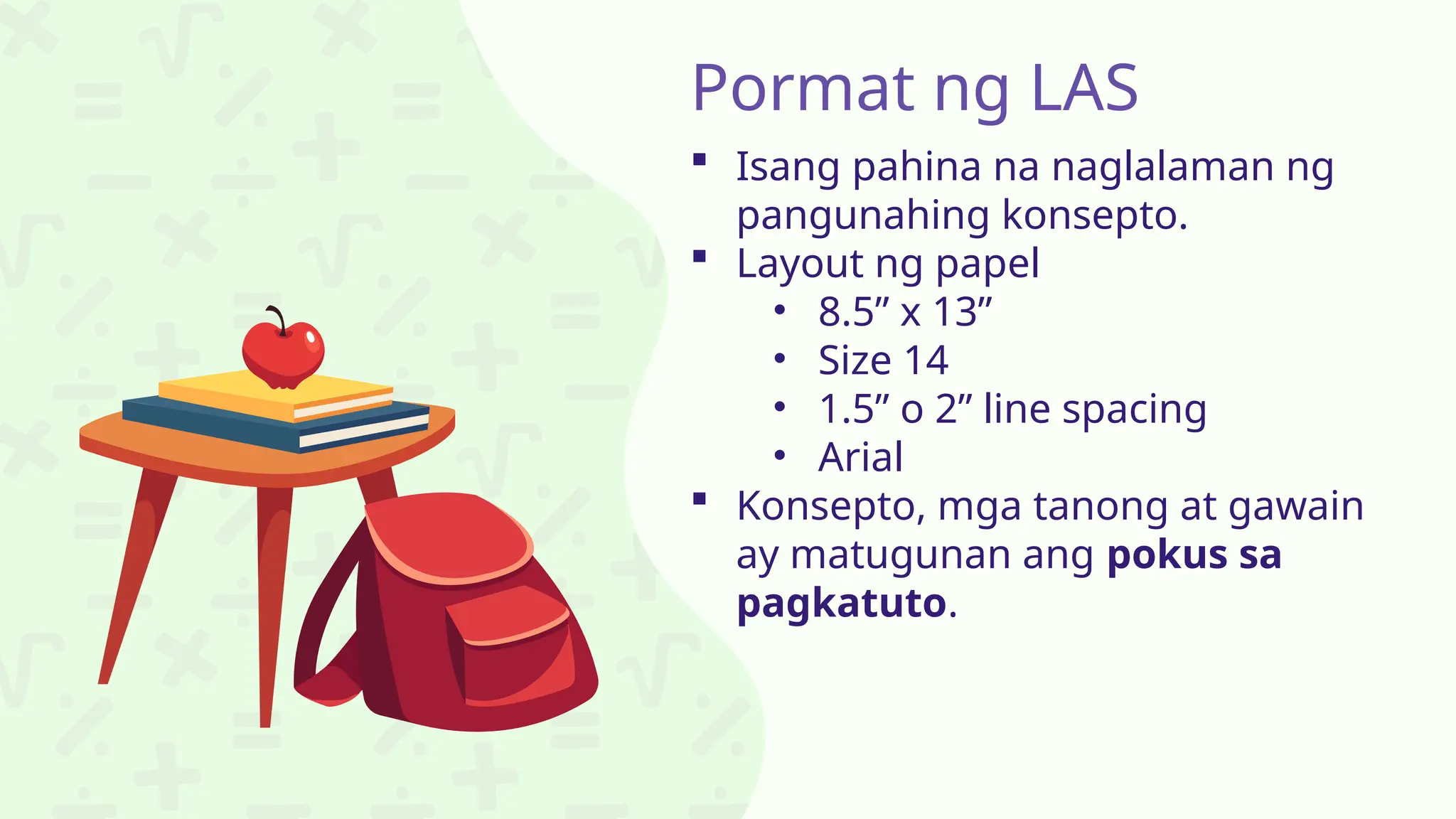
Pormat ng LAS
 Isang pahina na naglalaman ng
pangunahing konsepto.
 Layout ng papel
• 8.5” x 13”
• Size 14
• 1.5” o 2” line spacing
• Arial
 Konsepto, mga tanong at gawain
ay matugunan ang pokus sa
pagkatuto.
Paano kung sa isang
MELC ay may dalawa o
higit pang pokus?
“SUB-TASK”
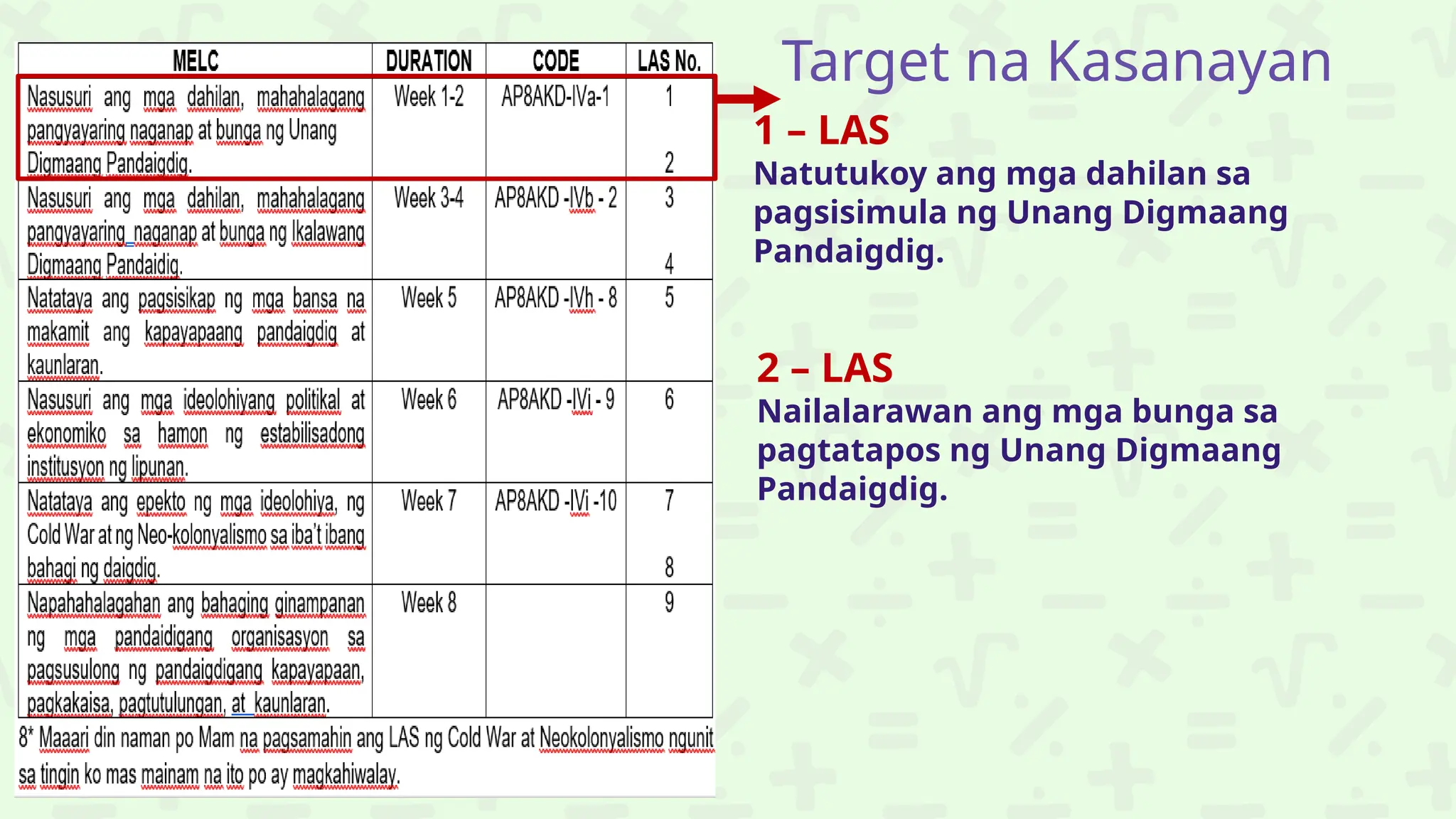
Target na Kasanayan
1 – LAS
Natutukoy ang mga dahilan sa
pagsisimula ng Unang Digmaang
Pandaigdig.
2 – LAS
Nailalarawan ang mga bunga sa
pagtatapos ng Unang Digmaang
Pandaigdig.
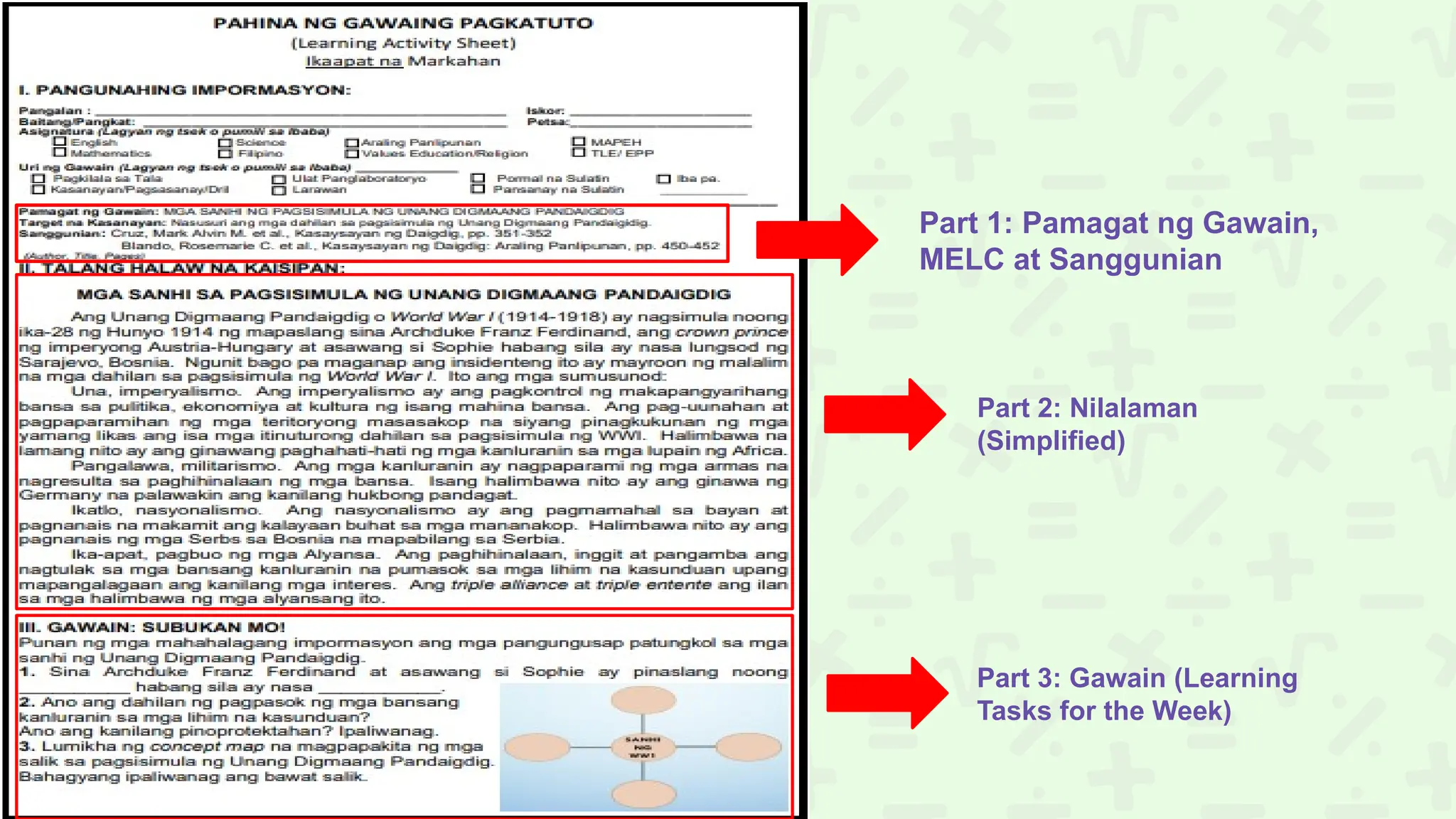
Part 1: Pamagat ng Gawain,
MELC at Sanggunian
Part 2: Nilalaman
(Simplified)
Part 3: Gawain (Learning
Tasks for the Week)
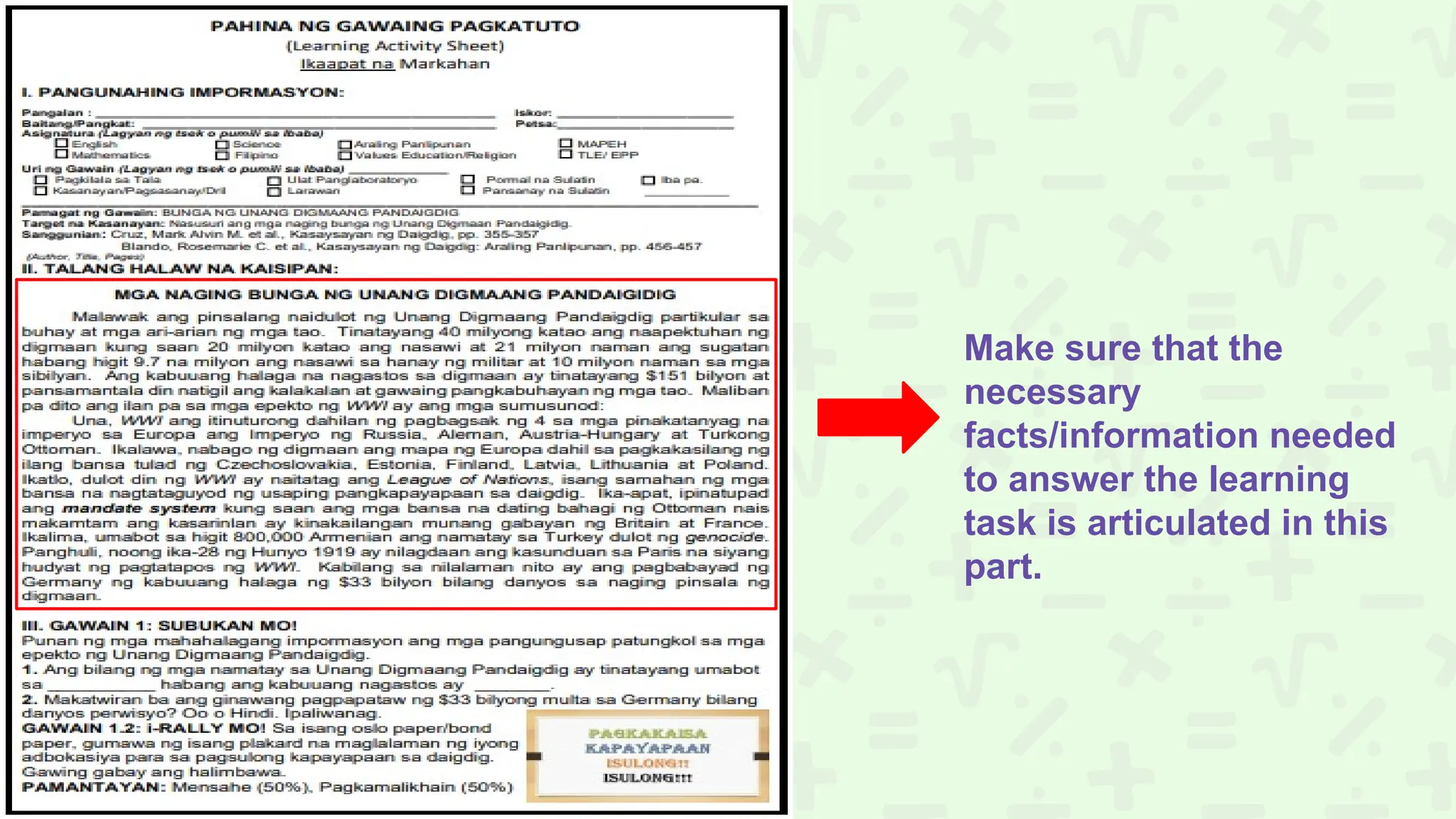
Make sure that the
necessary
facts/information needed
to answer the learning
task is articulated in this
part.
REFERENCES
Andresson, A., (2008). “Seven Major Challenges for E-Learning in Developing Countries Case Study eBIT, Sri
Lanka”, International Journal of Education and Development using ICT, Vol. 4, No. 3
Garin, R., Reyes, R., Domantay, G. F., & Rosals, J., (2017). Contextualized and Localized Teaching as a Technique in
Teaching Basic Statistics. Asia Pacific Journal of Education,Arts and Sciences,Vol. 4 No. 1, pp. 62-7
Krause, S. J.,Waters, C., & Stuart,W. J., (2016). Effect of Contextualization of Content and Concepts on Students’
Course Relevance andValue in Introductory Materials Classes
Mouraz,A., & Leite, C. (2013). Putting knowledge in context: Curriculum contextualization in history classes.
Transformative Dialogues:Teaching & Learning Journal, 6(3), 1-11.
RA 10533 Enhanced Basic Education Act of 2013
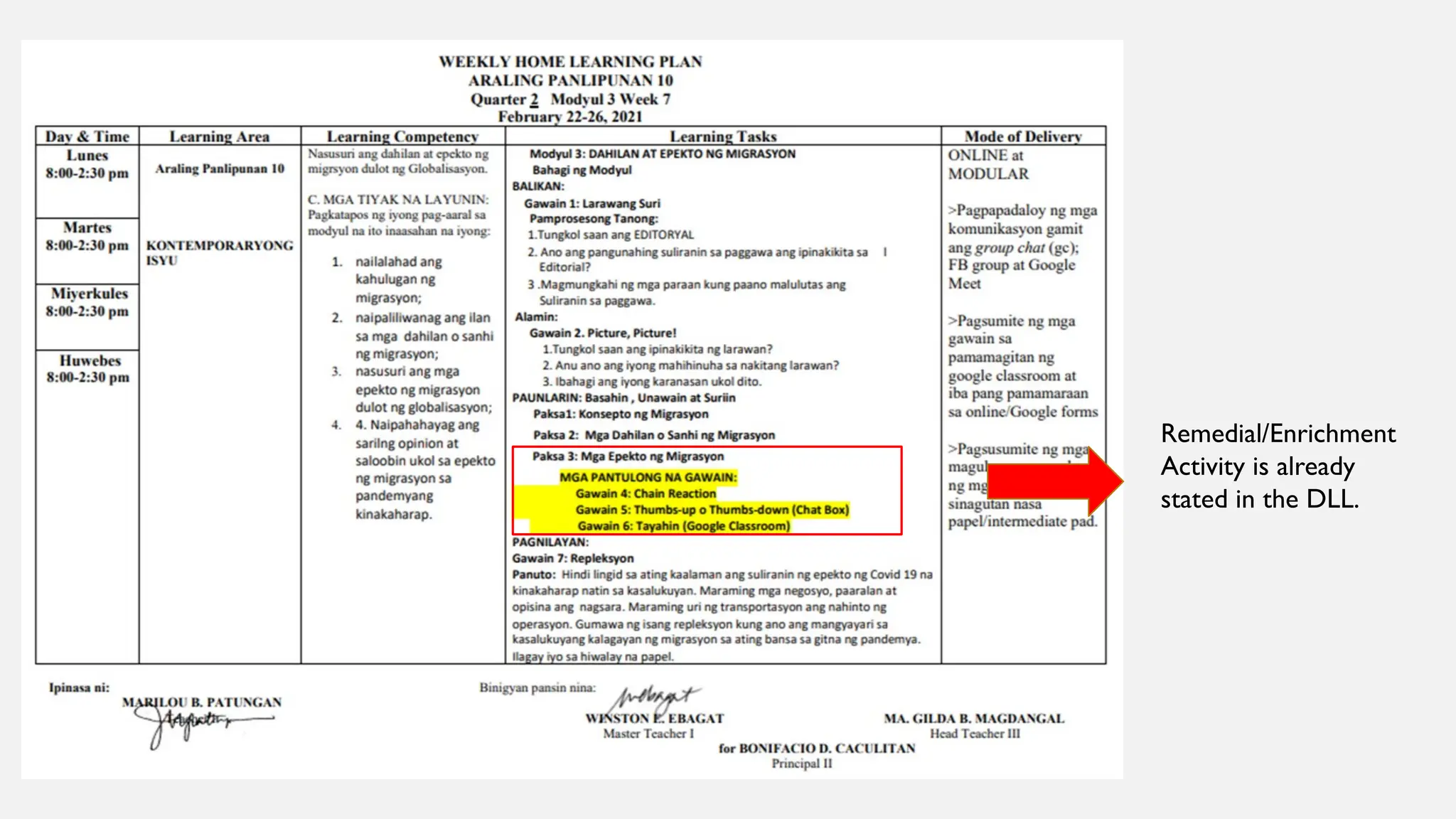
Remedial/Enrichment
Activity is already
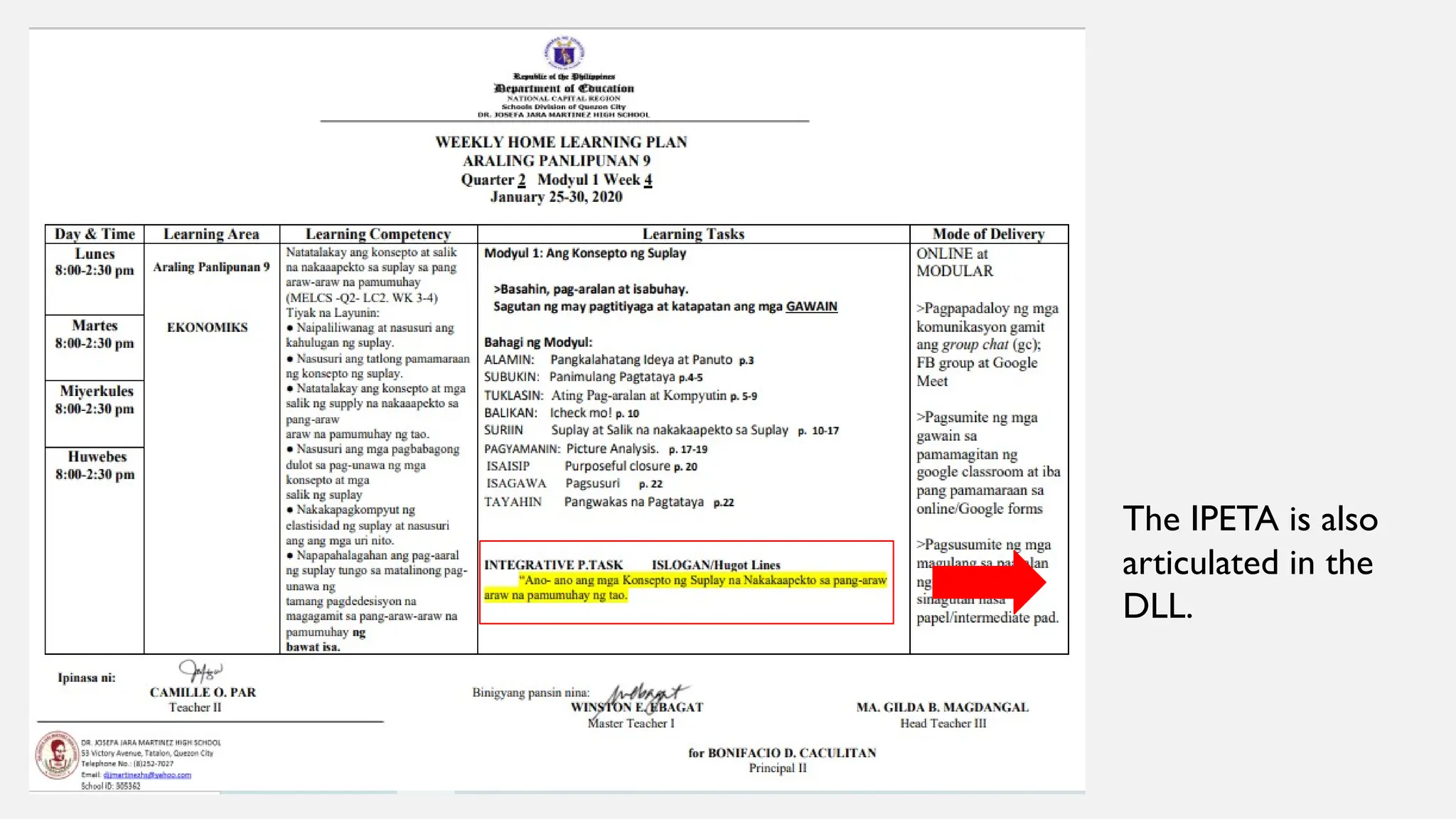
stated in the DLL.
The IPETA is also
articulated in the
DLL.
TOPIC FOR NEXT LAC: GIVING
TIMELY FEEDBACK
Who would like to volunteer as
Resource Speaker?

Contextualization-localization-of-learning-resource-materials-FINAL.pptx

  • 1.
    PROGRAM FLOW TIME 10:00- 10:15am Registration 10:15-10:30 OpeningProgram 10:30-11:15 LAC Session Proper 11:16-11:45 Open Forum & Sharing of Insights 11:46 – 11:55 Closing Remarks
  • 2.
    COMMITTEES Committees Opening & ClosingRemarks Mrs. Ma. Gilda B. Magdangal Program / Prayer & Nationalistic Song Ms. Camille O. Par Documentation & Minutes Mrs. Sarah JaneV. Bachiller Open Forum & Synthesis Mrs. Marilou B. Patungan Certificates & Facilitator Mrs. Judith Avergonzado-Artana Speaker Mr. Winston E. Ebagat
  • 3.
    CONTEXTUALIZATION & LOCALIZATION OF LEARNINGRESOURCE MATERIALS 1st LAC Session of AP Department for SY 2021-2022
  • 4.
    GENERAL OBJECTIVE To capacitateteachers in crafting and designing a contextualized and localized learning resource materials.
  • 5.
    SPECIFIC OBJECTIVES At theend of the LAC session, the teachers are expected to: • Define the concepts and meanings of contextualization and localization; • Recognize the significance of contextualizing and localizing learning resource materials responsive to the needs of the learners; • Distinguish learning contextualization and material localization; • Justify the need to create and design contextualized and localized learning resource materials • Create contextualized and localized learning resource materials.
  • 6.
    Priming activity • Tellwhether the following statements or situations illustrate Localization or Contextualization or both
  • 7.
    1. Gamit angmga lokal na produkto ng inyong komunidad, gumawa ng advertisement kung paano ito maitatampok o maipapakilala. 2. Ano ba ang pakiramdam kapag brownout o kapag nawalan ng suplay ng tubig? 3. Bumuo ng isang mini-business plan gamit ang natutunan sa TLE para sa binabalak na negosyo ng grupo. 4. Magsagawa ng “price survey” ng mga sangkap sa pagluluto ng pinangat.
  • 8.
    5. Matapos ninyongmatutunan ang aralin tungkol sa produksyon, ang bawat pangkat ay inaasahang magsadula ng “economic activity” sa inyong lugar.
  • 9.
    1. What areyour bases in deciding whether a statement is localized or contextualized? 2. What is your impression about localization and contextualization?
  • 10.
    Localization and Contextualization ArticleXIV, Section 14 of the 1987 Philippine Constitution which states that “The State shall foster the preservation, enrichment, and dynamic evolution of a Filipino national culture based on the principle of unity in diversity in a climate of free artistic and intellectual expression” LEGAL BASES
  • 11.
    Article XIV, Section5. (1),which states that “The State shall take into account regional and sectoral needs and conditions and shall encourage local planning in the development of educational policies and programs.”
  • 12.
    Localization and Contextualization RA10533 Enhanced Basic Education Act of 2013 LEGAL BASIS
  • 13.
    Sec. 10.2 (d)and (h) – Implementing Rules and Regulations for RA 10533 “The curriculum shall be CONTEXTUALIZED and global;” “The curriculum shall be flexible enough to enable and allow schools to LOCALIZE, INDIGENIZE, and enhance [the curriculum] based on their respective educational and social contexts.”
  • 14.
    Features of Kto 12 Program
  • 15.
    Contextualization refers to theeducational process of relating the curriculum to a particular setting, situation or area of application to make the competencies relevant, meaningful and useful to the learners.
  • 16.
    * Examples ofContextualization Nailalapat ang kahulugan ng Ekonomiks sa pang-araw araw na pamumuhay ? competency
  • 17.
    Kung Ikaw aybibigyan ng pagkakataon na pumilii ng sistemang pang-ekonomiya na paiiralin sa ating bansa , anong sistema ang iyong pipiliin ? Bakit? Art of Questioning * Examples of Contextualization
  • 18.
    * Examples ofContextualization Activity
  • 19.
    Curriculum K TO 12 *Example of Contextualization
  • 20.
    the process ofrelating learning content specified in the curriculum to local information and materials from the learner’s community As one of the degrees of contextualization, localization is defined as: Localization
  • 21.
    Localization of contentis about how the course material is adapted in order to fit local culture, language and religious beliefs (Andersson, 2008).
  • 22.
    * Examples ofLocalization Nasusuri ang iba’t ibang estruktura ng pamilihan sa iyong komunidad na tumutugon sa pangangailangan ng maraming tao competency
  • 23.
    1. Kung ikaway Mayor, ano ang iyong higit na bibigyan ng bigat sa paggawa ng desisyon, ang benepisyo mula sa industriyalisasyon o ang epekto nito sa kapaligiran at sa mga mamamayan? Pangatwiranan Art of Questioning * Examples of Localization
  • 24.
  • 25.
    Why do weneed to localize and contextualize the curriculum and the use of learning materials? CULTURAL DIVERSITY GEOGRAPHY INDIVIDUAL
  • 26.
    Localization and Contextualization Thecurriculum is alive, it changes depending who is implementing it, where and when it is implemented. In order for you to localize and contextualize the curriculum, “you have to think of where you are so that you can make the curriculum relevant to you.” – Usec. Dina Ocampo when we localize [the curriculum], we agree to it This means that different areas in the country will also use different materials, they will use different instruments so that they can deliver the standards of the curriculum.
  • 27.
  • 28.
    The REACT Strategy Curriculaand instruction based on contextual learning strategies should be structured to encourage five essential forms of learning: EXPERIENCING
  • 29.
    Learning in thecontext of life experience, or relating, is the kind of contextual learning that typically occurs with very young children. With adult learners, however, providing this meaningful context for learning becomes more difficult. The curriculum that attempts to place learning in the context of life experiences must, first, call the student’s attention to everyday sights, events, and conditions. It must then relate those everyday situations to new information to be absorbed or a problem to be solved. .
  • 30.
  • 31.
    Experiencing—learning in the contextof exploration, discovery, and invention—is the heart of contextual learning. However motivated or tuned-in students may become as a result of other instructional strategies such as video, narrative, or text-based activities, these remain relatively passive forms of learning. And learning appears to "take" far more quickly when students are able to manipulate equipment and materials and to do other forms of active research.
  • 32.
  • 33.
    Applying concepts and informationin a useful context often projects students into an imagined future (a possible career) or into an unfamiliar location (a workplace). This happens most commonly through text, video, labs, and activities, and these contextual learning experiences are often followed up with firsthand experiences such as plant tours, mentoring arrangements, and internships.
  • 34.
  • 35.
    Cooperating—learning in the contextof sharing, responding, and communicating with other learners—is a primary instructional strategy in contextual teaching. The experience of cooperating not only helps the majority of students learn the material, it also is consistent with the real-world focus of contextual teaching.
  • 36.
  • 37.
    Learning in thecontext of existing knowledge, or transferring, uses and builds upon what the student has already learned. Such an approach is similar to relating, Students develop confidence in their problem-solving abilities if we make a point of building new learning experiences on what they already know.
  • 38.
  • 39.
    • Localization and contextualizationcan be done in all subject areas • Localization maximizes materials that are locally available
  • 40.
    • To contextualize,teachers use authentic materials, activities, interests, issues, and needs from learners’ lives • Should create rooms for students to pose problems and issues and develop strategies together for addressing them
  • 41.
    WHY DO WENEED TO CONTEXTUALIZE/LOCALIZE? What does the experts say?
  • 42.
    WHY DO WENEED TO CONTEXTUALIZE/LOCALIZE? Localizing learning materials often benefits the students because it is anchored to their needs (Andersson, 2008). Contextualization of a course's content and concepts can improve student motivation, learning, and persistence.
  • 43.
    “EFFECTS OF CONTEXTUALIZATION” KRAUSE,WATERS & STUART (2016) 1.) It has been shown that instruction with contextualized content can activate learners' prior knowledge and promote more effective problem solving; 2.) Contextualization of content in interactive classroom engagement activities that motivates students with a concept's relevance can improve learning. 3.) Contextualization of content helps students reflect on their learning to bridge ideas from a familiar concrete context of an abstract concept so they can recognize their own personal relationship to these concepts.
  • 44.
    OTHER FINDINGS According toMouraz and Leite (2013), contextualization is a prerequisite in addressing the content and organization of activities to be undertaken in the classroom. Students' engagement in their schoolwork increases significantly when they are taught, why they are learning the concepts and how those concepts can be used in real-world contexts. According to Ozele, cultural contextualize education motivates students to know more about their cultural heritage in order to appreciate and understand other cultural heritage.
  • 45.
    SIMPLIFIED LEARNING ACTIVITY SHEETS(SLAS) Part II of LAC Session
  • 46.
    CVIF-DLP Learning Activity Sheet -Ito ay isang kagamitang pampagtuturo na nakabatay sa K-12 curriculum ng Kagawaran ng Edukasyon. - Hinihikayat ang sariling pagkatuto sa mga mag-aaral at napatunayang epektibo sa pagpapabuti ng akademikong pagganap ng mga mag-aaral.
  • 47.
    CVIF-DLP Learning Activity Sheet Inihandapara sa sariling pagkatuto na naglalaman ng pangunahing idea na matutunan ng mag-aaral. Isinusulat muli upang mapahusay ang pagpapanatili ng kaalaman tungkol sa paksa. Binuo para sa mga mag-aaral upang basahin at magawa ang gawain mag-isa.
  • 48.
    CVIF-DLP Learning Activity Sheet Dapatay malinaw at nauunawaan ng mag-aaral. Kailangan masagutan ng mga ng mga mag-aaral ng walang paunang pagtalakay ng paksa.
  • 49.
  • 50.
    LAS - Ito aypangunahing kasangkapan sa pagtuturo at pagkatuto ng mga mag- aaral
  • 51.
     Isang pahinana naglalaman ng isang konsepto.  Hindi nangangailangan ng panimulang panayam  Kinokopya ang kabuoan gamit ang kamay  May 2-3 tanong sa pagsasanay  Lingguhang ipinapasa sa bawat guro. LAS
  • 52.
    Nilalaman ng LAS: Dapat nakapaloob ang pangunahing idea sa pagkatuto.  Kailangan mayroong 1 o 2 na pokus sa pagkatuto. o Simple, malinaw, tiyak, mapahahalagahan at makakamit o Ayon sa pananaw ng mag mag-aaral o Nakabatay sa MELCs  Sanggunian ay dapat mabanggit.
  • 53.
  • 54.
  • 55.
  • 56.
  • 57.
    Pormat ng LAS Isang pahina na naglalaman ng pangunahing konsepto.  Layout ng papel • 8.5” x 13” • Size 14 • 1.5” o 2” line spacing • Arial  Konsepto, mga tanong at gawain ay matugunan ang pokus sa pagkatuto.
  • 58.
    Paano kung saisang MELC ay may dalawa o higit pang pokus? “SUB-TASK”
  • 59.
    Target na Kasanayan 1– LAS Natutukoy ang mga dahilan sa pagsisimula ng Unang Digmaang Pandaigdig. 2 – LAS Nailalarawan ang mga bunga sa pagtatapos ng Unang Digmaang Pandaigdig.
  • 60.
    Part 1: Pamagatng Gawain, MELC at Sanggunian Part 2: Nilalaman (Simplified) Part 3: Gawain (Learning Tasks for the Week)
  • 61.
    Make sure thatthe necessary facts/information needed to answer the learning task is articulated in this part.
  • 62.
    REFERENCES Andresson, A., (2008).“Seven Major Challenges for E-Learning in Developing Countries Case Study eBIT, Sri Lanka”, International Journal of Education and Development using ICT, Vol. 4, No. 3 Garin, R., Reyes, R., Domantay, G. F., & Rosals, J., (2017). Contextualized and Localized Teaching as a Technique in Teaching Basic Statistics. Asia Pacific Journal of Education,Arts and Sciences,Vol. 4 No. 1, pp. 62-7 Krause, S. J.,Waters, C., & Stuart,W. J., (2016). Effect of Contextualization of Content and Concepts on Students’ Course Relevance andValue in Introductory Materials Classes Mouraz,A., & Leite, C. (2013). Putting knowledge in context: Curriculum contextualization in history classes. Transformative Dialogues:Teaching & Learning Journal, 6(3), 1-11. RA 10533 Enhanced Basic Education Act of 2013
  • 63.
  • 64.
    The IPETA isalso articulated in the DLL.
  • 65.
    TOPIC FOR NEXTLAC: GIVING TIMELY FEEDBACK Who would like to volunteer as Resource Speaker?

Editor's Notes

  • #10 After answering the short pretest on identifying contextualization and localization, I’m sure you still have queries and uncertainties that need to be address .But I’m also sure that this is not the first time you have encountered this world. In fact for the past 3 year of training since Grade 7. This iwas one of the sessions. In addition you might unconciously doing this or considering this as supervisors, master teachers or teacher in your respective places because contextualization have been refer to many terms like, CONTEXTUAL AND TEACHING LEARNING, CONTEXTUALIZED INSTRUCTION, EMBEDDED INSTRUCTION, SITUATED COGNITION, THEME BASED INSTRUCTION, CURRICULUM INTEGRATION , ACADEMIC-OCCUPATION INTEGRATION , INFUSED INSTRUCTIONS , DEVELOPMENTAL EDUCATION LEARNING COMMUNITIES, WORKPLACE LITERACY AND FUNCTIONAL CONTEXT EDUCATION …… Despite of these we should agree that it should only boils down to CONTEXTUALIZATION. AND IT IS EMPARATIVE THAT WE SHOULD KNOW IT’S LEGAL BASES… The firt two of these legal bases were taken from Philippines Constitution. Article XIV, Section 14 of the 1987 Philippine Constitution states that... ... Although contextualization is not clearly implied here, we can deduce the fact that it really supported the contextualization as reflected in the underlined phrase Filipino national culture... Filipino national culture brings a common context amidst of diversity. And the state has the accountability to make such preservation, enrichment and dynamic evolution of a Filipino Culture be possible
  • #11 Also from National, state also recognizes the regional and sectoral needs and conditions. Therefore they are encourage to take into account local planning in the development of educational policies and programs
  • #12  From the two cited legal bases from the constitution, the localization and contextualization gained clearer support Because here the two terms are actually mentioned. It’s in the RA 10533 Enhance Basic Education Act of 2013. Specifically…
  • #13 Specifically in Sec. 10.2 (d) and (h) – Implementing Rules and Regulations for RA 1053. which states that “The curriculum shall be CONTEXTUALIZED and global;” See the word contextualized here is used as compared in the two legal bases from the constitution and we have to take note also aside from contextualized , that the curriculum shall be global. It also reflected here that the curriculum must have certain flexibility and this flexibility will enable and allow the schools to LOCALIZED AND INDIGENIZE . And what is also emphasized here is the fact that this flexibility must be based on their respective educational and social context. In this two section from RA 10533 it is noticeably that there are four key words related to contextualization like word CONTEXTUALIZED, GLOBAL, LOCALIZE AND INDIGENIZE. These four where not defined here.. The definitions of these four can be traced from DepEd Orders like a certain DepEd Order for Indigenous People Framework for Education.
  • #15  So after all the legal bases the Article IV Sections 5 & 1V, RA 10533 Enhanced Basic Education Act of 2013 section 10.2 d and h and DepEd Mission. Again these legal bases do not define localization and contextualization. So at this point let’s make the definition of contextualization and localization clear to all of us. Contextualization refers to the educational process of relating the curriculum to a particular setting, situation or area of application to make the competencies relevant, meaningful and useful to the learners . Relating the curriculum may also mean connecting information from the curriculum or simply connecting information to a particular setting , situation or area of application . This where the students have their own frame of reference ..Own frame of reference means … students own inner world of memory, experience and response whether it social, cultural, physical and pscyhological . But the question is why do we need to relate the curriculum to a particular context? Well the contextualization assumes that mind naturally seek meaning in the context, that is the environment where the person is located and that it does so through searching for relationship that make sense and appear useful . It is in the environment where the student discover meaningful relationship between abstract ideas and practical application in the context of real world. Concepts are internalized through the process of discovering , reinforcing and relating
  • #16  * Show all the examples of examples and when discussing each examples ask the participants if this is good example of contextualization and justify the answer. * Ask facilitator validate their answering using the definition of contextualizatiion, variable of contextualization and other facts to consider.. At the end stress forms of examples like if it competencies, activities, assessment, art of questiong, program and subjects
  • #20 On the other hand localization is the the process of relating learning content specified in the curriculum to local information and materials from the learner’s community. With this definition I would like stress that Localization does not come only with localizing instructional materials.. As stressed it’s about the local information or local condition or setting where the students have strong frame of reference? Remember the frame of reference? the inner world of memory, experience and response. And the variable local signifies strong variable in localization
  • #22  * Show all the examples of examples and when discussing each examples ask the participants if this is good example of contextualization and justify the answer. * Ask facilitator validate their answering using the definition of contextualizatiion, variable of contextualization and other facts to consider.. At the end stress forms of examples like if it competencies, activities, assessment, art of questiong, program and subjects
  • #25  Okay congratulation we are now clear with the definition of contextualization and localization.. And now let’s answer this question “Why do we need to localize and contextualize the curriculum and the use of learning materials?. Actually in answering this we can look at macro perspectives and answers are embodied in the acronym CGI which stand for Cultural Diversity, Geography, Individual.. Cultural Diversity.. It is really fact the we are really one of the most diverse culture in the world, our culture is actually attributed to the fact that it’s a melting pot of other foreign cultures and that is the reason why we have a very evident difference of cultural orientation. This differences brought influence to our need, interest and experiences. Also, our geography is also big contributory factor to the cultural diversity. And the third is individual the center of this educational process of contextualization and localization is the individual. Each individual is unique from other. Has his own interest, experience, orientation and needs. And all these must be address . The Localization and Contextualization are the best way to address these. Higher than these is the fact that we need to make to curriculum relevant to the learners.. We need to bridge the learner from the classroom to real world.
  • #26 As emphasized by USEC Dina “In order for you to localize and contextualize the curriculum, “you have to think of where you are so that you can make the curriculum relevant to you.” – Usec. Dina Ocampo”..thinking where you are also thinking of where the students are .. Remember in the education process the two actors are really inseparable..the teachers and the learners In the second, when we localize we agree to it. That different areas in the country will also use different materials, they will use different instruments so that they can deliver the standards of the curriculum. Again.. This is true but remember that we are stressing that localization is not only about localizing the materials
  • #27 When we talk of HOW TO LOCALIZE AND CONTEXTUALIZE. THERE ARE REALLY DIFFERENT WAYS ON HOW TO LOCALIZE DEPENDING ON THE FORMS (It is compentecy, activity, assesment, subject, program?) Consider the other theories of learning that support Contextualization and Localization Use of teaching strategies.
  • #29  example dito ay
  • #39  * Localization can be in simple and complex form Localization and contextualization cut across the phases of learning There are different tools that can be used in contextualizing There are varied ways on how to contextualize and localize Development of materials for contextualization and localization can be done