UKOLN is supported  by: The Tools of our Trade: AACR2/RDA and MARC Guest lecture at London Metropolitan University 15 th  March 2010 Ann Chapman Community and Outreach Team
What are our Tools? AACR/RDA  = content standard for resource description and access MARC  = communication and exchange format providing a structure for encoding the content of bibliographic and authority data Related to: ISBD  = rules that organise the display of a bibliographic description of an item in a catalogue FRBR  = a entity-relational model of the data required to find, identify, select and obtain resources
ISBDs International Standard Bibliographic Descriptions Developed 1969 onwards by IFLA Defined seven areas of description and their order Title Statement of Responsibility Edition Resource specific information Publication details Physical description Series information Notes and standard identifiers
FRBR Functional Requirements of Bibliographic Records IFLA study; report published 1998 Entity-relationship model that defines: Tasks : find, identify, select, obtain Resource relationships : work, expression, manifestation, item Entity relationships : people, corporate bodies (agents) concepts, objects, events, places
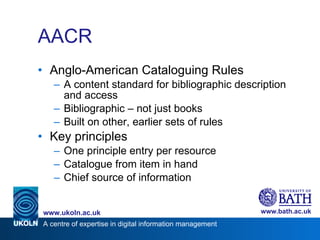
AACR Anglo-American Cataloguing Rules A content standard for bibliographic description and access Bibliographic – not just books Built on other, earlier sets of rules Key principles One principle entry per resource Catalogue from item in hand Chief source of information
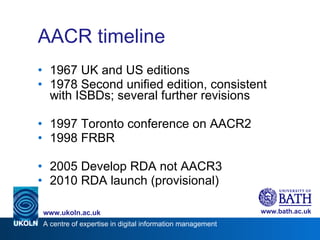
AACR timeline 1967 UK and US editions 1978 Second unified edition, consistent with ISBDs; several further revisions 1997 Toronto conference on AACR2 1998 FRBR 2005 Develop RDA not AACR3 2010 RDA launch (provisional)
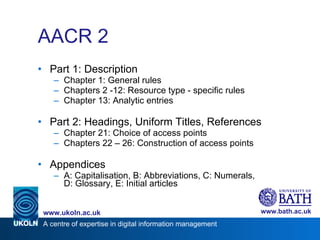
AACR 2 Part 1: Description Chapter 1: General rules Chapters 2 -12: Resource type - specific rules Chapter 13: Analytic entries Part 2: Headings, Uniform Titles, References Chapter 21: Choice of access points Chapters 22 – 26: Construction of access points Appendices A: Capitalisation, B: Abbreviations, C: Numerals, D: Glossary, E: Initial articles
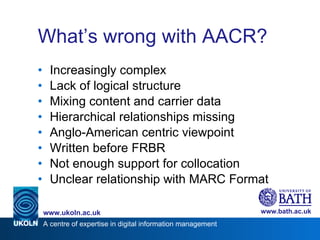
What’s wrong with AACR? Increasingly complex Lack of logical structure Mixing content and carrier data Hierarchical relationships missing Anglo-American centric viewpoint Written before FRBR Not enough support for collocation Unclear relationship with MARC Format
RDA – The Aims Rules should be easy to use and interpret  Be applicable to an online, networked environment Provide effective bibliographic control for all types of media Encourage use beyond the library community Be compatible with other similar standards Have a logical structure based on internationally agreed principles Separate content and carrier data Examples – more of them, more appropriate
Who is working on RDA? Joint Steering Committee (JSC) 1 representative each from: ACOC, ALA, BL, CCC, CILIP, LC JSC reps consult with their ‘constituency’ In UK, CILIP/BL Committee on RDA plus specialist groups (e.g. Rare Books Group, IAML(UK & Ireland) And in the period 2005 to 2009 RDA Editor: Tom Delsey RDA Project Manager: Marjorie Bloss
And also Task focused working groups RDA GMD/SMD Working Group RDA and ONIX Initiative RDA Examples Working Groups RDA MARC Working Group and DCMI RDA Task Group
How is RDA being developed? Draft – (responses – revised drafts – further responses, etc.) – acceptance Latest draft released 17 Nov. 2008; responses from: ACOC, ALA, BL, CCC, CILIP, LC France, Germany, New Zealand, Norway, Spain, Sweden ISSN International Centre  Final product – the publishers ( ALA , CILIP, CLA)
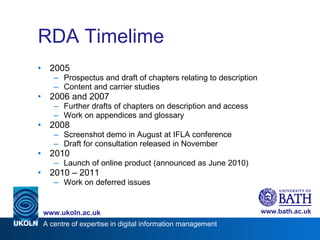
RDA Timelime 2005 Prospectus and draft of chapters relating to description Content and carrier studies 2006 and 2007 Further drafts of chapters on description and access Work on appendices and glossary 2008 Screenshot demo in August at IFLA conference Draft for consultation released in November 2010 Launch of online product (announced as June 2010) 2010 – 2011 Work on deferred issues
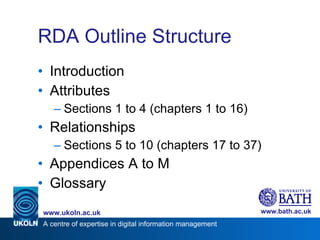
RDA Outline Structure Introduction Attributes Sections 1 to 4 (chapters 1 to 16) Relationships  Sections 5 to 10 (chapters 17 to 37) Appendices A to M Glossary
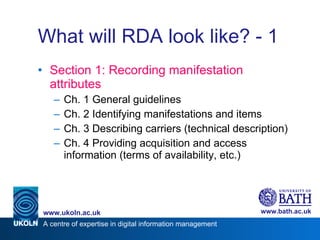
What will RDA look like? - 1 Section 1: Recording manifestation attributes Ch. 1 General guidelines Ch. 2 Identifying manifestations and items Ch. 3 Describing carriers (technical description) Ch. 4 Providing acquisition and access information (terms of availability, etc.)
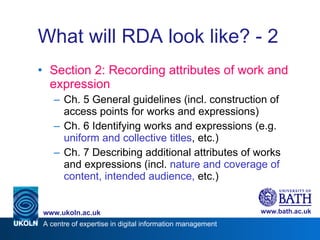
What will RDA look like? - 2 Section 2: Recording attributes of work and expression Ch. 5 General guidelines (incl. construction of access points for works and expressions) Ch. 6 Identifying works and expressions (e.g.  uniform and collective titles , etc.) Ch. 7 Describing additional attributes of works and expressions (incl.  nature and coverage of content, intended audience,  etc.)
What will RDA look like? - 3 Section 3 : Ch. 8, 9, 10, 11 Recording attributes of person, family and corporate body (=  name headings ) Section 4 : Ch. 12, 13, 14, 15, 16 Recording attributes of concept, object, event and place (=  subject headings ) Section 5 : Ch. 17 Recording primary  relationships  between work, expression, manifestation and item Section 6 : Ch. 18, 19, 20, 21, 22 Recording  relationships  to persons, families and corporate bodies associated with a resource
What will RDA look like? – 4 Section 7 : Ch. 23 Recording  subject relationships Section 8 : Ch. 24, 25, 26, 27, 28 Recording  relationships  between works, expressions, manifestations and items Section 9 : Ch. 29, 30, 31, 32 Recording  relationships  between persons, families and corporate bodies Section 10 : Ch. 33, 34, 35, 36, 37 Recording  relationships  between concepts, objects, events and places
What will RDA look like? - 5 Appendices A: Capitalisation B: Abbreviations C: Initial articles D: Record syntaxes for descriptive data (ISBD, M21, DC) E: Record syntaxes for access point control data F: Additional instructions on names of persons G: Titles of nobility, rank, etc. H: Conversion of dates to Gregorian calendar J, K, L, M: Relationship designators Glossary Index
Using RDA Analyse the resource being described What is the content type? Held in what carrier form? To what other resources is it related? To which persons, families or corporate bodies is it related? To what concepts, events and places is it related?
One rule for all … Mostly: Rules apply to all content types Rules apply to all media types With Examples of application to specific content and media Occasionally: Rules apply to specific materials or contents (e.g. treaties, religious texts, music)
Words, words, words … Can look opaque or ‘going round in circles’ Trying to avoid reference to specific content and carriers Hope to improve wording over time ‘ Use as the preferred  source of information  a source forming part of the  resource  itself that is appropriate to (a) the type of description and (b) the presentation format of the  resource .’ Means  preferred  source of information  may vary according to: Comprehensive or analytical description Multiple pieces, early print, moving images, or ‘all other materials’
RDA – What will it be? Online resource (full text) Free open access – June to 31 Aug. 2010 Free month trial (not confirmed) US $325 for first user (sliding scale multiple users) http://www.rda-jsc.org/rdapricing.html   Library schools – likely different but not decided Potentially: Concise text Tailored texts (law, music, serials, etc.) Training resource Incorporation into LMS cataloguing modules
RDA and beyond RDA aims to be: Independent of communication formats UNIMARC, MARC, MARCXML, MODS/MADS DC, EAD, ISBD, VRA, MPEG7 Compatible / better aligned with other similar standards Archives: ISAD(G) Museums: Cataloging Cultural Objects
RDA and MARC Mapping RDA and MARC 21 Report issued in Nov. 2006; various proposals subsequently go through MARBI process How will RDA impact on MARC 21? Some new fields / subfields are being defined How will MARC 21 impact on RDA? Data provisions in MARC 21 not covered in current draft of RDA
MARC – 1960s Library of Congress project Database of catalogue records Production of catalogue cards US & UK versions Reflected differing cataloguing practices Developed in parallel but not identical ways
MARC – 1970s  Variant formats developed Based on either US or UK formats (AUSMARC, DANMARC, KORMARC, etc.) USMARC developed 8 material formats (Books, Serials, Maps, etc.) UNIMARC developed in 1977 by IFLA Intended as exchange format Used as the Bib format in some countries (e.g. France)
MARC – Recent changes Expansion of USMARC to a family of formats Bibliographic, Holdings, Authority, Classification, Community Information Integration of USMARC bibliographic format Previous 8 formats integrated Widespread adoption of MARC 21 Some countries simply adopt USMARC 1997 – USMARC & CANMARC become MARC 21 2003/4 – MARC 21 enhanced by UK proposals; British Library adopts MARC 21 2006/7 – MARC 21 enhanced by German proposals: this will enable libraries to move from MAB to MARC 21
MARC Structure Leader 0xx – control numbers, coded data 1xx – primary access point 2xx – description, GMD, edition, publication 3xx – physical description 4xx – series 5xx – notes 6xx – subject access points 7xx – additional access points 8xx – series added entries 9xx – local fields
Maintaining MARC 21 Twice yearly MARBI meetings Discussion papers Proposals UK and MARC 21 BIC Bibliographic Standards Group [email_address] http://www.bic.org.uk/16/Bibliographic-Standards/
Some MARC changes for RDA New fields 336 Content Type (Bib, Auth) 337 Media Type (Bib, Holdings) 338 Carrier Type (Bib, Holdings) 370 to 377 (Auth) (e.g. field of activity, occupation, gender, family information, associated language) New codes New codes in 007 (Bib, Holdings) New codes in 008 (Bib) See more detail at: http://www.loc.gov/marc/formatchanges-RDA.html
MARC and XML MARC has alpha-numeric 3-digit tags 100.1 Personal Name 245 $a Title $b Subtitle XML has element labels <namePersonIndirectOrder> <title> <titleSubtitle> <titleCoverTitle>
Looking into the crystal ball FRBR Potential influence on cataloguing systems Authority records, uniform titles, work records OPACs Multiple interfaces for different audiences More flexible search interfaces and displays Enhance for accessibility - supports all users Links (actual resources, restrictions, supporting or associated resources) RDA Potential use outside the library domain
Contact details Ann Chapman UKOLN University of Bath, Bath BA2 7AY [email_address] http://www.ukoln.ac.uk/bib-man/ http://www.ukoln.ac.uk/ukoln/staff/a.chapman/
Creative Commons Licence This licence allows the slides to be reused and, if necessary, modified for non-commercial use provided acknowledgements are given to Ann Chapman and UKOLN and the same licence is used for such modified resources. http://creativecommons.org/licenses/by-nc-sa/2.0/

Tools of our Trade (RDA, MARC21) 2010-03-15

  • 1.
    UKOLN is supported by: The Tools of our Trade: AACR2/RDA and MARC Guest lecture at London Metropolitan University 15 th March 2010 Ann Chapman Community and Outreach Team
  • 2.
    What are ourTools? AACR/RDA = content standard for resource description and access MARC = communication and exchange format providing a structure for encoding the content of bibliographic and authority data Related to: ISBD = rules that organise the display of a bibliographic description of an item in a catalogue FRBR = a entity-relational model of the data required to find, identify, select and obtain resources
  • 3.
    ISBDs International StandardBibliographic Descriptions Developed 1969 onwards by IFLA Defined seven areas of description and their order Title Statement of Responsibility Edition Resource specific information Publication details Physical description Series information Notes and standard identifiers
  • 4.
    FRBR Functional Requirementsof Bibliographic Records IFLA study; report published 1998 Entity-relationship model that defines: Tasks : find, identify, select, obtain Resource relationships : work, expression, manifestation, item Entity relationships : people, corporate bodies (agents) concepts, objects, events, places
  • 5.
    AACR Anglo-American CataloguingRules A content standard for bibliographic description and access Bibliographic – not just books Built on other, earlier sets of rules Key principles One principle entry per resource Catalogue from item in hand Chief source of information
  • 6.
    AACR timeline 1967UK and US editions 1978 Second unified edition, consistent with ISBDs; several further revisions 1997 Toronto conference on AACR2 1998 FRBR 2005 Develop RDA not AACR3 2010 RDA launch (provisional)
  • 7.
    AACR 2 Part1: Description Chapter 1: General rules Chapters 2 -12: Resource type - specific rules Chapter 13: Analytic entries Part 2: Headings, Uniform Titles, References Chapter 21: Choice of access points Chapters 22 – 26: Construction of access points Appendices A: Capitalisation, B: Abbreviations, C: Numerals, D: Glossary, E: Initial articles
  • 8.
    What’s wrong withAACR? Increasingly complex Lack of logical structure Mixing content and carrier data Hierarchical relationships missing Anglo-American centric viewpoint Written before FRBR Not enough support for collocation Unclear relationship with MARC Format
  • 9.
    RDA – TheAims Rules should be easy to use and interpret Be applicable to an online, networked environment Provide effective bibliographic control for all types of media Encourage use beyond the library community Be compatible with other similar standards Have a logical structure based on internationally agreed principles Separate content and carrier data Examples – more of them, more appropriate
  • 10.
    Who is workingon RDA? Joint Steering Committee (JSC) 1 representative each from: ACOC, ALA, BL, CCC, CILIP, LC JSC reps consult with their ‘constituency’ In UK, CILIP/BL Committee on RDA plus specialist groups (e.g. Rare Books Group, IAML(UK & Ireland) And in the period 2005 to 2009 RDA Editor: Tom Delsey RDA Project Manager: Marjorie Bloss
  • 11.
    And also Taskfocused working groups RDA GMD/SMD Working Group RDA and ONIX Initiative RDA Examples Working Groups RDA MARC Working Group and DCMI RDA Task Group
  • 12.
    How is RDAbeing developed? Draft – (responses – revised drafts – further responses, etc.) – acceptance Latest draft released 17 Nov. 2008; responses from: ACOC, ALA, BL, CCC, CILIP, LC France, Germany, New Zealand, Norway, Spain, Sweden ISSN International Centre Final product – the publishers ( ALA , CILIP, CLA)
  • 13.
    RDA Timelime 2005Prospectus and draft of chapters relating to description Content and carrier studies 2006 and 2007 Further drafts of chapters on description and access Work on appendices and glossary 2008 Screenshot demo in August at IFLA conference Draft for consultation released in November 2010 Launch of online product (announced as June 2010) 2010 – 2011 Work on deferred issues
  • 14.
    RDA Outline StructureIntroduction Attributes Sections 1 to 4 (chapters 1 to 16) Relationships Sections 5 to 10 (chapters 17 to 37) Appendices A to M Glossary
  • 15.
    What will RDAlook like? - 1 Section 1: Recording manifestation attributes Ch. 1 General guidelines Ch. 2 Identifying manifestations and items Ch. 3 Describing carriers (technical description) Ch. 4 Providing acquisition and access information (terms of availability, etc.)
  • 16.
    What will RDAlook like? - 2 Section 2: Recording attributes of work and expression Ch. 5 General guidelines (incl. construction of access points for works and expressions) Ch. 6 Identifying works and expressions (e.g. uniform and collective titles , etc.) Ch. 7 Describing additional attributes of works and expressions (incl. nature and coverage of content, intended audience, etc.)
  • 17.
    What will RDAlook like? - 3 Section 3 : Ch. 8, 9, 10, 11 Recording attributes of person, family and corporate body (= name headings ) Section 4 : Ch. 12, 13, 14, 15, 16 Recording attributes of concept, object, event and place (= subject headings ) Section 5 : Ch. 17 Recording primary relationships between work, expression, manifestation and item Section 6 : Ch. 18, 19, 20, 21, 22 Recording relationships to persons, families and corporate bodies associated with a resource
  • 18.
    What will RDAlook like? – 4 Section 7 : Ch. 23 Recording subject relationships Section 8 : Ch. 24, 25, 26, 27, 28 Recording relationships between works, expressions, manifestations and items Section 9 : Ch. 29, 30, 31, 32 Recording relationships between persons, families and corporate bodies Section 10 : Ch. 33, 34, 35, 36, 37 Recording relationships between concepts, objects, events and places
  • 19.
    What will RDAlook like? - 5 Appendices A: Capitalisation B: Abbreviations C: Initial articles D: Record syntaxes for descriptive data (ISBD, M21, DC) E: Record syntaxes for access point control data F: Additional instructions on names of persons G: Titles of nobility, rank, etc. H: Conversion of dates to Gregorian calendar J, K, L, M: Relationship designators Glossary Index
  • 20.
    Using RDA Analysethe resource being described What is the content type? Held in what carrier form? To what other resources is it related? To which persons, families or corporate bodies is it related? To what concepts, events and places is it related?
  • 21.
    One rule forall … Mostly: Rules apply to all content types Rules apply to all media types With Examples of application to specific content and media Occasionally: Rules apply to specific materials or contents (e.g. treaties, religious texts, music)
  • 22.
    Words, words, words… Can look opaque or ‘going round in circles’ Trying to avoid reference to specific content and carriers Hope to improve wording over time ‘ Use as the preferred source of information a source forming part of the resource itself that is appropriate to (a) the type of description and (b) the presentation format of the resource .’ Means preferred source of information may vary according to: Comprehensive or analytical description Multiple pieces, early print, moving images, or ‘all other materials’
  • 23.
    RDA – Whatwill it be? Online resource (full text) Free open access – June to 31 Aug. 2010 Free month trial (not confirmed) US $325 for first user (sliding scale multiple users) http://www.rda-jsc.org/rdapricing.html Library schools – likely different but not decided Potentially: Concise text Tailored texts (law, music, serials, etc.) Training resource Incorporation into LMS cataloguing modules
  • 24.
    RDA and beyondRDA aims to be: Independent of communication formats UNIMARC, MARC, MARCXML, MODS/MADS DC, EAD, ISBD, VRA, MPEG7 Compatible / better aligned with other similar standards Archives: ISAD(G) Museums: Cataloging Cultural Objects
  • 25.
    RDA and MARCMapping RDA and MARC 21 Report issued in Nov. 2006; various proposals subsequently go through MARBI process How will RDA impact on MARC 21? Some new fields / subfields are being defined How will MARC 21 impact on RDA? Data provisions in MARC 21 not covered in current draft of RDA
  • 26.
    MARC – 1960sLibrary of Congress project Database of catalogue records Production of catalogue cards US & UK versions Reflected differing cataloguing practices Developed in parallel but not identical ways
  • 27.
    MARC – 1970s Variant formats developed Based on either US or UK formats (AUSMARC, DANMARC, KORMARC, etc.) USMARC developed 8 material formats (Books, Serials, Maps, etc.) UNIMARC developed in 1977 by IFLA Intended as exchange format Used as the Bib format in some countries (e.g. France)
  • 28.
    MARC – Recentchanges Expansion of USMARC to a family of formats Bibliographic, Holdings, Authority, Classification, Community Information Integration of USMARC bibliographic format Previous 8 formats integrated Widespread adoption of MARC 21 Some countries simply adopt USMARC 1997 – USMARC & CANMARC become MARC 21 2003/4 – MARC 21 enhanced by UK proposals; British Library adopts MARC 21 2006/7 – MARC 21 enhanced by German proposals: this will enable libraries to move from MAB to MARC 21
  • 29.
    MARC Structure Leader0xx – control numbers, coded data 1xx – primary access point 2xx – description, GMD, edition, publication 3xx – physical description 4xx – series 5xx – notes 6xx – subject access points 7xx – additional access points 8xx – series added entries 9xx – local fields
  • 30.
    Maintaining MARC 21Twice yearly MARBI meetings Discussion papers Proposals UK and MARC 21 BIC Bibliographic Standards Group [email_address] http://www.bic.org.uk/16/Bibliographic-Standards/
  • 31.
    Some MARC changesfor RDA New fields 336 Content Type (Bib, Auth) 337 Media Type (Bib, Holdings) 338 Carrier Type (Bib, Holdings) 370 to 377 (Auth) (e.g. field of activity, occupation, gender, family information, associated language) New codes New codes in 007 (Bib, Holdings) New codes in 008 (Bib) See more detail at: http://www.loc.gov/marc/formatchanges-RDA.html
  • 32.
    MARC and XMLMARC has alpha-numeric 3-digit tags 100.1 Personal Name 245 $a Title $b Subtitle XML has element labels <namePersonIndirectOrder> <title> <titleSubtitle> <titleCoverTitle>
  • 33.
    Looking into thecrystal ball FRBR Potential influence on cataloguing systems Authority records, uniform titles, work records OPACs Multiple interfaces for different audiences More flexible search interfaces and displays Enhance for accessibility - supports all users Links (actual resources, restrictions, supporting or associated resources) RDA Potential use outside the library domain
  • 34.
    Contact details AnnChapman UKOLN University of Bath, Bath BA2 7AY [email_address] http://www.ukoln.ac.uk/bib-man/ http://www.ukoln.ac.uk/ukoln/staff/a.chapman/
  • 35.
    Creative Commons LicenceThis licence allows the slides to be reused and, if necessary, modified for non-commercial use provided acknowledgements are given to Ann Chapman and UKOLN and the same licence is used for such modified resources. http://creativecommons.org/licenses/by-nc-sa/2.0/