RDARDA
&&
Features of RDAFeatures of RDA
Presented byPresented by
Murchana Borah
Milisha D'Silva
OverviewOverviewOverviewOverview
● What is RDA?
● Development of RDA
● Involvements?
● What is FRBR?
● Features of RDA
● How RDA is different from AACR 2
● Pros & Cons
● Future
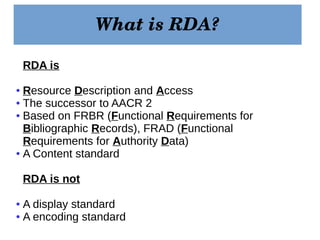
What is RDA?What is RDA?
RDA is
● Resource Description and Access
● The successor to AACR 2
● Based on FRBR (Functional Requirements for
Bibliographic Records), FRAD (Functional
Requirements for Authority Data)
● A Content standard
RDA is not
● A display standard
● A encoding standard
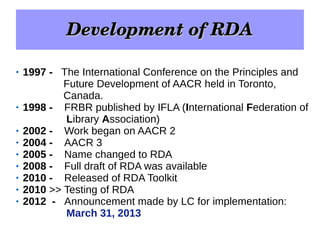
Development of RDADevelopment of RDADevelopment of RDADevelopment of RDA
 1997 - The International Conference on the Principles and
Future Development of AACR held in Toronto,
Canada.
 1998 - FRBR published by IFLA (International Federation of
Library Association)
 2002 - Work began on AACR 2
 2004 - AACR 3
 2005 - Name changed to RDA
 2008 - Full draft of RDA was available
 2010 - Released of RDA Toolkit
 2010 >> Testing of RDA
 2012 - Announcement made by LC for implementation:
March 31, 2013
InvolvementsInvolvementsInvolvementsInvolvements
The Joint Steering Committee
The Co-Publishers Board
● American Library Association(ALA)
● Canadian Committee on Cataloguing
(CCC)
● Chartered Institute of Library and
Information Professionals (CILIP)
Functional Requirements for
Bibliographic Records
FRBRFRBR
Work
Expression
Manifestation
Item
Work
Expression
Manifestation
Item
Person
Corporate Body
Person
Corporate Body
Concept
Object
Event
Place
Concept
Object
Event
Place
Work : “A distict intellectual and artistic creation”
Example: The sound and the fury, by William Faulkner
Work : “A distict intellectual and artistic creation”
Example: The sound and the fury, by William Faulkner
Manifestation : “The physical embodiment of the expression of a work”
Example: The sound and the fury, by William Faulkner. London,
Vintage, 1995. ISBN: 0099475014
Manifestation : “The physical embodiment of the expression of a work”
Example: The sound and the fury, by William Faulkner. London,
Vintage, 1995. ISBN: 0099475014
Item : “a single examplar of a manifestation”
Example: The sound and the fury, by William Faulkner. London:
Vintage, 1995. ISBN: 0099475014. UIU Undergrad.,call #:
PS3511.A86 S71995
Item : “a single examplar of a manifestation”
Example: The sound and the fury, by William Faulkner. London:
Vintage, 1995. ISBN: 0099475014. UIU Undergrad.,call #:
PS3511.A86 S71995
Expression : “the intellectual and artistic realization of the work”
Examples: The sound and the fury by Faulkner (text)
Expression : “the intellectual and artistic realization of the work”
Examples: The sound and the fury by Faulkner (text)
User TasksUser TasksUser TasksUser Tasks
● find—i.e., to find resources that correspond to
the user’s stated search criteria
● identify—i.e., to confirm that the resource
described corresponds to the resource sought, or
to distinguish between two or more resources
with similar characteristics
● select—i.e., to select a resource that is
appropriate to the user’s needs
● obtain—i.e., to acquire or access the resource
described.
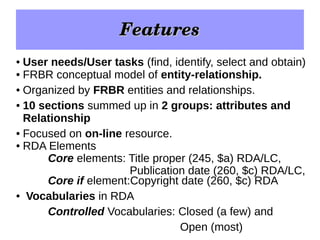
FeaturesFeaturesFeaturesFeatures
● User needs/User tasks (find, identify, select and obtain)
● FRBR conceptual model of entity-relationship.
● Organized by FRBR entities and relationships.
● 10 sections summed up in 2 groups: attributes and
Relationship
● Focused on on-line resource.
● RDA Elements
Core elements: Title proper (245, $a) RDA/LC,
Publication date (260, $c) RDA/LC,
Core if element:Copyright date (260, $c) RDA
● Vocabularies in RDA
Controlled Vocabularies: Closed (a few) and
Open (most)
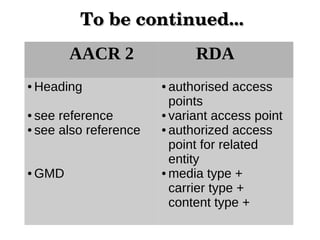
        To be continued...To be continued...
AACR 2AACR 2 RDARDA
● Heading
● see reference
● see also reference
● GMD
● authorised access
points
● variant access point
● authorized access
point for related
entity
● media type +
carrier type +
content type +
● Mode of issuance and type of description: what I am
cataloging?
- Mode of issuance
Single unit,
Multi-part monograph,
Serial,
Integrating resource
- Type of description
Comprehensive,
Analytical
Hierarchical
● The General Material Designation(GMD) replaced with:
- Content type (text, musical notation, cartography, etc.)
- Carrier type (audio-cassette, cartridge, slides, etc.)
- Media type ( the intermediation device)
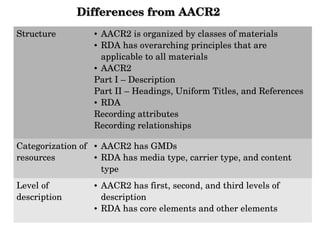
Structure ● AACR2 is organized by classes of materials
● RDA has overarching principles that are 
applicable to all materials
● AACR2
Part I – Description
Part II – Headings, Uniform Titles, and References
● RDA
Recording attributes
Recording relationships
Categorization of 
resources
● AACR2 has GMDs
● RDA has media type, carrier type, and content 
type
Level of 
description
● AACR2 has first, second, and third levels of 
description
● RDA has core elements and other elements
Differences from AACR2Differences from AACR2
Transcription
● Abbreviation
● AACR2: abbreviations used in some transcribed 
elements (2nd
 ed.)
● RDA: abbreviations in transcribed elements 
permitted only if abbreviations appear on the 
source (Second edition)
Statement of 
Responsibility
● AACR2 ­ Rule of three
● RDA – transcribe statement of responsibility as 
found, regardless of number
Publication 
information
● AACR2 – give the first named place and the first 
place in the country of the cataloging agency
●
RDA – give the first named place, regardless of 
country
Sources of 
information
● AACR2 specifies a chief source of information for 
each class of material
● RDA divides resources into three categories: one or 
more pages, leaves, sheets, or cards; moving 
images; other resources
continued...continued...
Pros        &        ConsPros        &        ConsPros        &        ConsPros        &        Cons
●
● A cataloging standrd for
the digital environment
● A framework what
describes all the resources
● User focused
● Support metadata sharing
among metadata
communities.
● New uses of library online
services
● Others claims RDA
doesn't go far enough.
● Some claims RDA goes
too far.
● Concern about learning
and training more
● RDA is difficult to adapt
● Costly
● RDA is an unfinished standard
RDA Toolkit is designed to be a
living document
● The future direction of RDA is unclear
RDA

RDA

  • 1.
  • 2.
    OverviewOverviewOverviewOverview ● What isRDA? ● Development of RDA ● Involvements? ● What is FRBR? ● Features of RDA ● How RDA is different from AACR 2 ● Pros & Cons ● Future
  • 3.
    What is RDA?What is RDA? RDA is ● ResourceDescription and Access ● The successor to AACR 2 ● Based on FRBR (Functional Requirements for Bibliographic Records), FRAD (Functional Requirements for Authority Data) ● A Content standard RDA is not ● A display standard ● A encoding standard
  • 4.
    Development of RDADevelopment of RDADevelopment of RDADevelopment of RDA  1997 -The International Conference on the Principles and Future Development of AACR held in Toronto, Canada.  1998 - FRBR published by IFLA (International Federation of Library Association)  2002 - Work began on AACR 2  2004 - AACR 3  2005 - Name changed to RDA  2008 - Full draft of RDA was available  2010 - Released of RDA Toolkit  2010 >> Testing of RDA  2012 - Announcement made by LC for implementation: March 31, 2013
  • 6.
    InvolvementsInvolvementsInvolvementsInvolvements The Joint SteeringCommittee The Co-Publishers Board ● American Library Association(ALA) ● Canadian Committee on Cataloguing (CCC) ● Chartered Institute of Library and Information Professionals (CILIP)
  • 7.
    Functional Requirements for BibliographicRecords FRBRFRBR Work Expression Manifestation Item Work Expression Manifestation Item Person Corporate Body Person Corporate Body Concept Object Event Place Concept Object Event Place
  • 9.
    Work : “Adistict intellectual and artistic creation” Example: The sound and the fury, by William Faulkner Work : “A distict intellectual and artistic creation” Example: The sound and the fury, by William Faulkner Manifestation : “The physical embodiment of the expression of a work” Example: The sound and the fury, by William Faulkner. London, Vintage, 1995. ISBN: 0099475014 Manifestation : “The physical embodiment of the expression of a work” Example: The sound and the fury, by William Faulkner. London, Vintage, 1995. ISBN: 0099475014 Item : “a single examplar of a manifestation” Example: The sound and the fury, by William Faulkner. London: Vintage, 1995. ISBN: 0099475014. UIU Undergrad.,call #: PS3511.A86 S71995 Item : “a single examplar of a manifestation” Example: The sound and the fury, by William Faulkner. London: Vintage, 1995. ISBN: 0099475014. UIU Undergrad.,call #: PS3511.A86 S71995 Expression : “the intellectual and artistic realization of the work” Examples: The sound and the fury by Faulkner (text) Expression : “the intellectual and artistic realization of the work” Examples: The sound and the fury by Faulkner (text)
  • 10.
    User TasksUser TasksUserTasksUser Tasks ● find—i.e., to find resources that correspond to the user’s stated search criteria ● identify—i.e., to confirm that the resource described corresponds to the resource sought, or to distinguish between two or more resources with similar characteristics ● select—i.e., to select a resource that is appropriate to the user’s needs ● obtain—i.e., to acquire or access the resource described.
  • 11.
    FeaturesFeaturesFeaturesFeatures ● User needs/Usertasks (find, identify, select and obtain) ● FRBR conceptual model of entity-relationship. ● Organized by FRBR entities and relationships. ● 10 sections summed up in 2 groups: attributes and Relationship ● Focused on on-line resource. ● RDA Elements Core elements: Title proper (245, $a) RDA/LC, Publication date (260, $c) RDA/LC, Core if element:Copyright date (260, $c) RDA ● Vocabularies in RDA Controlled Vocabularies: Closed (a few) and Open (most)
  • 12.
            To be continued...To be continued... AACR 2AACR 2RDARDA ● Heading ● see reference ● see also reference ● GMD ● authorised access points ● variant access point ● authorized access point for related entity ● media type + carrier type + content type +
  • 13.
    ● Mode ofissuance and type of description: what I am cataloging? - Mode of issuance Single unit, Multi-part monograph, Serial, Integrating resource - Type of description Comprehensive, Analytical Hierarchical ● The General Material Designation(GMD) replaced with: - Content type (text, musical notation, cartography, etc.) - Carrier type (audio-cassette, cartridge, slides, etc.) - Media type ( the intermediation device)
  • 14.
    Structure ● AACR2 is organized by classes of materials ●RDA has overarching principles that are  applicable to all materials ● AACR2 Part I – Description Part II – Headings, Uniform Titles, and References ● RDA Recording attributes Recording relationships Categorization of  resources ● AACR2 has GMDs ● RDA has media type, carrier type, and content  type Level of  description ● AACR2 has first, second, and third levels of  description ● RDA has core elements and other elements Differences from AACR2Differences from AACR2
  • 15.
    Transcription ● Abbreviation ● AACR2: abbreviations used in some transcribed  elements (2nd  ed.) ●RDA: abbreviations in transcribed elements  permitted only if abbreviations appear on the  source (Second edition) Statement of  Responsibility ● AACR2 ­ Rule of three ● RDA – transcribe statement of responsibility as  found, regardless of number Publication  information ● AACR2 – give the first named place and the first  place in the country of the cataloging agency ● RDA – give the first named place, regardless of  country Sources of  information ● AACR2 specifies a chief source of information for  each class of material ● RDA divides resources into three categories: one or  more pages, leaves, sheets, or cards; moving  images; other resources continued...continued...
  • 16.
    Pros        &        ConsPros        &        ConsPros        &        ConsPros        &        Cons ● ● A catalogingstandrd for the digital environment ● A framework what describes all the resources ● User focused ● Support metadata sharing among metadata communities. ● New uses of library online services ● Others claims RDA doesn't go far enough. ● Some claims RDA goes too far. ● Concern about learning and training more ● RDA is difficult to adapt ● Costly
  • 17.
    ● RDA isan unfinished standard RDA Toolkit is designed to be a living document ● The future direction of RDA is unclear